Category Archives: Review

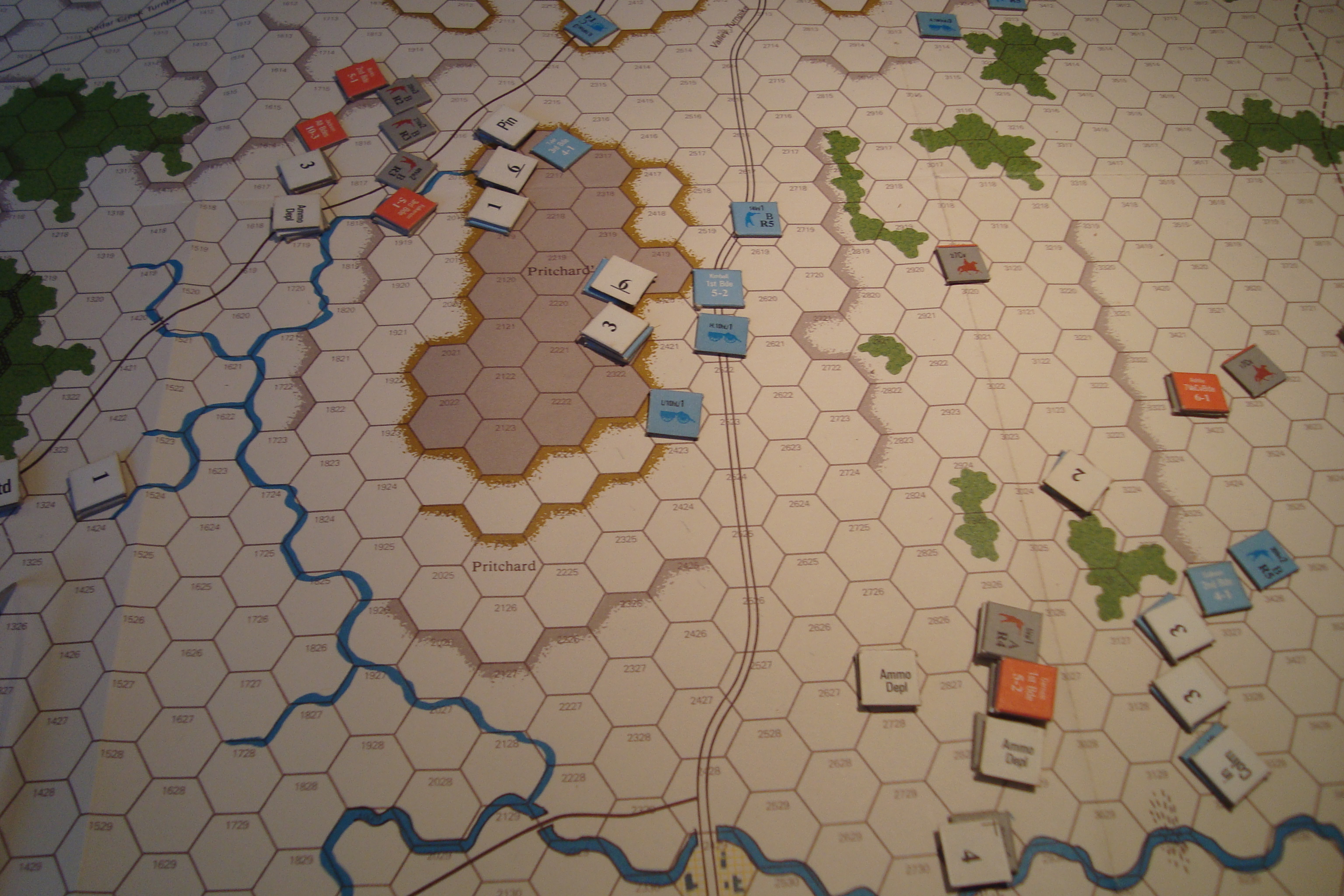
Stonewall: Battle of Kernstown – A Quick Review of GBACW – Mk 1

This is a quick review of Kernstown and the (almost) first iteration of the GBACW series.  While there were some minor changes moving forward through the next several games, the basic rules were used for at least five games.

Decisions: Plenty for both commanders.  For the Confederates, it’s where to attack and with what.   For the Union commander, how to react and with what.

History: Both commanders are faced with the same operational problems as their historical counterparts. Both commanders have to “do a lot” with very little.

Luck: The ammunition depletion roll is a real problem.  It severely hampered the Union brigade fighting Garnett just east of town.

Atmosphere: Really good, with lots of moving parts.  The Pin result while undergoing defensive fire can really upset your tactical plan.

Mastery:  Can’t quite answer this now.  Will have to wait until I play the next few games in the series.  I had to read the rules quite a few times before playing.

Tweaks: Right now I can’t think of any reason to tweak it.

Abstraction: Command and control (including rally) might be a little too easy and flexible.

Clarity: Good.

Comprehensive: An excellent introduction to grand tactical battle in the Civil War.

Speed: A little fiddly, especially with all the markers.  Playing one of the monster games would be something.

Scenarios: None for this game, but not really necessary given Confederate entrance and flanking possibilities.

Summary: Fun, and a challenge.  Once I got the hang of the turn sequence, it moved quickly, with lots of action.  One complaint I have is that the marker chits detract from the aesthetics of the game.  Small complaint.

Now Who's Who?
Now Who’s Who?  Final Dispositions.  Pritchard’s Hill In Center.  Garnett Bottom Right.  Jackson Upper Right.

Component quality is SPI early 80’s.  I’ve always liked their maps.  The counters……..mmmmmmm….let’s just say they are functional.

Irregular Wars Review

Been playing “Irregular Wars – Confict at the World’s End”, off-and-on for the past couple of weeks. I bought the 2nd Edition rules last Winter for potential use as the ground combat system for my East African Renaissance Campaign. I was looking for something more streamlined than De Bellis Renationnis (DBR).

I’ve played DBR for a number of years using 25mm figures. Before that, it was George Gush’s rulesets. Gush was extremely detailed, DBR less so. I’ve enjoyed all of these rules. I’ve also played DBR’s cousin De Bellis Antiquitatis (DBA) with 15mm ancient and medieval armies. It is also a good system, but its renaissance variants seemed to lack period chrome.

Irregular Wars is described as “A Wargaming System for Small Actions in the Age of Discovery”. The 90 page book contains both rules,army lists and campaign guidance. It is a system….one which allows a great deal of flexibility, emphasizes playability and not gamesmanship. This is a far cry from DBR/DBA’s emphasis on precise alignment of units for melee and distances for shot. Even distances (or units) are flexible in IW, as each unit of measure is derived from base width. Any type of basing can be used, which avoids the living hell that is  rebasing.

Many of my figures are based for DBR. The one “element” look just didn’t seem right for the larger table size allowed by IR. The solution was easy, just double up the bases. The result is a nice “block” unit providing a sense of density on the table.

While the lists aren’t as detailed as DBR’s, they are varied and provide for a random army composition. Outside of compulsory companies, the Lord (as IR puts it) must recruit an agreed upon number of troop types, then role a die to determine the number of companies available for each type. The number of figures per company is low, so an army can be built quickly and inexpensively.

IR uses several die types to randomize game situations. These range from d6 to d2. It also employs Chance Cards as well as a pre-game Disease and Mishaps table to inject uncertainity into a game. The ruleset includes five scenario types for those players looking for more than a straight-up fight. Easily reproducable game charts are contained at the end of the book.

Each unit is rated for resolve (more on that in a moment), movement, melee, short range fire and long range fire. Certain units have special capabilities. Here is a link to an  Army Rosters sheet I put together, as well as a link to a unit  Capabilities Chart.

The author states that resolve is the key element in the game system. Units lose resolve as the result of unfavorable combat outcomes, reaching a point where they waver (and retire) and, finally, when resolve reaches a zero level, eliminated as fighting units. Both wavering and scattering companies can effect the resolve of other companies. The Lord can rally a company, restoring one point of resolve. Resolve levels range from 5 to 3, with the former representing elite units.

The turn sequence is a basic roll for initiative, shoot, action, and melee. Gunpowder weapons may fire once before having to take an action to reload. Actions are not limited to movement or disengagement from melee. Specific units can hurl curses at the opposition reducing their resolve, or invoke blessings to restore resolve. Melee is straightforward and bloody. Melee strengths are added to a d6 roll. It doesn’t take long for those 3 resolve units to waver.

The result is something that I hoped to find, with well crafted random elements making it well adapted for solitaire play. Highly Recommended.

War In The Aegean Review

I’m going to use the criteria cited in a previous post and published by “Lloyd”.   Please read his article for insights concerning the criteria.

Decisions:  Not much flexibility for the commanders.  The VP schedule makes it very clear what has to be done, and the game mechanics concerning Rhodes takes the decision to invade out of the hands of the commander.  However, the coordination of air and naval units is very demanding and interesting.

History:  Both commanders are faced with the same operational problems as their historical counterparts.  Both commanders have to “do a lot” with very little.

Luck:  Plenty of that here with the variable number of impulses per turn, random day or night impulses, spotting, Luftwaffe availability, and Rhodes invasion die roll.  The German commander needs lots of it in order to shepard his combat units across the Aegean.  The Royal Navy needs the right die rolls in order to locate the invasion flotillas.

Atmosphere:  It’s a tense game.

Mastery:  Fairly easy to learn, and it took several replays to get the feel of coordinating air and naval forces.  On the other hand, you can do everything “right” and still lose because of the Luck factor.

Tweaks:  It’s a fairly comprehensive set of rules.  I tweaked it to reduce the number of impulses per turn, messed around with the sighting die roll, and Luftwaffe availability.  The solitaire task force rules – which I didn’t use – are very tweakable.

Abstraction:  Really not much.  Everything that was going on was going on, on the map (wow, what a sentence!).

Clarity:  Good.  However, I never figured out if early task force/naval units could all return.

Comprehensive:  Very good.  Lots of charts reduce the need to consult the rules.

Speed:  Fairly slow.  Even with low counter density, the joint operations involved made each impulse take some time.

Scenarios:  Not much flexibility at all.  The campaign game, with or without Rhodes.  That’s it.

Summary:  I enjoyed playing this game.  It took a lot of time due to the variable impulses, which I eventually capped at three per turn, spotting rolls, and need to think through each move.  The game definately grew on me, and I was intrigued by the operational problems faced by both commanders.  It’s very playable solitaire, but I think it would move more quickly with two players because the game dynamics are so fatiguing without a break.