Category Archives: Naval

GWAS – The Wheel Had Been Built

Can’t rationalize my way past this one.

Digging around various Great War At Sea (GWAS) archives, I came across this 1898 Naval Campaign over at Web Grognards.   An excellent effort  covering a lot of bases.  I would really like to find out where he discovered the specifics.

BTW, I hadn’t visited Web Grognards lately.  Boardgamegeek has surpassed it as an overall resource, but WG still is an excellent source of information, especially older games.

Underrated!

GWAS – Re-inventing The Wheel?

I’ve come up with three basic scenarios.

The first assumes Admiral Cervera’s fleet runs the U.S.blockade and makes it to Havana.  From there, he can threaten the Florida Straits, U.S. East Coast and/or Puerto Rico.

The second anticipates Spain commits to reinforcing the Philippines,  with a U.S. counter move sending the Eastern Squadron to the Mediterranean, protected by the Covering Force.

Finally, that Spain purchases ships from Chile.  This possibility affected U.S. dispositions.  The Chilean ships were the O’Higgins, weeks away from completion in a British shipyard, as well as two ships already in service, the Esmeralda and Ministro Zenteno.  The latter two were situated in the Pacific, where they could sail to the Philippines, with the O’Higgins close to Spanish territorial waters.

While working my way through all of this, I came to realize this is really a series of Red vs.  Blue operational problems, with the Spanish-American War providing historical context.  The scenarios are more than counterfactual, as the underlying assumptions are so very significant, anticipating Spanish domestic and foreign policies resulting in a trained and maintained fleet, without the ambivalence and defeatism.

After scratching all of this out,  I took a detailed look at the scenarios accompanying the game.  They are good, well explained, and cover what happened several might-have-been.  There’s even a campaign game linking the scenarios with die-driven variables!

So, my afterthought is “Why Did I Do All Of This?”  Well, I guess it would be depth of knowledge and the ability to view the historical events not as a series of separate scenarios, but within a  broader scope.

At times, it’s good to rationalize.

GWAS – Attention Now Focused

Well, the seemingly indispensable 3×3 blue hexagonal grid never arrived.  Some Amazonian problem with delivery.  Very vague.  Frantic Google activity revealed no viable substitutes without paying too much.

Now unable to throw a reasonable amount of money at the problem, I was forced to think.  Reluctantly, I started grinding the gears.  DIY options involved a lot of work…No interest in that.  Further grinding resulted in a question; “Why do I have to use hexes?”

The ship counters are one inch long.  The rules call for movement by number of hexes.  Convert hexes to inches – or ship lengths.  How about changes of course?  Changes are effected by stern or bow pivots of 60 degrees.  Why not use a protractor until you can eyeball the pivot without help?

Now I just needed a blue surface.  You MUST fight naval battles on a blue surface.  It cannot be done any other way.  Believe me.

The solution was to use either an ocean gaming mat, or the DBA “table”.   My ocean mat is an early version of the type with a fleece texture.  OK for miniatures, but counters are clunky to move and just don’t look right. The DBA table has a surface color of blue,  intended for just this sort of thing, but typically covered with GeoHex tiles for land battles.

Having taken care of the tactical infra-structure, it was time to get on with the strategic and operational aspects of the project.  So, back to Trask’s history, and this time really focus on the Navy’s organization and plans.

For my purposes, the naval campaign takes place from early April through July.  I’ve bookended the campaign with the U.S. decision to organize and  implement a blockade of Cuba and the return to Spain of Admiral Camara’s fleet which had intended to attack Admiral Dewey’s forces in the Philippines.

The historical naval campaign….what a cluster!  Orders  from the Secretary of the Navy  to Key West changing on a daily, and sometimes hourly, basis.  Ships being shunted between fleets and missions.  Order and counter-order.  The Navy’s mission was four-fold:  Defend coastal cities  from Spanish attack, blockade Cuba, escort the expeditionary force forming in Tampa, and stop any Spanish efforts to reinforce Cuba.  Later, two other missions were discussed and almost implemented.  One was  to raid  coastal cities on the Iberian Peninsula and outlying islands.  The other was to counter any Spanish attempt to regain control of the Philippines.

Rather than construct a time-oriented orders of battles, it seemed best to use the basic organization which called for – eventually – four US entities.  Initially these were the North Atlantic Fleet and Flying Squadron.  The  Eastern Squadron and Covering Force were created later in the campaign, and comprised of units from the  two basic organizations.  Ships were also  periodically detached for patrol duties.  Again, rather than go through an attach and detach process during the course (turns) of the campaign, it seemed best – and easiest – to “pool” (no pun intended)  these primarily Auxiliary Cruisers into a group available for scouting duties.

The basic organization is:

North Atlantic Fleet (Admiral Sampson), Key West – Iowa, Indiana, Oregon (maybe delayed reflecting its redeployment to Caribbean), New York, Amphrite, Terror, New Orleans, Montgomery.

Flying Squadron (Admiral Schlee), Hampton Roads – Texas, Massachusetts, Brooklyn, Columbia, Minneapolis.

Scouting Pool – Harvard, Yale, St. Louis, Minneapolis, St. Paul.

Reinforcements To Philippines – Monterey, Monachock.

One option discussed by leadership was to form an Eastern Squadron, with the mission of  countering Spain’s attempt dispatch ships to contest Admiral Dewey’s control of Manila Bay.

The Eastern Squadron included the following ships:  Oregon, Massachusetts, Newark, Yosemite, Yankee, Dixie.

The Eastern Squadron was to be assisted by a  Covering Force.  This force was to engage any Spanish effort to attack the Eastern Squadron as it passed by Spain until it was east of Gibraltar.

The Covering Force included: New York, Brooklyn, Iowa, Indiana, Texas, New Orleans, Badger, Yankee, Mayflower.

Putting together Spain’s fleet organization was simple.  Just go with the historical composition of Admirals Cervera’s and Camara’s fleets.  But, with the intriguing possibility  of Spain succeeding with their plans to purchase one if not three Chilean ships – O’Higgins, Esmerelda and Ministro Zenteno.  Spain’s conduct of the naval operations was marked by the same level of vacillation and indecision as U.S. operations.

Enough for now.  Ole Miss vs Miss State coming on.  Can’t miss another episode of “Lane Kiffin’s Ego.”
GWAS – Attention Diverted

Way back in March I posted about a Great War At Sea (GWAS) project involving Chile and Argentina.

That one is now on a backburner, with my new emphasis on the “what ifs” of the Spanish-American War.  As usual, the move from South America to the Caribbean did not involve a straight line.  Instead the initial detour was to “Plan Black”, a possible United States-Germany confrontation.  This, in turn, was an offshoot of a by-chance read about the international squabble(s) over Guam and the Philippines in which Germany was an active participant.

Plan Black was a bust, since the GWAS scenarios are set during the Dreadnought Era, and I wanted something turn-of-the-twentieth-century.  Looking for a path of least resistance, I dug into GWAS’s 1898, The Spanish-American War,  module.  This opened up some immediate possibilities.

Fortunately, I own a copy of David Trask’s “The War With Spain In 1898”.  This one volume history covers the naval aspects in some detail, going far beyond the usual coverage which is typically limited to the battles of Manila Bay and Santiago De Cuba.

The game’s scenarios cover some hypothetical situations, but I was interested in a campaign that assumed (and this is quite an assumption) that Spain had not neglected its fleet for ten years, and was a far better match for the United States “New Navy”.  This is where Trask’s book was so helpful.

But, things ground to a halt when I decided to use the alternate Dreadnought tactical rules.  These require a roughly 3 ft x 3 ft hexagonal grid sheet, and I don’t have one.

Amazon should be delivering a blue hexagonal grid sheet any day now.  Everything else is ready to go.

And, I will get to Chile vs. Argentina. Sometime.

Prolonged Absence

Yes, another one.  Function of lassitude (February) as well as South American cruise (March).

The cruise started in Valparaiso, Chile, then along the coast of Chile, around Cape Horn, ending in Buenos Aires.  It was a lot of fun.  The only exception was the badly executed tour of the Falkland battlefields.

The itinerary included cruising the fiords of Patagonia as well as the Beagle Channel and Straits of Magellan.

Our on-land adventures left me with the impression that there is no love lost between Argentina and Chile.

This got me thinking about the South American naval rivalries/races of the late 19th and early 20th century.

Right after returning home, I dug out my copy of Avalanche Press’ “Cone of Fire” module for their Great War At Sea series.  A quick glance at the scenario booklet seemed to indicate there were no scenarios covering a turn-of-the-twentieth century hypothetical encounter.

So, I consulted some sources I have here at home, as well as searching on-line.  Lots of information to process.  This article provided  a helpful summary.  This article provides a wider perspective.

I decided to build a scenario using “Operation Soberania” as a guide.  This is the 1978 Argentinian plan to occupy contested islands in Patagonia.  Same operational situation, just later in the 20th century.

Of course, after all of this,  a second reading of the booklet revealed specific scenarios including  force compositions.  My excuse for missing these is the scenarios are not presented in chronological sequence.  Weak.

Still, the “unnecessary” research was time well spent.  I have a better overall knowledge of the topic.

I’m tempted to link the naval action with  ground combat on the contested islands using the old “Rifle and Sabre” rules for late 19th century.  Counters represent 100+/- soldiers and artillery batteries. Might be fun.

Well, as always,  the trick is to get it on the table.

SOPAC – Finished

Yes, wrapped up…….with an unanticipated and very abrupt ending.

As usual, it was as function of (another) rules/scenario comprehension (or lack of) gaffe.

I forgot that in this scenario, neither side is affected by “Interservice Rivalry”.  This status has a significant impact on gameplay as these rivalries preclude activating both Army and Naval units in the same turn/offensive.  In SOPAC, the bulk of the respective naval forces are located in the New Hebrides and Solomons, while army units are in New Guinea/Australia.

Given card draws, the relatively weak strength of US naval forces during the first few turns, and this apparent operational limitation, the Allies had focused on New Guinea, with positive results.

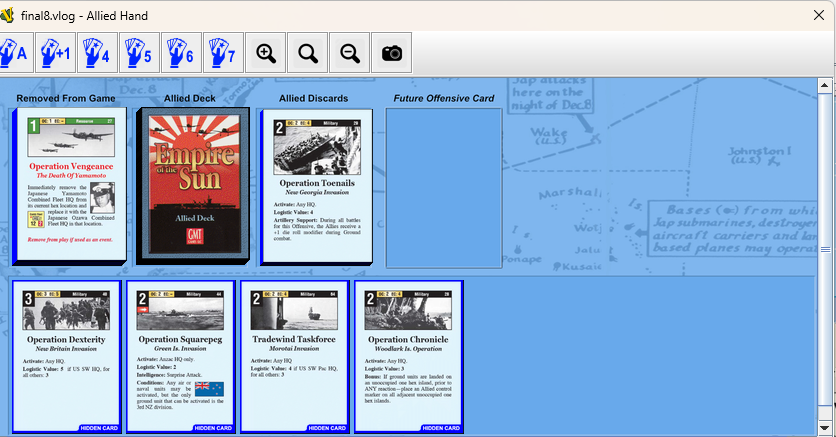
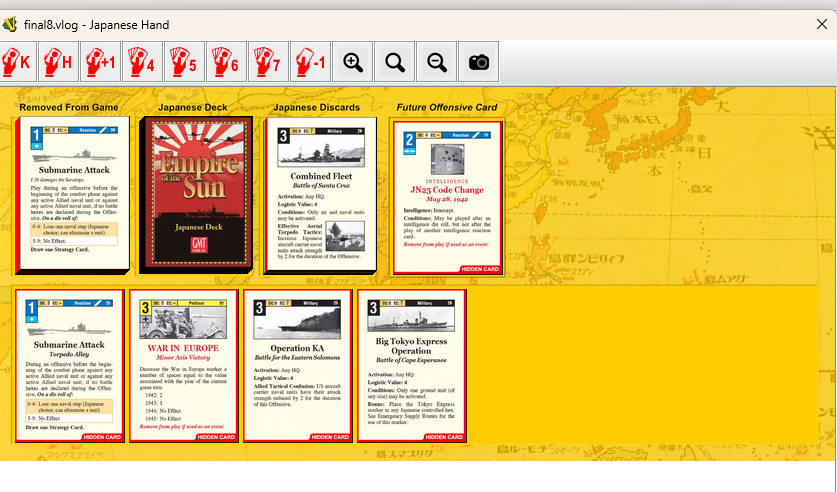
Here are the card draws for Turn 5.  Note that starting with Turn 5, the Allies have the first card play.  The Japanese can override that by playing a Future Offensives Card – which they do have (that might have been a good play…dunno).

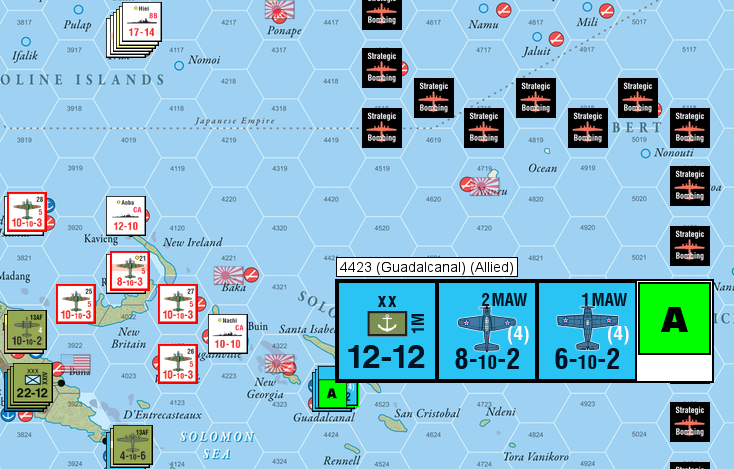
The Japanese Navy started the action off by activating their Solomon air assets for another pounding of Henderson Field.  The Allies refused to react with their carriers, so the only opposition was two Marine air units (in EOTS any units in the Battle Hex have to participate in combat, but  do not have to be activated to do so – which is a bonus because more “outside”  units can be activated to participate).

The preceding paragraph only tells part of the story.  The initial Allied response  was to react.  Not a good idea.  The Japanese had roughly 60 attack factors, with the Allies only able to muster 40.  The would have probably been a big BLAMMO, with crippling comparative losses for the Allies.  I love the “Undo” icon.

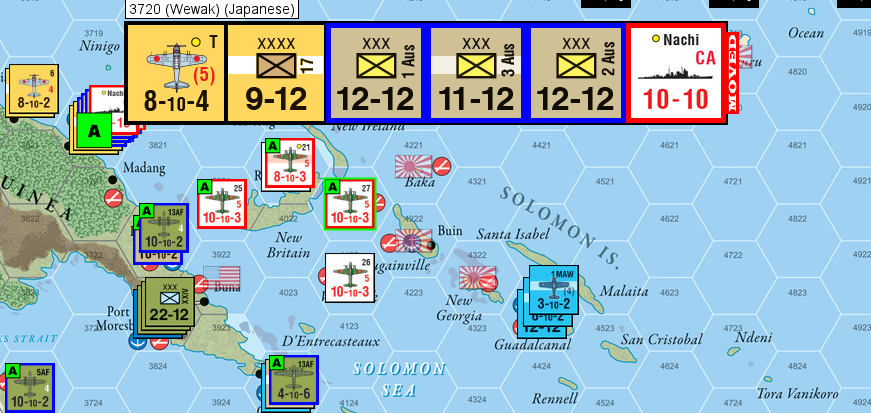
Meanwhile, the Allies continued their aggressive attacks in New Guinea, destroying the understrength corps that had arrived in New Guinea during the Replacement Phase of Turn 5.  Note the participating Japanese naval unit.  Another rules gaffe.  While I now recognized  interservice rivalries were not in effect, I forgot naval gunfire support applied only to the offensives player, not the reaction (defensive) side (if the offensive player has the only naval unit in the Battle Hex during ground combat, he/she enjoys a +2 combat die roll modifier).

The ensuing combat destroyed the 9-12 Japanese Army unit, ending any effective ground resistance (there still is a weak Japanese Naval Infantry unit just off the photo to the west (left)).

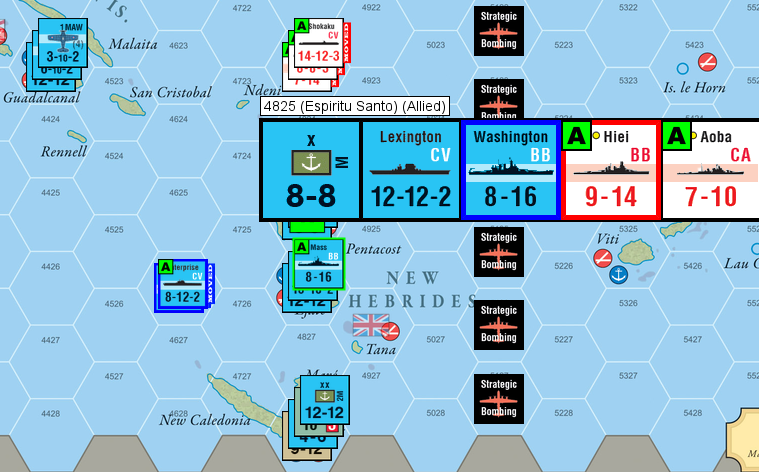
The Japanese response was to launch an all-out attack on the Allied naval units in the New Hebrides.  The Allies had no choice but to  react.

The VASSAL die-bot rolled high for the Allies and low for the Japanese.  The Japanese sailed back to Truk without the  Yamato and with damaged surface units.

Again, the preceding paragraph is just part of the story.  I initially used the Allied Central Pacific Headquarters to activate naval units.  This HQ can add three units to the activation force, but……..and this is important……it can only activate units in the New Hebrides.  This meant the The Wasp, now situated in New Guinea as part of the dispersion of naval assets to prevent catastrophic loss early in the game, could not join the reaction force.  Neither could the Army’s long-range bomber units.

However, Genius Boy had forgotten that the Halsey Card had been put in play earlier in the game.  Halsey’s South Pacific HQ can also add three units to the reaction force, and is not limited to the New Hebrides.  Add the Wasp and Army air, and the Allies strength was increased by 16.  Significant.

I shut the game down for the night, and returned to it the next day.  Mulling the options there seemed to be no way the Japanese could win.  The Allies now controlled three additional ports, and any Japanese counteroffensive would have to wait until they received replacements (a 9-12 reduced corp) for Turn 6.  While theoretically feasible, this attack would face strong ground units and a significantly reinforced US fleet.

Now it’s on to the Burma Scenario.

SOPAC – It’s Never Over Until…….

“Finally Finished”‘?  No……

Was reviewing the rules last night while preparing for my new session.  I was feeling pretty good about myself.  And then I discovered two more rules gaffes.

  1.  You can’t play a Future Offensives Card as your last play of the turn.  Both sides did this for the decisive Turn 6 .  Might have made a difference.  I’m not going to do a post mortem to find out.
  2. The elimination of a US division or brigade in an attack negatively affects Political Will.  Again, no post mortem, but I’m pretty sure at least one was wiped out.  I do remember an Australian Corps was destroyed, but their elimination does not affect Political Will.

Sigh……..

SOPAC So Far – Reboot

Made it through the first turn of the SOPAC scenario (which is Turn 3 of the campaign game).

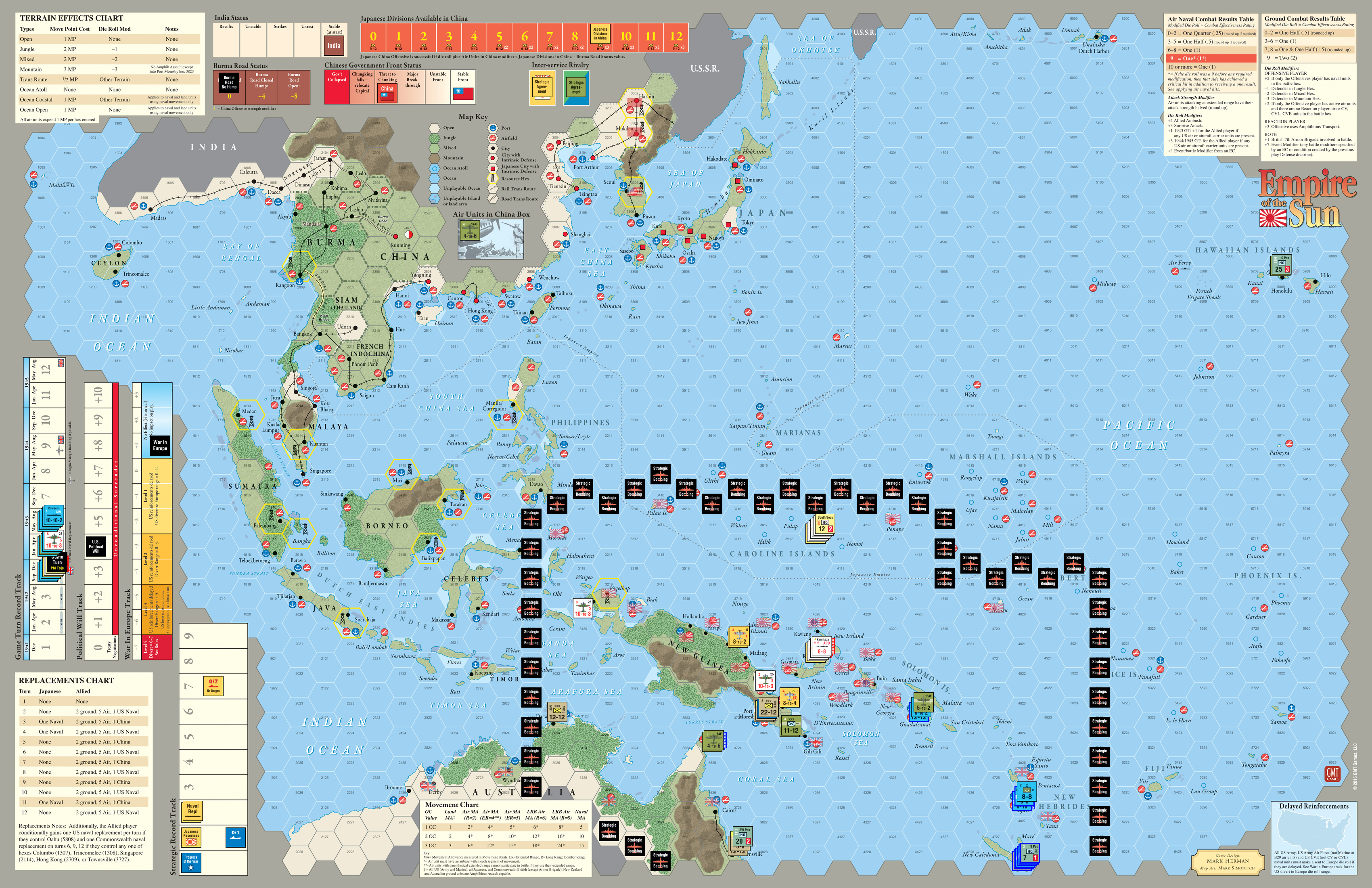
I’m pretty good with the Offensives Phase of the Sequence of Play.  Did have a major revelation, though.  Apparently any movement of a unit is considered an Offensive, and the destination is declared a Battle Hex.  So, my movement of two air units to a different base in Australia (see map screenshot below) results in that destination being declared a Battle Hex, with the possibility of the opponent making a Reaction Move if opposing units are within range.

Will have to do some research over at Boardgamegeek to confirm/deny this interpretation.

In any event, the Allies have landed at Guadalcanal, reinforced the initial landing, as well as moving units to New Guinea in preparation for an offensive out of Port Moresby.  The Japanese attempt to defeat the initial Guadalcanal landings with air and naval forces out of Rabaul was turned back with losses on both sides.

Any Japanese efforts during this initial turn are limited as the bulk of the Combined Fleet is in home waters, and not available until the following turn.  The Allies will also receive significant naval reinforcements during Turn 4.  Should be interesting.

Here’s a Vassal screen shot for the end of Turn 3.  The Area of Operations (AO) is outlined in the bottom right corner.

SOPAC – So Far

As threatened, I’ve plunged into  VASSAL to play Empire Of The Sun’s (EOTS) “South Pacific” scenario.

Turned out to be double learning curve.  First curve is working with VASSAL.  Have  made a couple of half-hearted attempts in the past, without any sustained or focused play.  As to the scenario, I was surprised how quickly I’d forgotten the rules since my last play with Tim back in July.

In retrospect, I should have read that post.  Repeated a couple mistakes I had noted.

This is a great learning scenario that allows you to focus on card draw mechanics, activation, movement and both air/naval, as well as ground battle phases in just one area of the map.  While the scenario allows for play (and the significant rules overhead involved) in the  China/Burma theaters, those regions are not critical for achieving victory.

VASSAL’s Log function is handy for “What the Hell have I done” references as it  records everything you do.  It also documents but  your “back button” adventures when the player decides to “un-do” a previous decision.  Vacillation can be amusing.

You can quickly change sides, which makes solitaire play a breeze.

I also like the screen shot option, which I intend to use for this blog as soon as I reset my first game.

More later…Game One of the World Series is starting……

At Sea

Had a nice visit with Tim the other weekend.  We set up the South Pacific scenario for Empire Of The Sun.  This scenario is included in the latest edition, and also published separately in C3i Magazine.

We played the Plan Orange variant, also published in C3i, a few months ago.  Plan Orange posits an early 1930’s conflict and focuses on surface combat, with very limited air assets.  It’s a great way to “lean into” the system and did whet our appetite for more.  Good marketing.  There’s also a Burma variant, which just doesn’t appeal to me (as one BGG Comment contributor put it “just play the 1943 scenario on the big map” .

The South Pacific scenario has its own small map,  relatively low counter density and limited scope.  It’s perfect for a fun weekend and our proclivity for multiple resets.

And reset we did.  Were able to get three “games” in, none played to conclusion, due to rules and/or strategy miscues.  It’s always a learning experience.  In fact, our we did our first attempt “by the numbers” reading through each step using the Play Aids.

There are plenty of reviews out there, so I’ll focus on my personal lessons learned (that I can remember).

  1.  Read And Understand The Damn Cards:  Lots of information to digest and implement.
  2. Airfields Are Really Important:  Should be obvious, especially if one has read about the Bismarks Campaign.  They are focal points for operations, and extremely valuable for staging air assets to a Battle Hex.  Fundamental but sometimes forgotten.
  3. Understand The Sequence Of Assigning “Hits”:  Escort your carriers with plenty of surface vessels as they will absorb most, if not all, of the damage inflicted.
  4. Remember You Can Attrit Ground Units With Only Air Power:  You can’t kill them, but air attacks (CV or Land-Based) can flip them to the reduced side.  A possible strategy before an amphibious assault.
  5. Be Cool With the Air Naval Combat  Results Table:  Shown at the upper right hand corner of the link.  This is my least favorite part of the game.  So….you meticulously craft your offensive, are mindful of terrain etc and have the odds you want, but then have to roll on this bastard.  Roll a “One” and Blammo!, now at 50 percent strength. Ugh!!!
  6. Remember Inter-service Rivalries:  A big part of the game.  Both sides can rarely use both naval and army assets in the same offensive.

Back to Item 5.  I think I understand the rationale.  Take Midway (please).  Only a fraction of the US naval air even found the Japanese fleet.  And, when they did, the attacks were uncoordinated.  So, a reduction in combat effectiveness due to the unforeseen is not unreasonable at all.

Tim and I were so fired-up we’ve decided to play on Vassal.  I’ve started that process and……it’s a process.