Renovated Venue

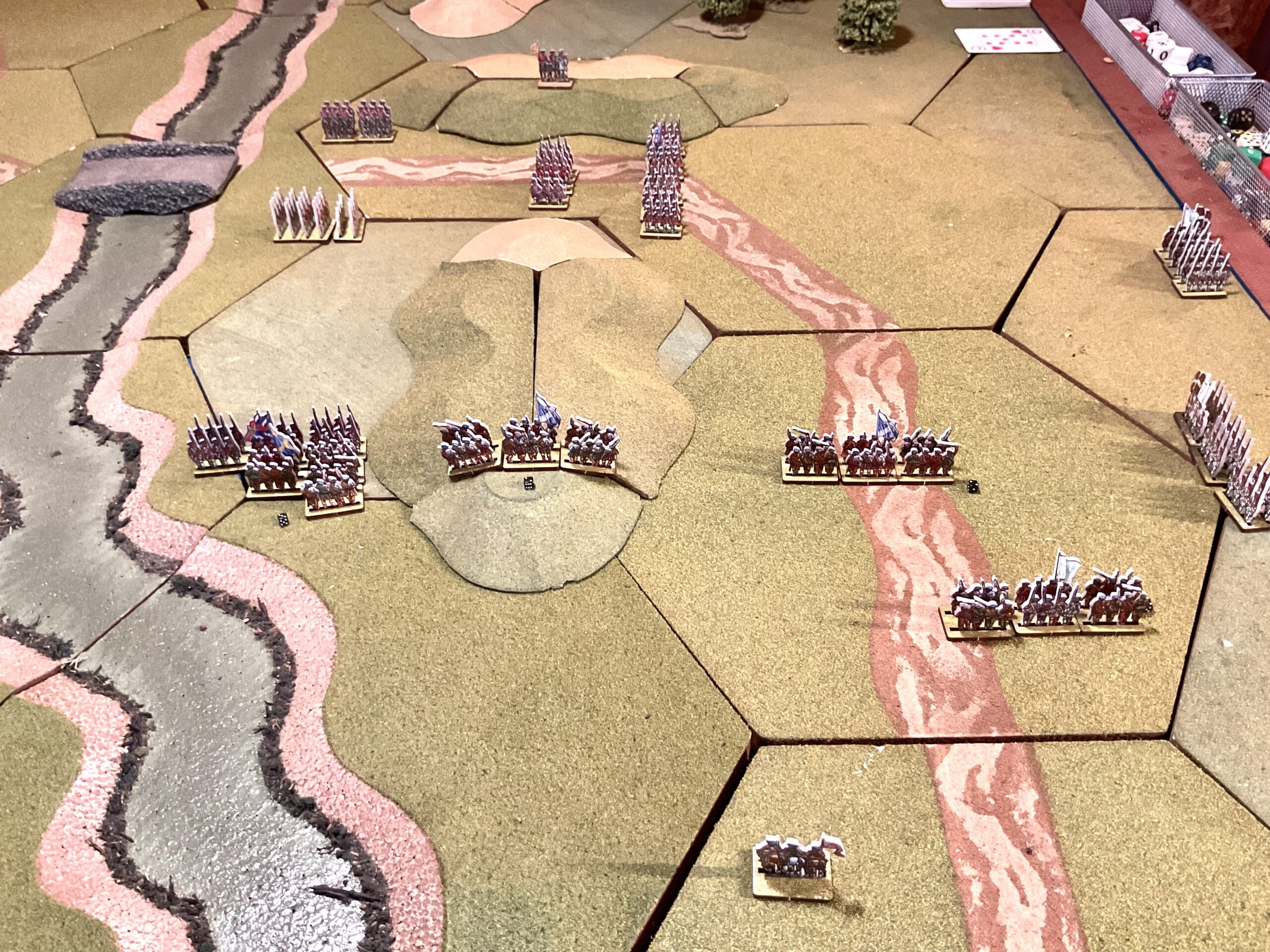
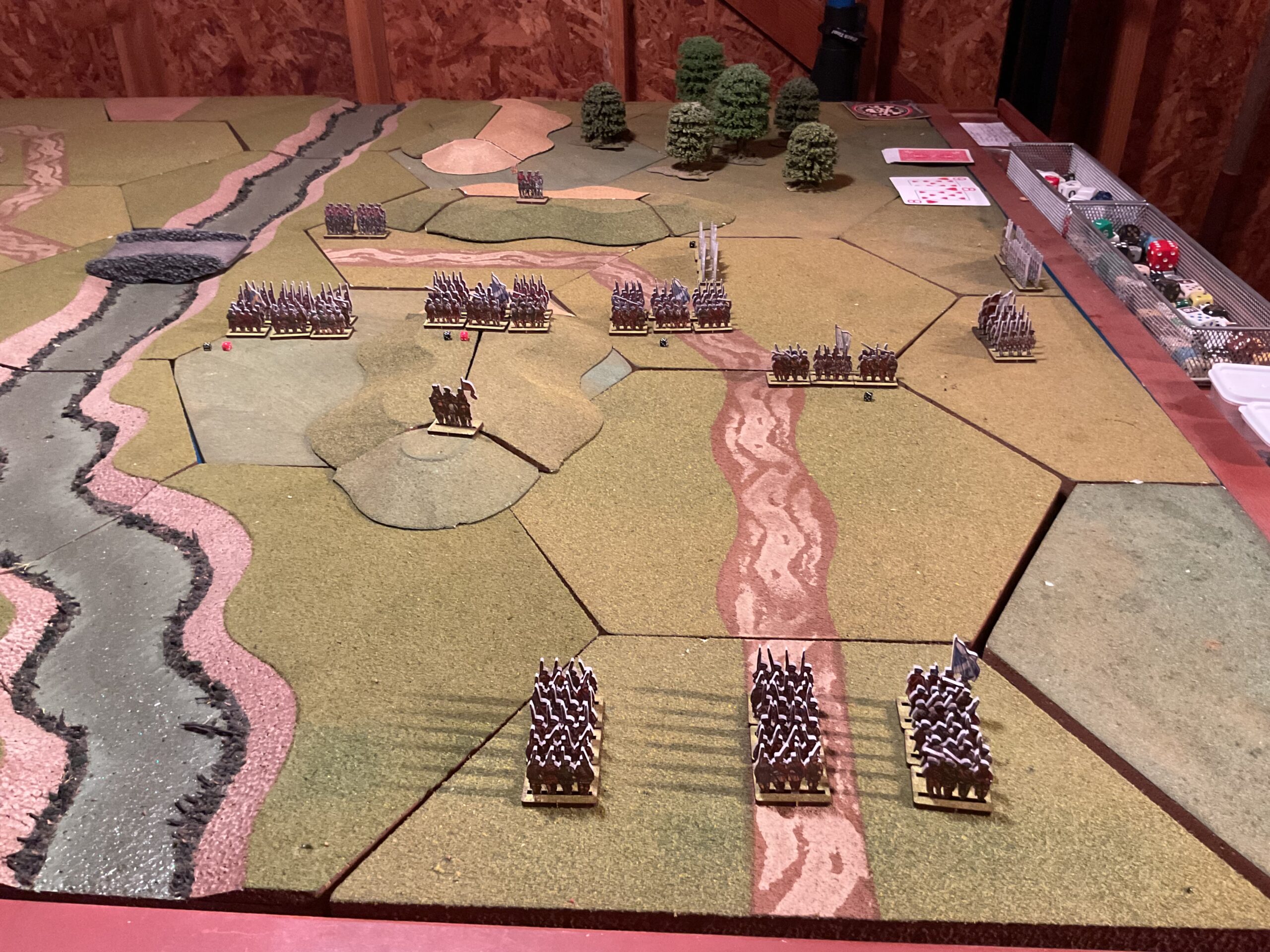
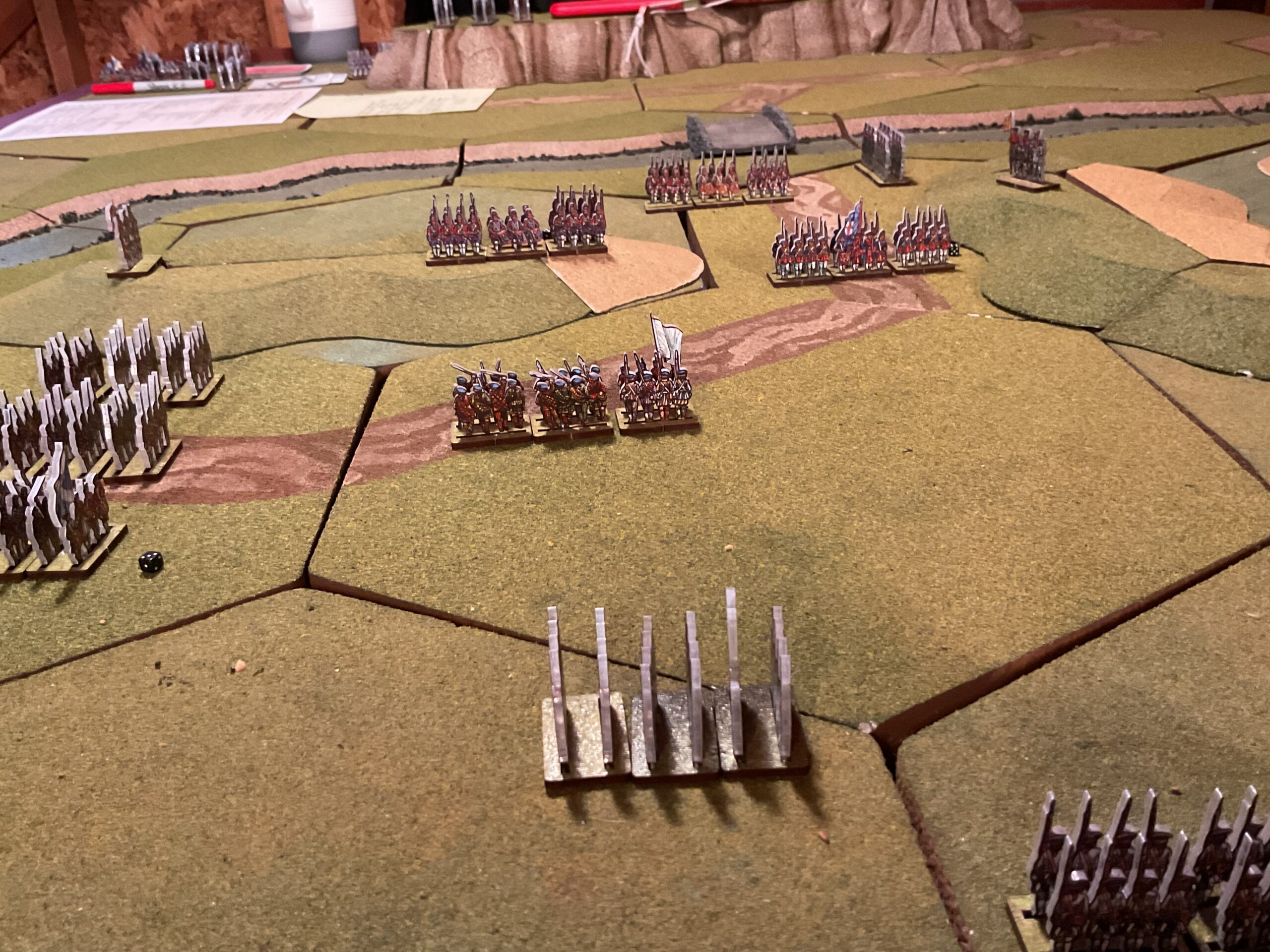
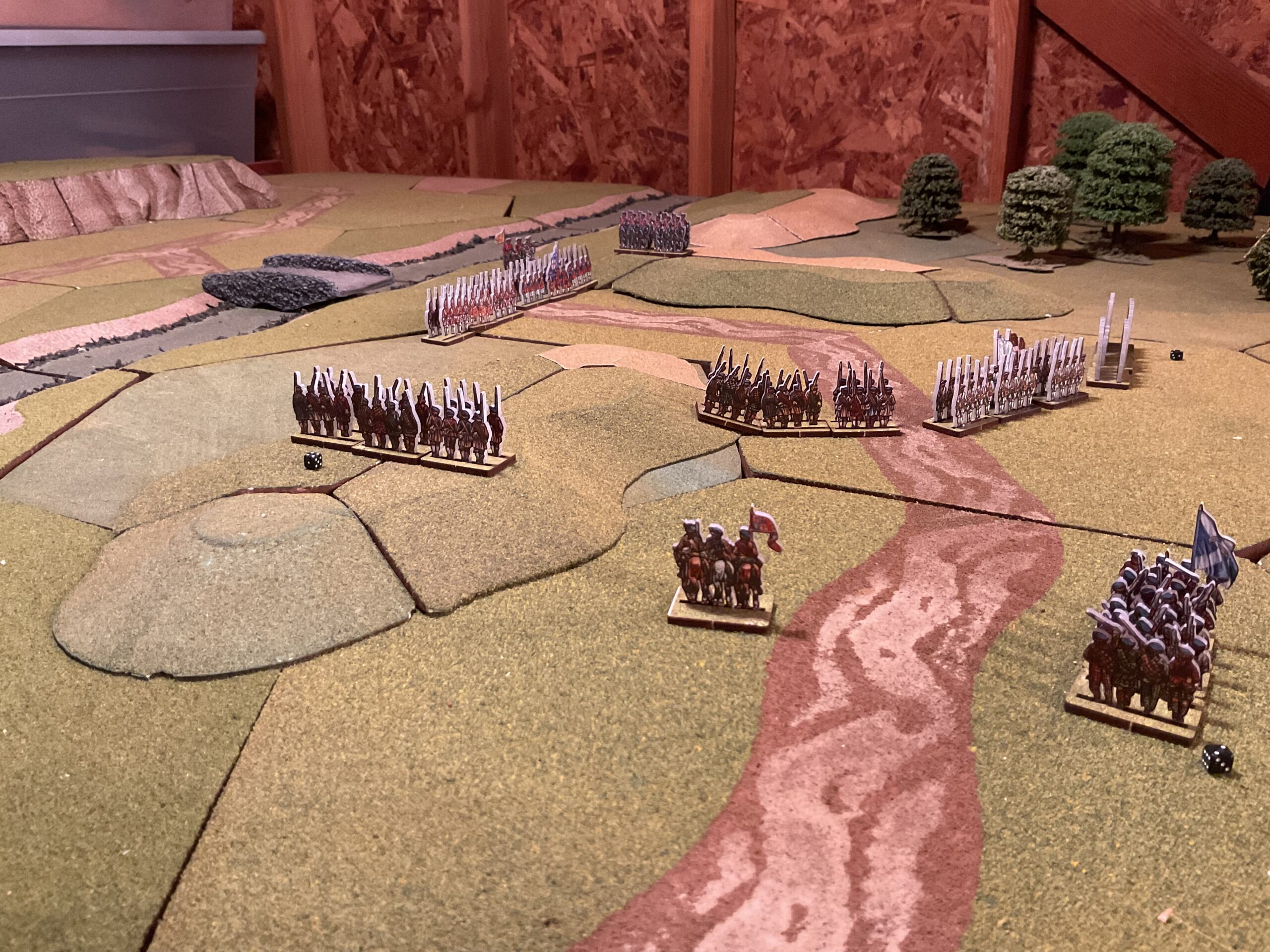
Got to it with Valour & Fortitude yesterday afternoon.  First game in The Shed in a long time.

As usual, thought I was prepared, but wasn’t.  Needed to put together unit ratings cheat sheet – with fire, melee and tenacity ratings,  get a deck of cards for the Fate Deck,  as well as retrieving my Commander Characteristics and Army Orders.

Despite these administrative chores, and following the Oregon vs USC football game on radio, I managed a couple of preliminary moves.

The unanswered question about the updated venue is how well it will heat up as temperatures continue to drop.  We’ll see.  I have the space heaters.

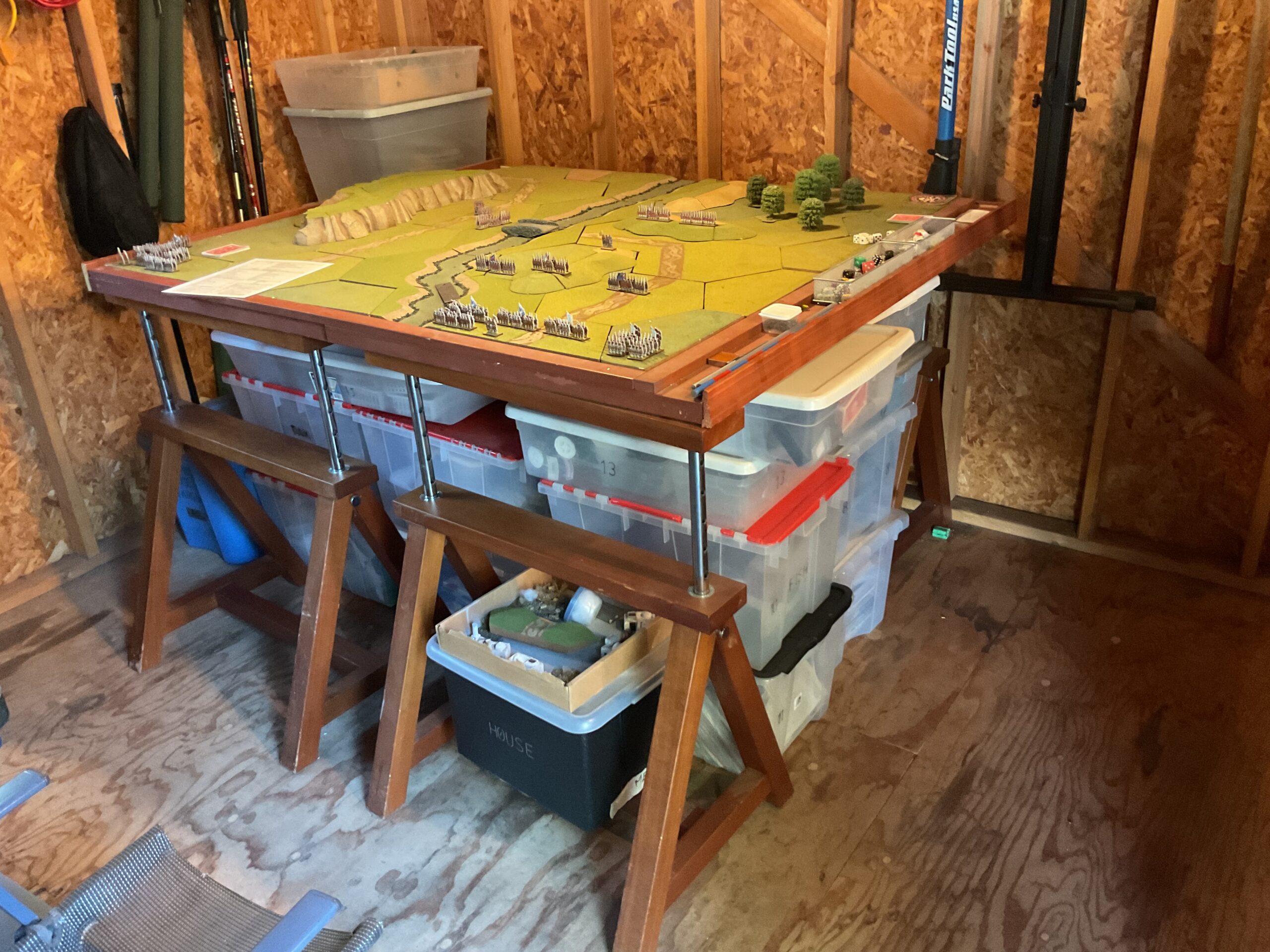
Here’s a quick shot of the table.  It’s roughly 4×5 feet.  Note all the boxes of terrain and gaming materials stored underneath. Decades of accumulation, with little if any purging.

Der Weltkrieg – Osmanli Harbi – The Ottoman War 1914-1918

Finally finished up Galacia after more than a year on the table.  Yes, that long.  Pathetic is too kind a description.

Shamed, I had no other option But to set up another Der Weltkrieg offering, Osmanli Harbi.  Much lower counter-count, but some very interesting scenarios and rules.

The module’s scenarios cover the Caucasus, Macedonia, Iraq, Sinai and Albania theaters.  Just the names bring back memories of these regions bedeviling me while playing Pursuit of Glory.

Each theater has separate battle scenarios, as well as a campaign, which the system refers to as “Duration Game Scenario(s).”

Decided to play a Sinai scenario involving the Third Battle of Gaza , and covering the period October through December 1917.

The game’s rules have some significant differences/additions from/to the Der Weltkrieg Standard Rules.

The overarching changes for  Osmanli Harbi address the differences between fighting in Europe and the game’s theaters.  These focus on the harsh environmentss, with its effects on operations as well as logistics.

Desert hexes have reduced stacking limits; roughly half of that allowed in the standard rules.  Units crossing desert hexes also lose one movement point.  An attacker suffers one additional loss when attacking into a desert hex.  Operations during Summer turns involve further reductions in movement allowances as well as increased mandatory combat loses.

Lines of Communications (LOC) and Supply Depots are introduced to reflect the lack of transportation networks in these remote theaters.

LOCs are required for a unit to remain in supply.  LOCs must be traced to a rail line, port, headquarters or depot, with a maximum length of two hexes in the desert.  The headquarters or depot must be within two hexes (in the desert) from a rail line or port.  You cannot “daisy chain” headquarters units.  So, in the desert, a unit risks out-of-supply effects if it is more than two hexes from a rail line, or four hexes with an intervening headquarters.    The effects are attritional, either losing one (1) strength point if moving more than half of its allowance – in any terrain, and/or having to roll for attrition during the Special (first) Phase of a monthly turn.

Other scenario-wide rules involve reduced rail construction and capacity.

The impact of these changes pale in comparison to the rule that allows  Ottomans to mount counter-attacks at maximum strength without infantry or cavalry units being supplied.  In the series rules, a unit can only counterattack at full strength with the expenditure of two (2) supply points per strength point.  If not supplied, the unit attacks at half-strength.  This is a significant factor, with the designer explaining  this rule reflects the Ottoman’s ability to put together scratch forces (much like German Kampfgruppes) to respond to Allied operational successes.

Each set of  scenarios also has its own special rules.  For Gaza, these include rail capacities, German and Austria-Hungary support units, the requirement(s) to maintain garrisons, and special attack rules for the 1918 Meggiddo scenario.

I am also using an alternate Combat Results Table (CRT).  This CRT is recommended for low counter density scenarios.

The 3rd Gaza scenario is a stand-up slugging match, with the British assaulting an entrenched Ottoman force.  It’s a good solo scenario since the Ottoman player simply using his limited reinforcements to plug gaps created by British attritional attacks.  Maneuver is limited by desert and mountain terrain.

Victory is determined by capturing/defending cities and combat losses – which are accounted for as “Demoralization Points”.

The first play-through resulted in a Central Powers (Ottoman) Decisive Victory, as the British (Entente) suffered significant casualties while seizing just one of three cities required for a Substantial Victory.

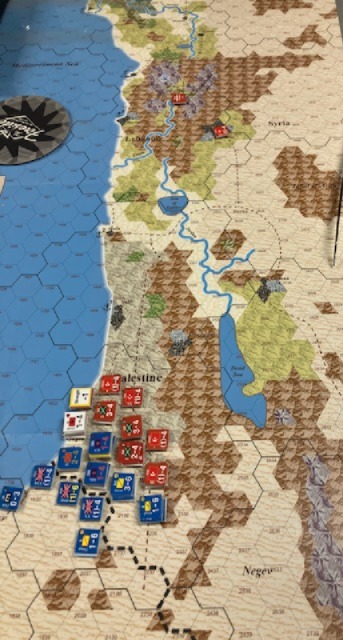
I’ve set the scenario up again, and am giving it another try.  Here’s shot of the game.


Valour & Fortitude – Jacobite Rebellion 1745

Setting up a Valour & Fortitude(V&F) 1745 Jacobite Rebellion game using  WorldofFun (WOF) 18mm plastic flats. Finally have the shed table (re)squared away and ready for action (photos in follow-up post).

You can read all about these rules over at the Perry Miniatures website.

I bought the figures several years ago without any specific game system in mind. V&F is all the rage, the rules are free, and they had army lists available for the rebellion. I use the past tense, as I have copies of the lists in Goodreader, but can’t find them on the net.

Why a new search? Well, I downloaded the Jacobite army sheet twice, but not the characteristics – or fate cards – sheet. Typical. I’ll cobble something together from other lists. Fortunately, only the first four characteristics on the sheet are unique. The remainder appear to be the same for each army.

While the game system involves drawing a fate card as the first action of a player’s turn, and using points to upgrade a commander’s capabilities,  I wanted to add other, more personal, characteristics for each side’s leaders. Rather than use the Irregular Wars system for that, I dug out the old standby, Programmed Wargames Scenarios by Charles Stewart Grant. Published in 1981, it has been an  influential and relevant resource.

Grant’s system uses dice to determine his array of characteristics for commanders, and “programmed” orders for either Red (Attacker), Blue (Defender), or both armies. It’s a good and fun solo system. He also includes an excellent and amusing set of “fate cards”.  However, I’ll use those contained in V&F for my first couple of games.

The results were interesting to say the least. Here’s a summary.

TRAIT/ORDERS

BRITISH (Blue – Defense)

JACOBITES (Red – Offense)

C in C Personality

Bold

Bold

Tactical Capabilities
Attack Good – +2 to unit attack Weak – -1 to unit attack
Defense Above Average – +1 to unit Weak – -1 to unit defense
Local Population Attitude

Indifferent

Indifferent

Allocation of Forces 50% defend South Hill 40% attack South Hill
30% defend North Hill 20% bypass to East, attack N. Hill
20% reserve (West of bridge) 40% reserve (off table)
Execution of Orders Give no ground. Defend well forward. Can move off contour to exploit favorable situation.

See Pg. 19 for responses to events.

See Pg. 21 for reserve response to events.

The local population option is an interesting touch.  Locals can actively aide one side or the other.  This includes sabotage, giving bad directions, or whatever one’s imagination conjures up.

I haven’t figured out how to apply the tactical modifiers.  Apply to the entire army or to a single unit designated by the CinC?

In addition to the CinC, V&F calls for Brigade Commanders.  A brigade can have anywhere from two to eight units.  I’ll have two Brigadiers per side.  However, I’m not assigning characteristics/traits to them since it’s my first game with this system, and I’ll have plenty of other opportunities to butcher the rules.

More as I get things figured out.

GWAS – Attention Diverted

Way back in March I posted about a Great War At Sea (GWAS) project involving Chile and Argentina.

That one is now on a backburner, with my new emphasis on the “what ifs” of the Spanish-American War.  As usual, the move from South America to the Caribbean did not involve a straight line.  Instead the initial detour was to “Plan Black”, a possible United States-Germany confrontation.  This, in turn, was an offshoot of a by-chance read about the international squabble(s) over Guam and the Philippines in which Germany was an active participant.

Plan Black was a bust, since the GWAS scenarios are set during the Dreadnought Era, and I wanted something turn-of-the-twentieth-century.  Looking for a path of least resistance, I dug into GWAS’s 1898, The Spanish-American War,  module.  This opened up some immediate possibilities.

Fortunately, I own a copy of David Trask’s “The War With Spain In 1898”.  This one volume history covers the naval aspects in some detail, going far beyond the usual coverage which is typically limited to the battles of Manila Bay and Santiago De Cuba.

The game’s scenarios cover some hypothetical situations, but I was interested in a campaign that assumed (and this is quite an assumption) that Spain had not neglected its fleet for ten years, and was a far better match for the United States “New Navy”.  This is where Trask’s book was so helpful.

But, things ground to a halt when I decided to use the alternate Dreadnought tactical rules.  These require a roughly 3 ft x 3 ft hexagonal grid sheet, and I don’t have one.

Amazon should be delivering a blue hexagonal grid sheet any day now.  Everything else is ready to go.

And, I will get to Chile vs. Argentina. Sometime.

Up Front – Filling the Gap

This Summer I played Up Front (UF) both solitaire and face-to-face.  It’s a comfortable game.  I keep coming back to it.

What I like about UF is that it isn’t too complex (like Advanced Squad Leader), isn’t too simple (like many miniature tactical/skirmish games), and is more accessible than Advanced Squad Leader Starter Kit (ASLSK).  By “accessible”, I’m referring to a level of detail requiring numerous chart references, multiple plays for the requisite knowledge, or a savant-like memory.

Also….you don’t need the space required for a board.  ASLSK has a number of compact one- board scenarios…..but not that many.  UF doesn’t require  multiple boards to enjoy an involved experience,  but the number of scenarios provided are limited.  However, those scenarios can be tarted-up using different force mixes, different nationalities, or removing cards to create new terrain and obstacles.  Actually, if you could still buy the game (and why that is involves a strange and terrible saga that I am only vaguely familiar with), a case could be made getting a second box to add cards.

By the way, Chris Farrell has some very interesting observations about the game over at his blog.

To keep the game in its comfortable place, I add selected sections to enhance the  Basic Game which is limited to Sections 1-16.

17.  Flank Fire and Encirclement; Lateral Group Transfers

18.  Weapons Acquisitions

19.  Malfunction and Repair

20.  Infiltration and Close Combat

For Chrome, I will include – on a case-by-case basis –  the following sections.

21.  Demolition

22.  Flamethrowers

23.  Pillbox

24.  Minefield

39.  Troop Types

With these five additional rules, you can attack a pillbox; first without any additional weapons, then with demolitions and, finally, flamethrowers.  After that, assault the pillbox through a minefield.  Excellent for solo play.

Tanks? Artillery?   I’ll leave those for Advanced Squad Leader or the Starter Kit.  Tanks & Artillery rules make me uncomfortable.

Learning Curve Continues

Finished up ASLSK’s Scenario S2, War of the Rats.

I thought it would be an easy mopping up after the early punishments meted out by the Germans.  But, the Soviets were surprisingly resilient.  It all came down to a climatic melee in the last German turn, in the last hex, of the last building.

Given the weapon mix (demolition charges and flamethrowers), unit types (conscripts and elite) and urban terrain, the scenario is a great introduction/review of the system’s first infantry-oriented iteration.  As I’ve posted  before, ordnance and especially armored fighting vehicles slow things down.

Well, why not another play?  I’m curious if my “overload tactics” will work again.  And, if so, can I finish off the Soviets quickly?  As a teaching colleague used to say “Repetition is the key to knowledge.”  Then, perhaps, something with ordnance…..

Bits And Pieces

Continuing to fiddle with the Balkan/Central Europe 1938 scenario.

Latest bit of information is a Wikipedia article on the Yugoslavian army, particularly the interwar section.  I know…thin stuff, but there isn’t a whole lot of pre-April War information out there.

Yugoslavia had sixteen (16) infantry divisions, one (1) alpine division, as well as two (2) cavalry divisions in 1935. Mobilization would create another eight (8) infantry, one (1) alpine and one (1) cavalry division within 30 days.

Well, it’s something to work with.

The  mobilization parameters need to be refined, especially for the less-than-reliable Croat units.  My instinct is to stay with random die roles for the Croats, and, since Europa uses two-week turns, having those mobilizing units attaining cadre status at the end of Turn 1, and divisional status at the end of Turn 2 if they do not move or are involved in combat.

Why not?

Vaporized

Over to Tim’s earlier this week for Up Front.

We’d played it once before a long time ago.  Was surprised, but happy,  when he suggested this for my July visit; especially since I had played it recently.

We set up the first scenario.  Since it does use all of the infantry rules it was perfect for our levels of (in) aptitude.

Since we weren’t using the Flanking Fire or Melee rules, the game became a lengthy positional gunfight.  The only incentive for moving forward was to increase each group’s firepower.

It took over two and one-half decks (scenario ends after the card deck has been played three times) for Tim to break my Americans with fifty percent casualties.

Emboldened by our “success” (which I define as an enjoyable experience without the mind aching turmoil that accompanies, let’s say, Pursuit Of Glory), we set up the same scenario with the  French fighting Italians somewhere in The Alps.  Both these crews have some real limitations when it comes to card draw and discard.  However, I didn’t realize my Italians also have some real weapon deficiencies.  They have to get to Relative Range 2 before their bolt-action rifles have any effect.

It was a short and violent.  I dutifully advanced, he fired, and my two groups were vaporized.  It took only three “hands” and the Italians (who will break at 40 percent casualties) were done.  Here’s a bad pic of the battlefield after it was over.  Notice the Italian casualties (cards) at the bottom left of the photo.

The cards with figures were those that panicked.  The others were KIA.

Regardless, it was a lot of fun and should be more fun using the advanced infantry rules.  Despite my focus on ASLSK, I think Up Front will be on the table quite a few times in the upcoming months.

Learning Curve

Continuing to work on my ASLSK skills with a reset on Scenario S2, this time using my own German dispositions, with a rough approximation of the Soviet dispositions used in the Basic Training magazine’s replay discussed in an earlier post.

I loaded up the west side of the board with German units.  It seemed to work.  The Soviet Conscript units melted away due to some really bad morale die rolls.  Aggressive German advances kept the broken units under Desperation Morale with the very tough -4 modifier to any rally dice rolls.    Here’s an impaired pic taken at the end of Turn 2.

In theory, the DM units have little or no chance to rally and should be destroyed, or at least suffer Casualty Reduction, by German Prep Fires at the beginning of Turn 3.  But, this is ASLSK and anything can happen.

Choppy…But Worth It

This popped up on Boardgamegeek’s Daily Kindle Deal list.  Had to grab it given my current 1938 Central Europe/Balkans effort.  The beauty of subscribing to this thread is the ability to pick up titles like this for pennies on the paper version dollar.

The book’s content presents an overview of the modernization of the Yugoslov Air Force prior to WW2; a choppy day-to-day account of the “April War”; and a discussion of the various aircraft employed.

I use “choppy” because of the author’s use of the Serbo-Croation abbreviations for personnel ranks and unit designations.  Hard for my parochial mind to absorb.

The highlights of the book are detailed descriptions and excellent photographs of  individual aircraft.  The Yugoslav air force was polyglot outfit, with a wide mix of (relatively) imported and domestically produced modern types, obsolescent/obsolete aircraft, and one-offs.  I can only imagine the resulting maintenance nightmare.

An interesting aspect of the narrative are the numerous references to sabotage of aircraft and outright disobedience and circumvention of orders by personnel  sympathetic to the Axis.

Definitely  worth the $2.99.