Started the campaign game, which didn’t last long. An 88mm anti-tank gun blew “Ripper” up on the second day of combat. All unspotted AT guns are treated as 88s until spotted. This one wasn’t, I didn’t use smoke and get the hell out of there, so (in Tim’s words) “Blammo”!
Definitely hooked on the game. Fairly comfortable with the rules and sequence of play. It’s heading back to Central Oregon, and will be set up on return.
Patton’s Best (PB) lies somewhere near the other end of the solo spectrum from In Magnificent Style. I would characterize it as “accessibly granular”. An excellent review can be found here.
I received this game as a gift in the late 90s. It has languished since then, even exiled to The Lake. However, the continuing bad weather was enough motivation to get it on the table and start punching counters.
The rules are organized, but lack a play-thru to help synthesize an understanding of the many steps involved. While an outline of the daily sequence is printed on the mounted map (along with several charts and Battle Board), one has to jump around between three other charts and brief explanations in the rules to gain a rudimentary understanding of game flow. It took several hesitant steps to get semi-comfortable with how to proceed.
Like its cousin, B-17, PB is best played as a mini or full campaign and not a one-off, although the rules allow for interesting daily missions. The elusive (it’s appended to the back of the After Action Report Pad, and took an internet search to locate) Combat Calendar breaks the Northwest European Campaign down into operational segments with differing tempos of operations, weather and missions.
PB has a great deal of replay value. The wide variety of German weapons, areas for combat, and types of Shermans (18!!!), make for any number of trials and tribulations for the crew. The After Action Report allows for good narrative and character development. A fine example of this is the “Spring Chicken” saga over at Web Grognards.
I’ll be digging into this one over the next several days. Might even bring it back to Central Oregon.
Never been much of a video game player. However, a long time ago I developed a serious addiction to Space Invaders. After school I’d head home, fire up the Atari, and hammer away at those lock-stepping aliens. After a month or so, I was slaughtering them at the cyclic rate.
Now the shoe’s on the other foot….I’ve been playing “In Magnificent Style”, Victory Games’ treatment of Pickett’s Charge. And, the slaughter has been immense.
This is a well received game, as indicated by the reviews Boardgamegeek. And, rightly so. But, to play it, one needs to be a glutton for punishment.
Confederate fortunes can change in an instant. A once orderly advance will deteriorate into a tactical shambles if the die rolls go wrong, or there is a series of unfortunate chit pulls. And, those instances will happen. The best considered prudent, or wild and audacious, advance will crumble given the time, distance and firepower challenges facing Longstreet’s Corps.
Still, the game has as strange allure. Part of it is the easy set-up, nice components, quick playing time, uncertainty, and need for only one chart sheet. And, as stated earlier, it is an elegant design.
I think it would make a great tournament game. Get about six players, and have them play three games each. Have plenty of beer available, and watch the players implode and explode when things start “going south”. It would be theatre.
Tim arrived early Friday evening, just in time for the Stanford football game. I had the table set up and ready to go. We agreed to start playing early Saturday morning. Tim took the British (Allies) and I had the Italians (Axis) forces. The plan was an ambitious one. To play the entire scenario, and watch as many of the headline college football games as possible. Oh yes….and consume many Henry’s. This was a job for professionals.
The Italians face some serious operational challenges. They are considered Out of Supply (Status 4) from the beginning of the game. Attack strength is quartered, defense and movement halved, with reduced Zones of Control (ZOC). They have no General Supply sources, and must rely on a limited number of Attack Supply factors to create either General Supply Points, or use for attacks. Italian Colonial troops (which form the bulk of their forces) can have air support only if it involves ten regiments (REs). Air units must role on the Success Table to fly a mission, unless they are in General Supply. If not, they can be aborted, or fail to fly. To top it off, Italian movement is limited until the British enter Italian East Africa.
The British commander has his own problems involving time and space. Time is critical because the Order of Battle (OB) requires two divisions have to be withdrawn by early summer. The distances in the game are significant, and by Spring, the possibility exists that roads and terrain key areas will be reduced to muddy morasses, limiting movement and effecting combat.
Play started at 0830 with Game Day as background ambiance. Here’s a summary of play.
Dec I 1940 – Clear
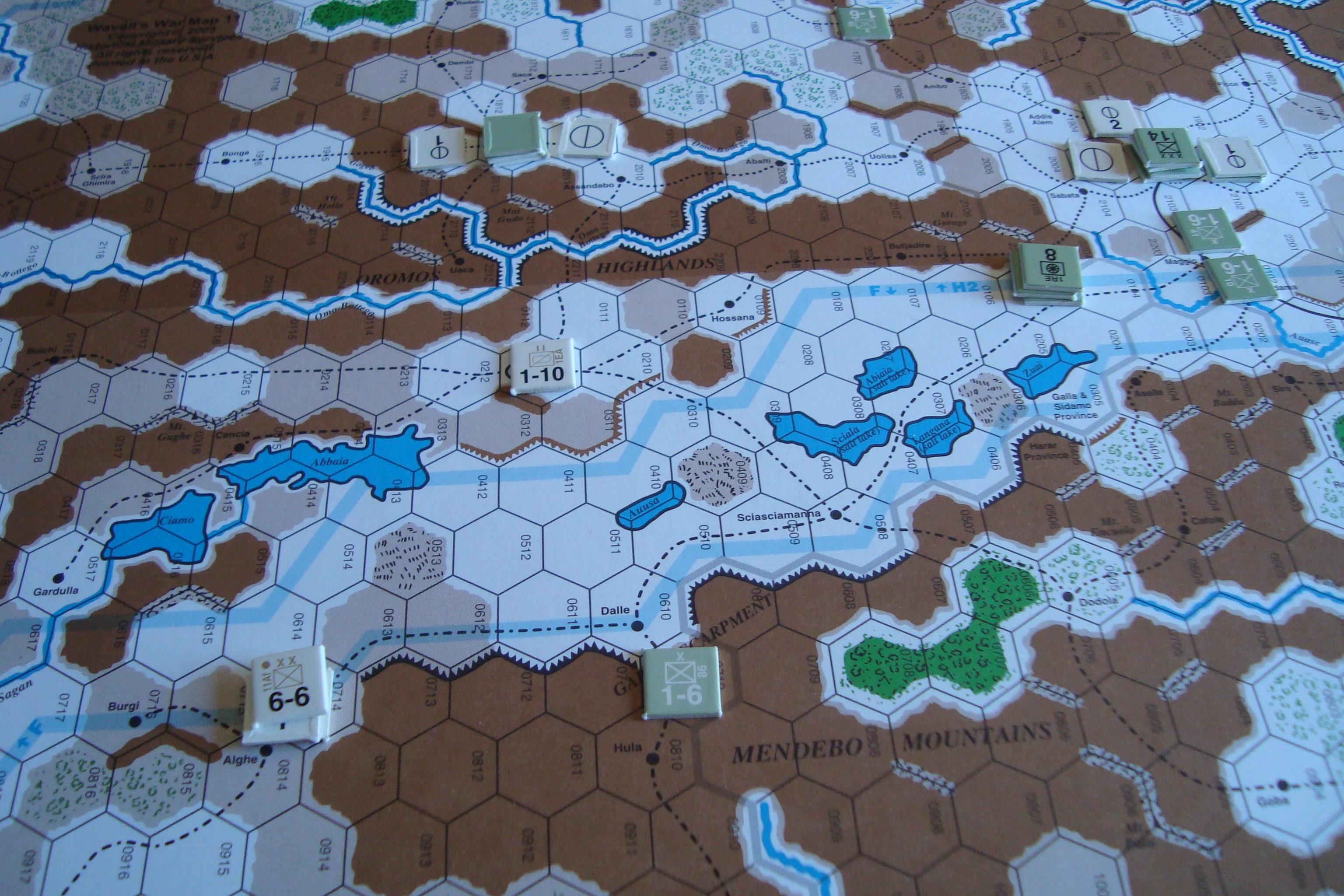
Allies: South Africans advance from Kenya in the south, with air units destroying a SM-79 I had unwisely deployed at a forward air field. Advances from Khartoum in the north southwards towards Kassala-Bascia-Massaula.
Axis: Consolidate scattered units in the vicinity of Kassala using HQs.
Dec II – Clear
Allies: Continue Kenya advance. Defeat Italian force at Kassala.
Axis: Retreat from Kassala to Bascia.
Jan I 1941 – Clear
Allies: Continue advance from Kenya in the south. Defeat Axis regiments holding vicinity of Bascia in the north, using motorized machine gun battalions to envelope for ZOC kill. Indian 4th Division advances south along coast from Port Saud.
Axis: Counter-attacks and destroys motorized machine gun battalions. Retreats east to mountains near Massaula.
Jan II – Clear
Allies: Advance along coast from Kenya, takes Mogadishu with amphibious assault. In the North, 4th Division continues advance shrugging off (over running) delaying Italian regiments.
Axis: Withdraws southern and eastern forces north towards Addis Ababa. Forms hasty defensive positions around Massaula. Air strike against British airfields unsuccessful.
Feb I – Clear
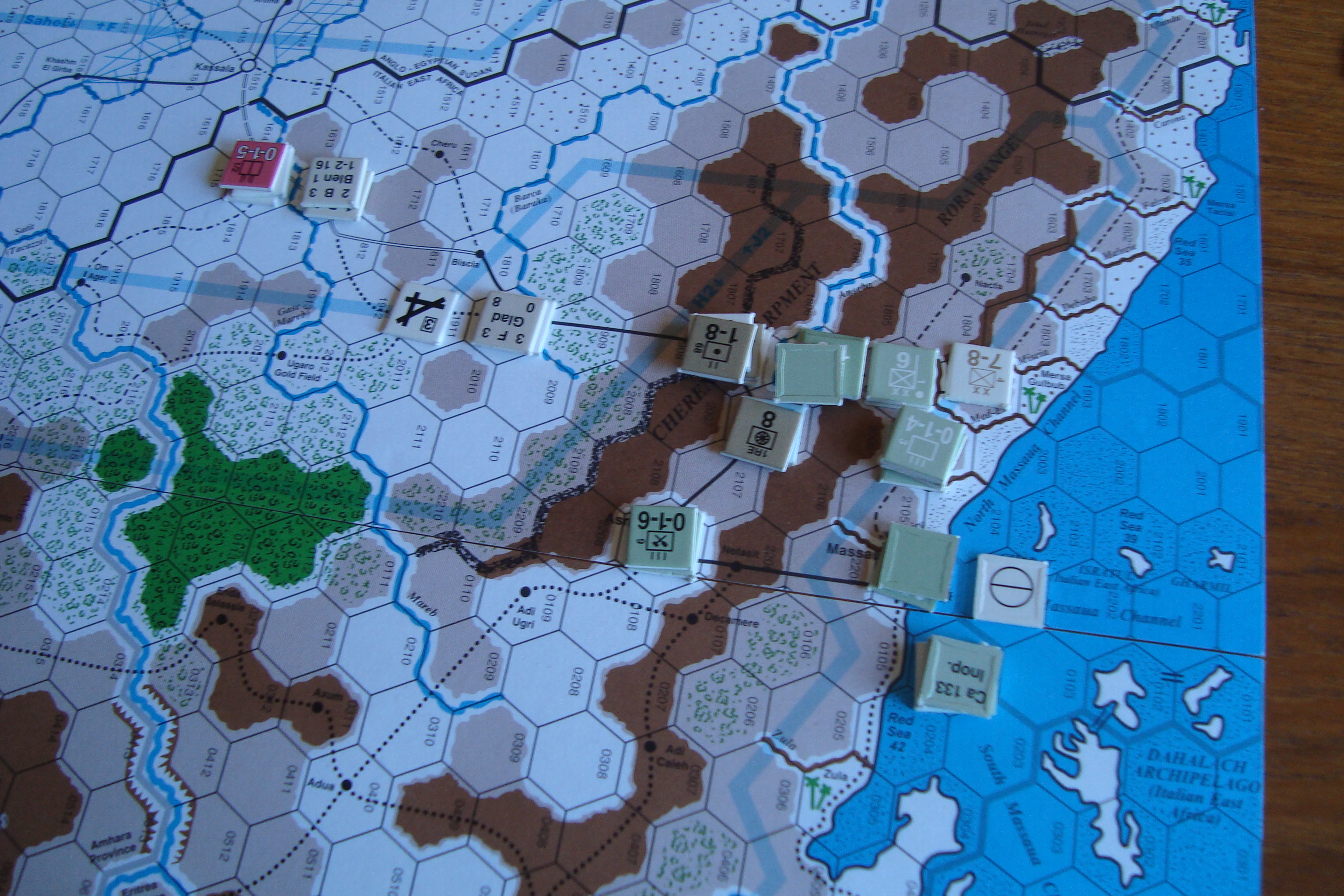
Allies: Takes Keren (key to breaching mountain defenses outside Massaula) on a half-exchange. Advances towards Addis Ababa.
Axis: Continues to withdraw towards Massaula, but hampered by British ZOCs.
South Africans Advance Towards Addis Ababa (Upper Right).
Feb II – Mud
Allies: Consolidate near Keren. South Africans now slog in mud towards Addis Ababa.
Axis: Establish defense around Massaula, continues to move/consolidate units near Addis Ababa.
British Begin Assault On Massalua Defenders After Capturing Keren. Flipped Italian Units Are Out Of Supply.
At this point , VIPs were tallied, with each side having two (2).
March I – Mud
Allies: Launch assaults on Massaula perimeter defenses. Slog in south continues.
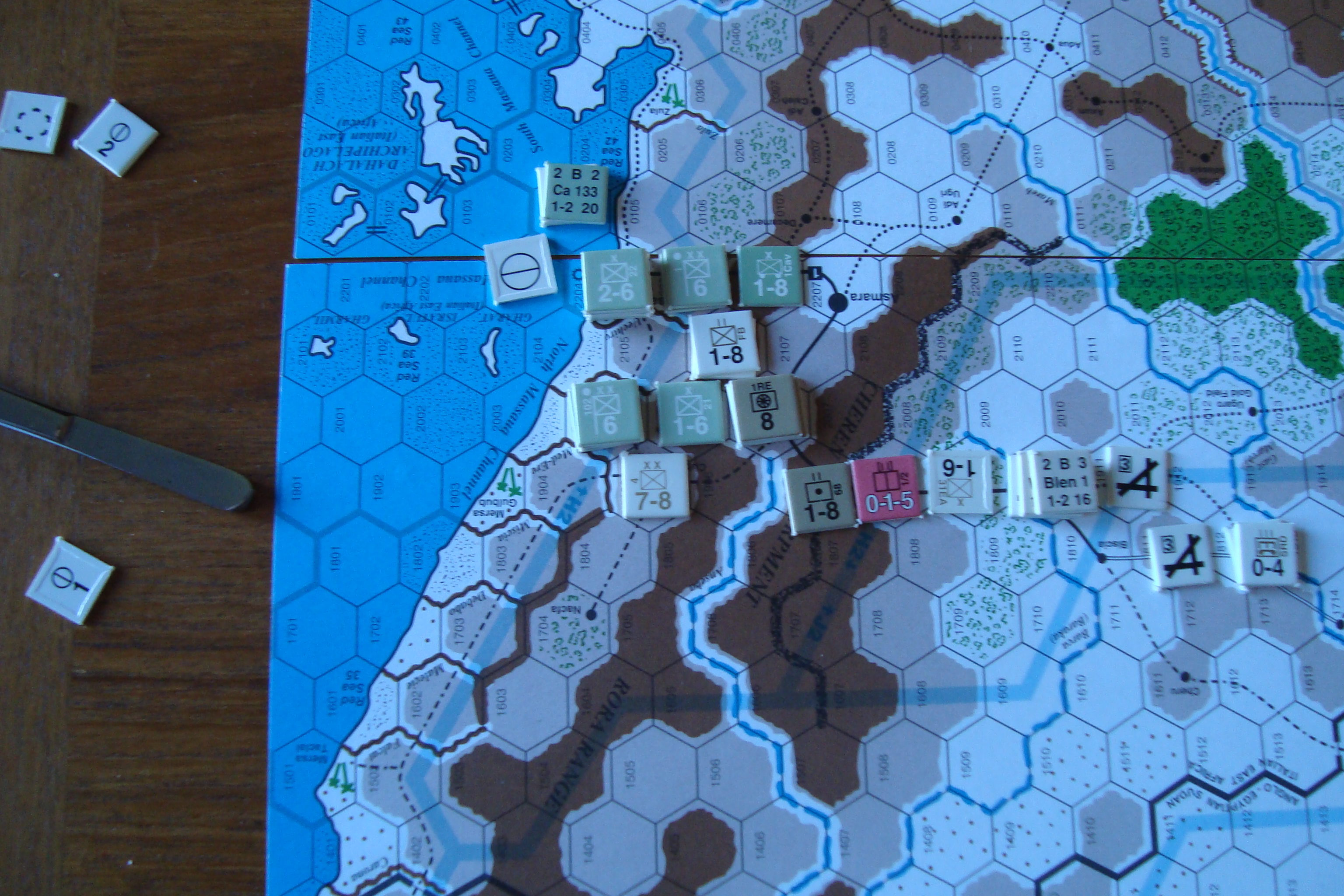
Axis: Now defending Massaula proper.
Final Defensive Perimeter For Massaula
March II – Mud
Allies: Capture Massaula (This will give them one (1) VIP), begin advance southwest towards Addis Abada. South Africans continue slog.
Axis: Forces in Addis Ababa deploy to forward defensive positions awaiting Allied advance.
April I – Mud (At this point Tim became understandably irritated by my uncanny ability to throw sixes. I pointed out to him that this was better for him with a weather role than a combat roll).
Allies and Axis: Same as March II.
At this point play stopped. We were engrossed in the Notre Dame-Texas game, and it appeared that the game would continue for more turns than time remaining to play.
You were much more aggressive in the second game. In prior games, you would use either the Bavarians or the Imperials, but not usually them both at the same time. Once you did, you were able to pick up a lot of territory. Either one of those forces are pretty strong and together they are a lot for the Protestants to handle.
I don’t know if you saw it or not, but there is a rule that if all of the cities in an area are at level 2 devastation, the VP for that area drop by one. It seems like a rule that wouldn’t come into play much, but both Saxony and Brandenburg might have lost VIPs in the last game. We rolled poorly for recovery and by the end of the game, central Germany was a howling wasteland.
I was a little gun shy with the Swedes. I had lost pretty much all of my other armies and leaders, so I didn’t want to get Gustavus killed in battle….Man, if I’d only had one more turn!
I probably should have been more aggressive against the Spanish and tried to attrit them down a little bit, so they couldn’t clobber the French. I thought about moving the army in the Netherlands out, but events always worked against it.
It occurs to me that I didn’t make particularly good use of my fortresses (it didn’t help that you rolled very well on your siege combats). I wonder if garrisoning them would force you to leave armies in place, rather than moving back to base areas at the end of the turn. Anything that slows down the Imperials in the early part of the game is worth trying…
Note: This was drafted last Friday morning, but due to sloth not posted until today.
Finally back from a month of travel.
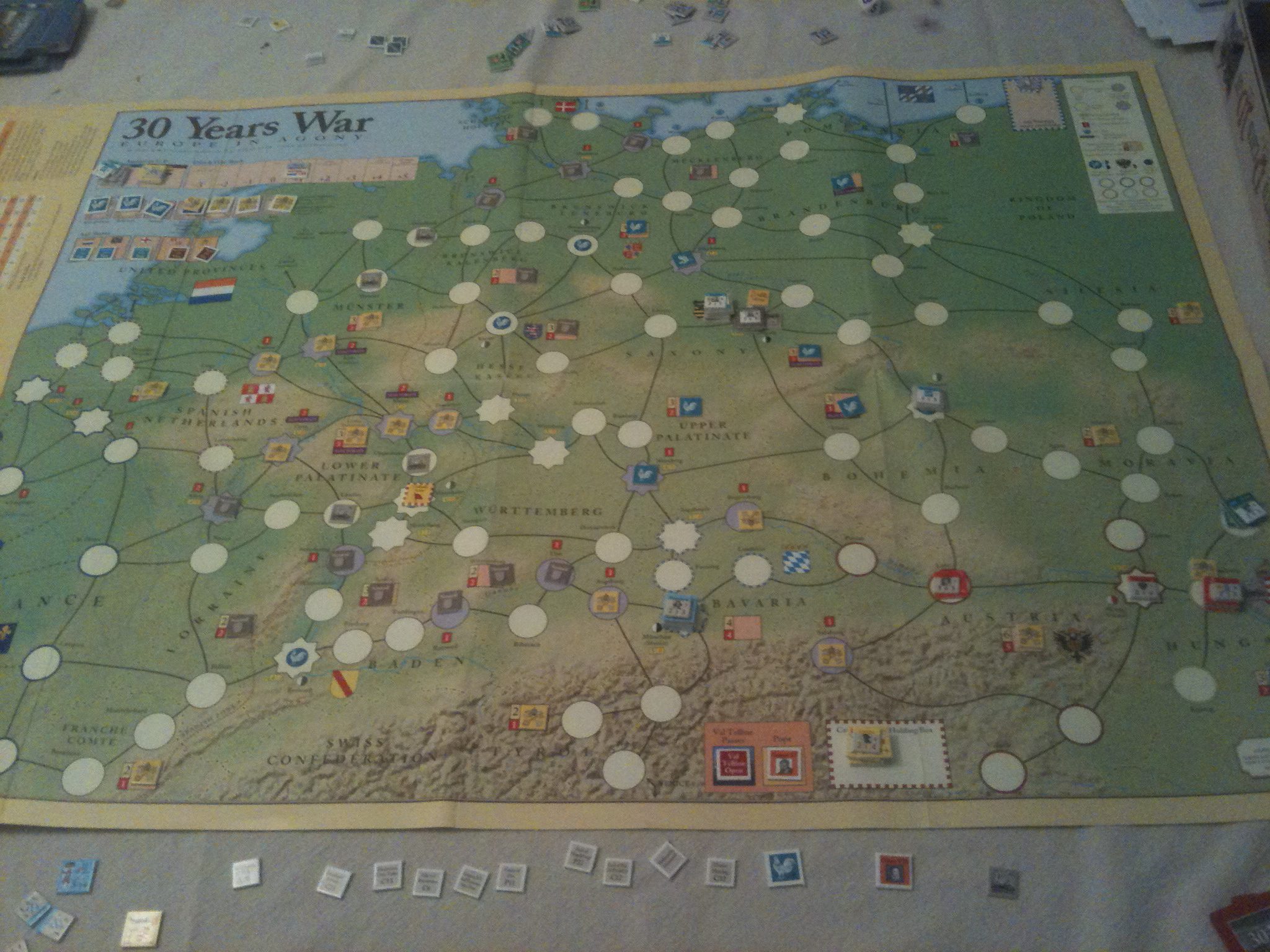
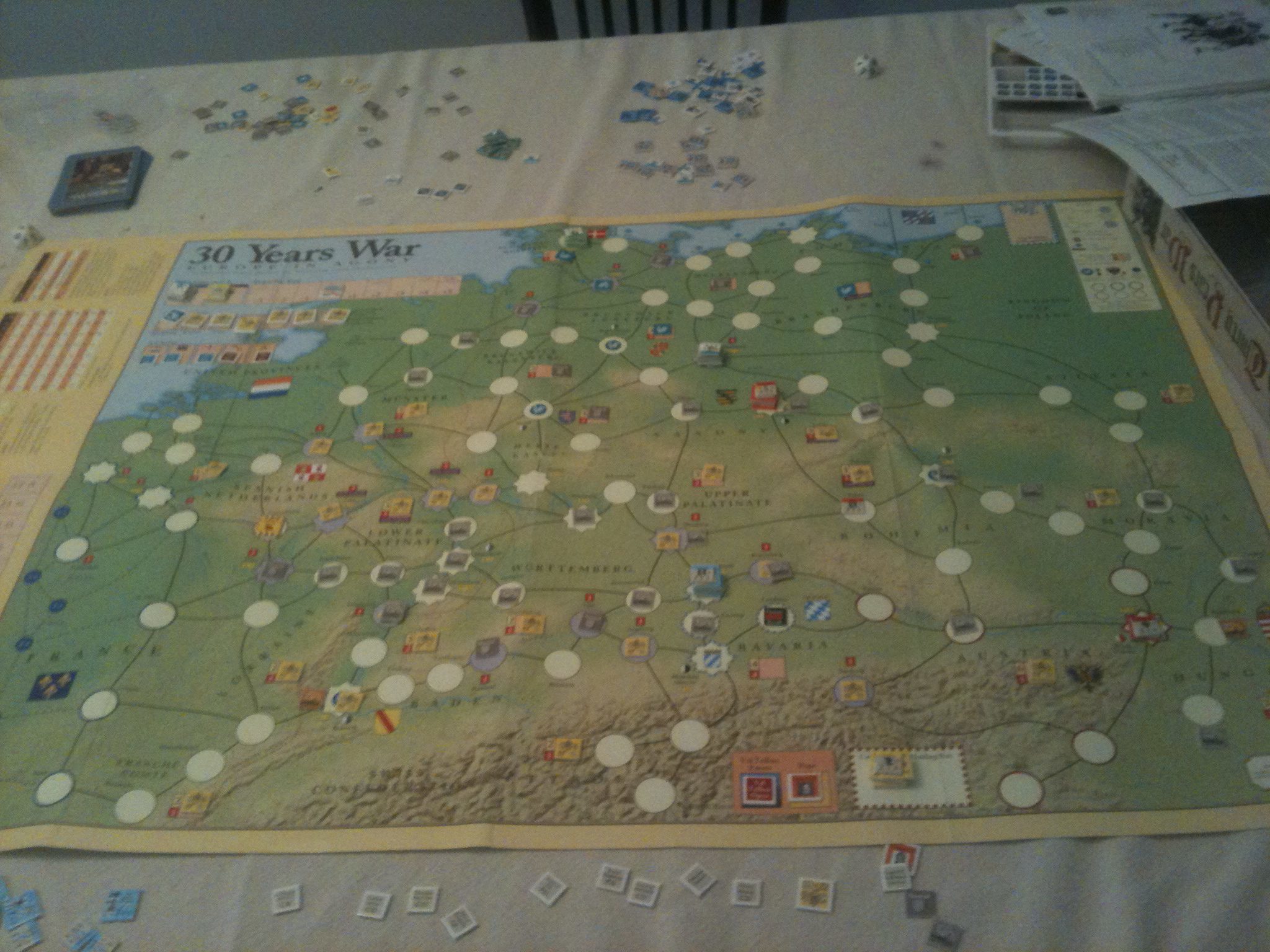
With Tim arriving later today for a game of Wavell’s War East African Campaign, I need to post up about our mid-August 30 Years War game. Tim took the Protestants, and I had the Catholics.
We played a few turns Friday afternoon/evening to re-familiarize ourselves. Lucky for me, we reset for a Saturday game. My play on Friday can best be described as cautious and inadequate.
Friday’s experience reinforced the lessons from our previous game. These were 1) Secure electorates for VIPs, 2) Recruit whenever possible 3) Try to pay as many of your forces as possible, rather than rolling for desertion, 4) Larger stacks of units are very effective and 5) The pillaging effects of movement can render large parts of the playing area almost untenable.
Both Lessons 2 and 3 involve the use of at least two cards per turn, leaving a maximum of four cards for operations. The Early War card deck has a large number of event cards, so the operational options are limited.
Play on Saturday had a good pace and tempo. Both of us adhered to the lessons learned.
By Turn Three I had been able to use my Spaniards (west of map, yellow counters) to secure the regions within their permitted area of operations.
By Turn 6, I had pushed Tim out of Hungary and advanced into the Palantine regions. France entered the war by Turn 8, pinning down my Spanish forces, with Tim’s Danes representing a threat from the North. Some electorates changed hands, but neither side could control the number required (all of them) to score significant VIPs.
I was very active with the Bavarian Forces (Blue counters in South). They took a beating, being wiped out and reconstituted twice. I was less aggressive with my Imperial veteran troops, taking losses from mercenaries. I rarely recruited militia.
Both sides used large stacks. Tim was especially adept at moving rapidly to destroy isolated units.
By game’s end Lesson 5 held true. Literally every province was devastated. Unfortunately, I did not take a photo of this.
The game’s last turn ended with a climatic battle between Imperial troops and Gustavus’ Swedes. Tim scored a tactical victory, but both sides were substantially reduced in size.
This is a good game that requires more than one playing to appreciate. Not as involved and mind numbing as Pursuit of Glory, but with far more nuance than Paths of Glory. We’ll put it on the table again.
Played a repeat of the mounted scenario last night, incorporating the new thoughts on rules and use of dice to guide play.
Added “Quality” as a troop attribute, using “Excellent”, “Good”, “Average” and “Poor”. These classifications were assigned probability percentages of 75, 60, 50, and 40 percent, respectively. I also rolled a D4 to see how many individuals might have qualities that differed from the group. Another D4 to determine what that might be, with a roll of “4” being “Excellent”, a “3”, “Good” etc.
Final “Yes”, “No” roll was for awareness, which effected the ability to react in the first few turns of the game.
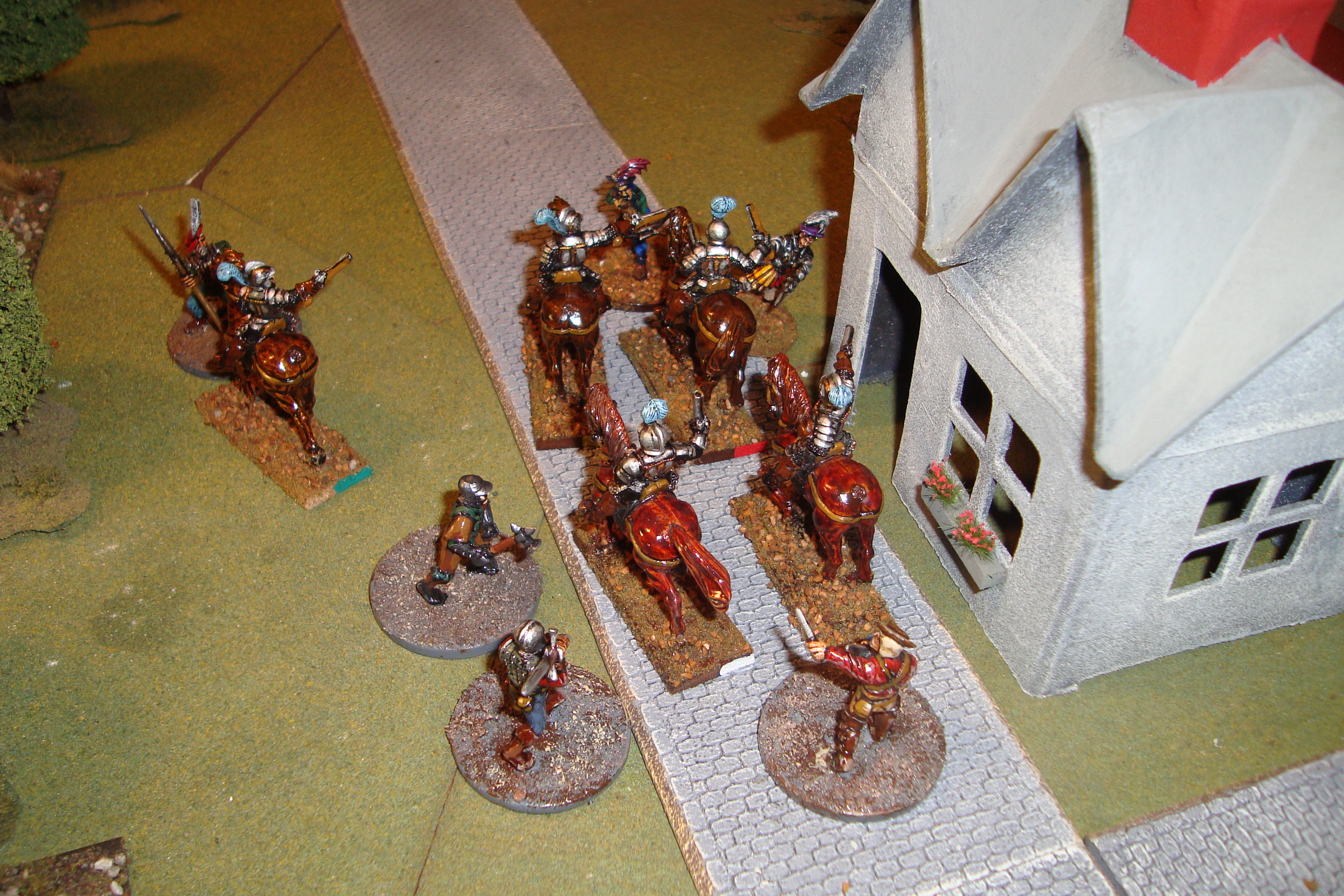
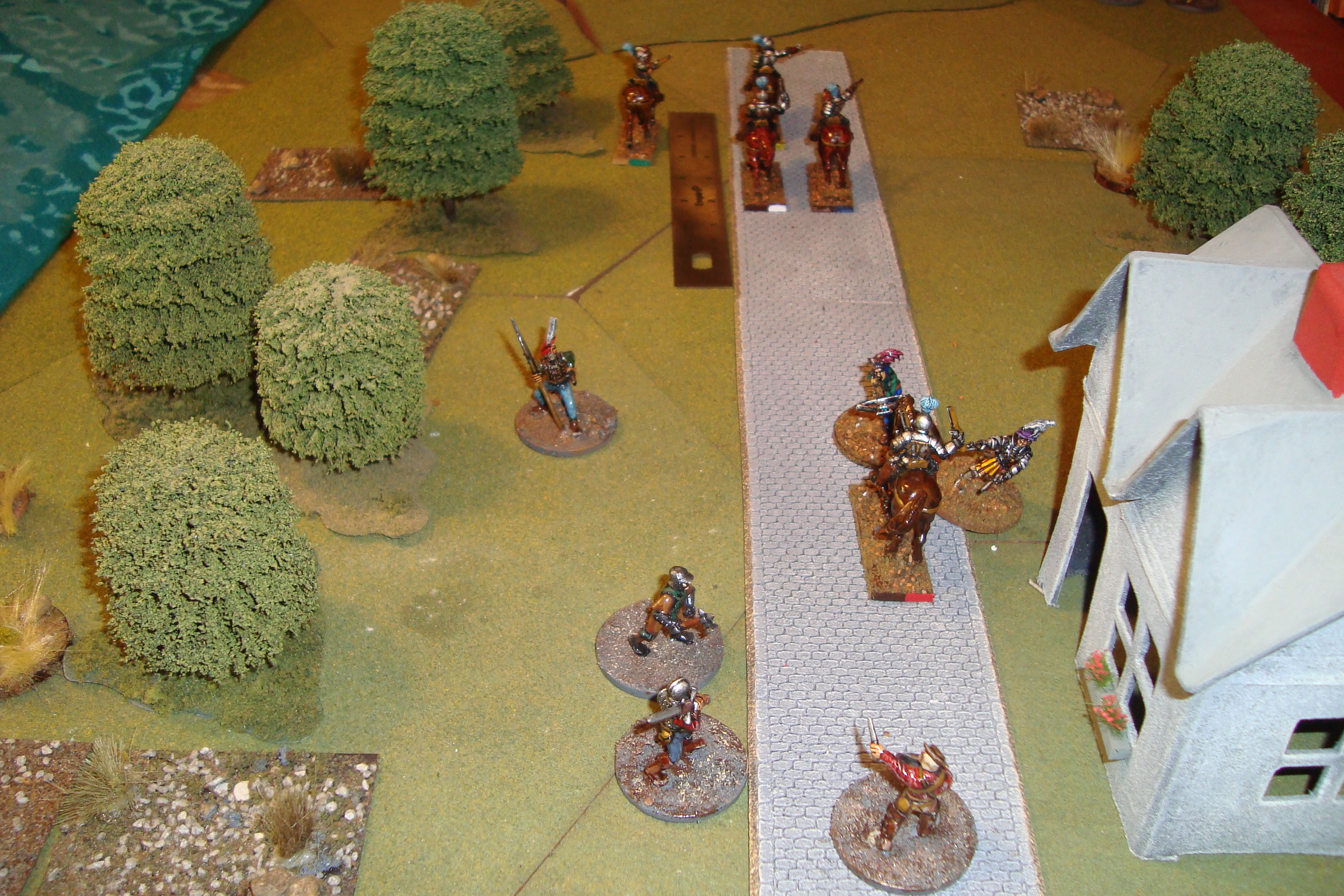
Turn 1: Blue had initiative, but was unaware, so Red entered at a trot.
Turn 2: Blue again had the initiative, became aware, with crossbowman moving to the road to shoot. Red accelerated to a gallop and entered into melee with the crossbowmen, with one bowman killed, and the other locked in melee with Red’s leader.
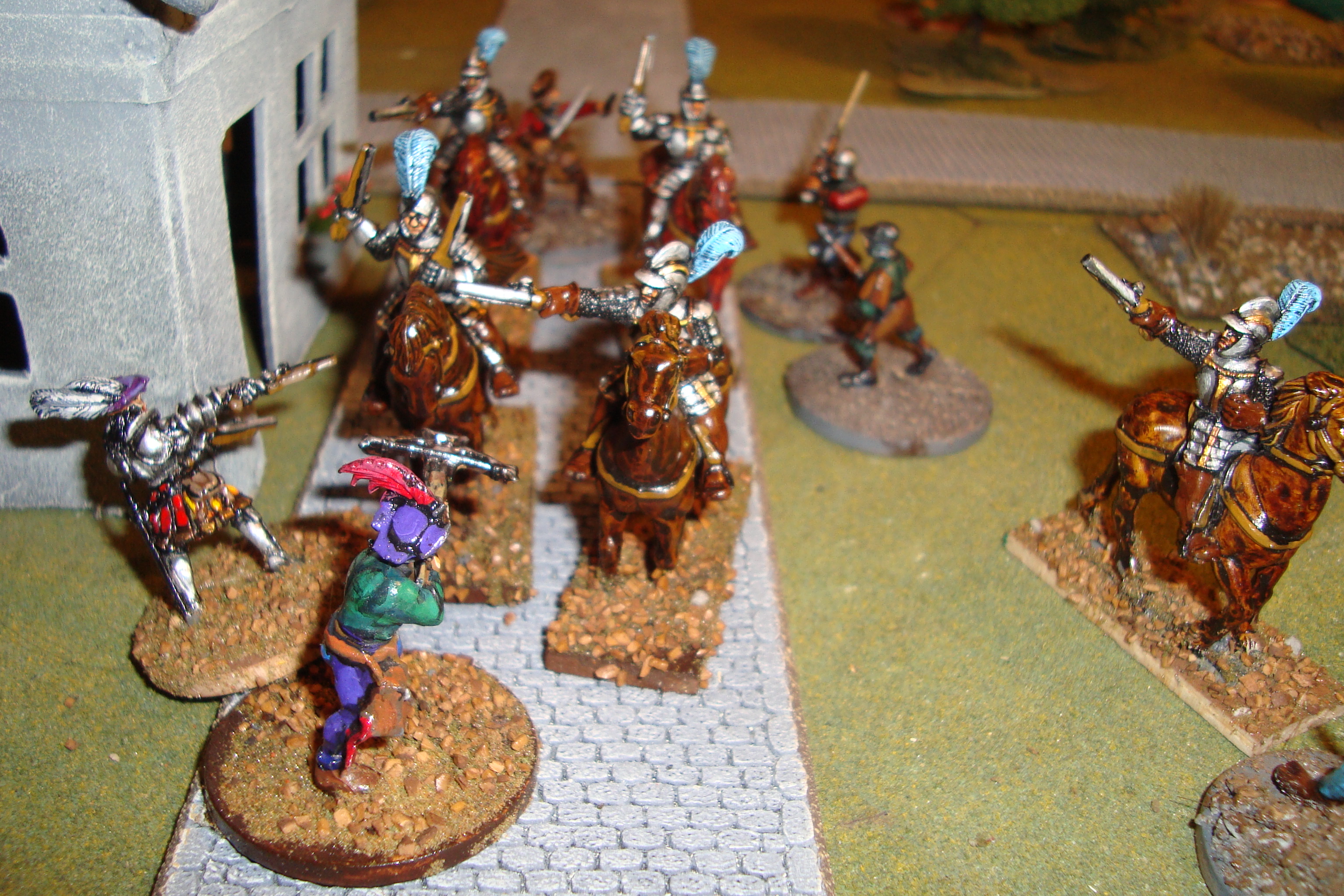
Turn 3: Death of the bowman did not effect Blue’s fear rating. Blue troops charged out of the house, surrounding the Red troopers. However, the troopers (excepting the leader locked in melee), simply charged through the swarm of their assailants. Red leader killed the other crossbowman.
Turn 4: Death of the second bowman increased Blue’s fear rating. Still having the initiative, Blue fled into the woods.
In retrospect, it was a bad move to move the crossbowman to the road. Should have waited. Still a quick and fun scenario. Another run-through tonight. Here’s a few photos.
Red Surrounded. Note Identification Colors On Rear Of Cavalry.Red Leader In MeleeRed Troopers Gallop Past Assailants. Leader Still Locked In Melee
Out on the road for the past week. Long drives. Had some time to think about the skirmish rules.
Will stick with RAW’s basic framework but will rely on the dice to determine the probability of actions not covered, but intuitively needed.
The “Yes, No” dice will take care of questions such as “Can he fire this turn or must he reload?”, or “Is there a modification for this moving target?”, or “Can he add pistol to melee strength”.
Don’t want to bogged down in charts and modifiers. Will add gallop (walk, then trot, then gallop), but other than that. Just play the game and rely on common sense. Will see how it works.
It involved five of my recently mounted cavalry descending on a house being looted by seven infantry, two of which armed with crossbows.
Rolled for whether cavalry was moving at trot or gallop, and whether looters were aware of their approach and could then move during the first turn. Cavalry galloped and looters moved.
The cavalry charged into the village, with most of the looters running into the house. The two crossbowmen snapped off shots, one of which killed a horseman. A horseman shot the looters’ leader (who also fired – and missed – while remaining outside the house) but, wearing armor, survived with a saving throw.
The horsemen charged past the house, regrouped and turned. The crossbowmen could not turn and fire. The horsemen then rode once again past the house. During the exchange of fire the looters’ leader was killed.
I stopped at this point, overwhelmed by the number of situations in these few turns that are not addressed by RAW.
1) There is only one speed for horsemen.
2) No reloading time for missle weapons.
3) With RAW sequence, shooters that are not oriented towards targets cannot turn and shoot, or can they?
a) If not, how long does “turning” take?
4) What happens if a leader is killed? Quick rules read-thru twice, no answer.
5) Galloping horseman easy to kill as running human?
I fully understand that these rules are somewhat secondary to nautical and campaign considerations. However, I’m not working with those two aspects.
In short, wrong rules. Good framework – especially greed/fear as I have mentioned before. But not enough detail.
But how much? Ahhhhh, the eternal Grognard question. I have Donald Featherstone’s classic Skirmish Wargaming, as well as the earliest published version of The Sword and The Flame.
Sounds like a mash-up. Another try tonight, with a couple new concepts.