All posts by Ralph

Bits And Pieces

Continuing to fiddle with the Balkan/Central Europe 1938 scenario.

Latest bit of information is a Wikipedia article on the Yugoslavian army, particularly the interwar section.  I know…thin stuff, but there isn’t a whole lot of pre-April War information out there.

Yugoslavia had sixteen (16) infantry divisions, one (1) alpine division, as well as two (2) cavalry divisions in 1935. Mobilization would create another eight (8) infantry, one (1) alpine and one (1) cavalry division within 30 days.

Well, it’s something to work with.

The  mobilization parameters need to be refined, especially for the less-than-reliable Croat units.  My instinct is to stay with random die roles for the Croats, and, since Europa uses two-week turns, having those mobilizing units attaining cadre status at the end of Turn 1, and divisional status at the end of Turn 2 if they do not move or are involved in combat.

Why not?

Vaporized

Over to Tim’s earlier this week for Up Front.

We’d played it once before a long time ago.  Was surprised, but happy,  when he suggested this for my July visit; especially since I had played it recently.

We set up the first scenario.  Since it does use all of the infantry rules it was perfect for our levels of (in) aptitude.

Since we weren’t using the Flanking Fire or Melee rules, the game became a lengthy positional gunfight.  The only incentive for moving forward was to increase each group’s firepower.

It took over two and one-half decks (scenario ends after the card deck has been played three times) for Tim to break my Americans with fifty percent casualties.

Emboldened by our “success” (which I define as an enjoyable experience without the mind aching turmoil that accompanies, let’s say, Pursuit Of Glory), we set up the same scenario with the  French fighting Italians somewhere in The Alps.  Both these crews have some real limitations when it comes to card draw and discard.  However, I didn’t realize my Italians also have some real weapon deficiencies.  They have to get to Relative Range 2 before their bolt-action rifles have any effect.

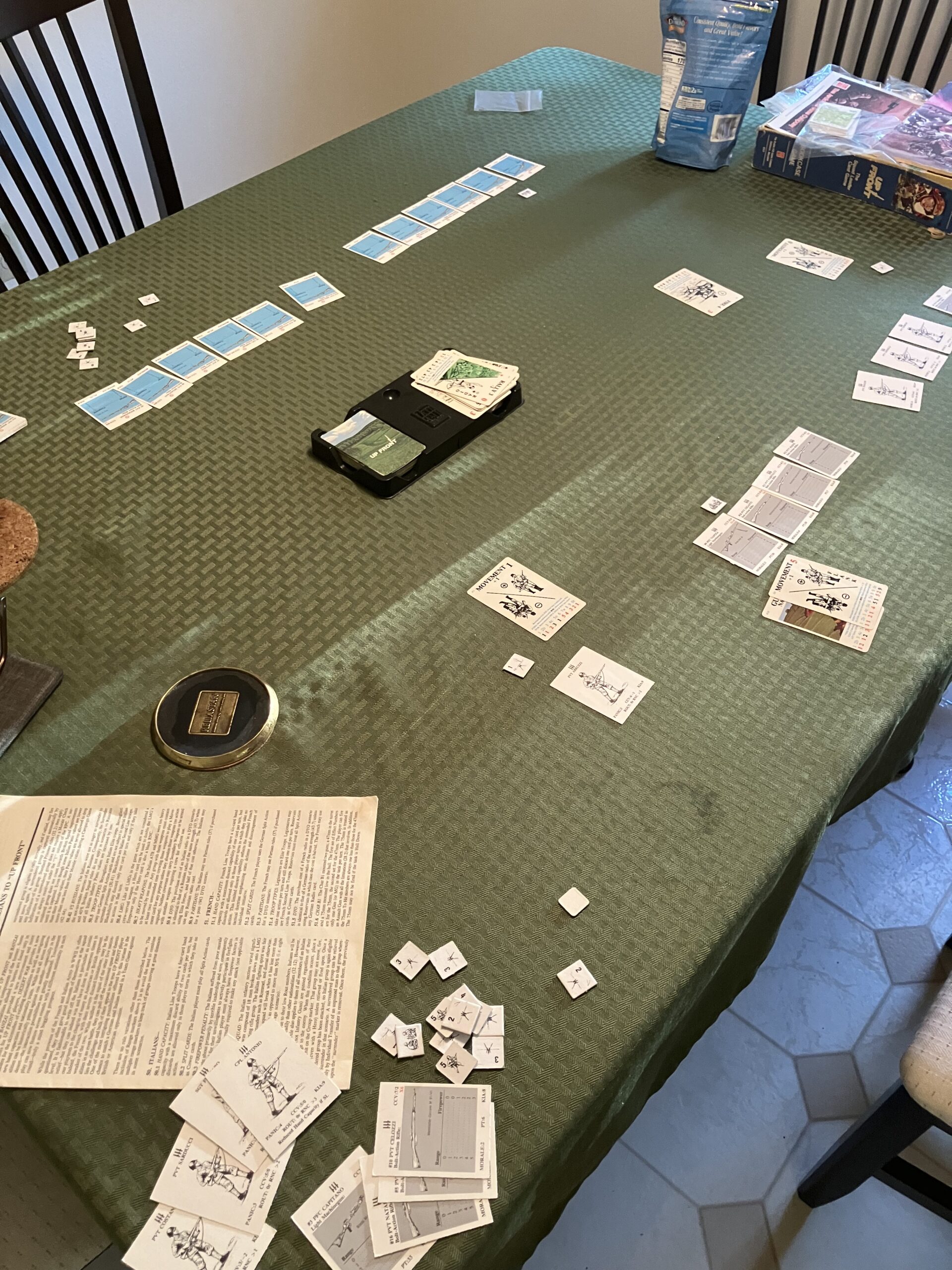
It was a short and violent.  I dutifully advanced, he fired, and my two groups were vaporized.  It took only three “hands” and the Italians (who will break at 40 percent casualties) were done.  Here’s a bad pic of the battlefield after it was over.  Notice the Italian casualties (cards) at the bottom left of the photo.

The cards with figures were those that panicked.  The others were KIA.

Regardless, it was a lot of fun and should be more fun using the advanced infantry rules.  Despite my focus on ASLSK, I think Up Front will be on the table quite a few times in the upcoming months.

Learning Curve

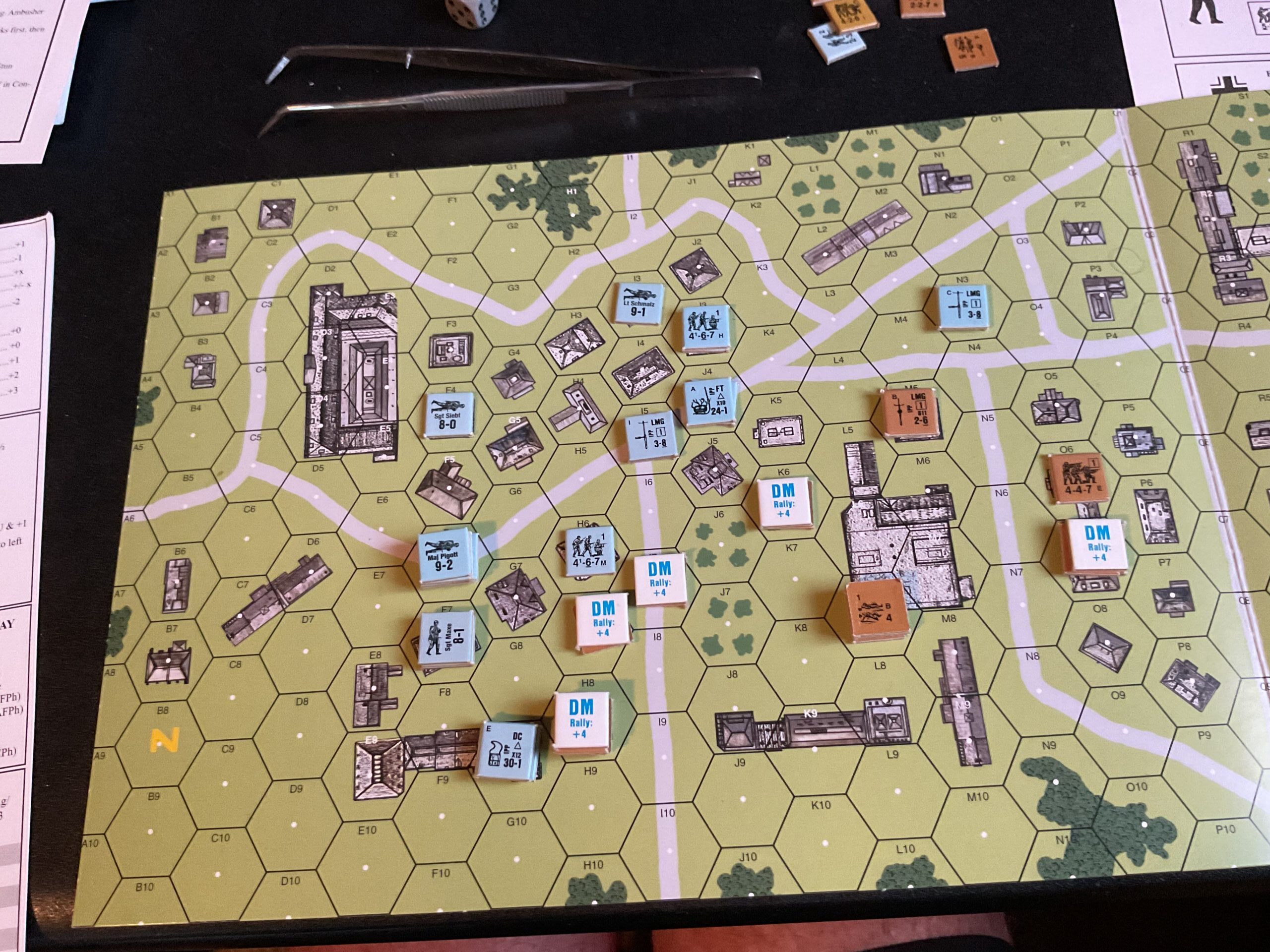
Continuing to work on my ASLSK skills with a reset on Scenario S2, this time using my own German dispositions, with a rough approximation of the Soviet dispositions used in the Basic Training magazine’s replay discussed in an earlier post.

I loaded up the west side of the board with German units.  It seemed to work.  The Soviet Conscript units melted away due to some really bad morale die rolls.  Aggressive German advances kept the broken units under Desperation Morale with the very tough -4 modifier to any rally dice rolls.    Here’s an impaired pic taken at the end of Turn 2.

In theory, the DM units have little or no chance to rally and should be destroyed, or at least suffer Casualty Reduction, by German Prep Fires at the beginning of Turn 3.  But, this is ASLSK and anything can happen.

Choppy…But Worth It

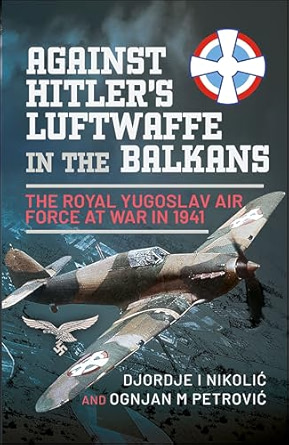
This popped up on Boardgamegeek’s Daily Kindle Deal list.  Had to grab it given my current 1938 Central Europe/Balkans effort.  The beauty of subscribing to this thread is the ability to pick up titles like this for pennies on the paper version dollar.

The book’s content presents an overview of the modernization of the Yugoslov Air Force prior to WW2; a choppy day-to-day account of the “April War”; and a discussion of the various aircraft employed.

I use “choppy” because of the author’s use of the Serbo-Croation abbreviations for personnel ranks and unit designations.  Hard for my parochial mind to absorb.

The highlights of the book are detailed descriptions and excellent photographs of  individual aircraft.  The Yugoslav air force was polyglot outfit, with a wide mix of (relatively) imported and domestically produced modern types, obsolescent/obsolete aircraft, and one-offs.  I can only imagine the resulting maintenance nightmare.

An interesting aspect of the narrative are the numerous references to sabotage of aircraft and outright disobedience and circumvention of orders by personnel  sympathetic to the Axis.

Definitely  worth the $2.99.

Slow Going

Taking my time with the  1938 Balkans/Central Europe scenario.  I’m using both regional names as they overlap – just ask Google.

Decided to start things off  with a Bulgarian invasion of Romania, with Hungary and Yugoslavia content to wait and watch.

While Bulgaria can commit almost all their assets to the invasion, Romania has to keep several units on their borders with Hungary.  In this battle of “Ants” (where 4-4s and 3-4s are few and far between), a handful of units can make a big difference.

The Bulgarians have already seized both of their territorial objectives, but are bogged down in front of Bucharest.  On the other hand, the Romanians are hard-pressed to defend their capital, much less launch any kind of offensive to retake their occupied cities. Here’s a quick snap.  Bucharest lies below the blue Romanian air units.

Despite the low counter density, it’s just not an infantry and artillery fight.

Both countries do have limited air assets.  The Bulgarians have a mixed bombing unit (one tactical and two strategic bombing factors), while the Romanians have a fighter unit and two bombing (one tactical and one strategic bombing factor) units.  The Romanian fighters returned the first sorties by the Bulgarian bombers and destroyed it in a subsequent attack. The bomber units have supplemented Bucharest’s defense.

Each country has only one engineer unit, but each is active. The Bulgarian engineers constructed an airfield within range of Bucharest, while the Romanians have built a fort to buttress the capital’s defenses.

Armored battalions have also been involved in the combats around Bucharest.

This is a pretty vanilla scenario so far.  I need to spend some time working on the mechanics for triggering Yugoslavian and Hungarian involvement.

Another Hiatus Ends

As usual, lots of plans to game at the Sunfish Capital Of The World, but little accomplished.

Back home digging out from a prolonged absence, but I have had time to get ASLSK back on the small table (as well as my 1938 Europa Scenario on the large table).

Impetus is my receipt of the “Basic Training” publication from MMP.  Mark Pitcavage provides his usual excellent coverage over at Desperation Morale.

I’m working my way through the War Of The Rats scenario replay.  This replay provides an opportunity to review the rules as well as see how experts play the game.  I’ve never played face-to-face, so this type of replay is very welcome despite, as Mark points out, the number of pages devoted to it.  A bit of a slog, but worthwhile.

For extras, “Basic” comes with handy charts, and a counter sheet with German and Minor units, plus a few tanks and guns.

Still having my on-going conflicted thoughts about ASL/ASLSK.  I really like the system, but after ordnance, the increased level of complexity for tanks and the Pacific Theater of Operations (PTO-ASLSK #4) gives me The Willies.

Old Friend – Up Front

Tired, frayed, torn and stained……took out Up Front to get reacquainted before my annual sojourn to The Sunfish Capital Of The World.

I hadn’t opened the battered box for quite a while.  Everything was there, including the rules and cards for the Desert War variant.  I’m starting a serious hunt for Banzai later today.

I bought the core game and variants back in the 80’s and from the look of the components, I must have either  a messy pig, or just played the hell out of them.  I want to think it’s the latter.

The reason for the reunion is  I need some quick set-up and play games during my stay.  Gaming space is limited, and there will be visitors.  The dining room table will be for eating, not for board gaming.

Up Front fills that requirement.  It plays in about an hour, with soldier card deployment, action deck shuffling, and marker setup taking about ten minutes maximum.

One problem…..the rules.  They are more involved than I remembered.  But, the time spent reacquainting myself with them, as well as discovering how much I do not remember, has been enjoyable.  After all of these years it’s still a unique system.

Started a quick play of the first scenario, and rediscovered how you don’t learn the rules by reading them, but by playing.

The game is not particularly solitaire friendly.  Solo systems are out there, but I just keep it simple.  Two reasons…. because my memory is shot, and I never look at a discard draw (last action of a player turn) at the time of draw, but wait until it is that side’s turn again.  I’ll call it “limited intelligence”.

Once Again

Back after another long hiatus involving travel and toil.

Drove over to Tim’s for another grind through Pursuit of Glory.  Grind?  Yes.  As posted before, the game is a brain twister, but very enjoyable.

As always, too much fun chatter and perhaps not enough serious gaming.  But, we were able to get into 1916, with Tim’s Allies having a decided advantage.

We agreed this session was different than the others.  Fewer casualties, with more activity in Sinai/Palestine/Syria than usual, with less in Persia and “The Back of Beyond”.

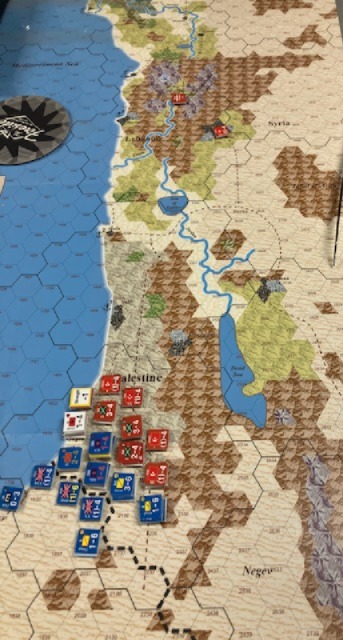
Here’s a breakdown of action by region.

Sinai/Palestine/Syria:  The Turks actually made it across the Suez Canal,  but were quickly forced back by British/ANZAC/Indian units.  Tim continued placing pressure on the Turks, taking Jerusalem and Damascus.  He correctly pointed out that I should have built a corps in Damascus.  Corps building is a real challenge for the Ottomans.  They do not receive corps as reinforcements, just divisions.  So, corps (which have increased fighting and staying power) must be assembled from two (for reduced corps) or three (full strength) divisions.  This means using operations points move them to a common location and/or to assemble them.

Mesopotamia:  The Allies steadily advanced from Basra towards Baghdad.  Here, I was able to assemble two corps, which stopped the Allies just short of the city.  The Central Powers had difficulties generating tribal resistance, which can be very effective  stopping/delaying an Allied advance.

Caucasus:  Not the usual bloodbath.  I attribute this to the few mandated offensives for either side, as well as no dreaded “Enver” offensives that can be devastating to the Turks, especially in the Winter when combat odds are very unfavorable for the attacker.

The Balkans:  This theater developed rather late in the game with first Romania (Allies) and then Bulgaria (Central Powers) entering the war.  The Serbs (Allies) were in an unfavorable position when the game ended.

Other:  Tim opened up the possibility of a landing in Gallipoli, which achieved its purpose of drawing valuable Ottoman units West, instead of East – where most of the action took place.  He did land at Salonika, but had not advanced by game’s end.

Tim did an excellent job of maintaining pressure on the Turks, forcing me to spend Operation Points on reacting as opposed to proactive uses such as corps building and strategic movement.  The latter is very important for the Ottomans, given the distances to be traveled and poor infrastructure.  Their “interior lines” are more of a handicap than advantage.

At game’s end, Tim had a decided advantage, with the Ottomans just five victory points from defeat.

Here’s a quick pic of the board at session’s end.


Set-Up!…..Play?

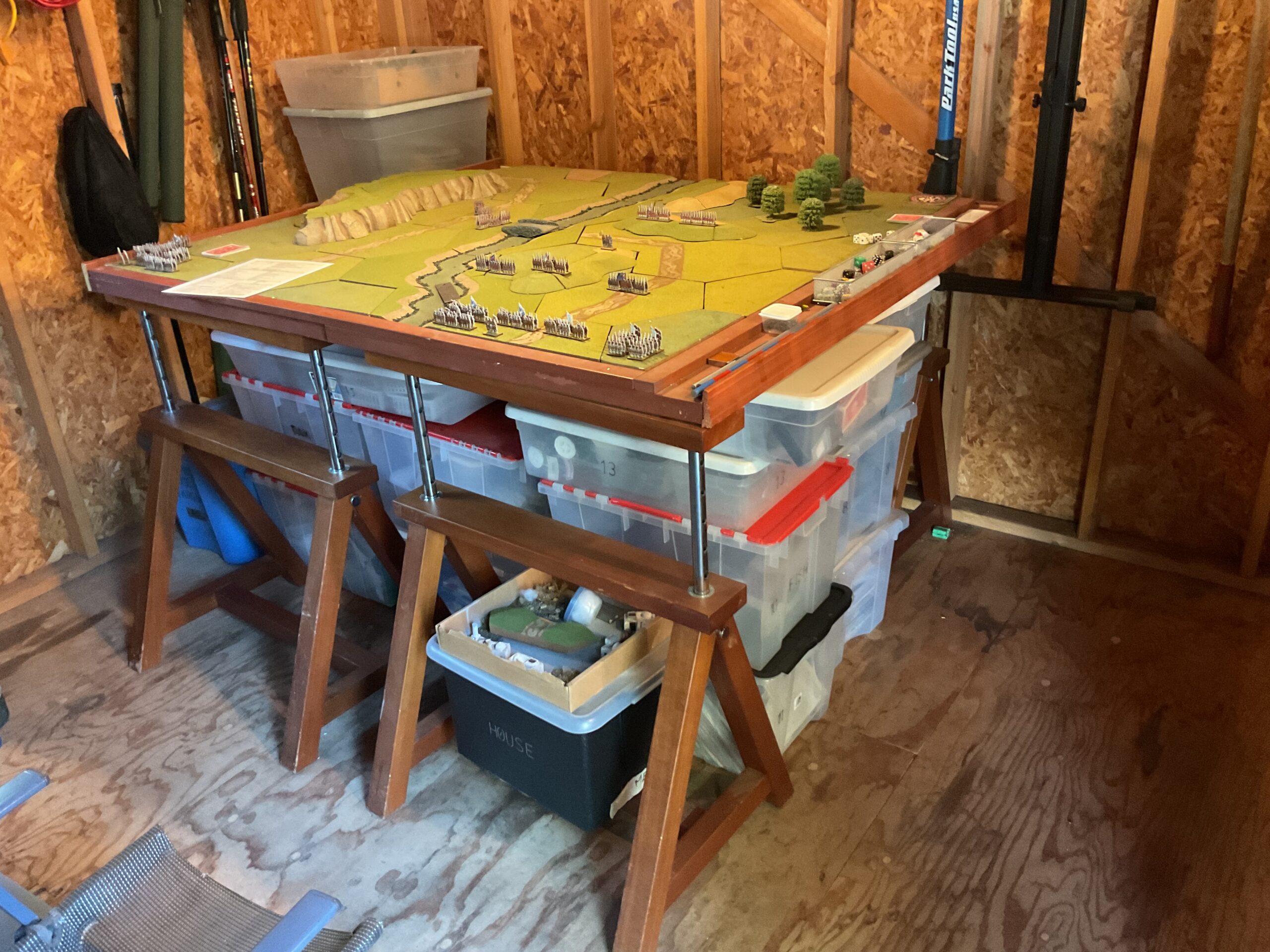
Here’s a pic of the set-up for Empire Reborn.

The blank counters are divisions that may or may not remain loyal to the government.  My thoughts are whatever units do not remain loyal will have another die roll to determine if their opposition is active or passive.

I also need to work through the readiness/mobilization process.  The current set-up has the Yugoslavians and Bulgarians already mobilized as divisions (except for aforementioned “blank” counters), the Romanians as cadres and Hungarians without divisional units, just brigades etc.    My instinct for my first play thru (and path of least resistance) is to allow everyone to mobilize as well as form divisional units.   Just focus on the operational aspects.

I’ll have time to ponder these weighty questions.  Another road trip looms…….

Structure…..However Flimsy

The hypothetical 1938 Balkan conflict (Empire Reborn) now has some parameters.  Maybe not the best, but at least some structure.

My latest efforts focused on victory conditions that, in turn, involved identifying the regions and ethnicities involved.

Balkan Front addresses the latter consideration with a  map outlining the area’s regions.

Unfortunately, I cannot find Map 14A (as well as all my War In The Desert counters – a collateral discovery while searching for maps).  But, I did find a scan of 14A which helped me work with my old Marita-Merker maps.

Decided to simplify matters by using control of a city or cities (shown below in parentheses) as objectives for each country.

Bulgaria’s  territorial objectives are  Northern Macedonia (Skopje) and Southern Dobruja (Varna and Pleven).  The Hungarian objectives are Transylvania (Cluj and Timpsora) and the Backa region (Novi Sad). Both Romania and Yugoslavia must  maintain their current borders.

Late in this process I recognized the maps reflect 1941 national boundaries.  In 1940’s  Treaty of Craiova, Romania’s ceded Southern Dobruja to Bulgaria.  The initial placement of each nation’s forces has to be adjusted accordingly.

The initial placement of units, like the order of battle (OB), is speculative and uses multiple less-than-reliable sources.  The composition and size of each country’s military changed significantly from 1938 to the opening of Barbarossa campaign in 1941 -where reliable OB information can be found.  “Educated Guess Work” is giving the OB process the benefit of the doubt.

Since the whole project is hypothetical and speculative, I decided to flesh out each country’s forces with some specialized units.  The inclusion of limited air, anti-aircraft, armor and engineer assets provides an opportunity to work with a wider variety of the Barbarossa  Unleashed rules. These rules will also be used in the Operation Groza game with Tim.

Additional scenario considerations now include guerilla warfare by disaffected minorities, the use of Balkan Front’s Yugoslavian mobilization guidelines in which certain regions – and the units based there – openly oppose Yugoslavia, and a variable game length  based on the Macedonia War (which helped inspire this entire twisted process) scenario published in Europa Magazine.

Need to get this moving so I can start pushing cardboard.