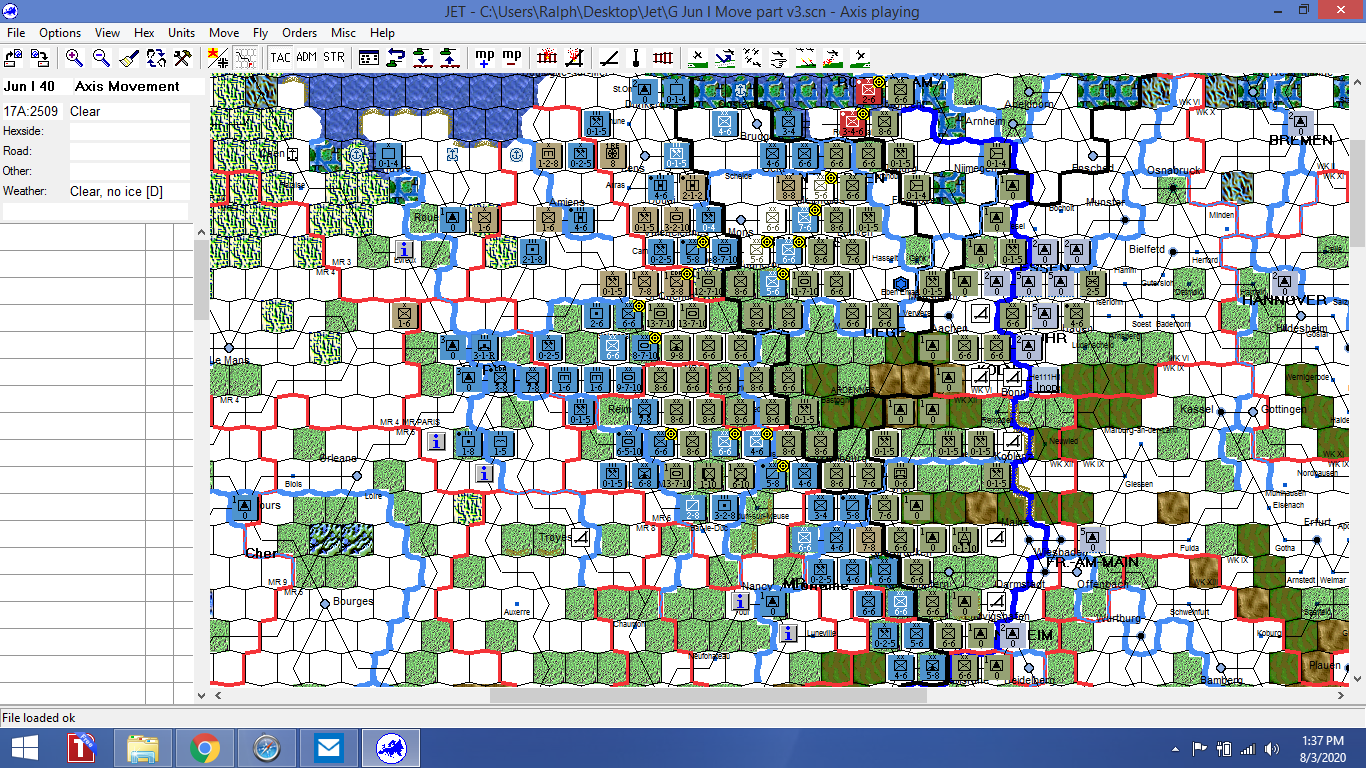
Germans Ready To Clear Belgium
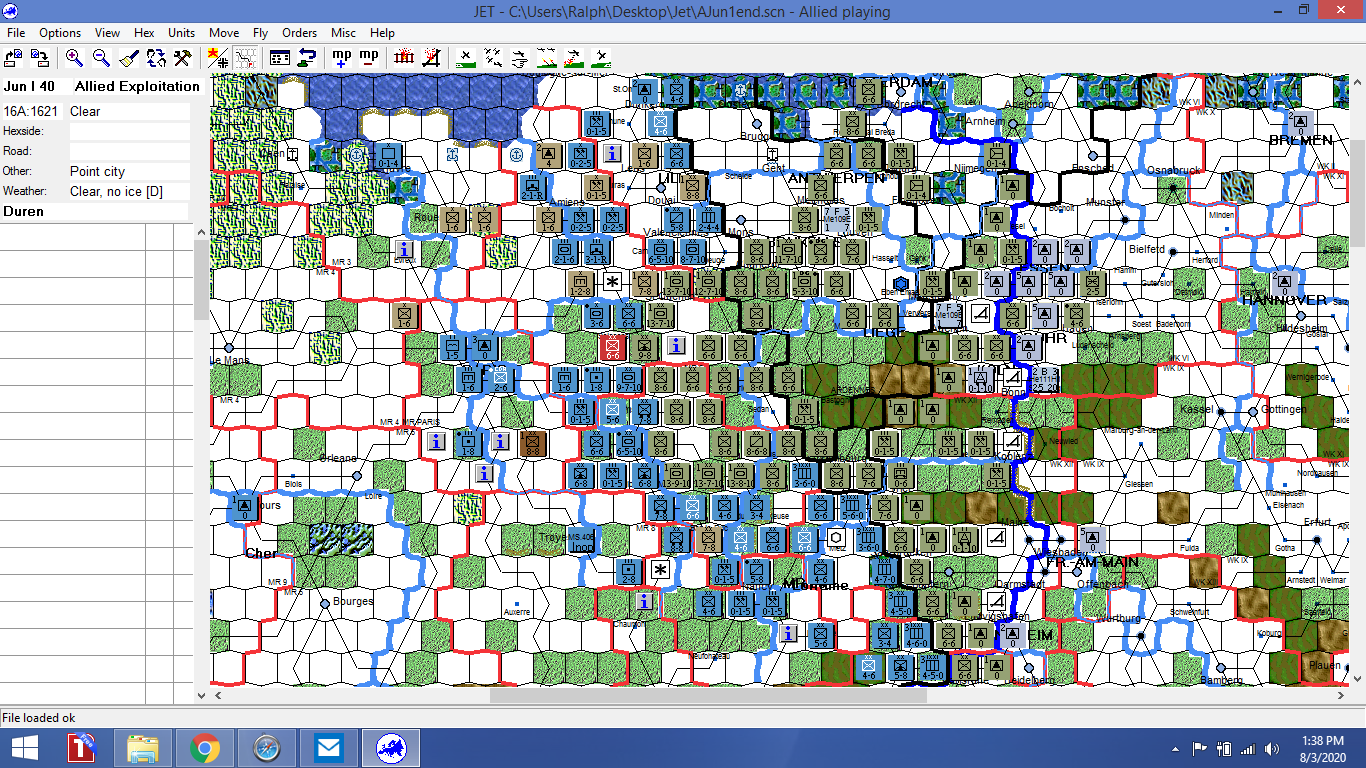
Allies Forced Back Into France
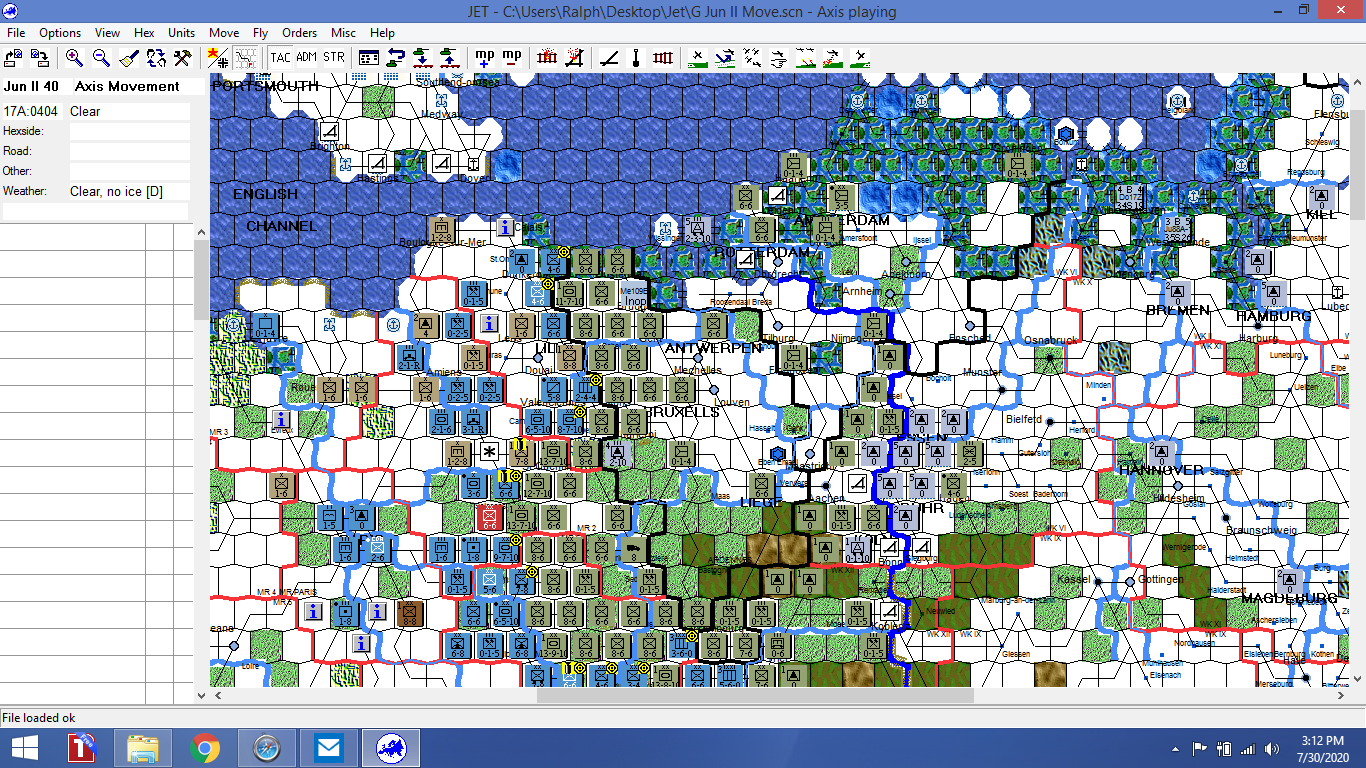
Continued German Pressure
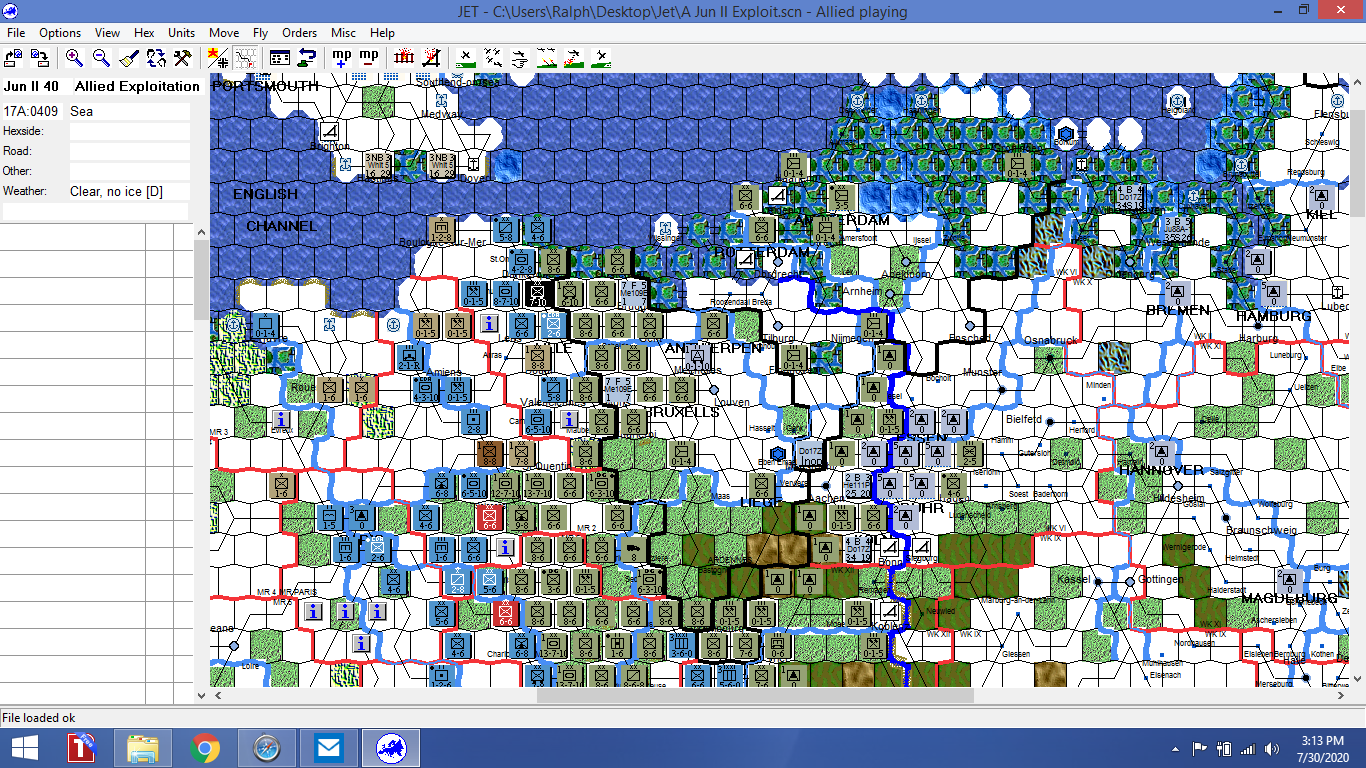
Allies Improvise Yet Another Defensive Line
Germans Ready To Clear Belgium
Allies Forced Back Into France
Continued German Pressure
Allies Improvise Yet Another Defensive Line
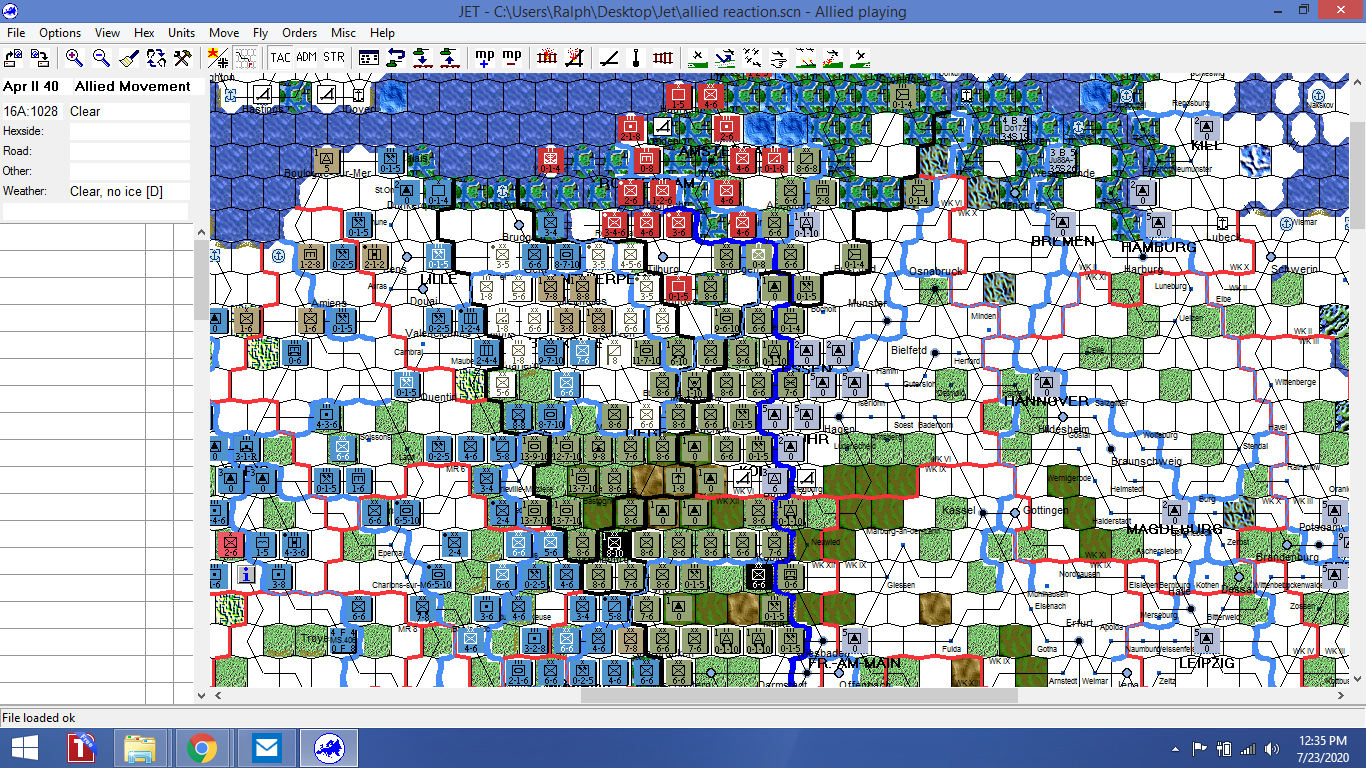
These screenshots summarize the May II Turn.
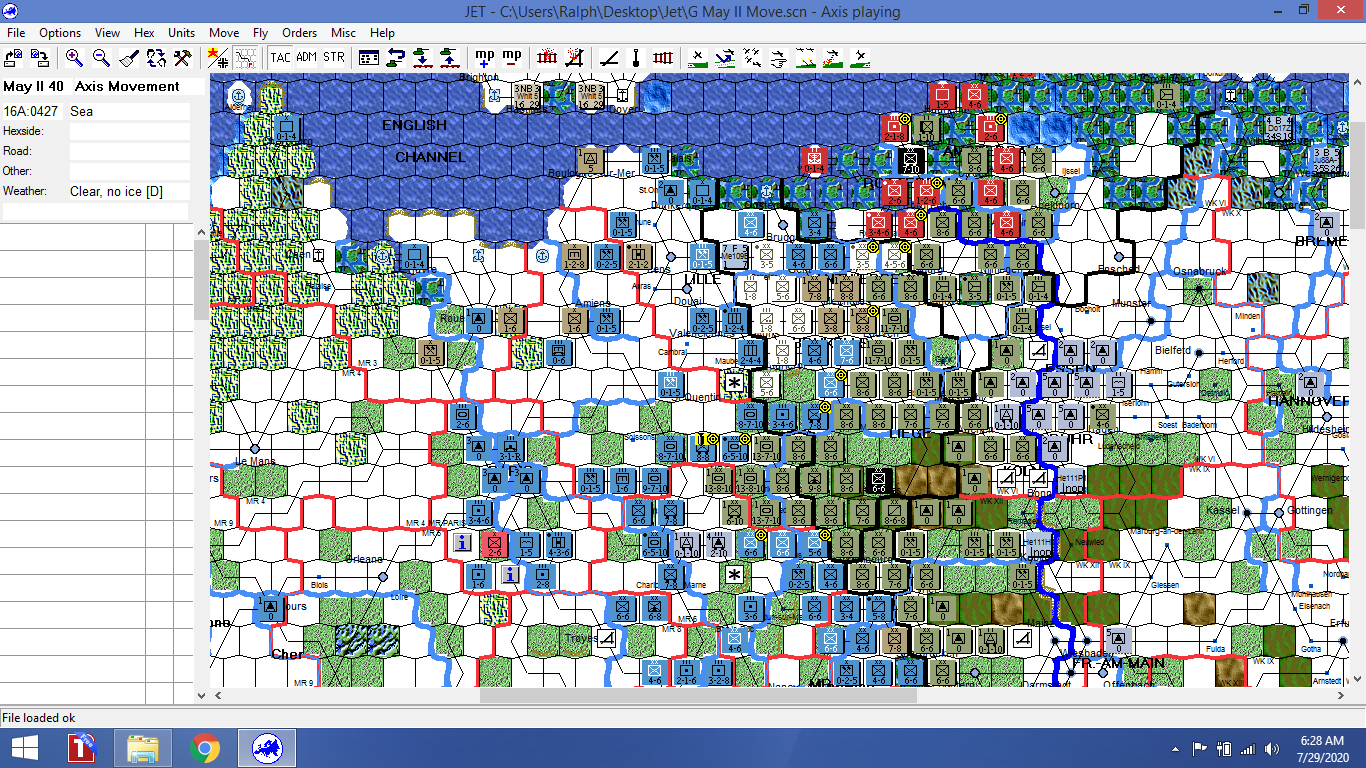
German armor sweeps past the weak ad-hoc French defenses and advances towards the Marne. Also, the German commander turns loose “Ants” to disrupt the Allied rear areas. To the north, German forces grind up the Dutch and Belgians, advancing to the Dyle Line.
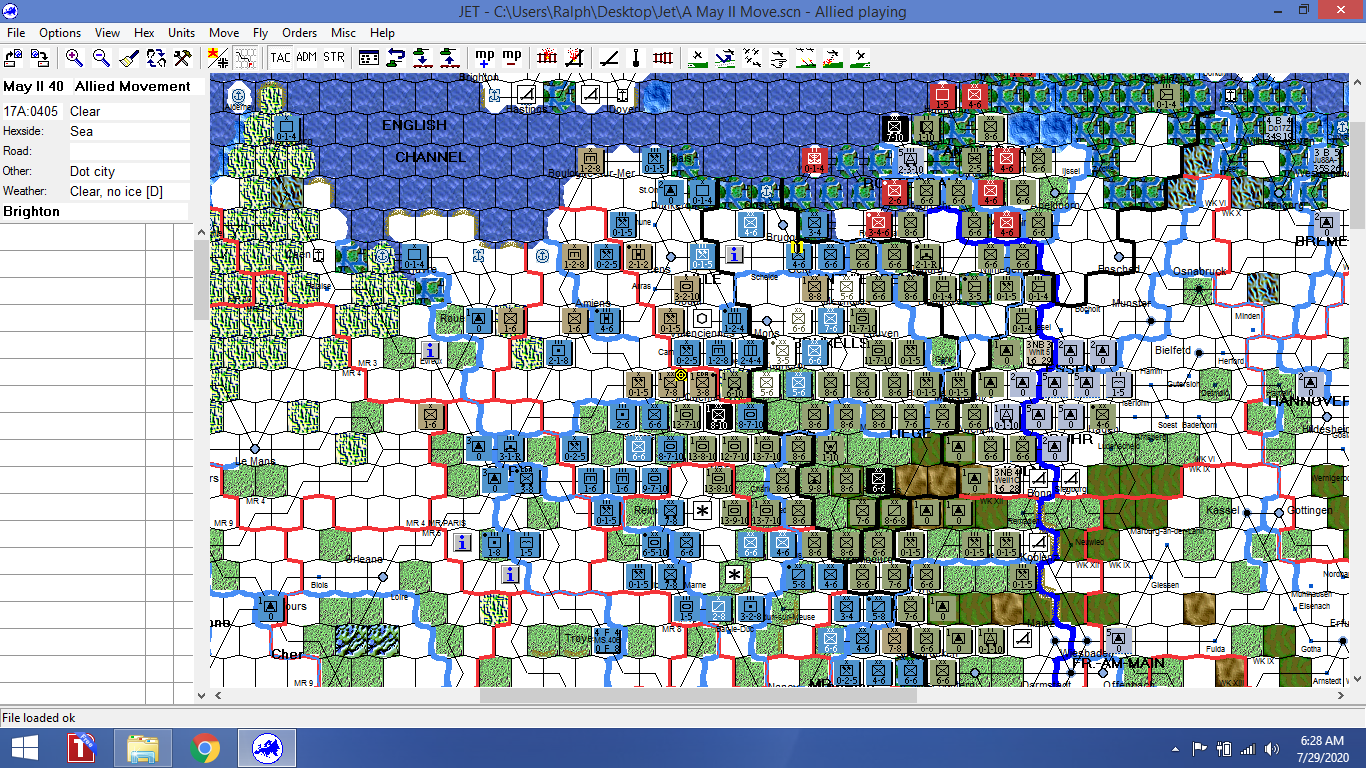
The Allies rush armored/mechanized units to contain the Ardennes penetration, while withdrawing from the Dyle line, using Belgian forces in support. The Dutch attempt to consolidate their defense in order to tie down German forces for as long as possible.
I’ve bitched about my Fall of France (FoF) game with Tim, but I am now compelled to report it.
As usual with this site, the graphics will be less than ideal, a condition due in equal parts to my ambivalence towards pushing the boundaries of computer literacy and reliving a wargaming hell.
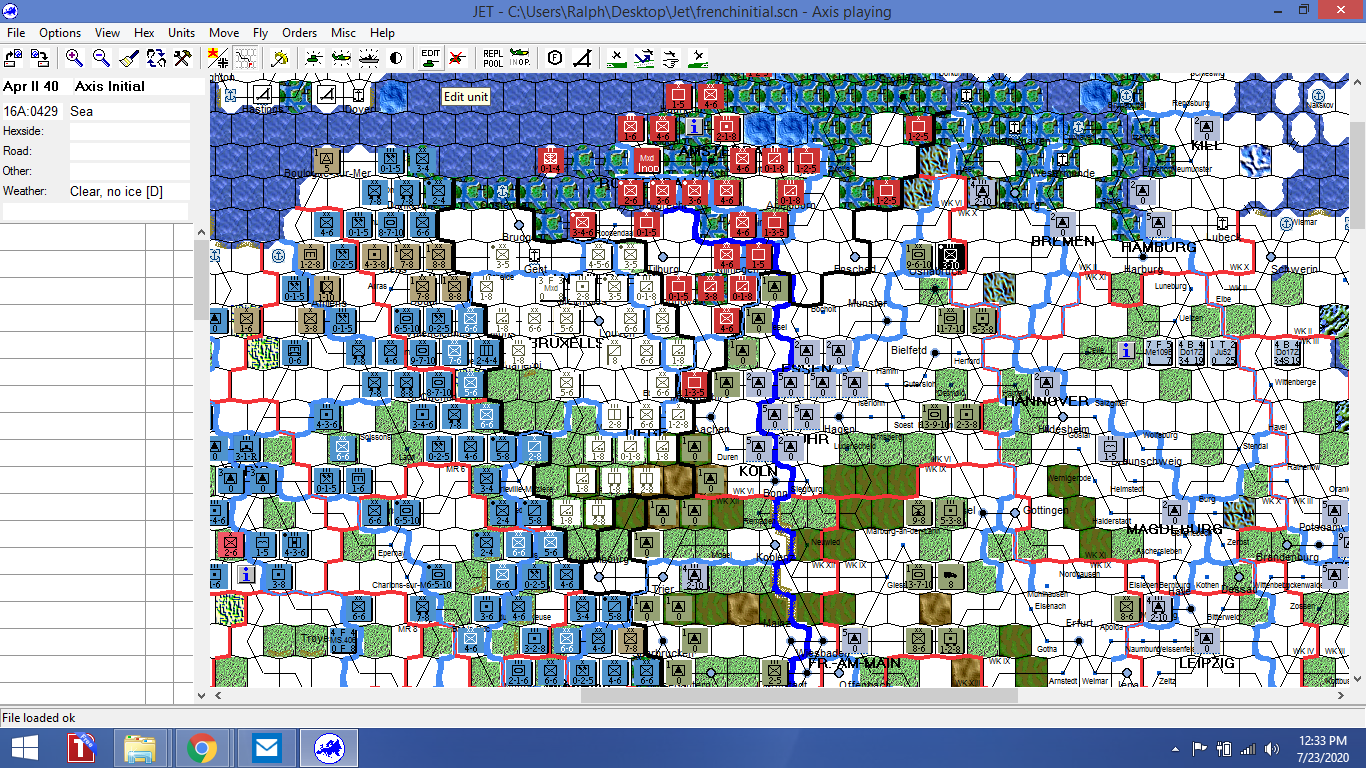
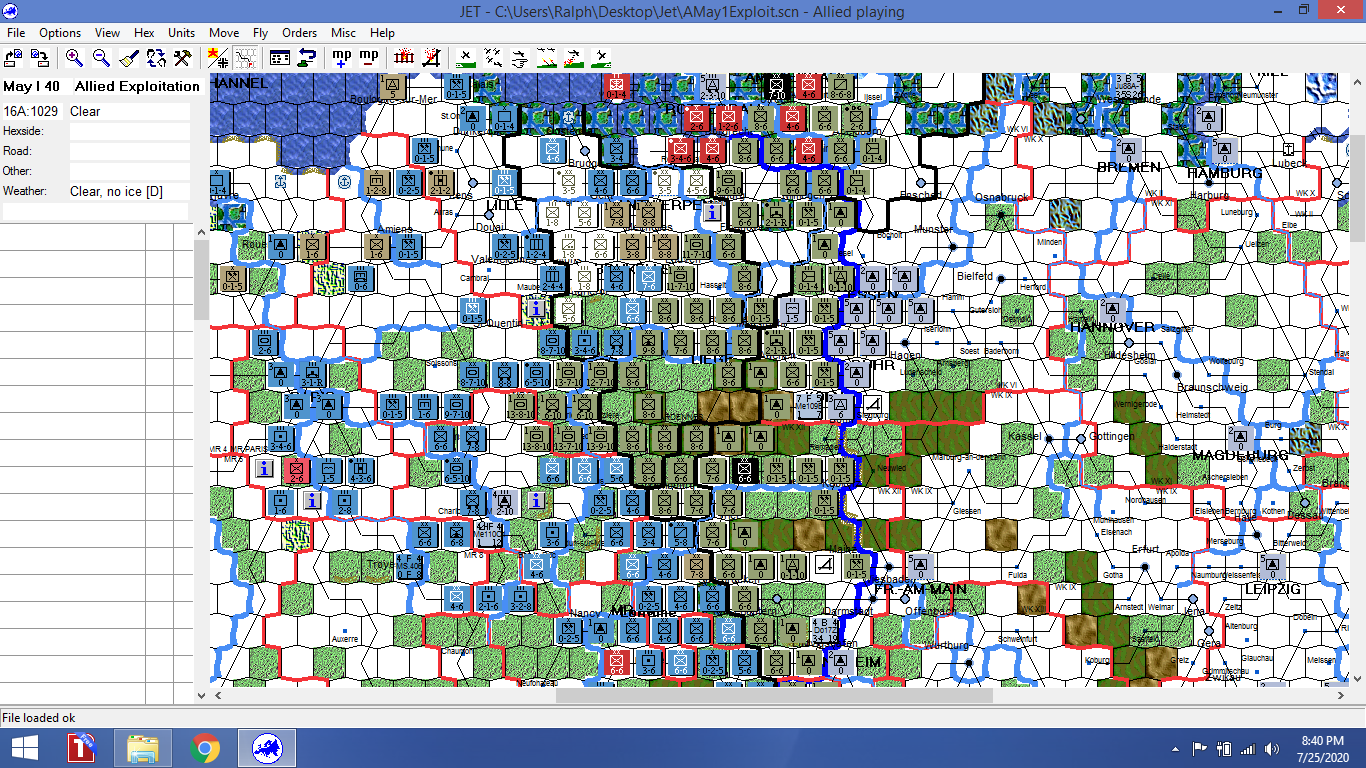
I was able to figure out how to get screenshots on my ancient Dell Windows 8 machine. However, the screen shots of the JET board are just that; a shot of what is on the screen. The JET mapboard takes up more than the screen, so the graphic evidence of this debacle will be from north of Frankfurt. That’s OK, because that it is where most of the carnage occured and is continuing to occur. We are now in the Allies Jun II turn, and things are looking very grim for the Allies. But….. we must start at the beginning.
The Germans have extremely powerful air and ground units. The screenshots show only the top unit in the hex. But, below that scary surface, lies even more panzer divisions, supported by motorized units, lots of motorized flak and artillery.
One revelation was how tough the German infantry stacks were. Three 8-8 infantry, paired with artillery represents a lot of combat power.
Allied units are solid, but lack mobility, flak and supporting units.I shudder when I think about the German’s powerful ground attack air assets used to support these armored and infantry forces.
Then, there are the historically based operational rules. They create a difficult framework for the Allies to work within.
The Germans start off with an invasion turn, which includes all normal Europa turn phases except the exploitation phase.
The Allies do have a reaction phase. However, this is scripted because most northern French units and those of the BEF must enter Belgium to occupy the Dyle River Line, setting up the historical “Sickle Cut”.
While Dutch and Belgian units can move during this Allied reaction phase, they cannot enter enemy zones of control.
With the Allies sucked into Belgium, the Germans start the regular May I turn.During the Allied player May I turn, no unit in an enemy ZOC (Zone of Control) can move, and all British or French units have their movement factors halved.
The Allies are further hampered by the inability of their combat / motorized units to attack a full-strength or move using full movement during their exploitation phase until the beginning of the June I turn. This reflects a lack of mechanized doctrine.
To make things even worse, during the May I turn any French non-mech/motorized unit has to retreat two hexes rather than one if it has fought an attacking German force with at least one panzer division.
One other note about the graphics. As I mentioned, JET is a real marvel. However, it cannot do several things within the rules as written Europa framework. The result is that you have to tweak things, and the file you forward may have a heading (found in the upper left hand corner of the screen) that isn’t quite accurate. An example: You cannot fly CAP (Combat Air Patrol) during the Initial Phase. You have to cheat, and “fool” the machine by forwarding to your Movement Phase, where it is allowed. So, on the files shown, the heading on the screen may show “German Movement Phase”, when in fact the file really reflects the Allied Initial Phase. Confused….good…..misery needs company…..and the weight of Tim’s advance has had me in a daze since early May.
The short story is the Kattegoans routed Lord Renaldo’s Portuguese in a hard fought battle.
At the end, few of either side’s companies (units) were capable of movement to contact since their Resolve had dropped to one, as both leaders were either involved in melee or too far away to effectively rally the affected companies. With low Resolve, a company cannot enter into melee, but can still shoot.
This problem was mitigated by my failure to role for Impetuous Actions for those units outside of command radius. However, I can partially rationalize this oversight because each company kept to their original plan. An exception was the Kattegoan leader taking his company on a wide envelopment. While in the short term this placed him out of touch with his companies, the end result was to flank and scatter (rout) Lord Renaldo’s company, putting an end to the battle.
I can’t rationalize my failure to use a leader’s +2 die roll modification in all but the last round of melee. This had a significant effect on the Portuguese, as Renaldo’s company was in a melee marked by a series of Inconclusive Draws (no effect on either side) for almost the entire battle.
Only the dogged Pikemen and a lone Crossbow company remained cohesive enough to cover the Portuguese withdrawal to Ekene, where they will remain for some time after this failure and accompanying loss of prestige. While Lord Renaldo will remain in command for the time being, that may change after word of the debacle reaches Lisbon.
Oumar, the Kattegoan leader, proved to be a somewhat unorthodox commander, leaving his companies to flank the Portuguese force. While aided by my rules omission, this tactic proved decisive. He is now considered an Experienced Lord ( proven leader)and will now receive a +1 die roll modification for Initiative.
Here’s a series of poor battle narrative photographs. I also need to figure out how to change the font/size for the captions.
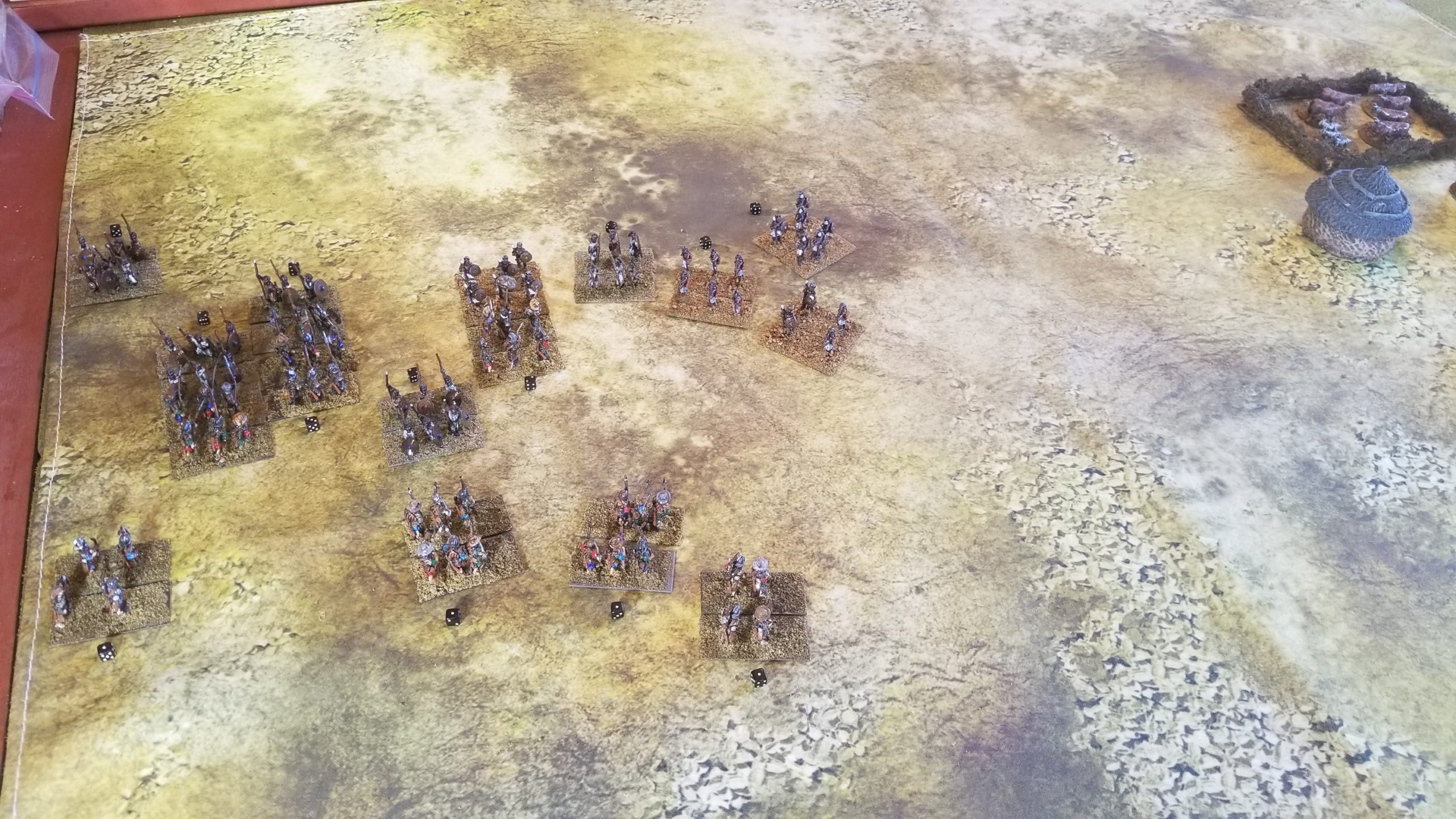
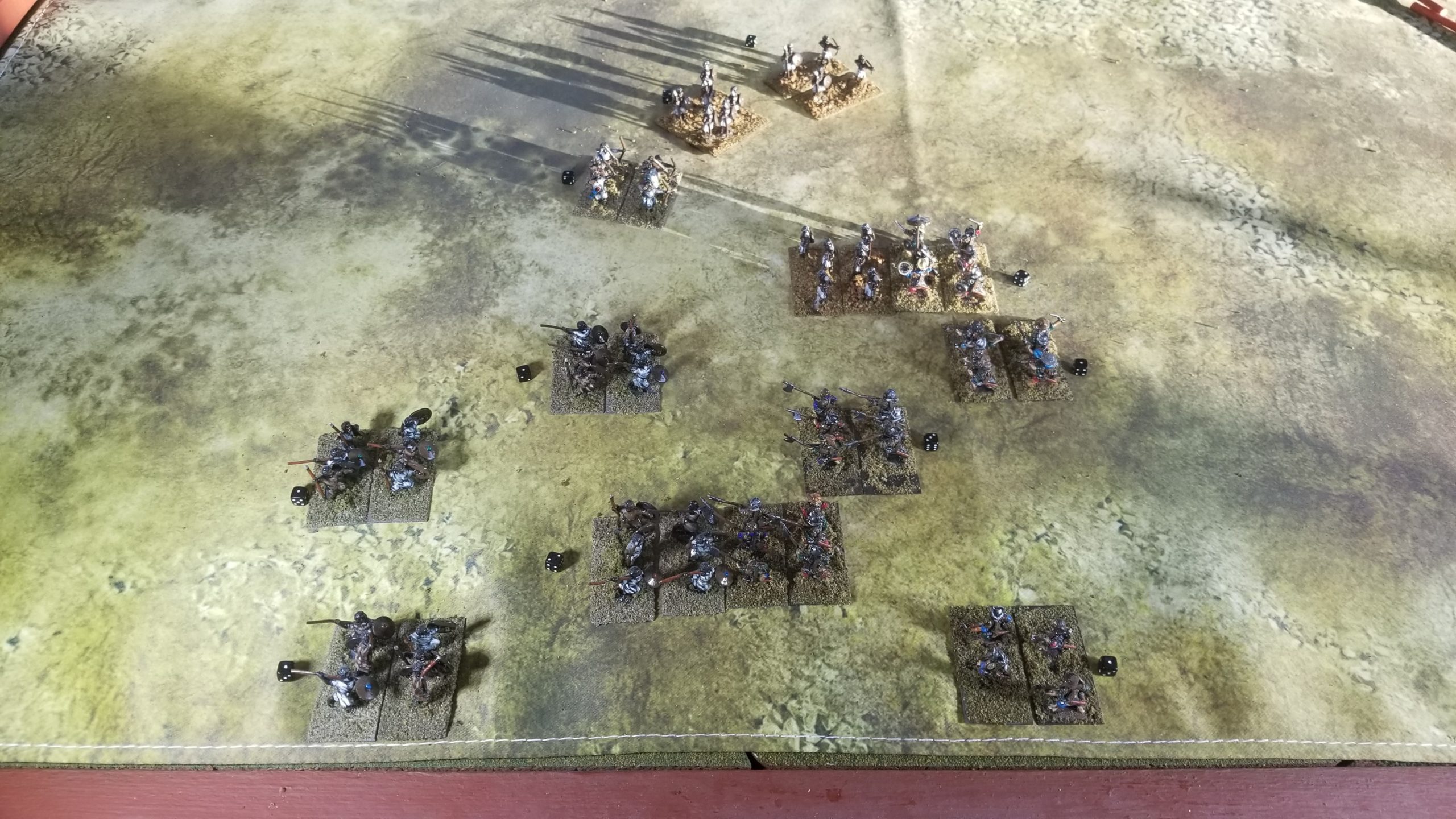
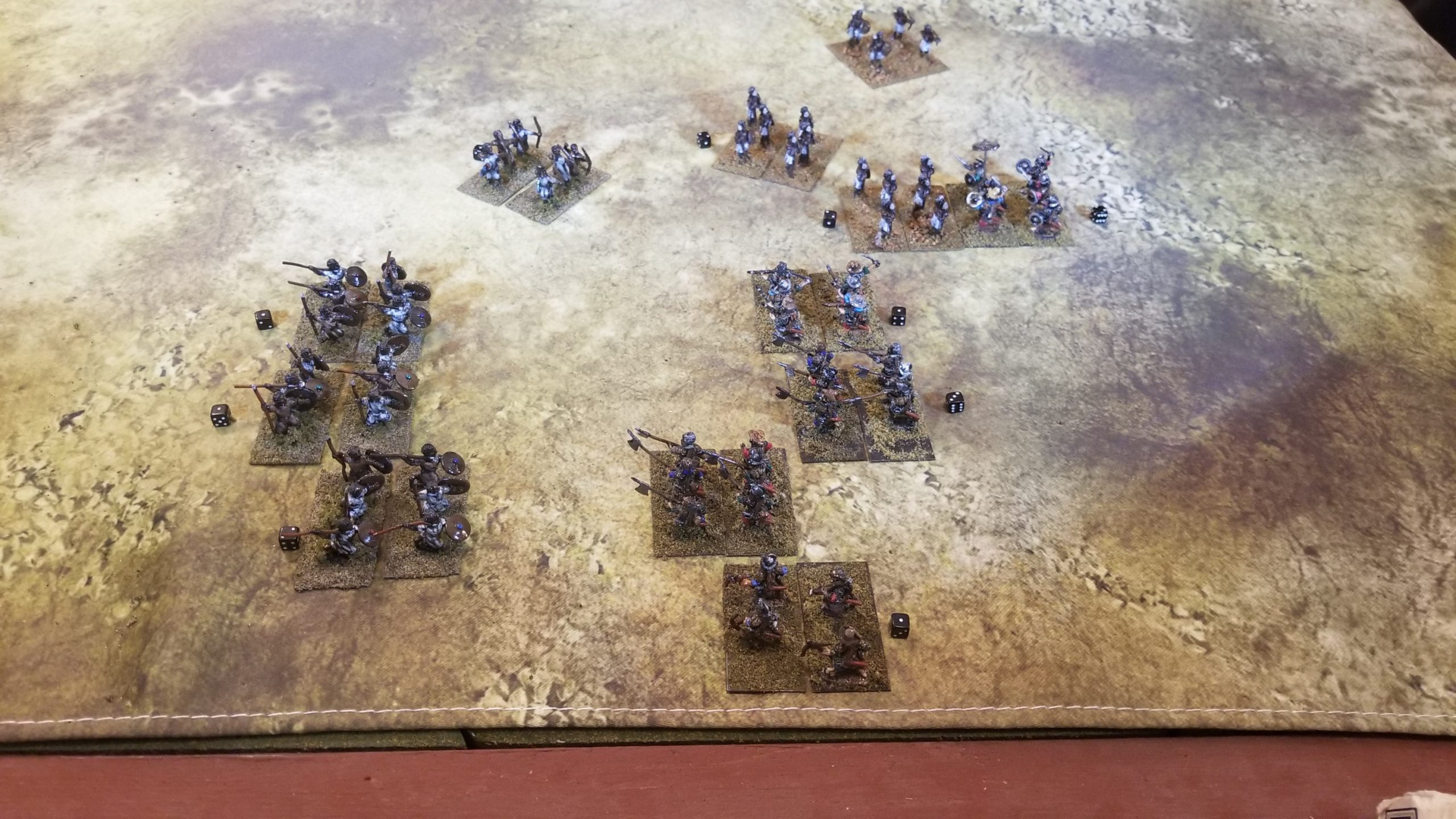
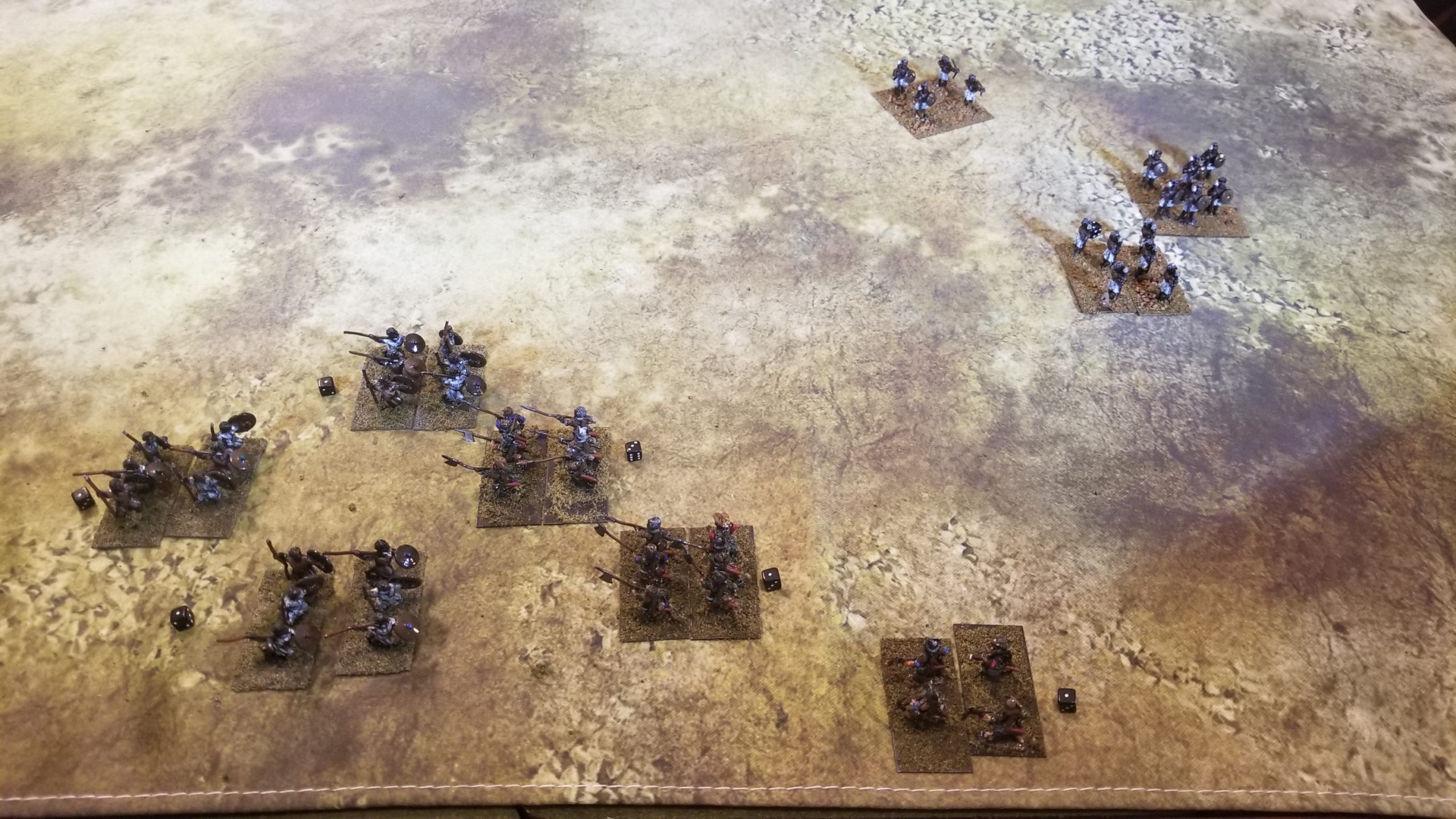
Remembered that I needed to role for Disease and Mishaps before starting play. The dice were not kind to Lord Renaldo. One of his two Targeteer units thought better of the whole proposition and deserted.
The Portuguese reacted well to the ambush, forming a defensive line. The Kattegoan warriors were too far away to make contact on their first move. View for the following photo is to the West.
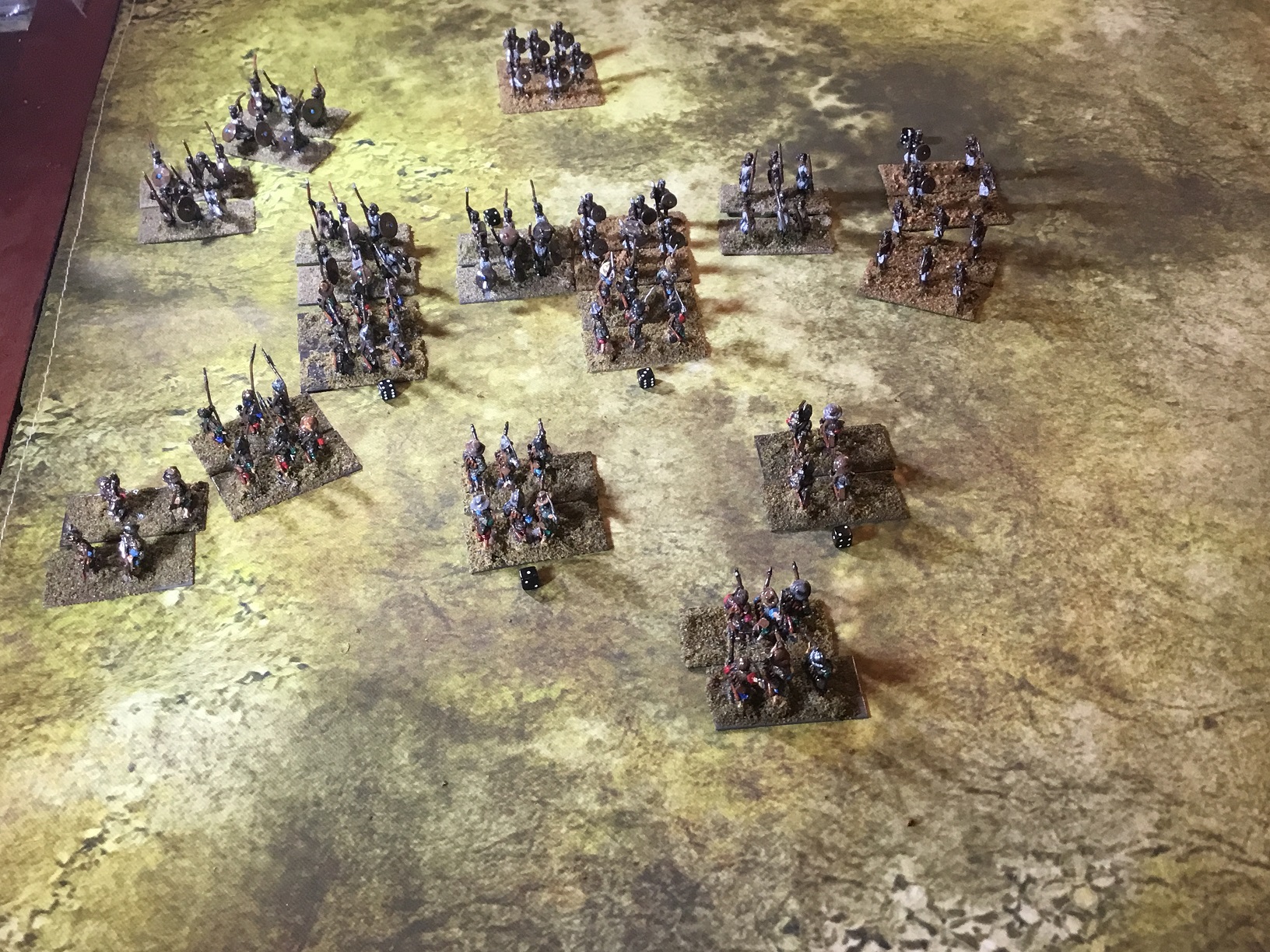
By the end of Turn 3, the Portuguese right wing units had moved up to support units in melee. The Kattegoan archers focused their efforts on the Portuguese right, but with little effect. The Portuguese musketeers struggled to attain good lines of fire. The following photos are looking North and West, respectively.
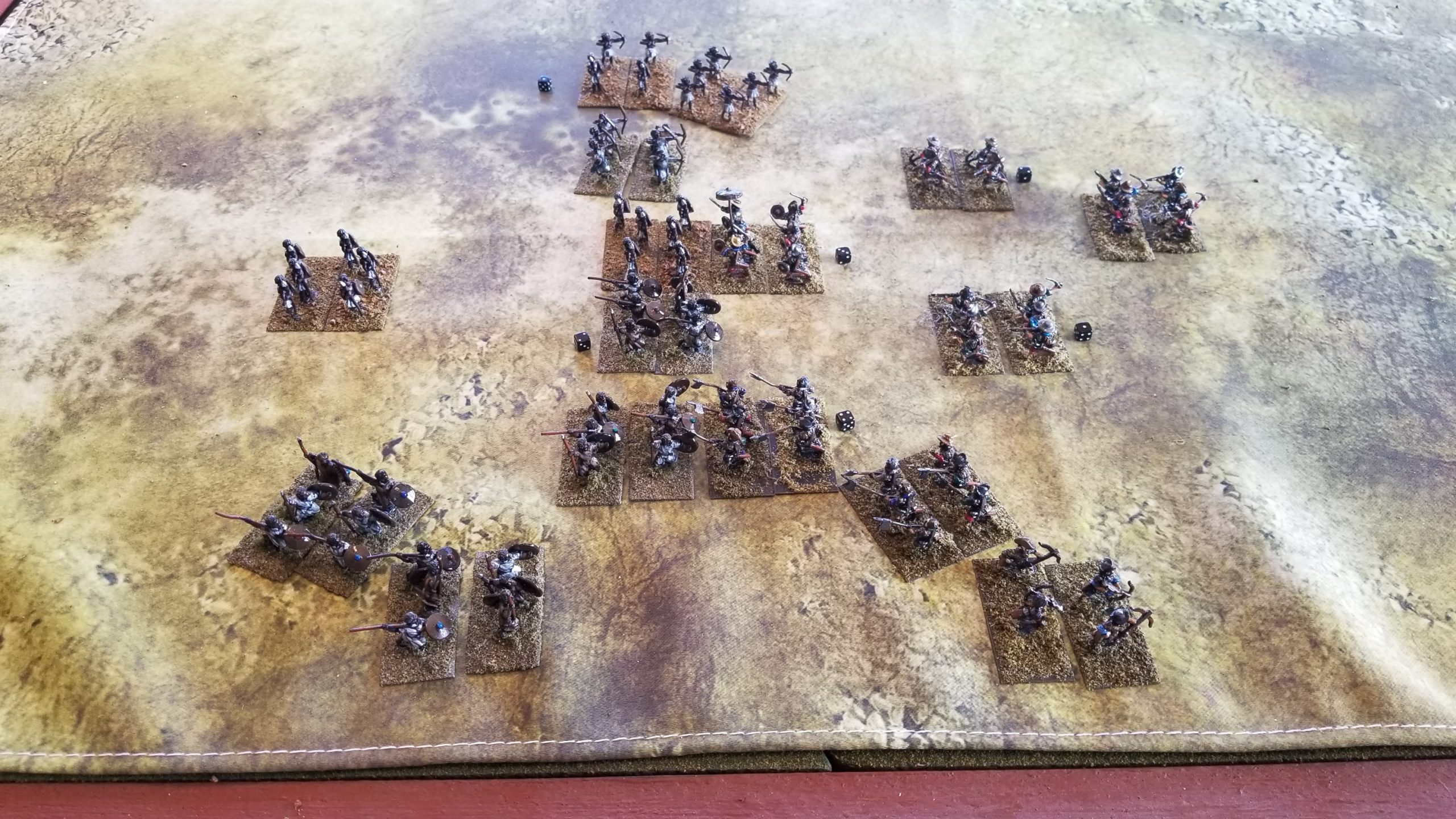
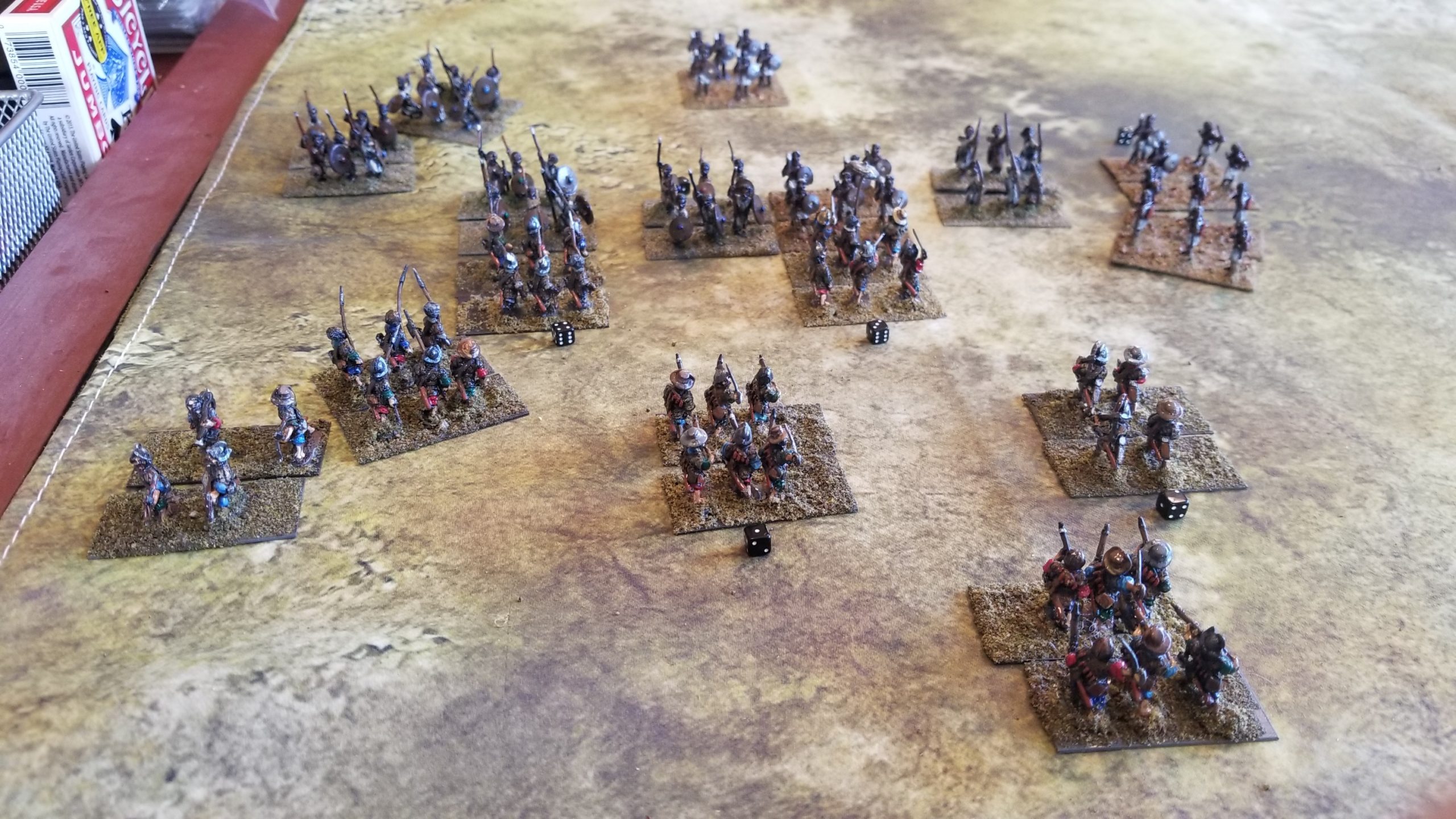
During Turn 4, the Portuguese line stabilized. Lord Renaldo’s Targetters anchored their center. The Kattegoan archers flanking fire was still ineffective. Here’s another view looking North.
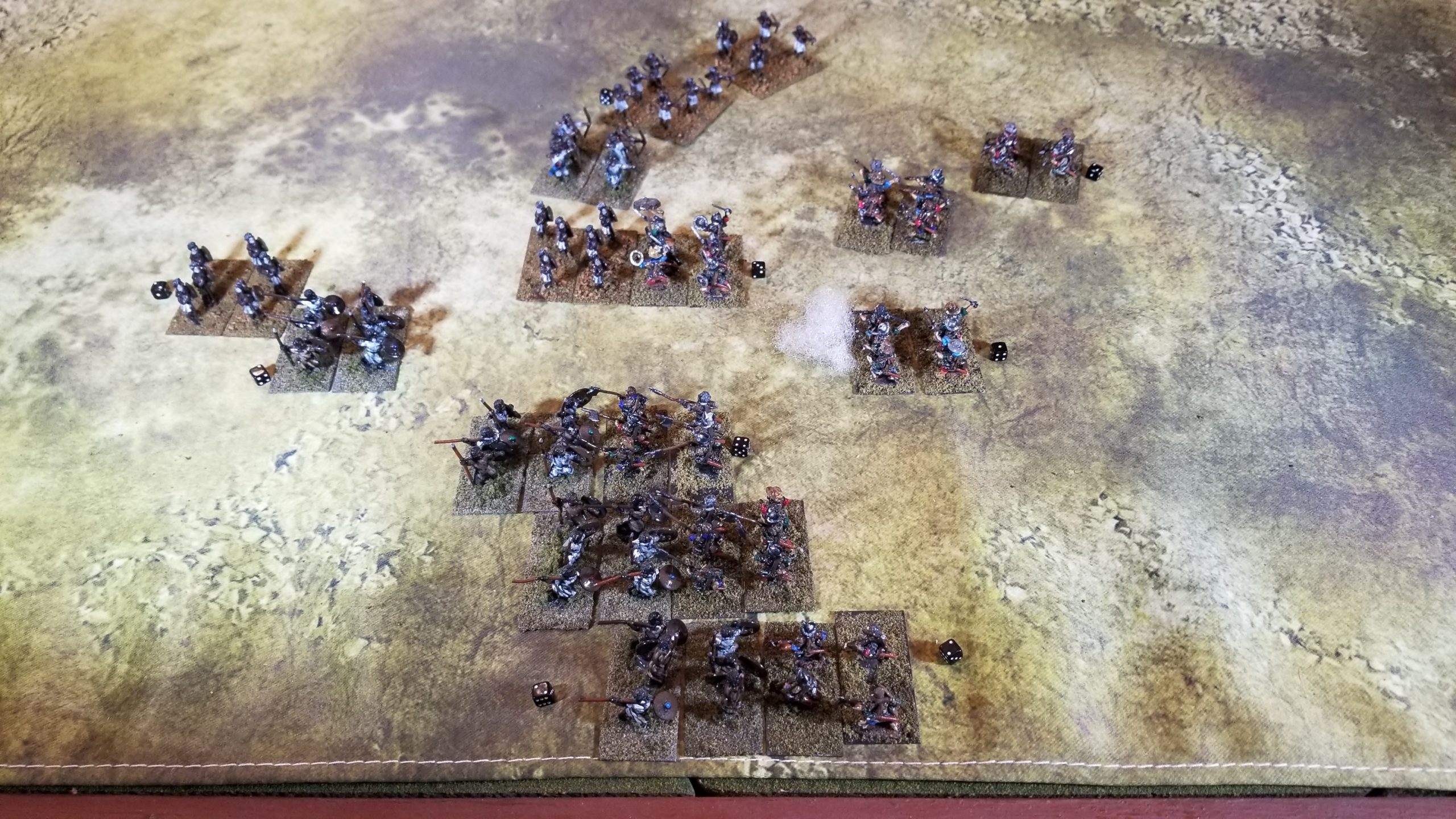
By the end of Turn 5, the Portuguese musketeers were firing with some effect. One melee has ended in a “Bloody Draw”, with both sides recoiling due to Resolve of only “1”. Neither unit can be rallied because Lord Renaldo is in melee, and the Kattegoan leader has somewhat inexplicably moved off some distance to the left (North) apparently to support the archers.
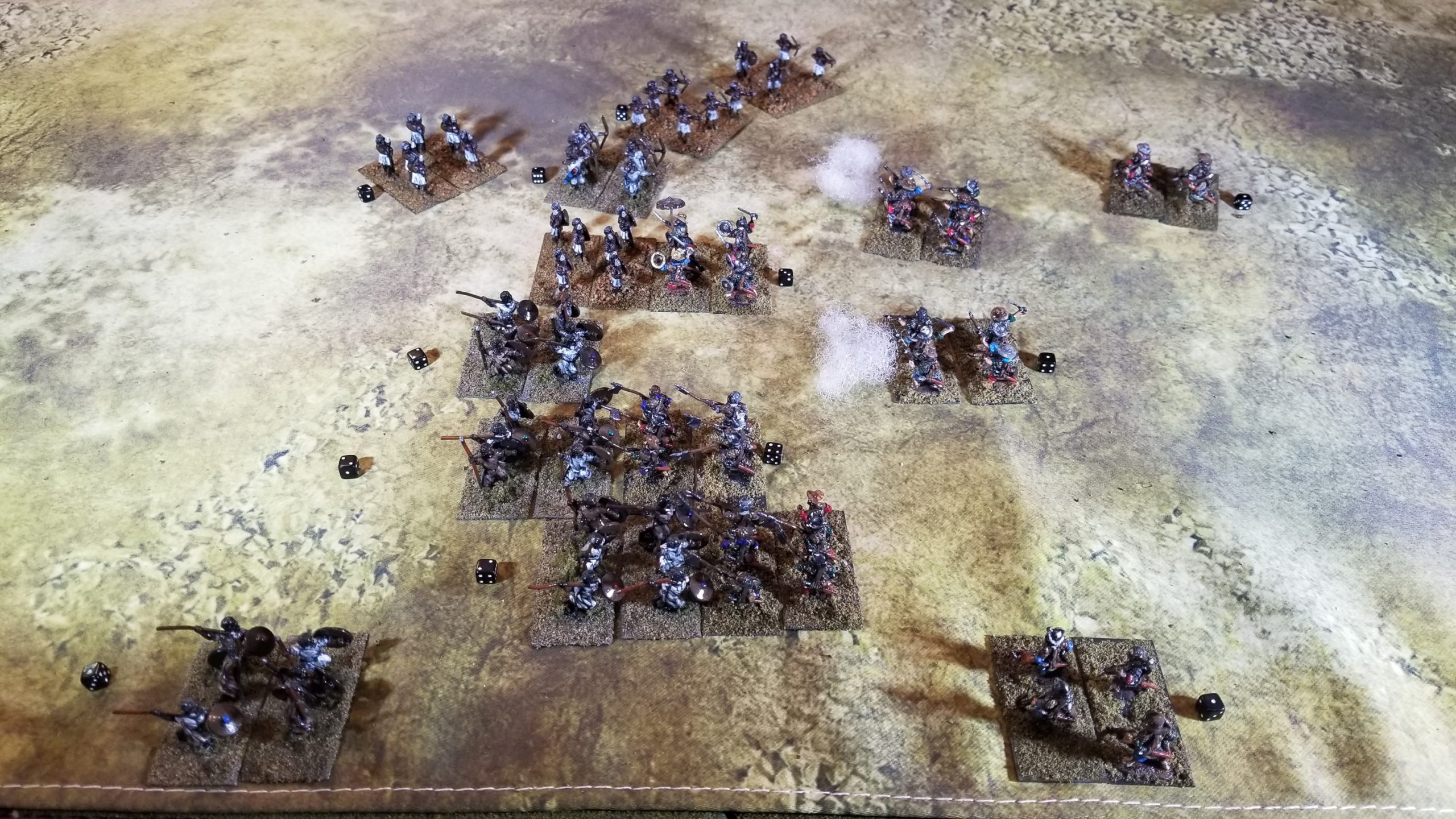
Finally got around to continuing my play of Romania – The Transylvania Gambit.
As previously posted, the Romania Army’s plan was badly flawed, and the scenario certainly reflects that. The availability of German reinforcements to bolster the Austro-Hungarians effectively stops any offensive across the Carpathians.
Despite the slow operational tempo of mountain fighting and Romania’s desperate-from-the-start prospects, I was settling down for another session when a casual glance at the rule book moved the game from the possibly forgettable to another memorable rules gaffe.
Tim’s been on me to compile and post a list of our grotesque errors of rules omissions and commissions. I have consistently demurred. Not out of personal shame, but because the compilation would be a very lengthy and time consuming process. So Tim, here’s one in real time.
All those German reinforcements hustled south using the Austro-Hungarian rail network, which has a capacity of three units per turn phase. It took a few phases, but the Romanian attacks were quickly blunted. Well, that was too quickly. While the entire rail capacity is three units, the capacity for any one rail line in that network is only one unit per phase. Whoops………..
The poor Romanians were not only fighting a flawed initial deployment and the mountainous terrain, but also some very tough units that should not have been there – at least not so quickly.
Well, that put paid to the game. It was going to be some time before the operational tempo accelerated past “slog” speed, especially with Winter just around the turn track corner. My current impatience is not the best mood to enjoy a scenario which accurately represents the time and resources required to build up combat power in this theater of operations.
So, despite my high regard for the system, I decided to pack it up, and move on to another game.
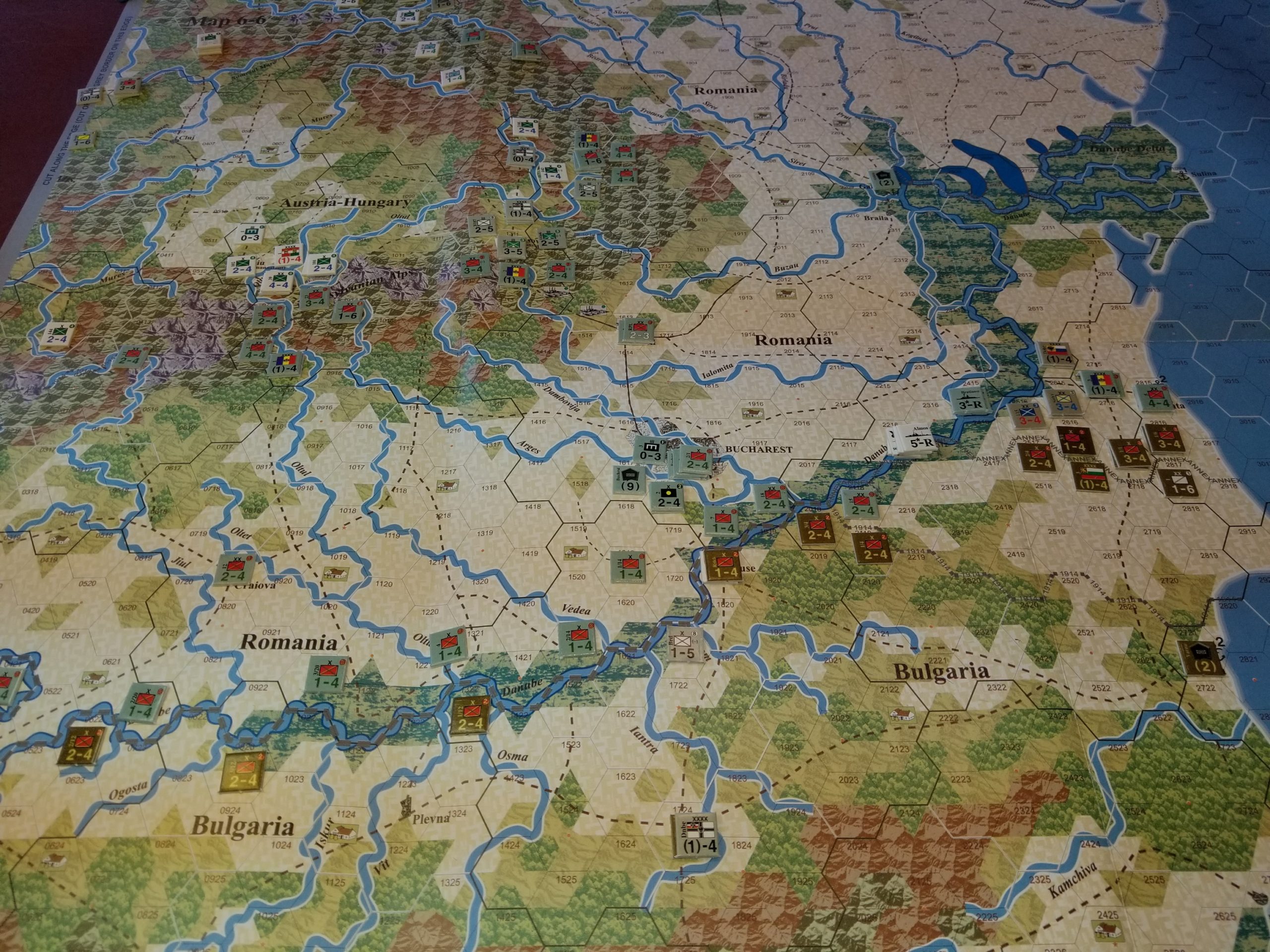
Here’s a photo taken right before it all went back in the box. Note all those gray German units in the North Central portion of the map.
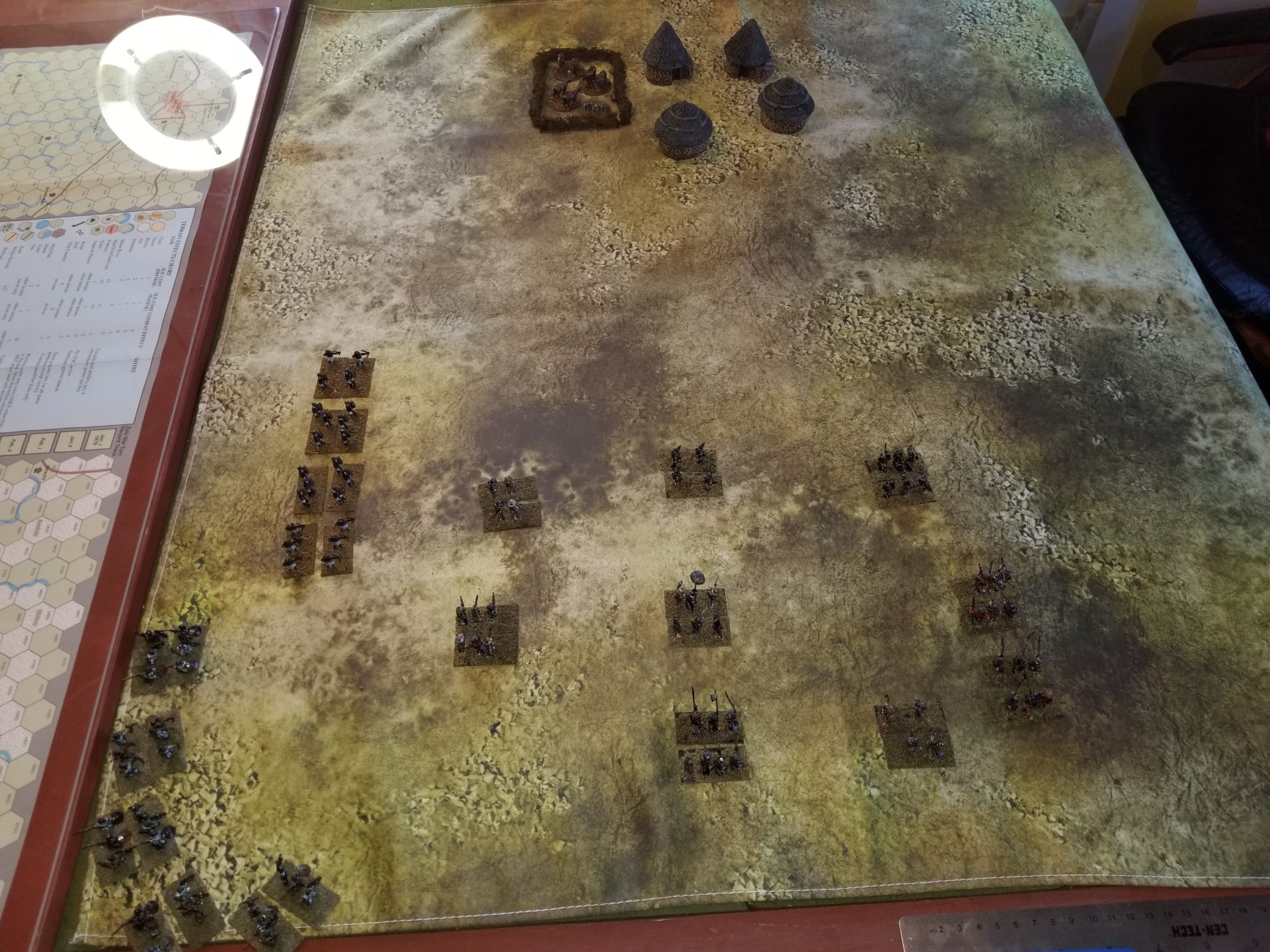
I set up the initial dispositions using the die rolls described in the previous post.
The Portuguese are disorganized, with Lord Renaldo near the front of his faction. The bulk of his companies are East and some distance from him. Only the grenadiers proceed him. His force is close enough to Kattego to trigger an immediate ambush.
The Kattegoans rolled for two ambush groups with forty percent of the force West of, and three units distance from the Portuguese. The larger group is to the Southwest and five units distance from the invadiers.
After a series of failed photographs last night, I changed the overhead light and saw the chance for a striking aerial shot of the battlefield. It is shown below. That orb is the reflection of a task lamp bouncing off my brand new plexiglass map cover. If it isn’t one thing…..
This treatment is included with Serbia The Defiant and covers Romania’s August 16 entry into World War 1.
Rather than cooperate with Entente forces in Salonika and attack Bulgaria, the Romanians opted to limit operations against Bulgaria and focus on regaining Transylvania.
This threat was quickly matched by Austro-Hungarian (A-H), German, Bulgarian and even Ottoman forces.
A-H troops offered stiff resistance in Transylvania, while a composite force of the latter three nations, under the command of the redoubtable General Von Mackensen, attacked Romania from the south. Romanian reverses on both fronts forced the already hard-pressed Russians to send reinforcements to bolster their new ally.
Romanian resistance collapsed, with an Armistice signed in April 1917.
The game is set up and ready to go. I’ll start pushing cardboard this evening.
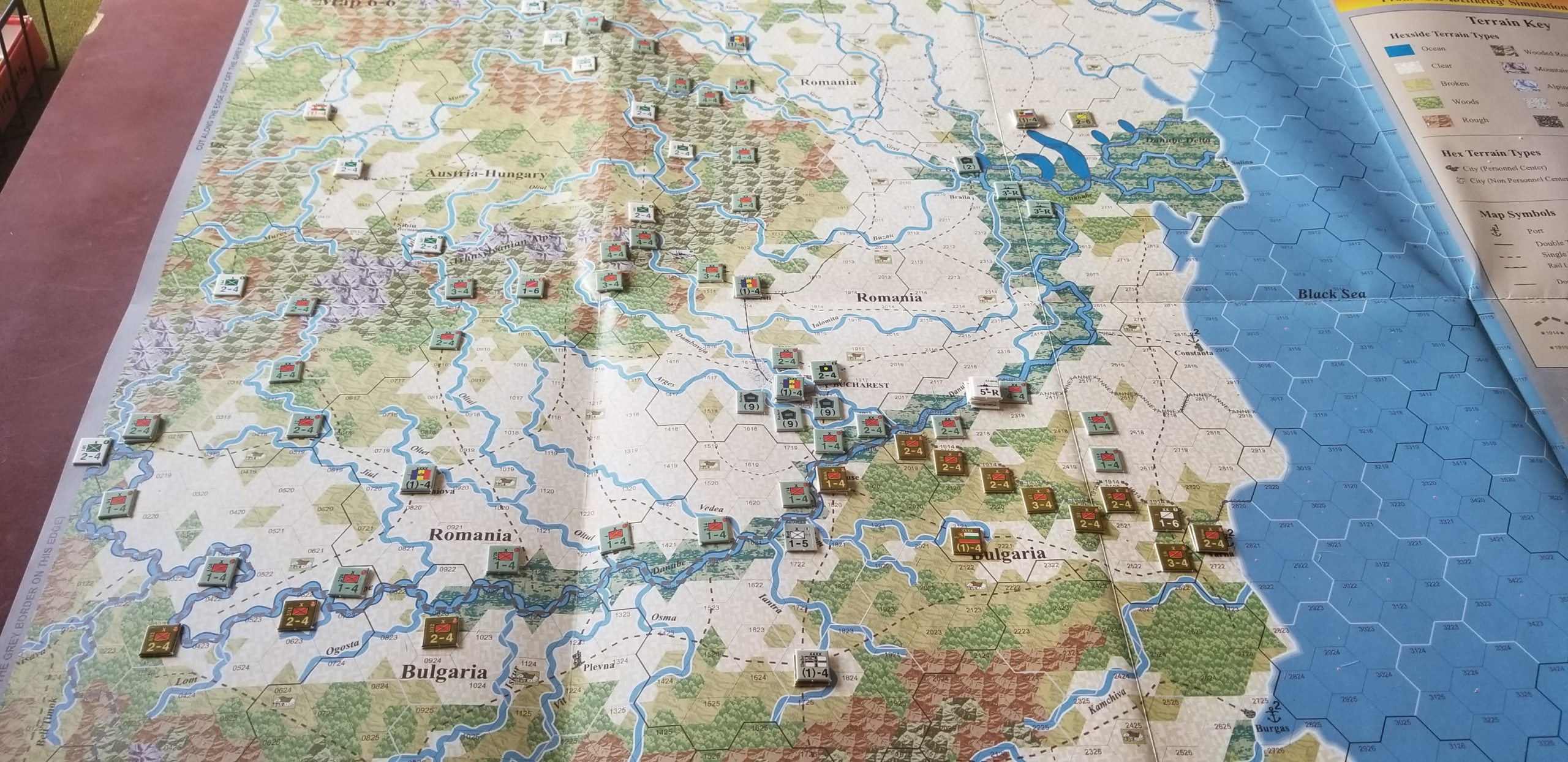
The game set up, along with the initial dispositions of both forces, is shown in the following photo. The Japanese flag represents the amphibious landing at Kota Bharu. Placement of the Japanese convoy, battleship and cruiser squadrons is determined during the Random Events Phase. Force Z is represented by the British flag in Singapore. The index card and colored blocks are used to keep track of weather and ship damage.
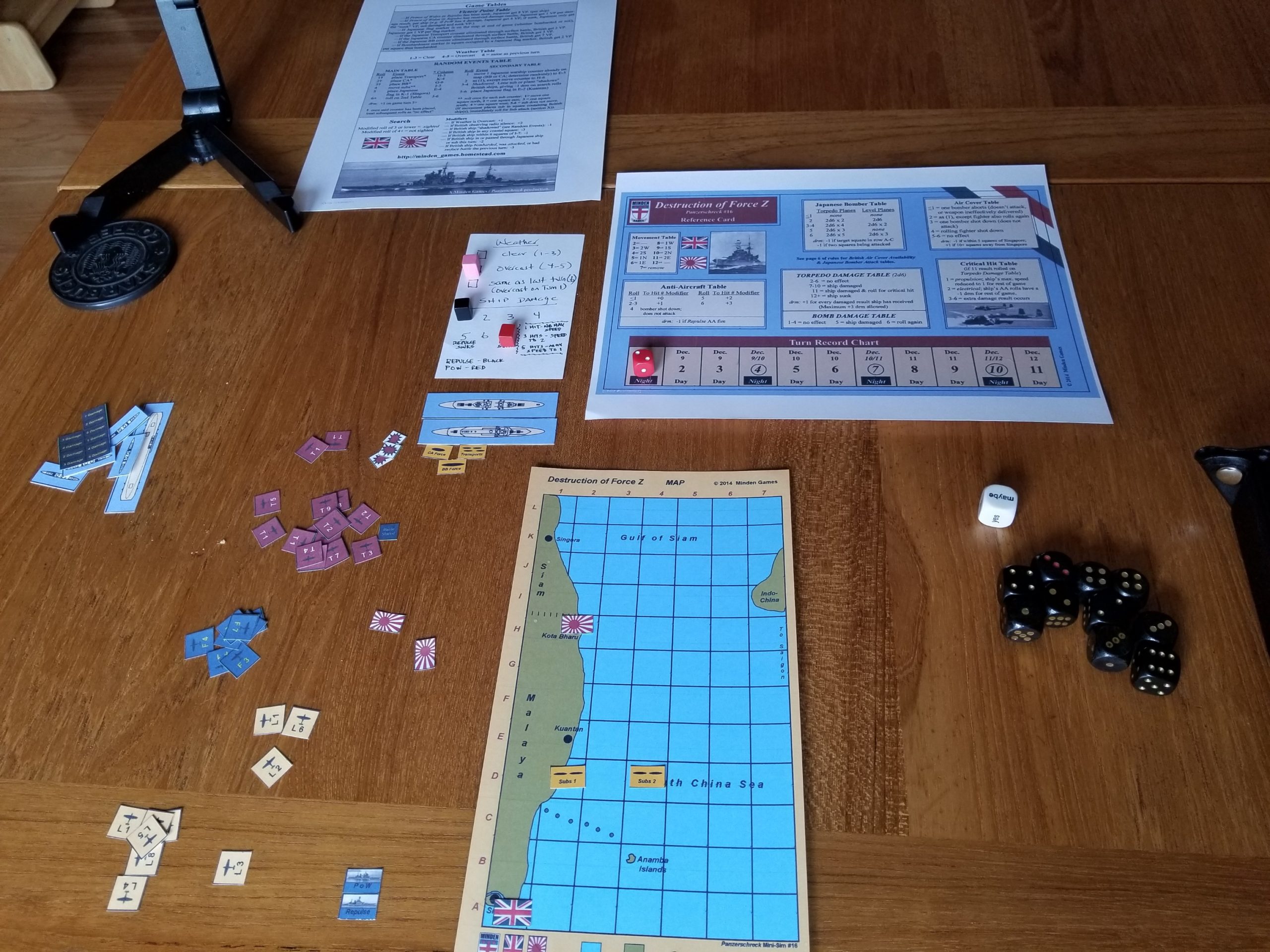
For the first three turns, Force Z moved east of the Anamba Islands, then turning north towards the landing. The Japanese were unable to locate Force Z, which was maintaining radio silence in the overcast weather, until it attacked the Japanese battleships (7 VPs) at night (Turn 4). I couldn’t find anything specific in the rules, so I decided Japanese surface units appearing during a turn couldn’t move, also. Despite hitting the Japanese ships, no damage was inflicted.
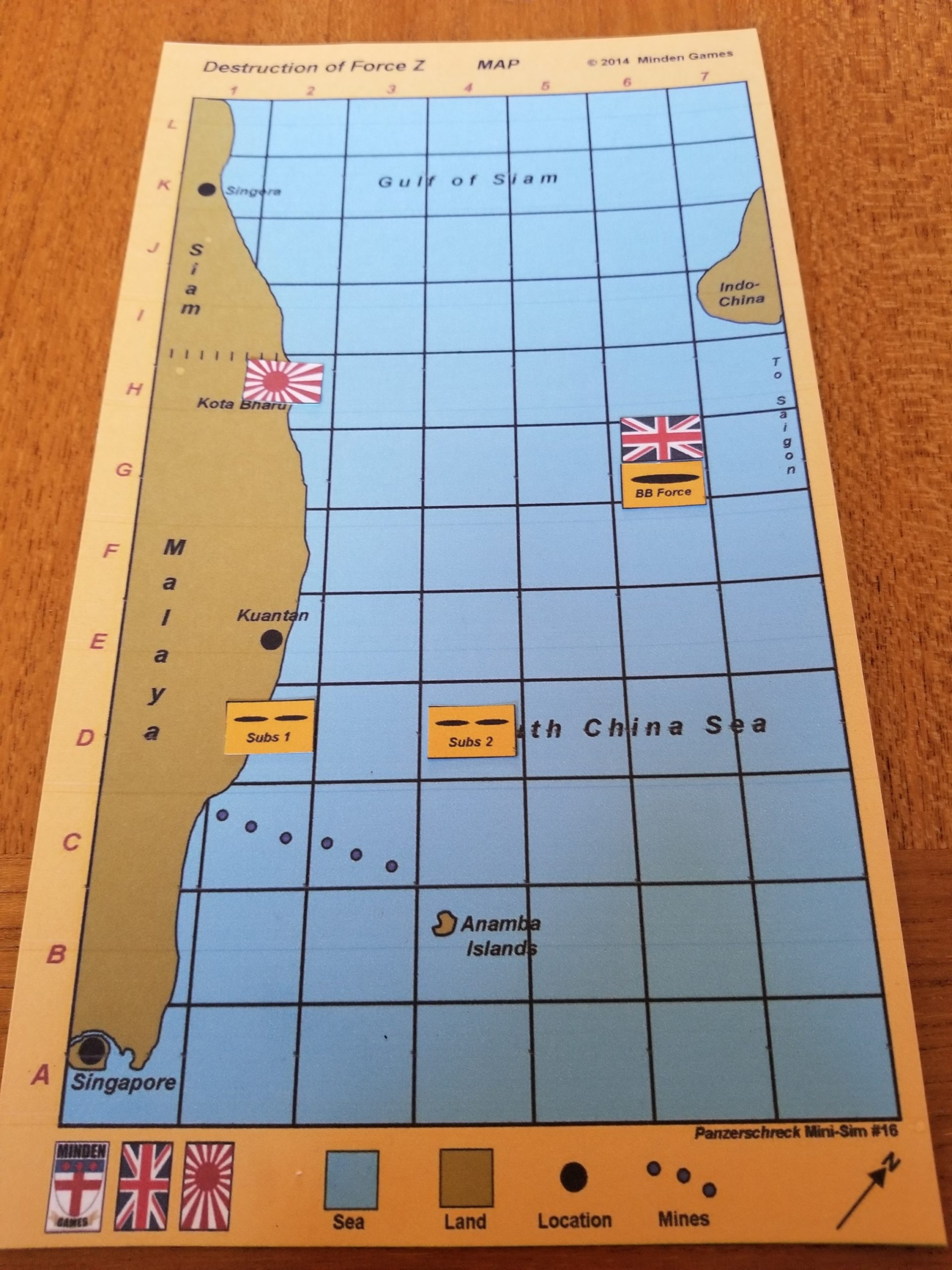
After this inconclusive encounter, the British sailed at flank speed towards Kota Bharu to bombard the the landings. The Japanese were still unable to locate Force Z, and could not prevent the destruction of their offshore convoy which had appeared off Kota Bharu during the Random Events Phase (Turn 5).
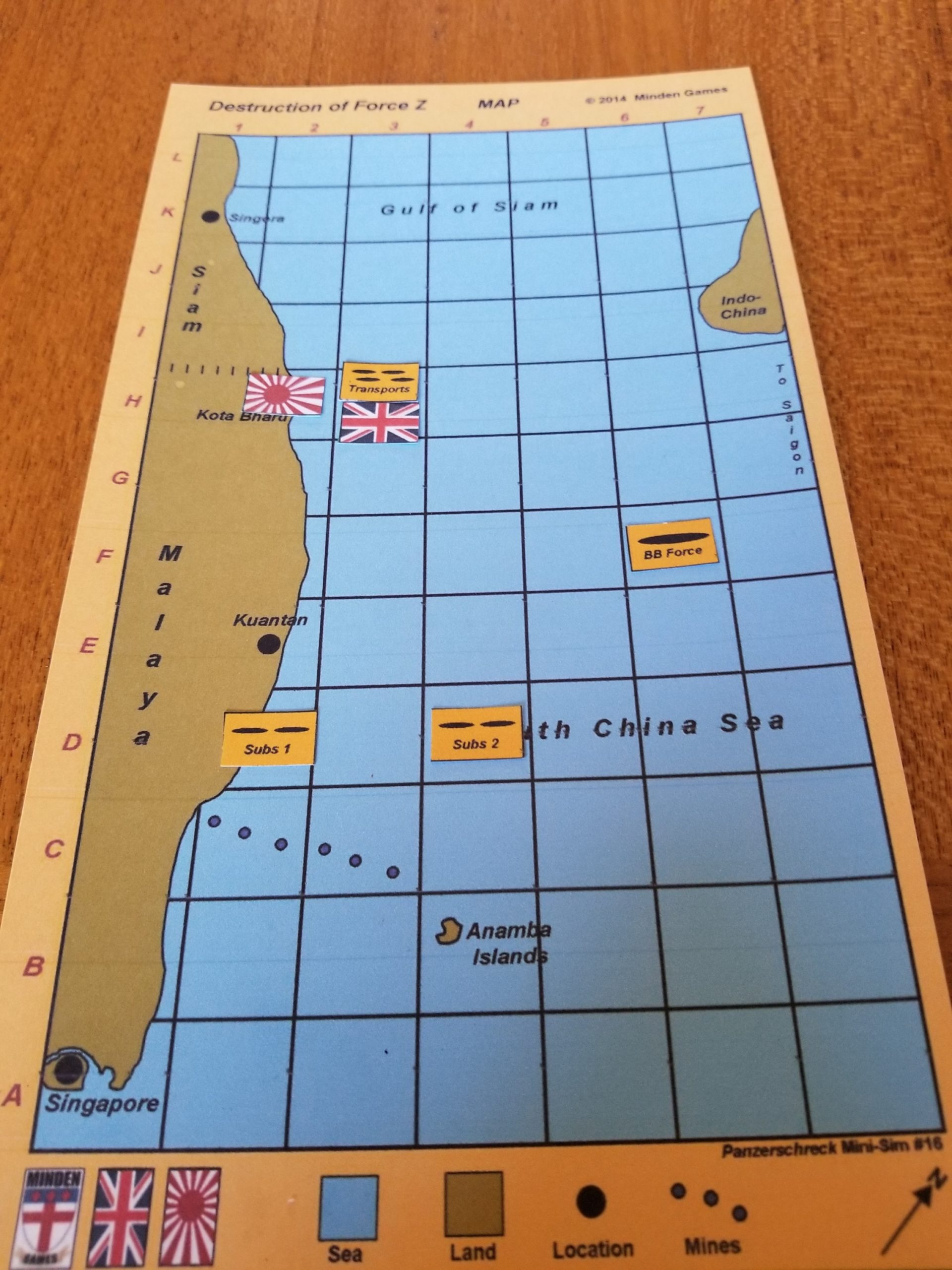
After this success, the British steamed south towards Singapore, breaking radio silence to request RAF air cover (Turn 6).
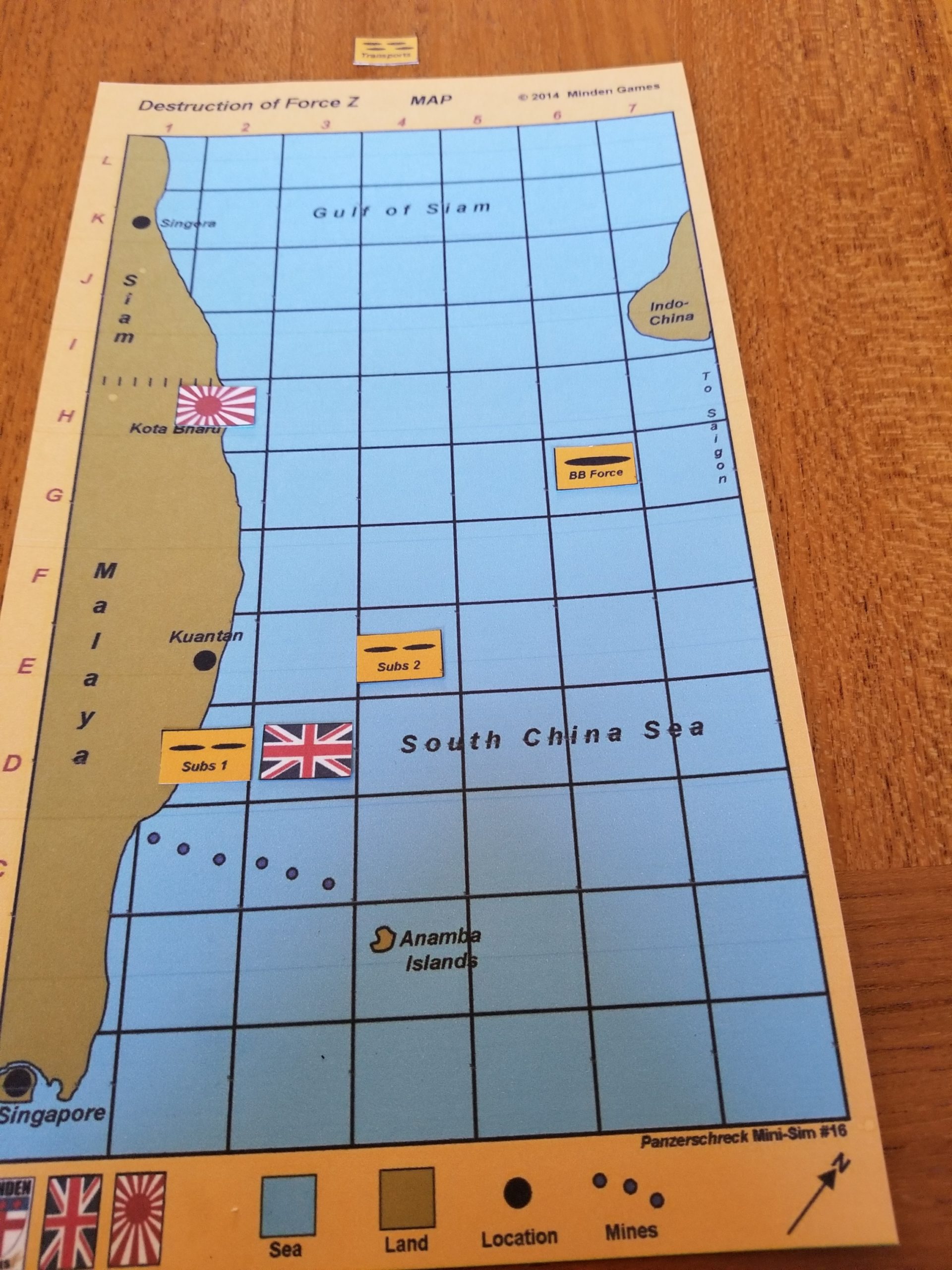
At this point, the Force Z commander decided take advantage of darkness (Turn 7), steaming north to again engage the VP-rich Japanese battleships. The Japanese cruisers entered the northern part of the map during the Random Events Phase.
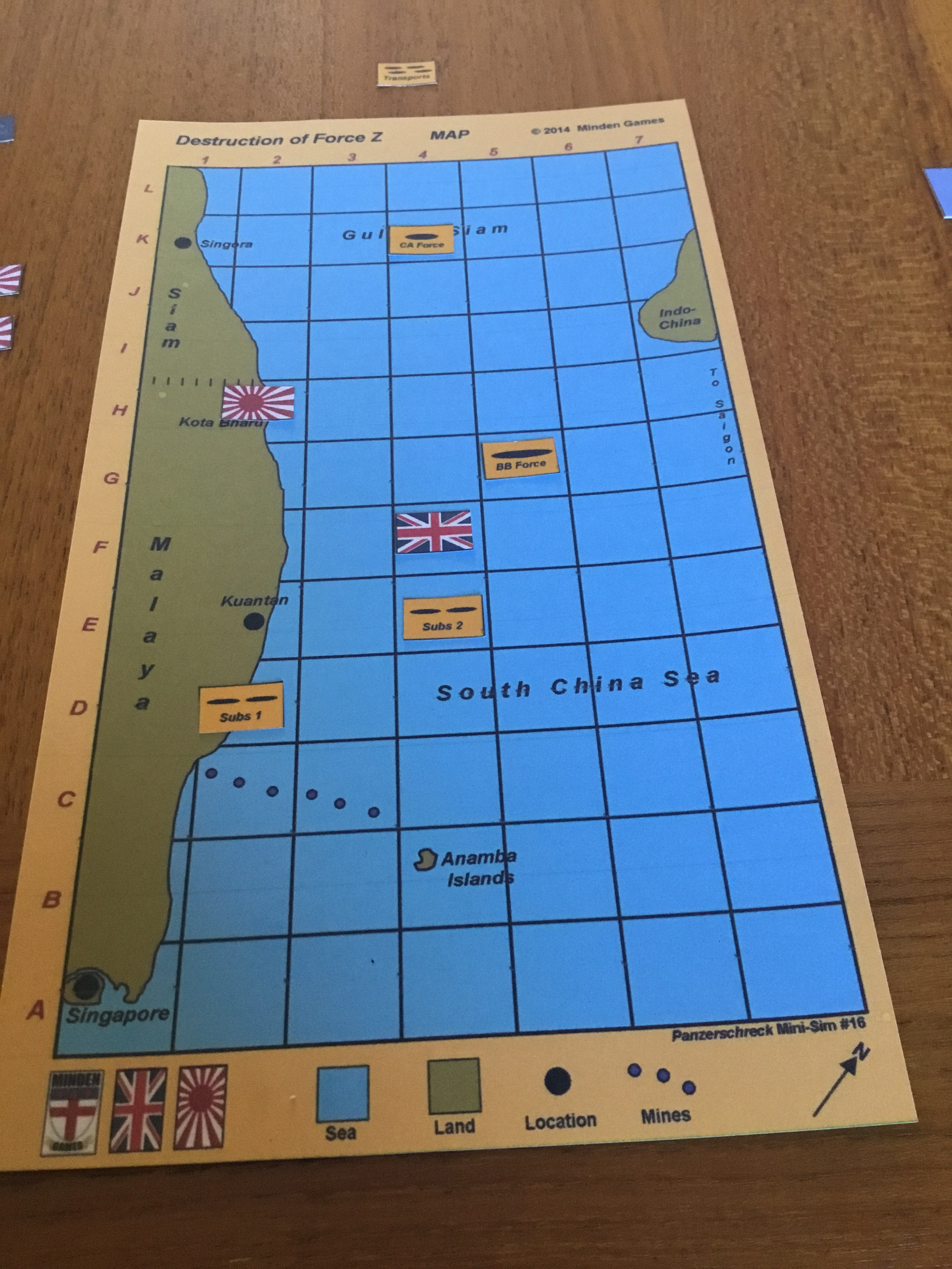
Force Z moved into the Japanese square, forcing a surface engagement. It was here that British luck ran out, as the Japanese search was a success, and no RAF fighter cover appeared to help fight off a massive level bomber and torpedo bomber attack.
The following photo shows how I handled the “tactical” aspect of the game.
Both British ships were in the square, so each can be attacked by bombers. D6 rolls determine the number of attackers and what ship(s) they attack. The rolls indicated a mixed force of 12 torpedo and 25 level bombers, all of which concentrated on the Prince of Wales. The first attack was by the level bombers. Each ship has a maximum of 10 d6 anti-aircraft rolls. These rolls either eliminate attackers, or are indicate to hit modifiers. Bombers need a modified roll of 10 to score a hit. A further damage die roll is made for each hit. The rolls are shown below. I use the dice, rather than the tally sheet included with the game to record rolls, and then use the result to determine hits. A die that “hits” is then placed above the “tactical display”, as a reminder of the rolls needed for determine damage.
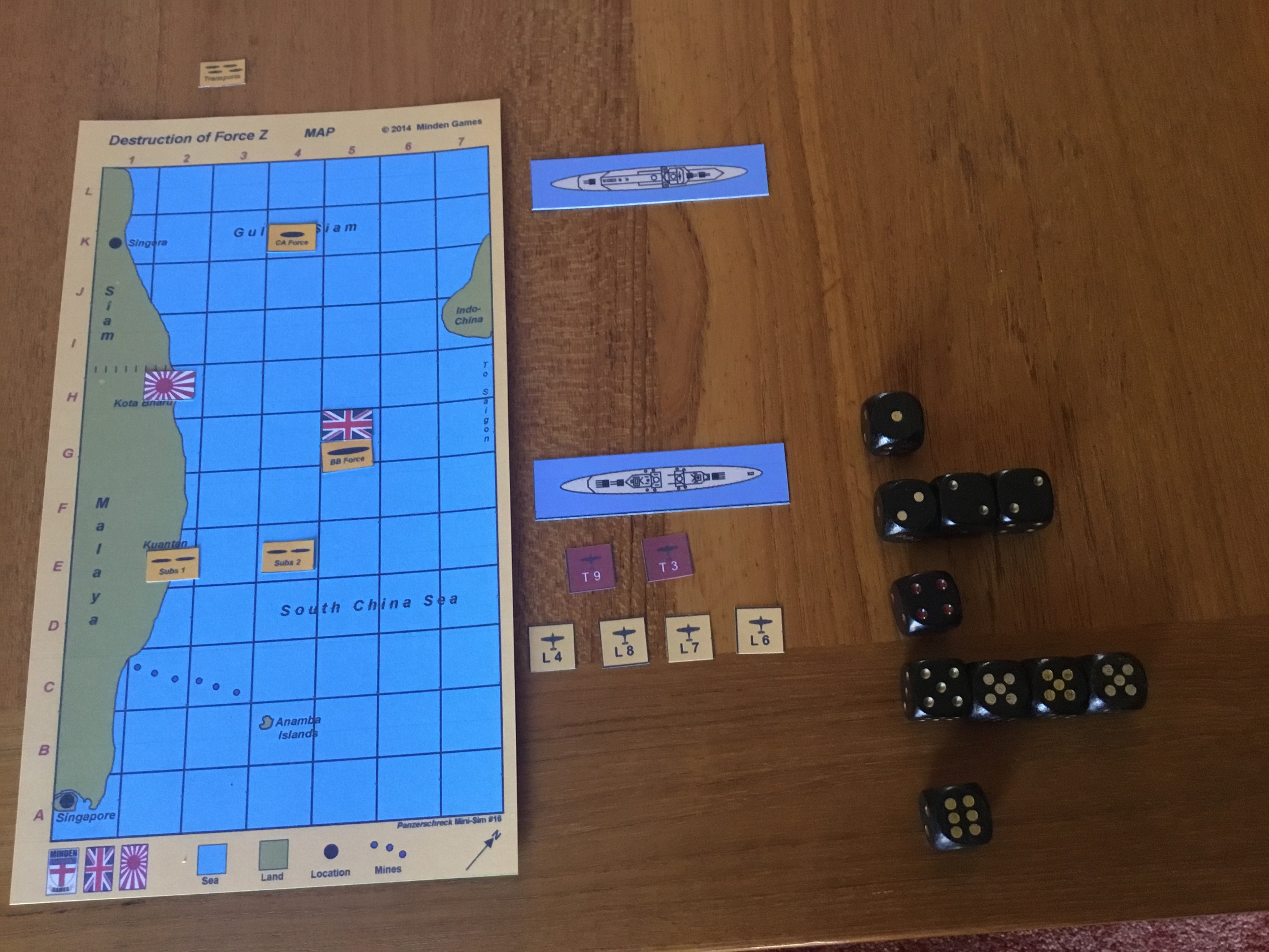
The torpedo bombers were handled in a separate series of rolls.
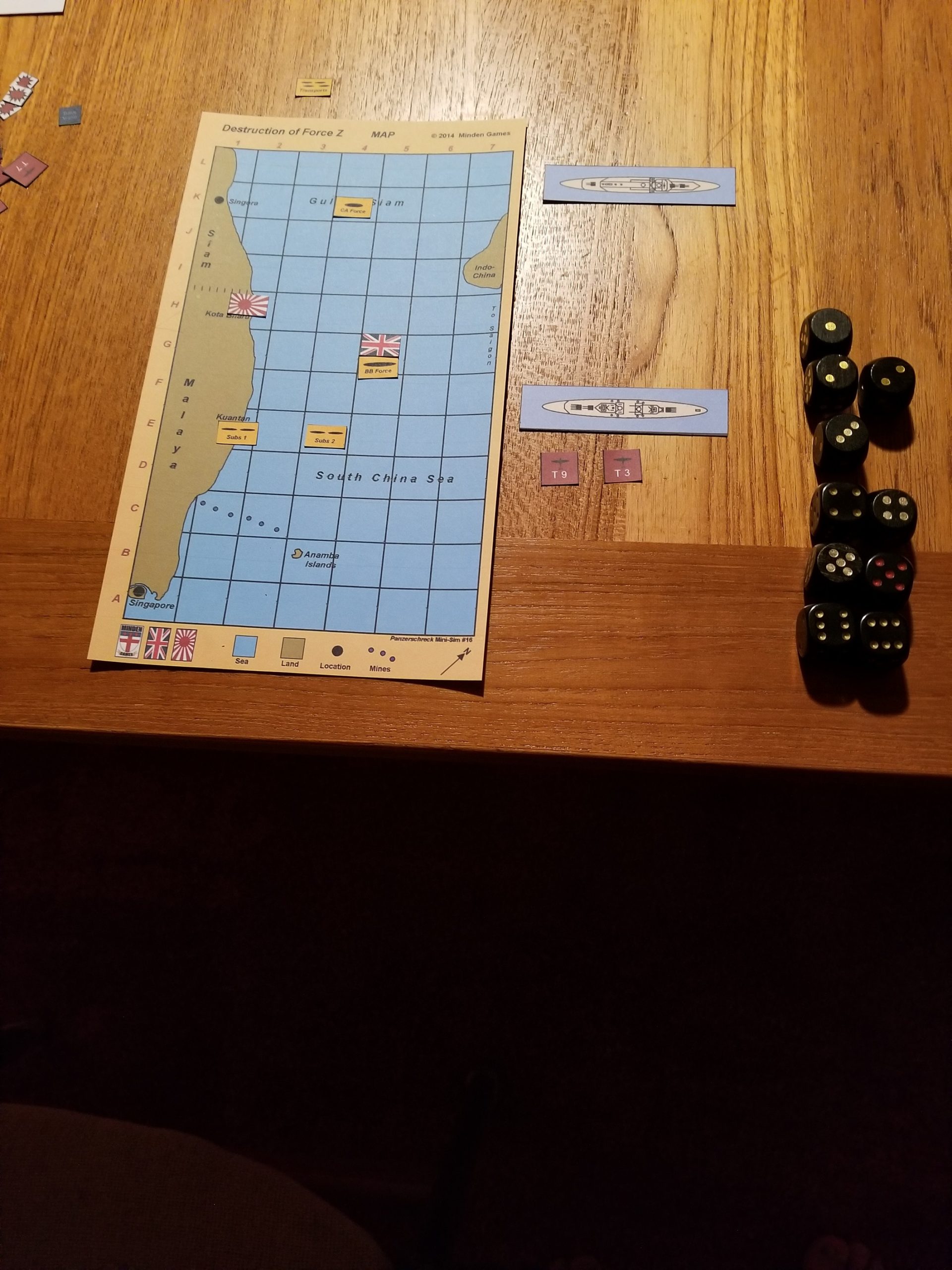
The Prince of Wales somehow survived, taking five hits, two less than the number to sink. Five hits reduced its movement rate to one square per turn. After this mayhem, a surface action occurred. The Japanese battleships and Prince of Wales were unaffected, but the Repulse took one damage hit.
The Repulse was ordered back to Singapore, while the stricken Prince of Wales could only hope for a failed Japanese search, or the intervention of the RAF. The ship was located and the RAF again failed to provide air cover. The level bombers did not find the Prince of Wales, but the torpedo bombers did. An attack by 27 aircraft sank the ship.
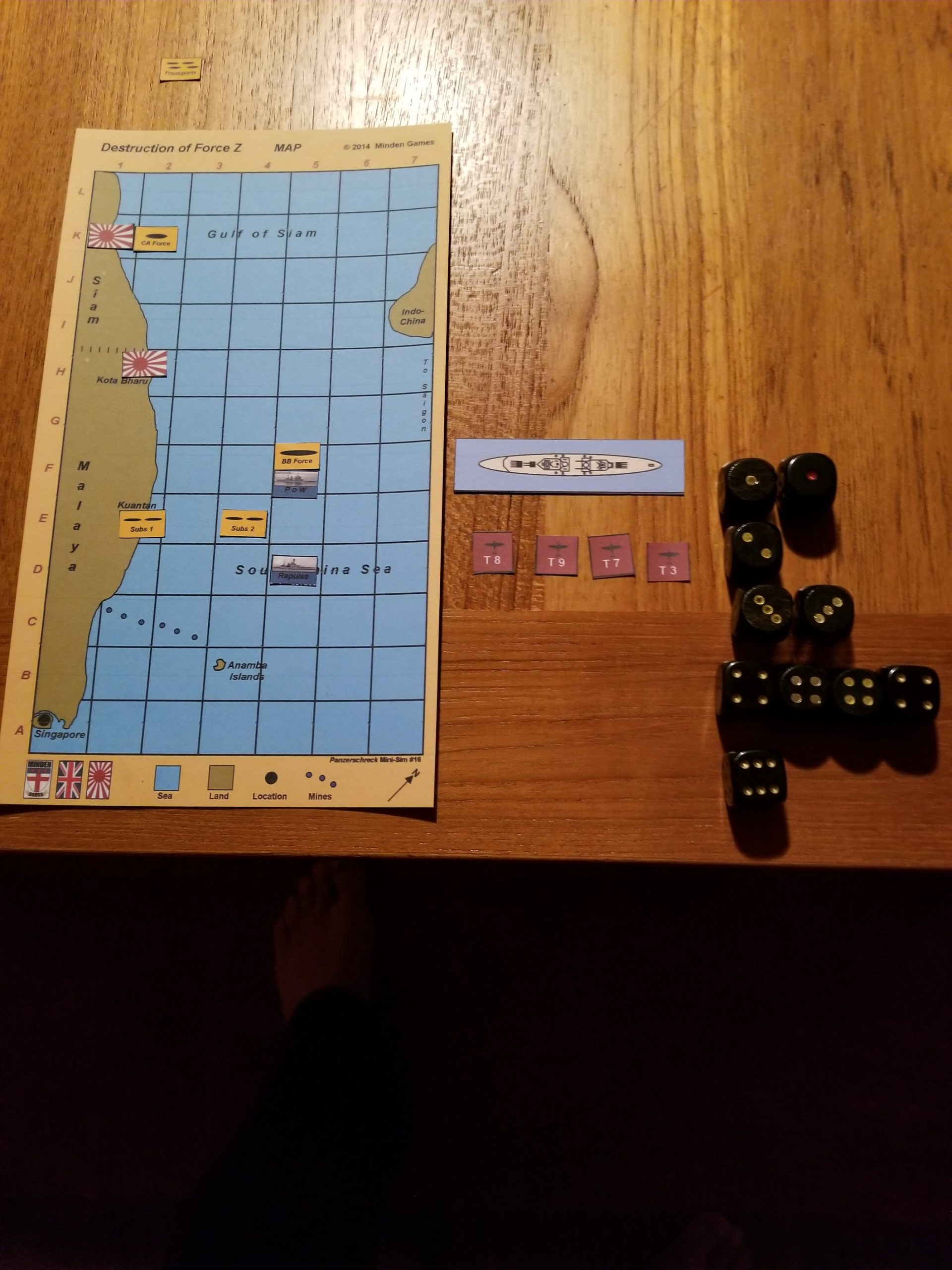
The Repulse continued south during the night (Turn 10), while the Japanese made another landing at Singora.
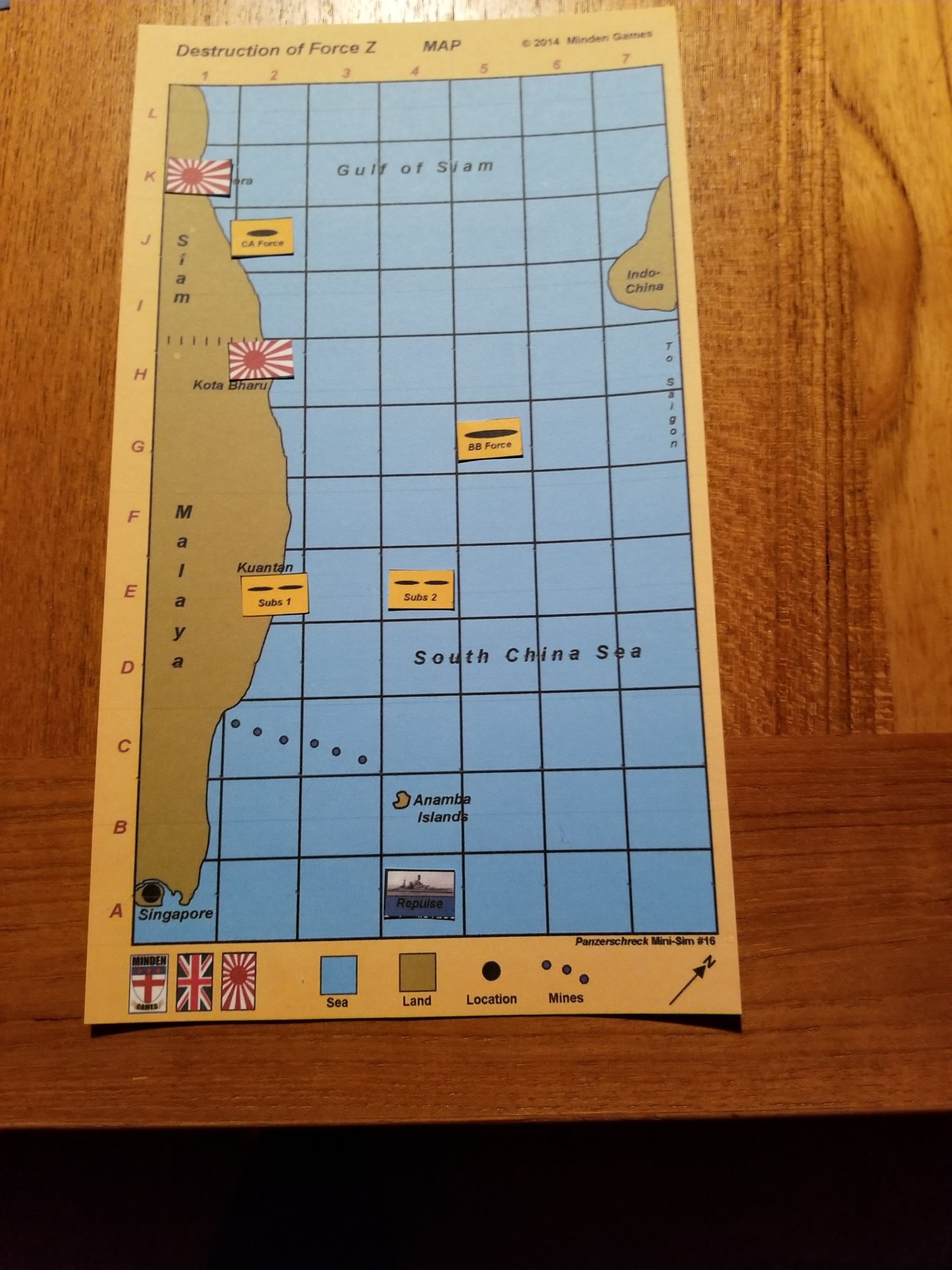
Repulse was able to return to Singapore before the Japanese Turn 11 Search Phase. This ended the game.
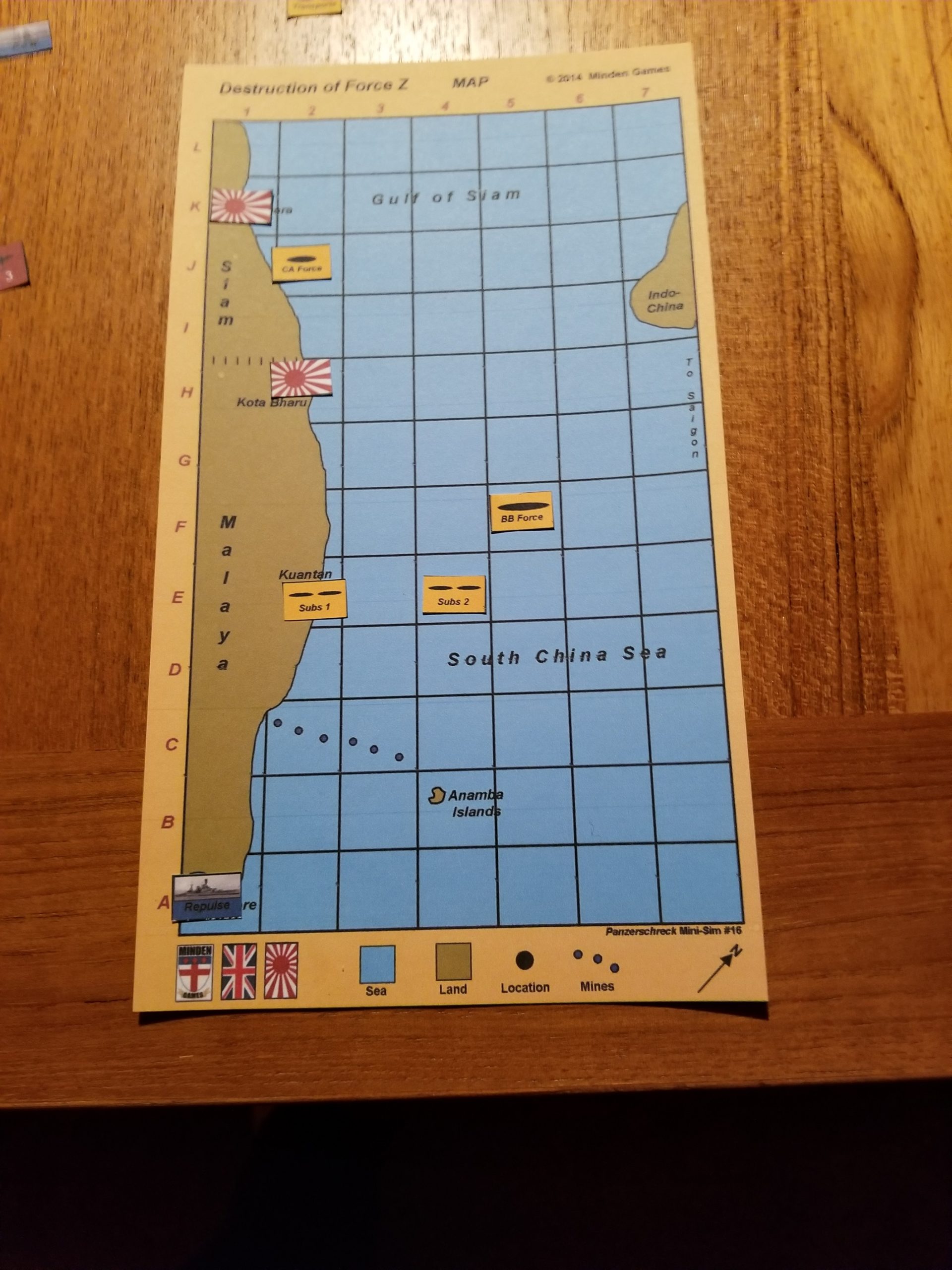
The Japanese victory point total breakdown was:
The net is 9 Japanese victory points. The historical total was 18 points.
Wrap-up in the next post.
Finished up the other night. It was a marginal Austro-Hungarian victory, based on casualties only. No objectives were taken, but the issue remained in doubt. While losing on “points”, the Russians certainly had the upper hand when it came to capturing objectives.
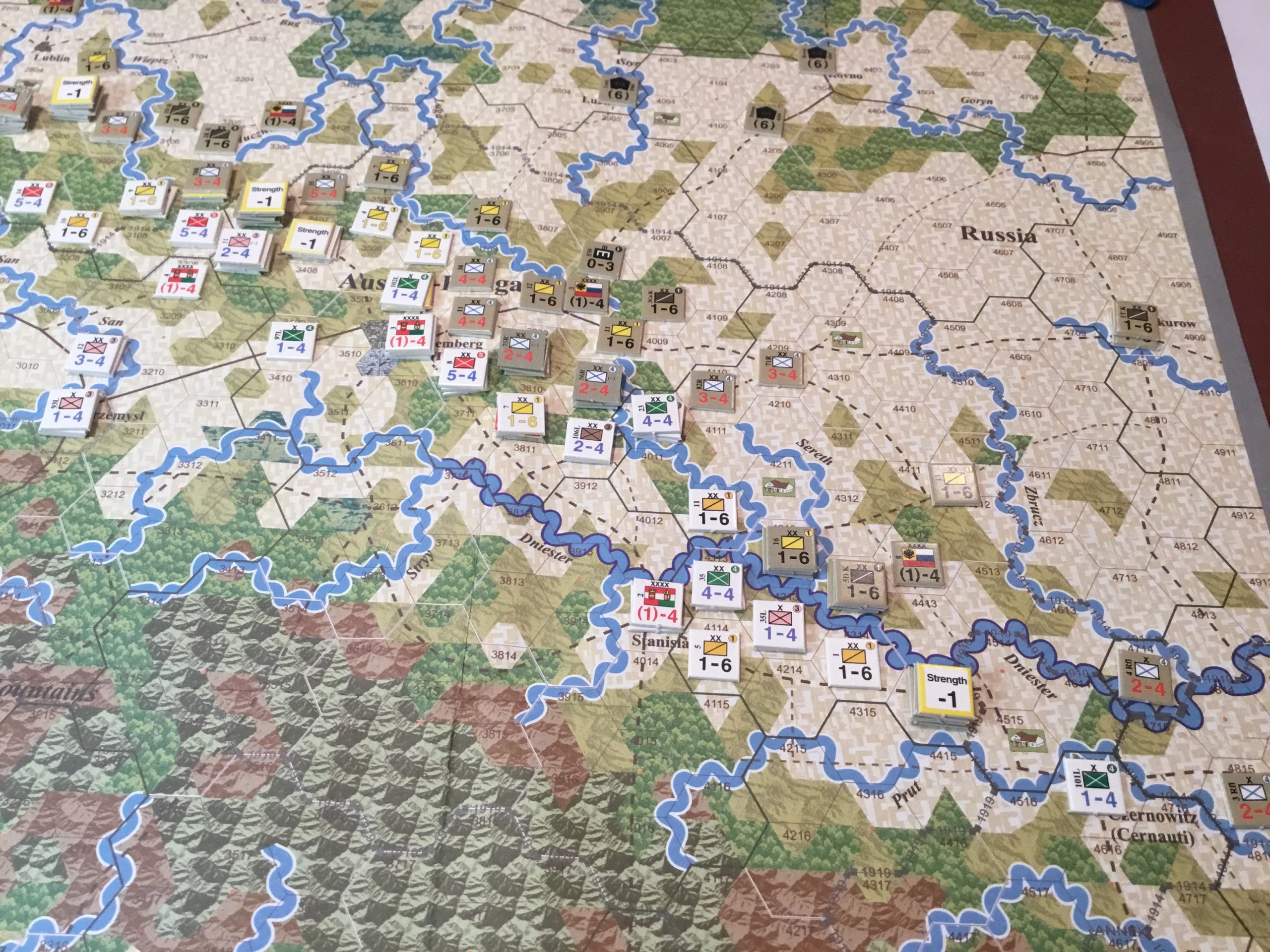
In the East, the A-H 2nd Army is in danger of being rolled up along its right flank by the Russian 8th Army advancing towards its objective of Stanislav. The very strong Russian corps is obscured by the -1 strength marker for the top of the four, 4-4 units.
To the west, the A-H 3rd and 4th Armies are locked in combat with the Russian 3rd and 5th Armies. Here, the Russian units are adjacent to their objective of Lemberg.
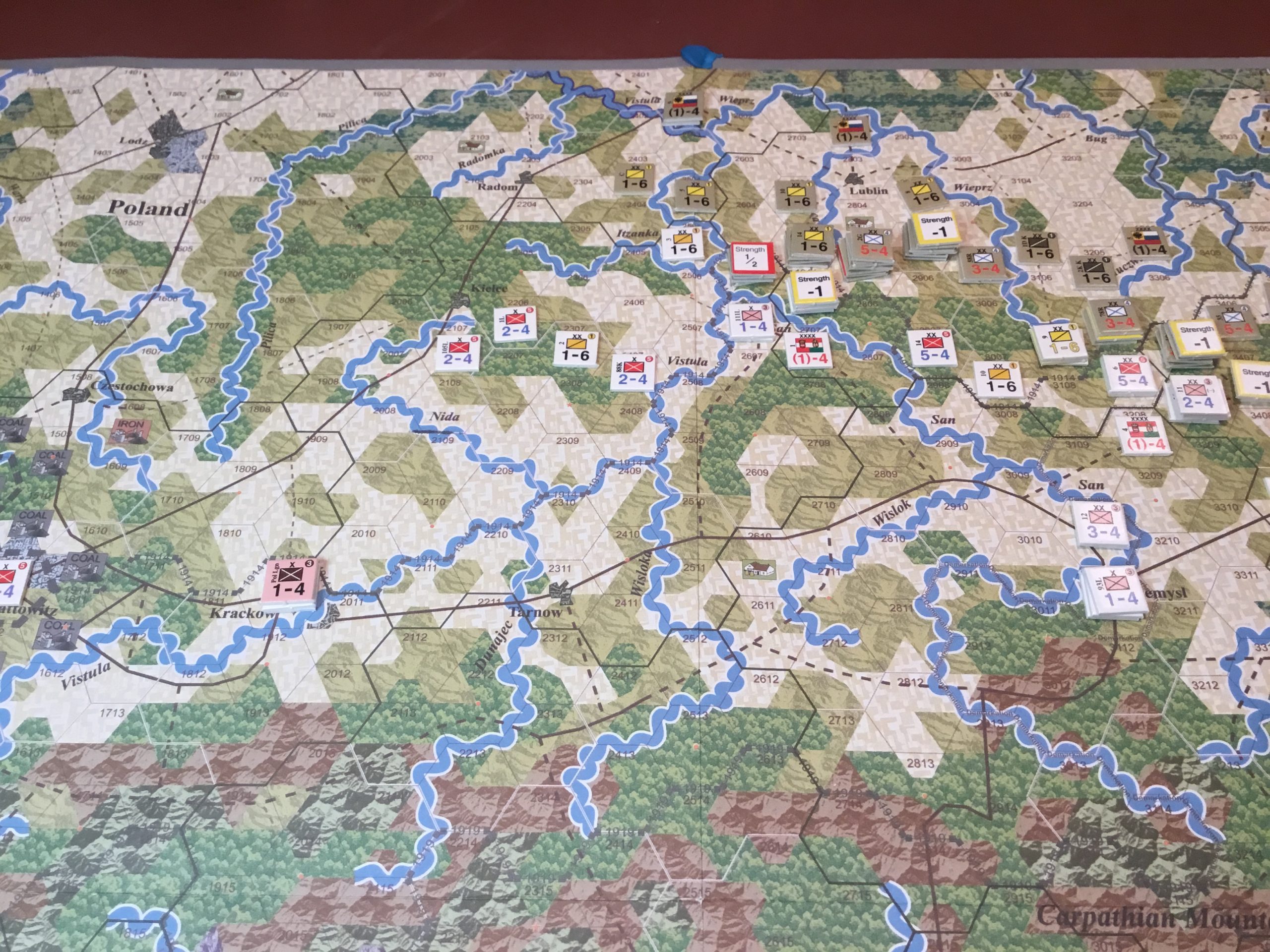
To the West, the A-H 4th Army is standing fast to the North of Fortress Przemyl, but its neighboring 1st Army is under extreme pressure, with little in the way of a Russian 3rd Army sweep towards its objective of Krakow.
A good game. I already have “Serbia The Defiant” on the table and will start play this weekend.