Powered through the game last night. Once you get going, it is as advertised…..a game that takes about 2 hours. And, it’s a lot of fun.
Should have done a better job of documenting turn-by-turn highlights, but I did take pictures. Here’s the narrative highlights.
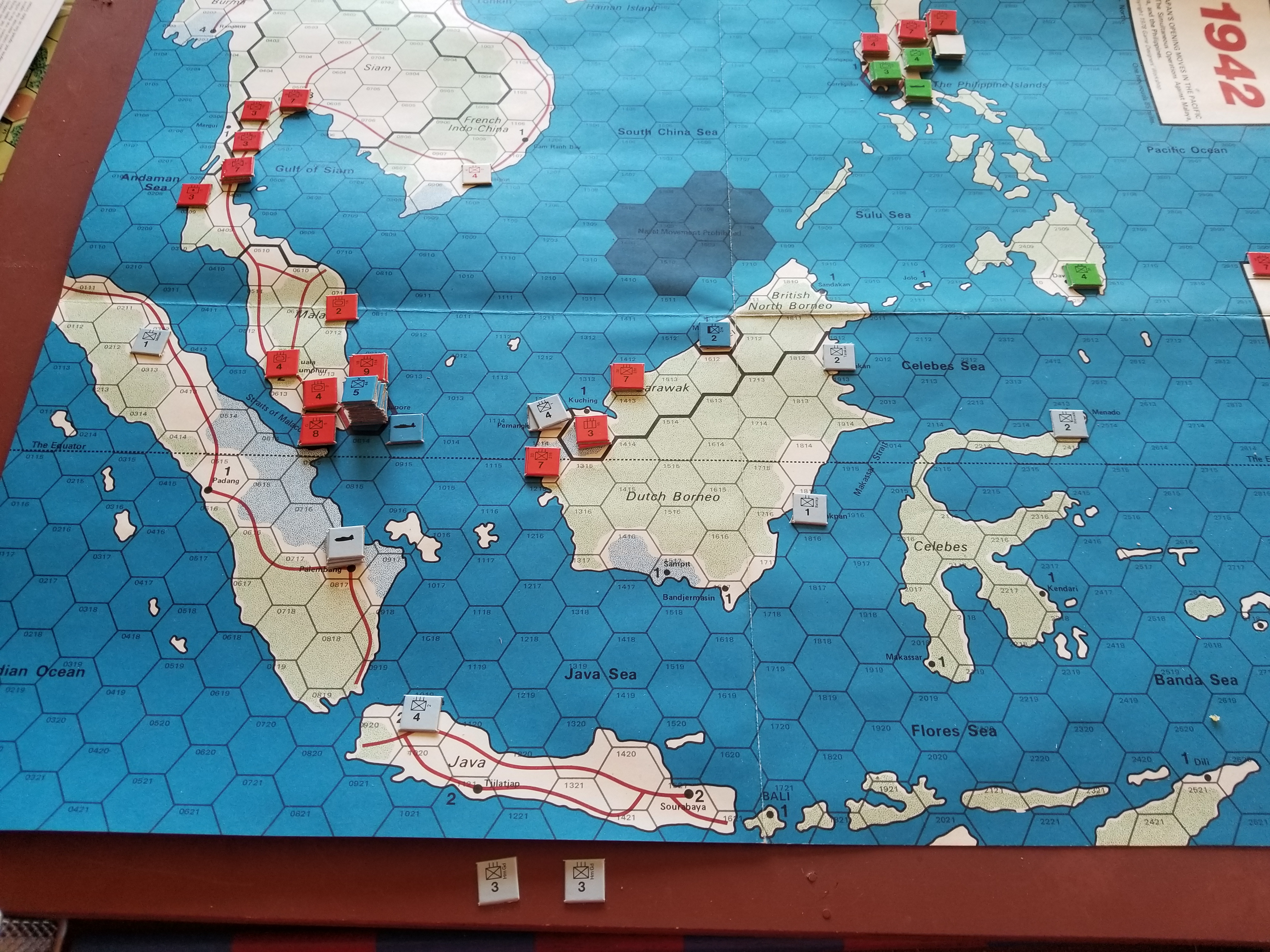
Beginning with Turn 3, the Japanese continued to pressure both American and Commonwealth forces, undertaking flanking attacks where they could get 3-1 or 4:1 odds, typically augmented by at least a +1 D6 roll modification due to air support. The Japanese were fortunate in that their attacks resulted in surrender results, which maximize victory points.
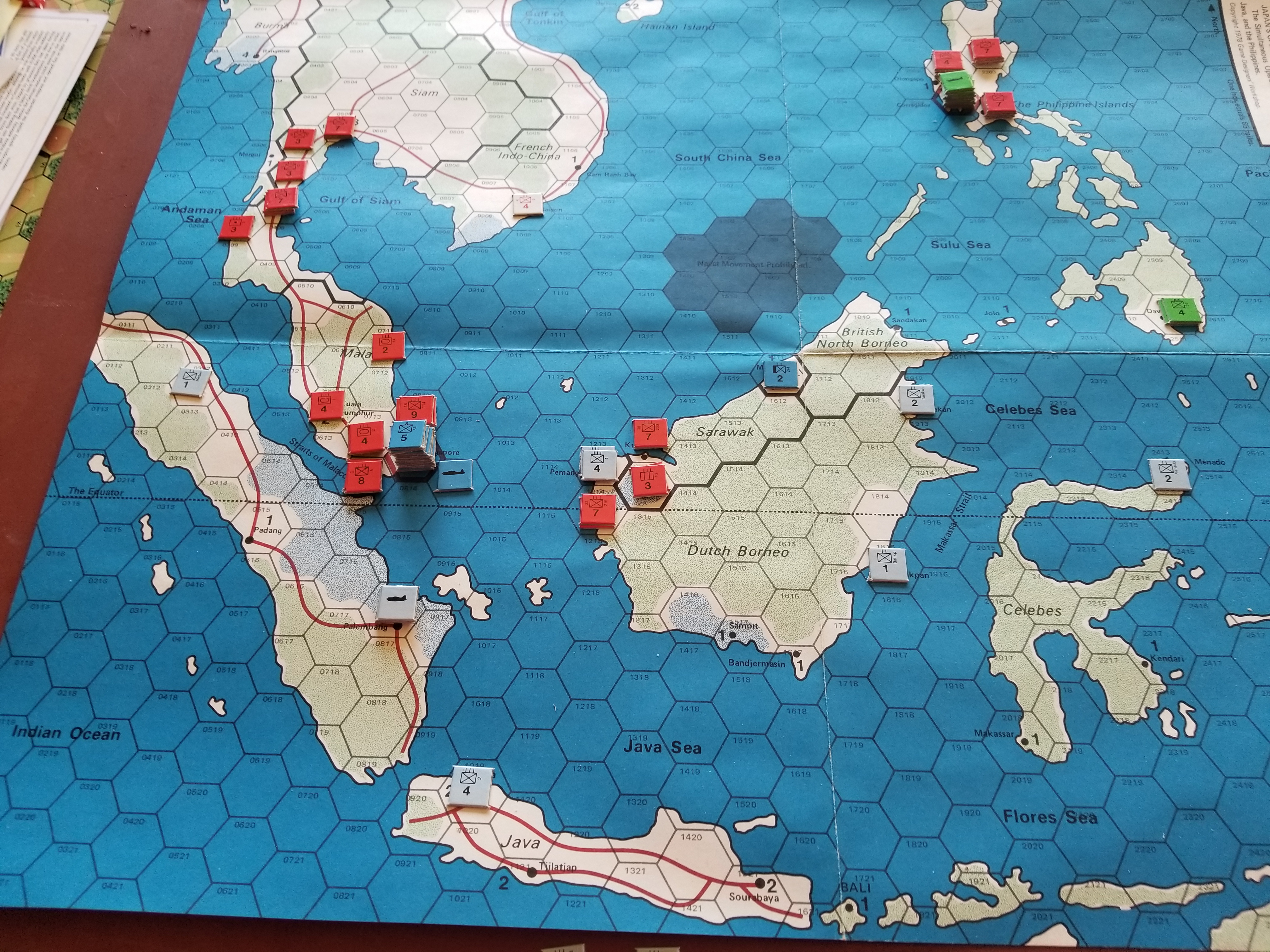
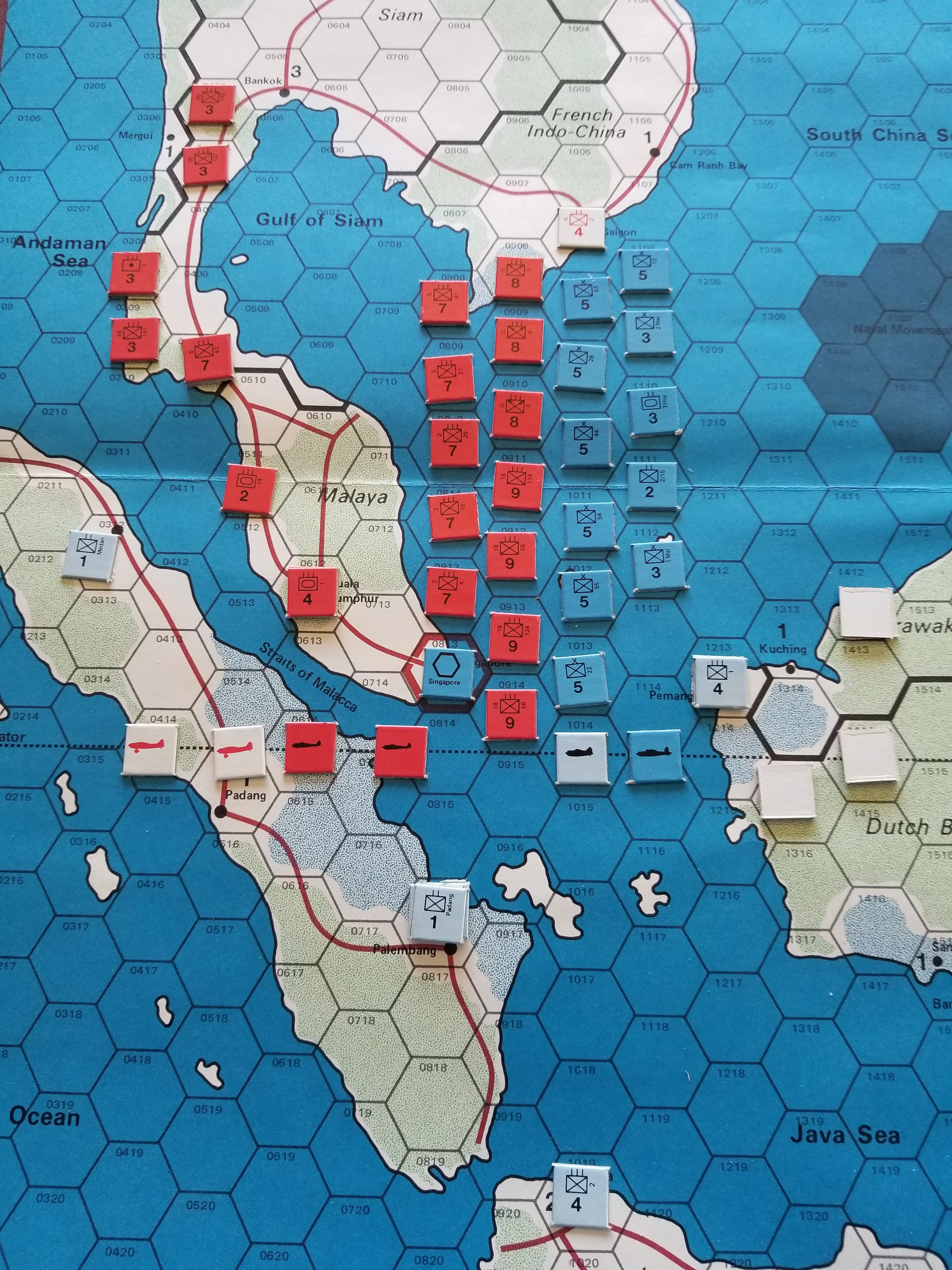
First Commonwealth, and then American forces withdrew to their fortresses of Singapore and Corregidor, respectively. There are no stacking limits in fortresses, so the Japanese were again forced to make low odds attacks.
The Turn 6 attack on Corregidor was at 3:1, with a +1 D6 roll. The Americans surrendered. The Japanese used Turn 7 to transfer air units. On the last turn of the game (Turn 8), the Japanese attacked Singapore, using all of their air power, including aircraft carriers. This support was countered by the lone Commonwealth unit, but augmented by Dutch air. That one air unit made all the difference. The 2:1 attack had a D6 roll of “2”, which modified by the +2 for air, with a result of “no effect”. If it had been a +3 for air, Singapore would have fallen.
The result was a marginal Japanese victory, as there were too many surviving Allied units (which reduce Japanese VIPs).
While not a simulation by any stretch of the imagination, this game forces the Japanese commander to shift resources and make attacks at lower odds than one would want; just like the real campaign. Likewise, the Allied commander has to eventually withdraw to fortresses, and hope for a positive outcome.
It’s tense, quick and fun.
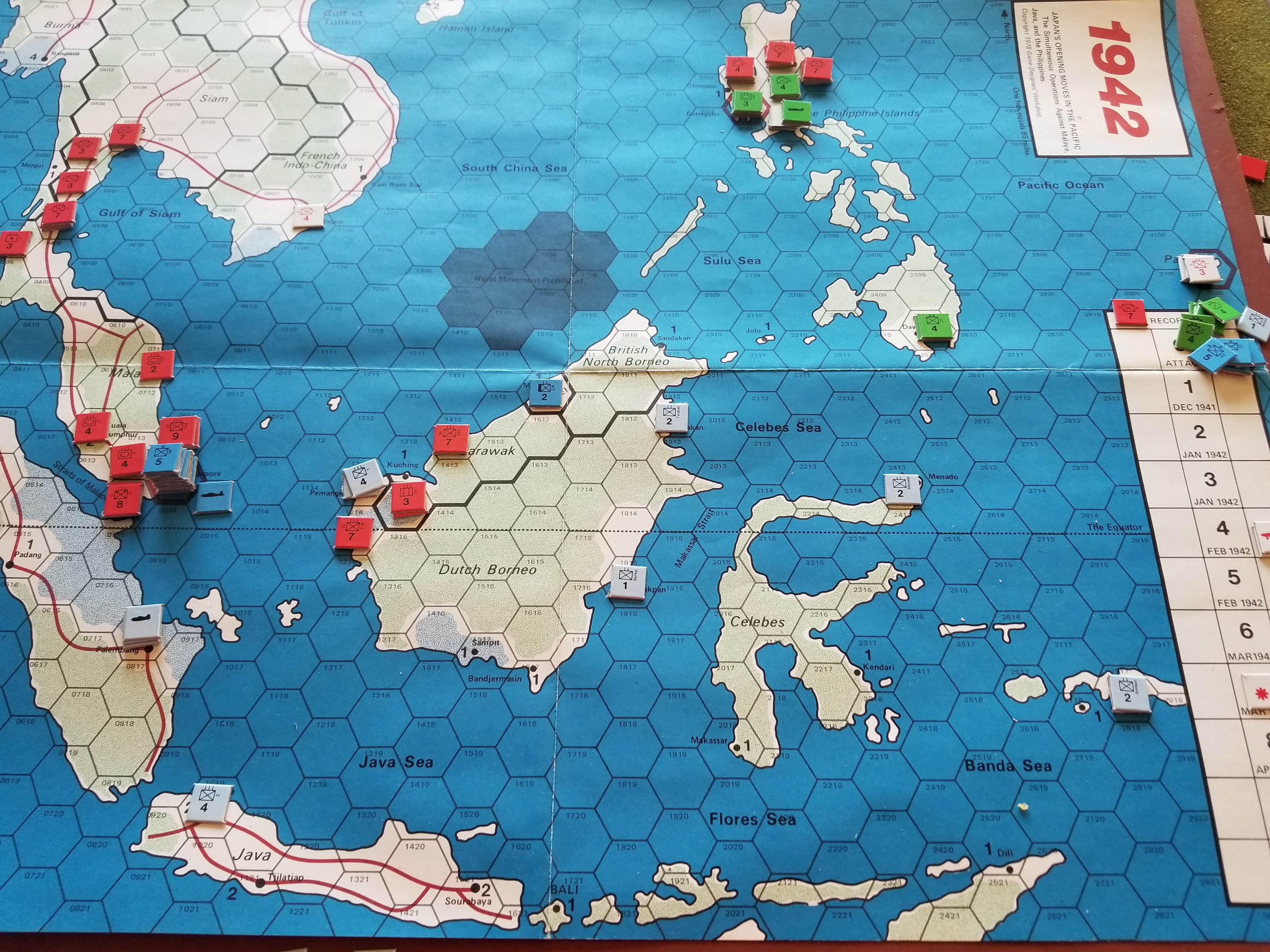
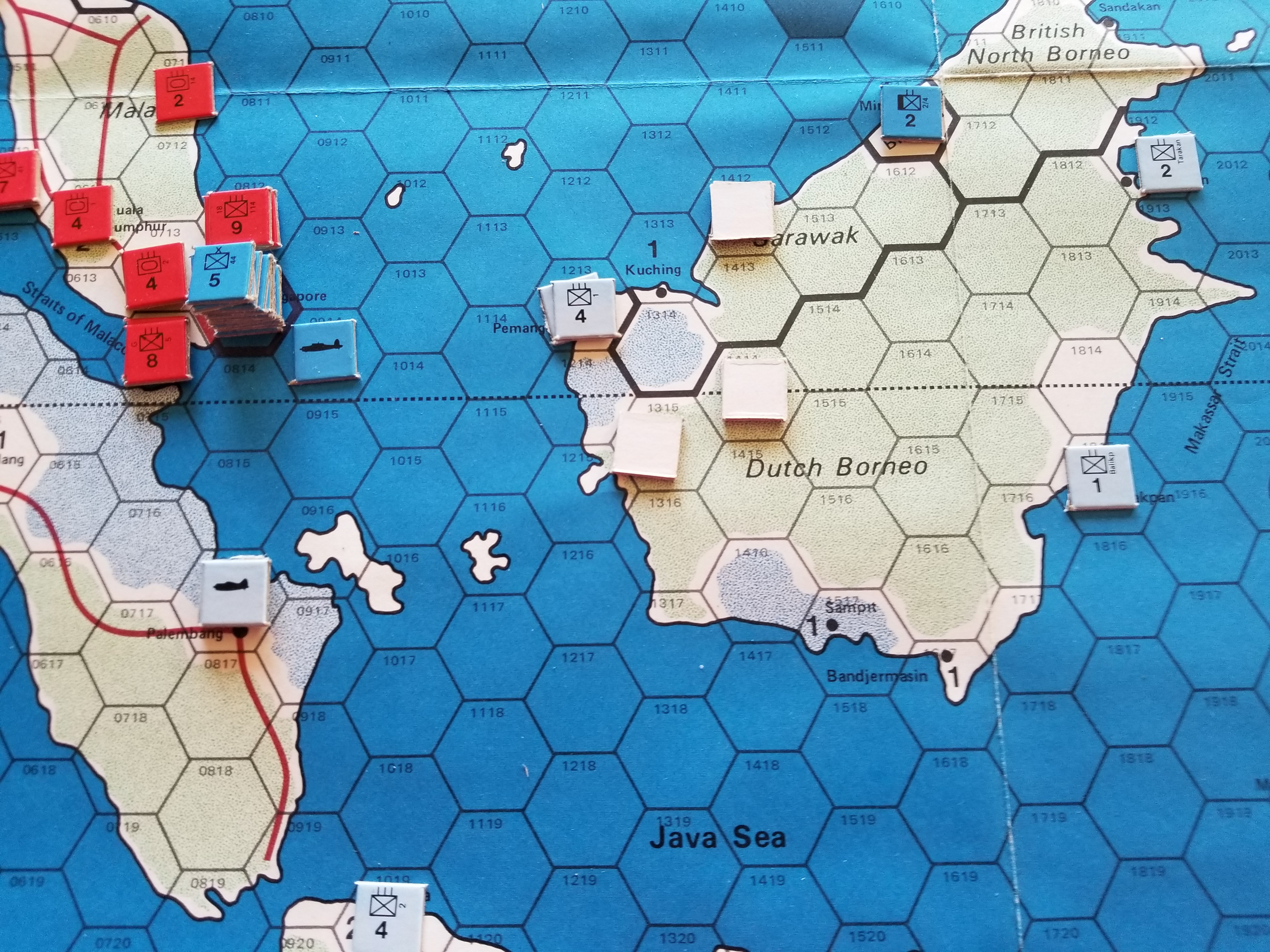
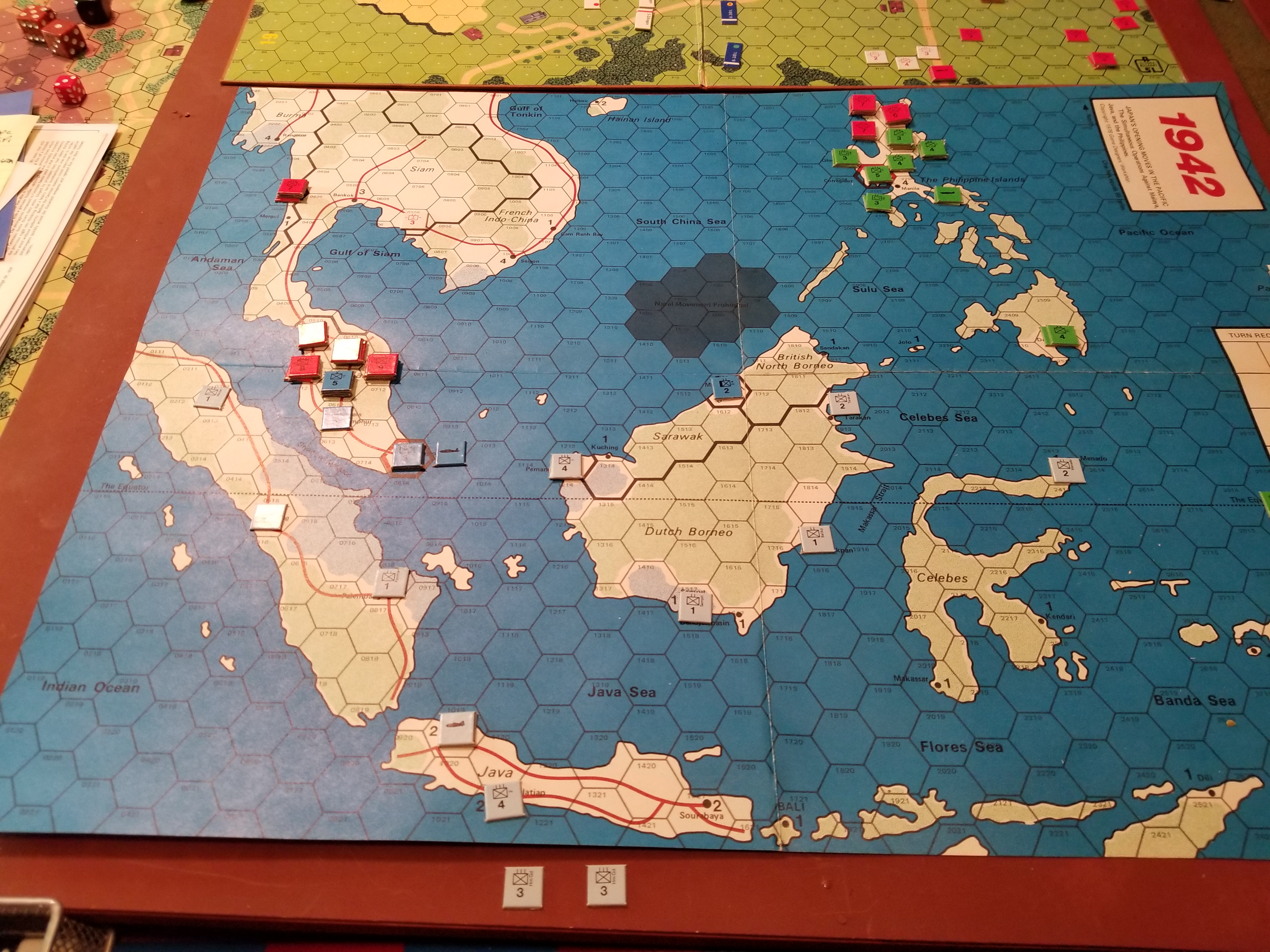
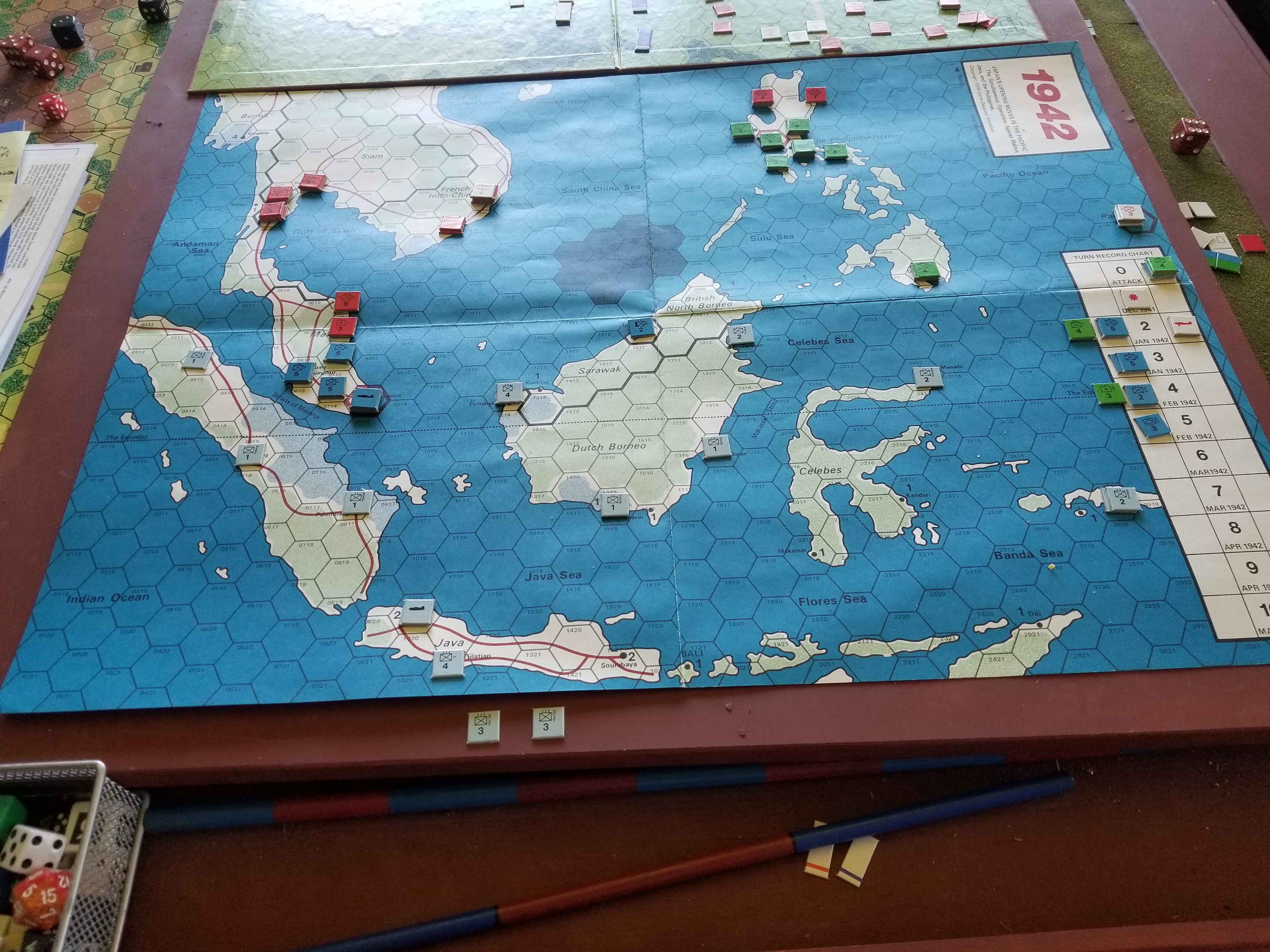
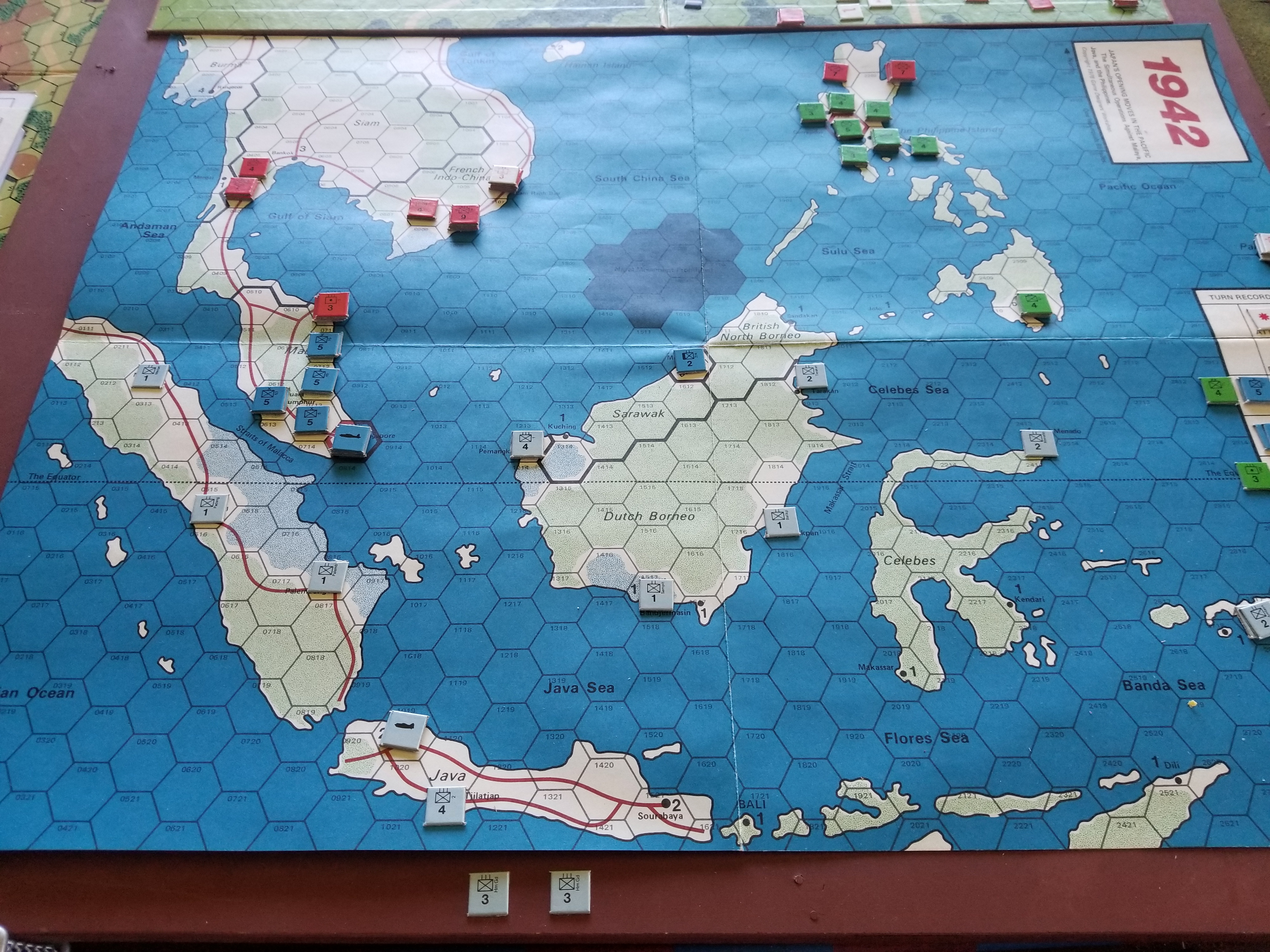
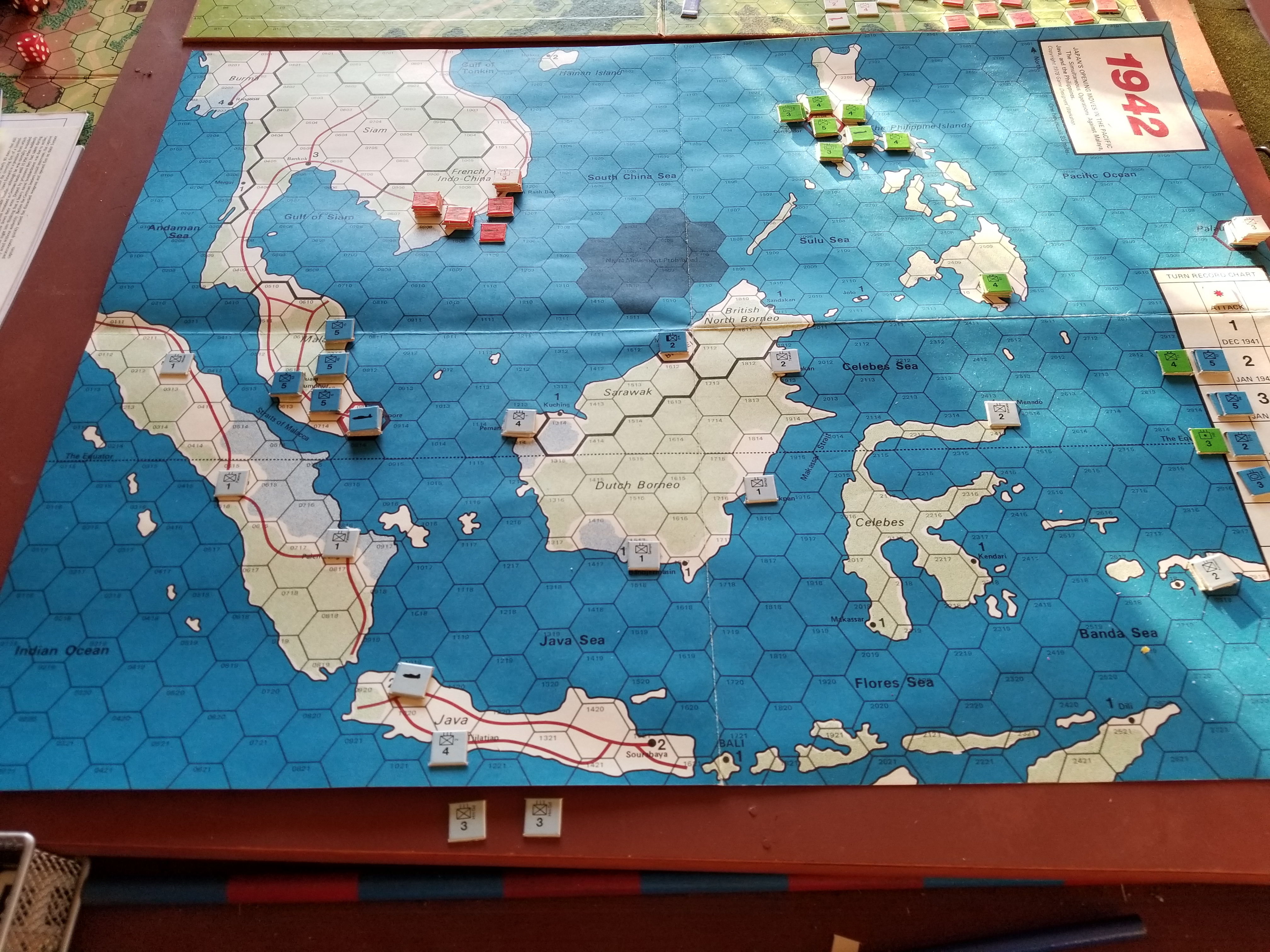
American Right Flank Is Disrupted. Japanese Close In On Dutch Garrison In Pemangkat. Dutch Air Umbrella Now Extends Over Singapore.Commonwealth Withdraws Into Singapore. Americans Preparing To Withdraw From Luzon To CorregidorBoth Commonwealth And American Troops Retire To Their Fortresses. Dutch In Pemangkat Are Surrounded.Japanese Attack And Capture Corregidor. American Units SurrenderJapanese Repulsed By DutchFinal Assault On Singapore
During the Allied (first) Phase of Turn 2, the Japanese suffered a slight reversal when the Americans destroyed the disrupted unit in Northern Luzon, and their main attack in the Malayan Peninsula was pushed back by Commonwealth forces.
Despite this, the Japan build-up in both areas continued unabated, at the cost of the additional naval movement points to sustain the landing areas.
Situation At End Of Allied Phase Turn 2. Disrupted Japanese Unit In Northern Luzon Has Been Eliminated.
While the Americans were able to stall strong Japanese attacks supported by Formosa based air units, the Commonwealth suffered a severe defeat in Northern Malaya. A bold (2:1 with +1 modifier due to naval air) attack resulted in four (!) Commonwealth units surrendering.
During Turn 3, the British commander, faced with the possibility of overwhelming flanking attacks, ordered a general retreat into the Fortress of Singapore. The Dutch responded by shifting their lone air unit to support Singapore. Japanese units then moved to surround the fortress. The Americans chose to consolidate their Northern Luzon defensive line and await the inevitable Japanese buildup and assault.
Decided to go with the historical Japanese invasion plans as outlined in Christopher Shore’s Bloody Shambles. His account of the air campaign is one of the most harrowing tales of military history I’ve read.
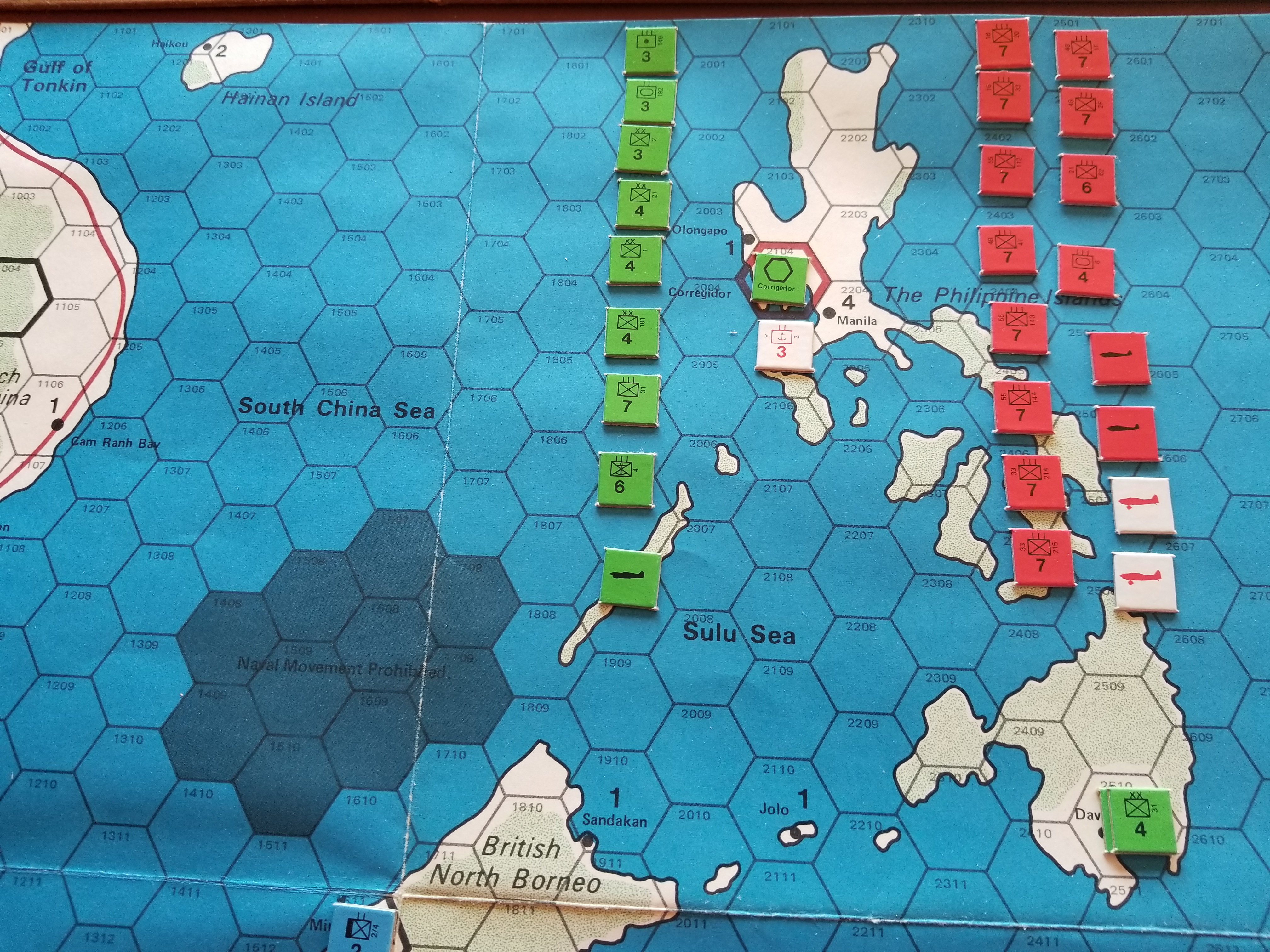
The Japanese landed on the west coast of Malaysia and the northern Philippines. Each landing area was outside of the (Turn 0) reduced Allied air umbrella.
Both Japanese beachhead assaults resulted in D6 roles of six, with the defeated Allied forces captured (with accompanying victory points). Each assault was supported by naval aviation assets.
In the following first phase of Turn 1, the Allies counterattacked. The American attack disrupted one of the Japanese beachheads, while the Japanese in Malaysia were forced to retreat.
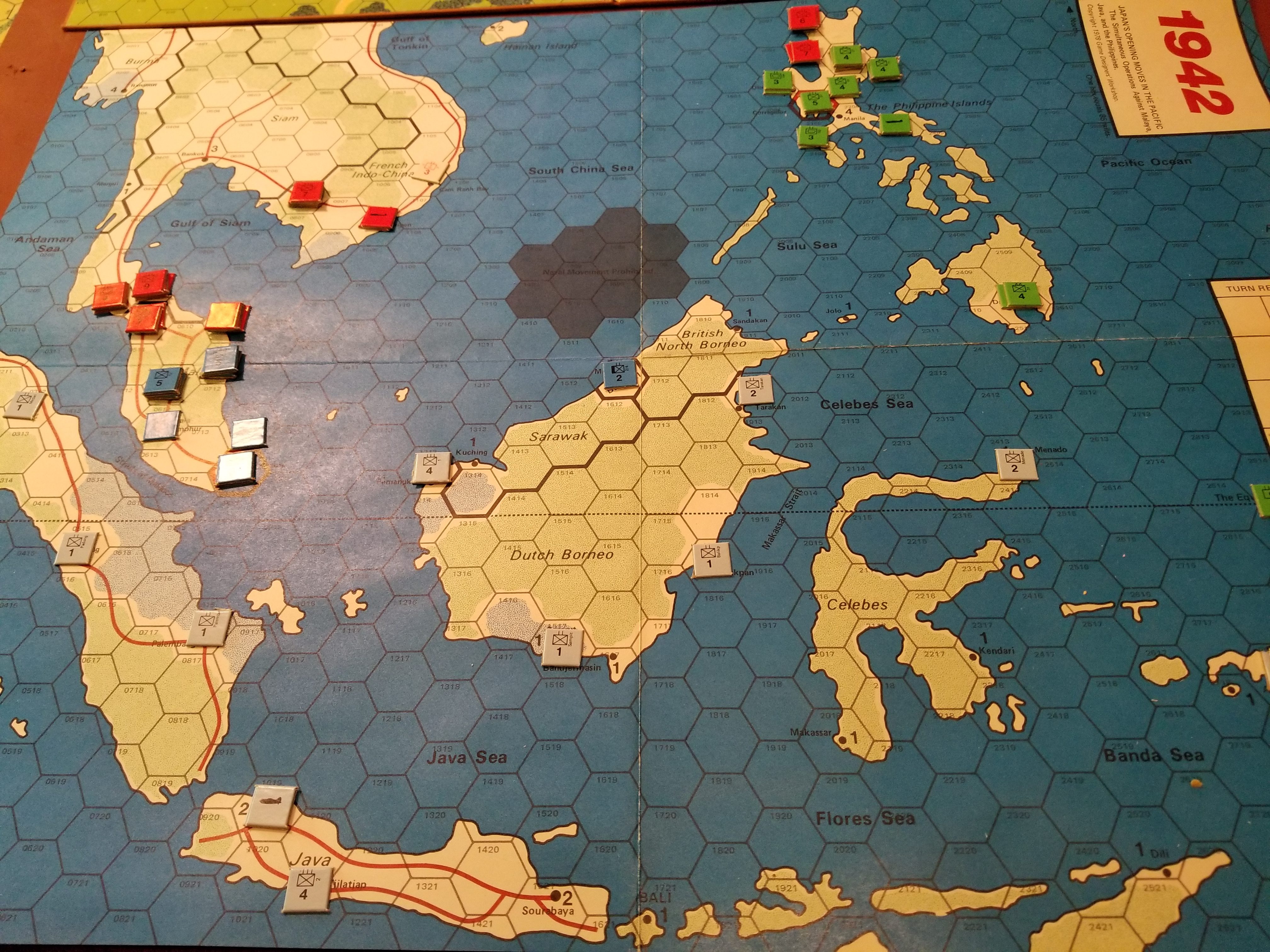
1942 is a simulation of the opening months of WW2 in the Pacific. Published in 1978, it is one of GDW’s Series 120 games ,all of which were designed to be finished in two hours. I’ve played a couple of the tactical games, but have always been intrigued by the three strategic games (1940, 1941 and 1942) in the series. For me, 1942 is a more interesting topic than the already over-published Fall of France and Barbarossa campaigns. I picked up a used folio version on EBay.
As you can imagine, it is a highly abstracted game.
Land units have a single strength rating, and all can move five hexes per turn.
There are no naval counters or combat. Land units simply move across sea hexes. A designated number of units can move (NMPs) by sea each turn. Additional NMPs are expended for amphibious landings, and to keep an invasion beach open as a source of supply. Some Japanese units have inherent naval movement capabilities.
Land based air units have an “umbrella” extending four hexes from base. Air units either attack units moving by sea, or assist in land combats within their “umbrella”. Air units may displace eight hexes and still maintain their “umbrella”. Japanese naval air units move by sea, but must be reconstituted (taken off board) for two turns after use.
Cities provide supply points to support units. Ground units out of supply cannot attack, and air units cannot function. Once a city is captured, it no longer provides supply to either side.
My initial impression is…… this is going to be really good, or really marginal.
Small Package! Initial Setup. Green – US, Blue – GB, Light Gray – Dutch.
Tim forward these comments. I give him full marks for having the psychological health to even remember the traumatic experience………….You can read his comments on our earlier game, here.
Man, what a weird game…You could probably tell, but I was mentally off balance after my atrocious dice rolling…I think what frustrated me is that I knew that you would be getting many, many replacements and reinforcements and that I needed to hit you hard when I had the chance, so the poor results from my opening attacks blew up my strategy. Then, I didn’t fall back far enough…
I think the Poles after the opening attacks should fall back quite a ways, at least far enough where it takes a while for Russian replacements/reinforcements to get to the front. That also helps to shorten the line and free up troops for counterattacks. I wonder if it would be the Poles’ while to knock out the Lithuanians during the period when they can’t attack in the North. I’m not sure, but it would be good to be actually doing something in the North….
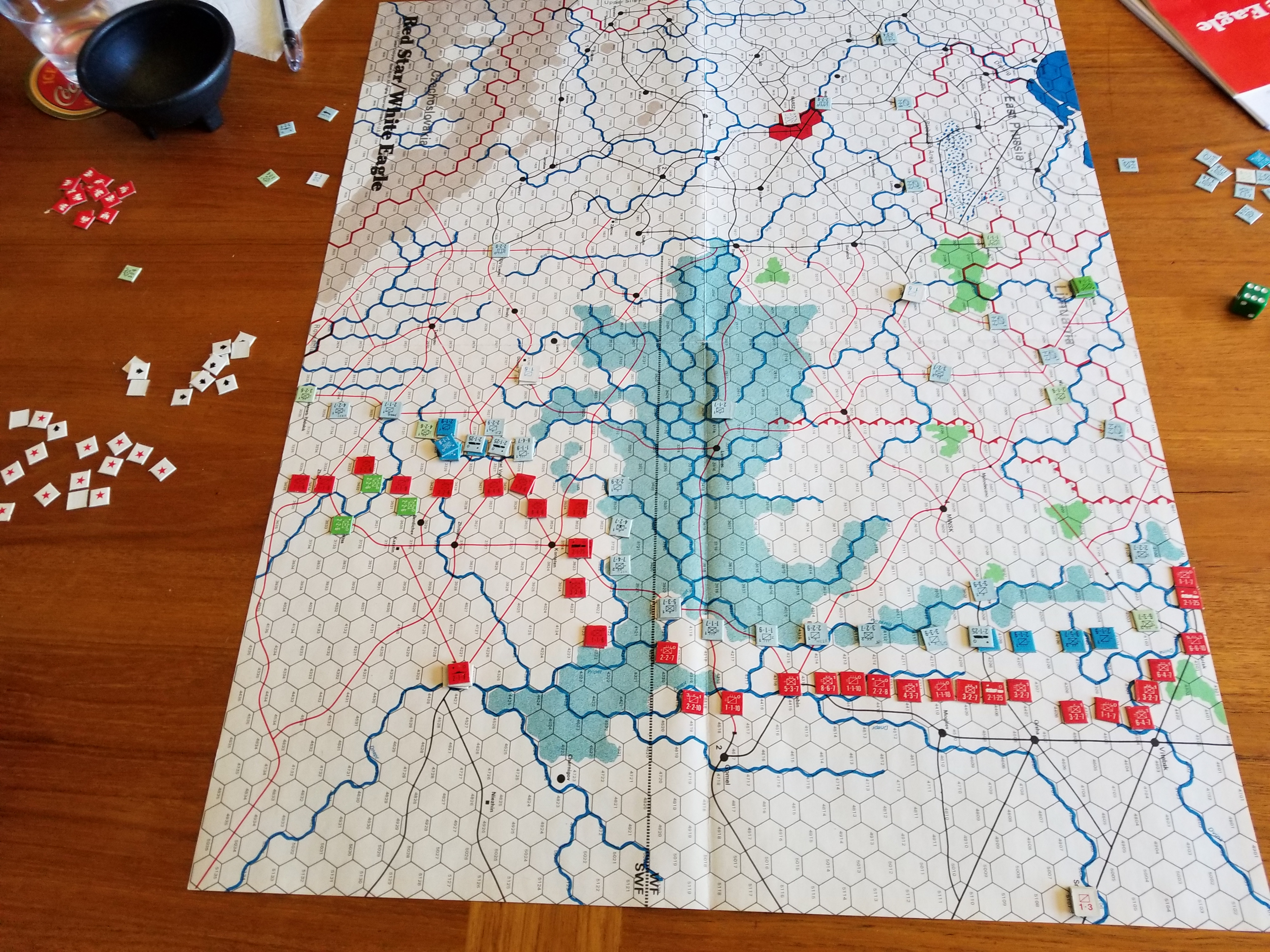
Tim came over for part of the Fourth of July weekend . Our game of choice was not really in the spirit of the holiday. While we have played Red Star/White Eagles Eagle before, this weekend was an entirely new experience . Once again, Tim took the Poles.
Here’s a summary of the important rules/characteristics of the game.
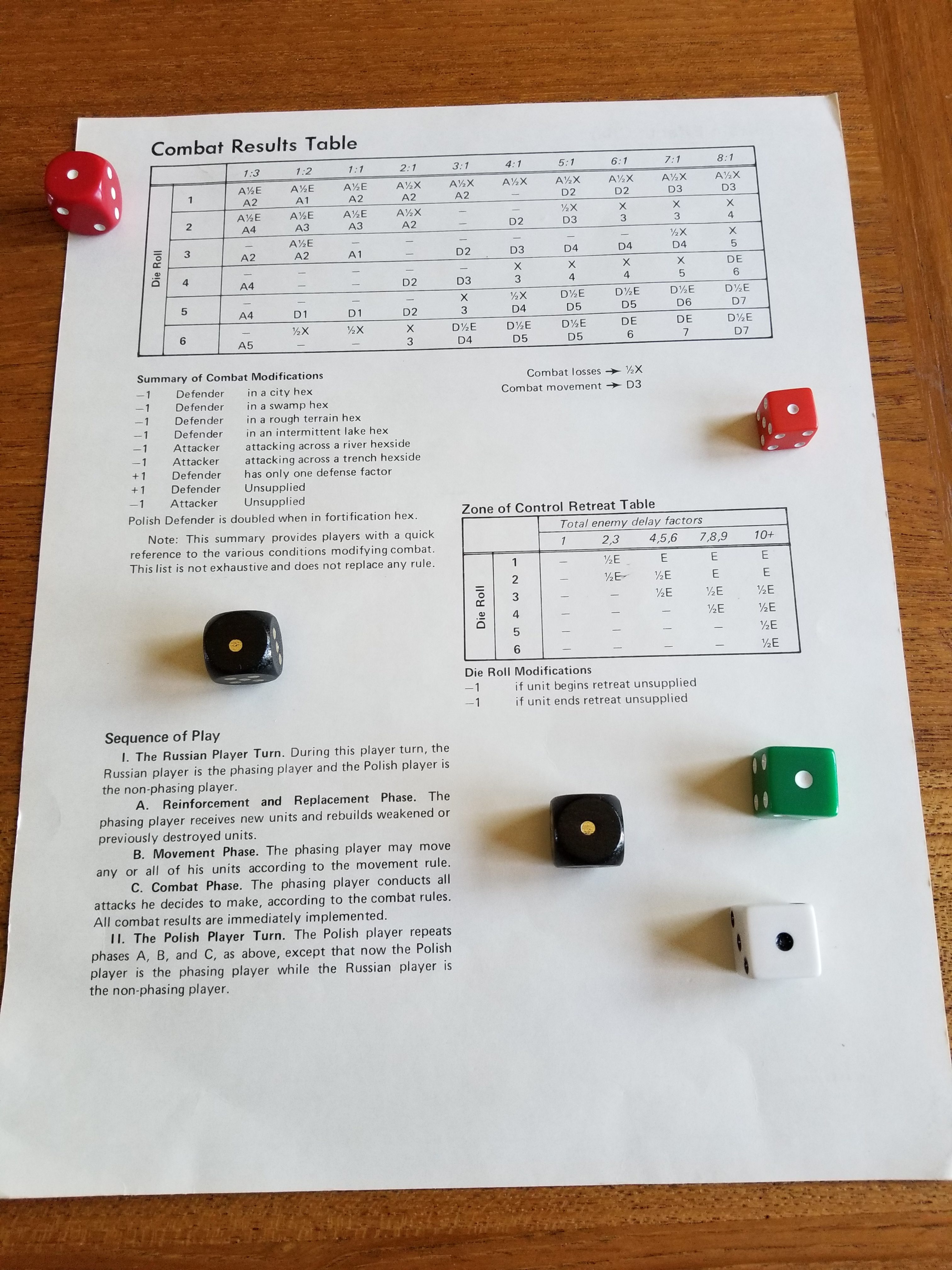
Bloody Combat Results Table (more on this later).
Extended Movement After Combat (both advance and retreat).
Strong Zones of Control for many Polish units (these can limit advances after combat and attrit defeated units retreating through the ZOC).
Soviet Fronts cannot cooperate.
Lack of traditional strong defensive positions (only forest and river lines that have exploitable gaps).River defensive positions lose their modifier if one attacking unit is not attacking across the river.
Fronts separated by Pripet Marshes
High reinforcement and replacements, especially for the Soviets.
Four turns per month.
Victory points awarded for capture of specific cities, only.
Tim arrived Friday afternoon having fought early holiday traffic and drivers of marginal capabilities . After sucking down three Henrys (each….I had to show solidarity), we set up and played three turns .
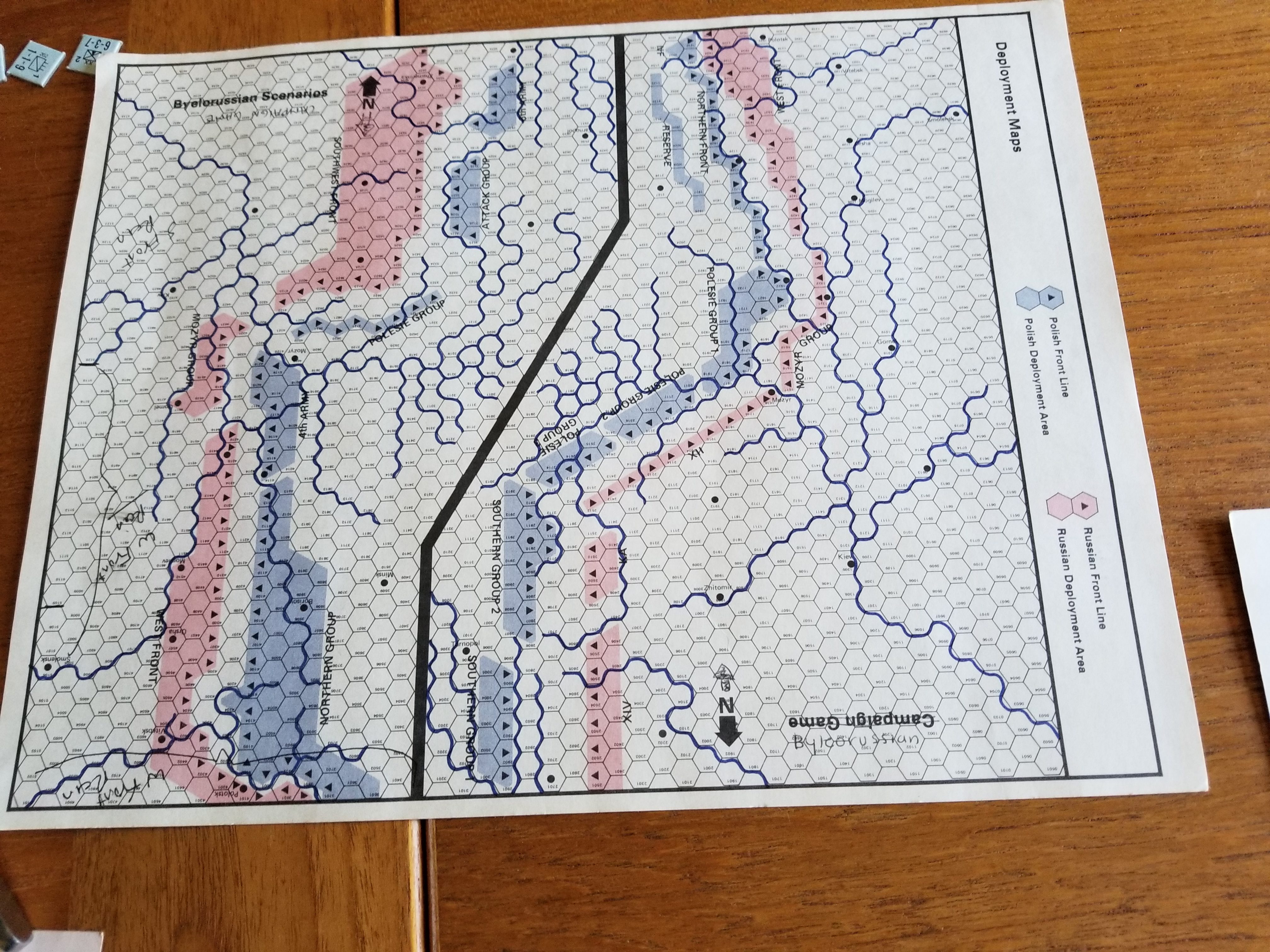
Play resumed the next morning. Right after we sat down Tim muttered , “You are going to hate me.” The initial set up was all wrong . Some might say alcohol had been involved , but the real culprit was the horrifically flawed set up diagram . Yes, it’s covered in the errata………
***Important Disclaimer*** I have absolutely no idea why all the photographs are canted. I am unaware of any body/head/eye bias that might have caused this. Also, the level of drinking was reasonable. May need tests.
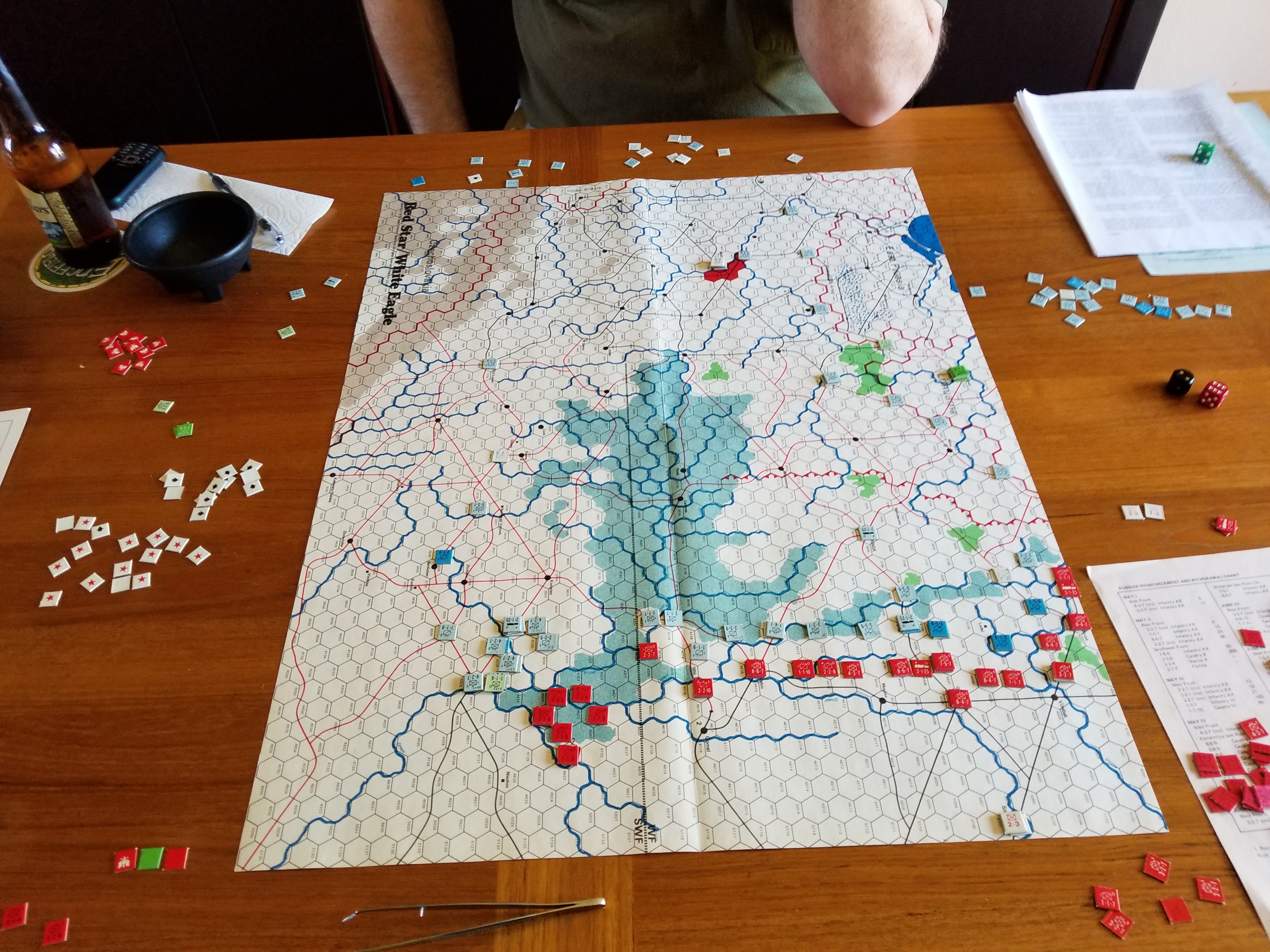
The Set Up Diagram. Note Handwritten Annotations For Errata…..They Didn’t Help.Initial Setup Mk II. I Think We Got It Right This Time
After we reset, things went from bad to worse for Tim. His southern front offensive staggered due to a series of D6 rolls of one. In this game a D6 role of one is not simply an exchange based on the defenders strength, it is an exchange where the attacker loses one half of its attacking force. At odds of 5:1 to 8:1 this is a staggering loss . In the past we assumed that the CRT was the same as that for Europa – after all the game’s mechanics are very similar to that system. The result was high levels of anxiety when rolling for an attack.
Tim’s Nightmare
Tim’s rolls were so bad I gave him three Mulligans . While this might seem overly generous, I realized that this results table could cut both ways .
Despite this bad luck the Poles took Kiev .
Poles Take Kiev.
Early in the game almost all of the action occurs in the south . Both players are limited in their options in the north due to a mandated Red Army stand down .
The other defining aspect of the campaign game is the arrival in the south of the Konarmiya Cavalry Army on the May IV turn. This is a powerful force made even more dangerous due to a charge bonus which increases the value of its cavalry’s by fifty percent . A combination of the early stand down and appearance of the Konarmiya puts the Soviet player in the position to launch very strong offensives on both fronts beginning with the June I turn.
Anticipating this, the Poles began a series delay/defend actions covering the withdrawal of both fronts to more favorable defensive positions. He skillfully took advantage of the ZOC control of of withdrawals, using some units for the delay/defense.
Favorable is a subjective term in this game as there is very little rough or mountainous terrain on either side of the Pripet marshes . The river lines while affording some defensive bonuses have significant gaps which can be flanked .
The Poles were subjected to a number of aggressive attacks, with the Soviets focused on flanking Polish units. The Soviet player can afford to be aggressive due to a very high rate of both reinforcements and replacements. And, yes, I had use those Mulligans.
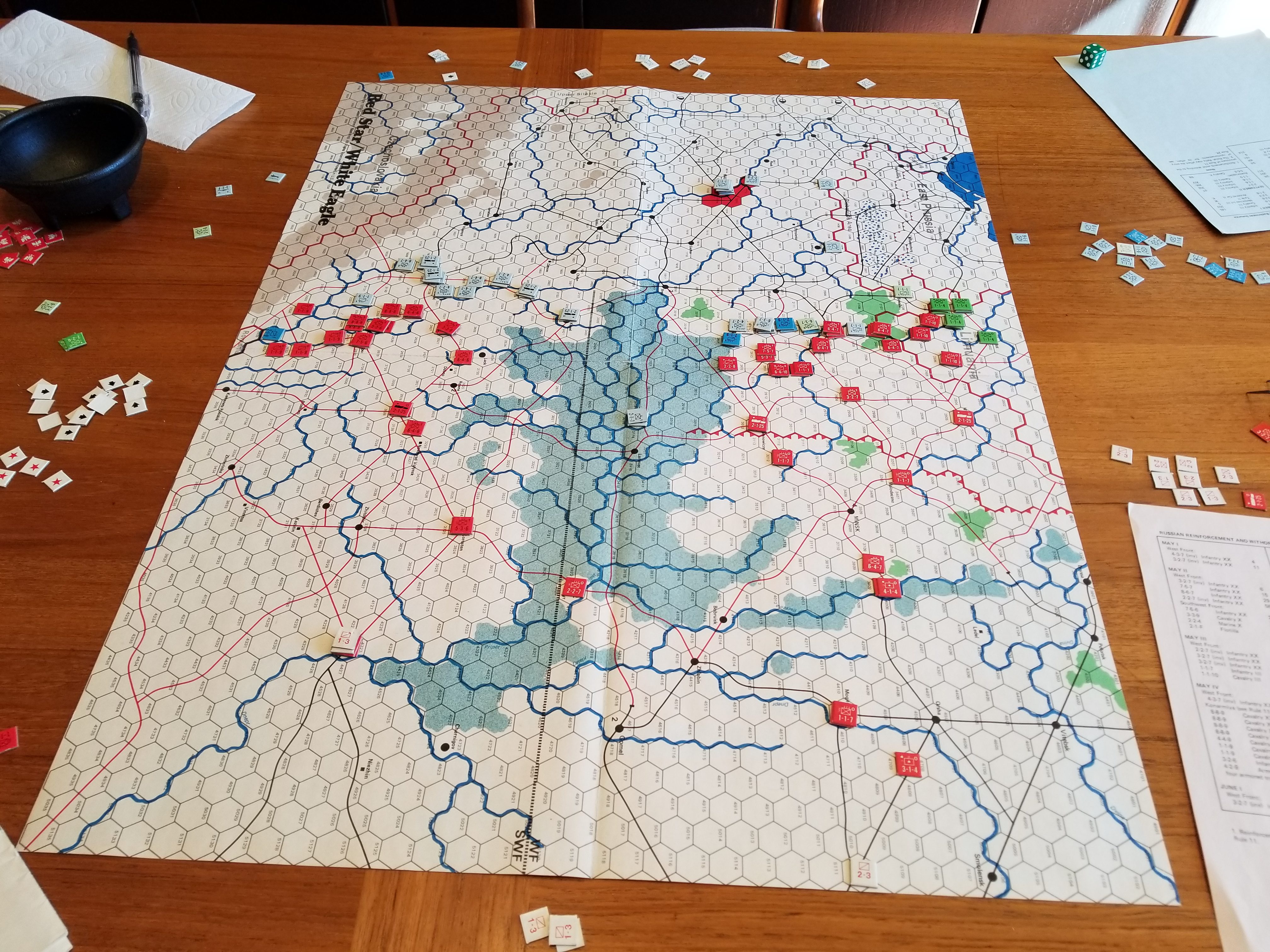
We called it quits after the July II turn. The Poles’ only hope was to hold on for another ten turns, when the Konarmiya must withdraw. Any destroyed Konarmiya units have to be replaced by other units, which could significantly attrit the Soviet forces. At that point, the Poles have only one turn to advance and grab as many cities as possible.
July II. End Game
The terms Tim and used most often when playing were “weird” and “crazy”. The CRT is a little different, the die rolling was crazy, but it was an interesting game.
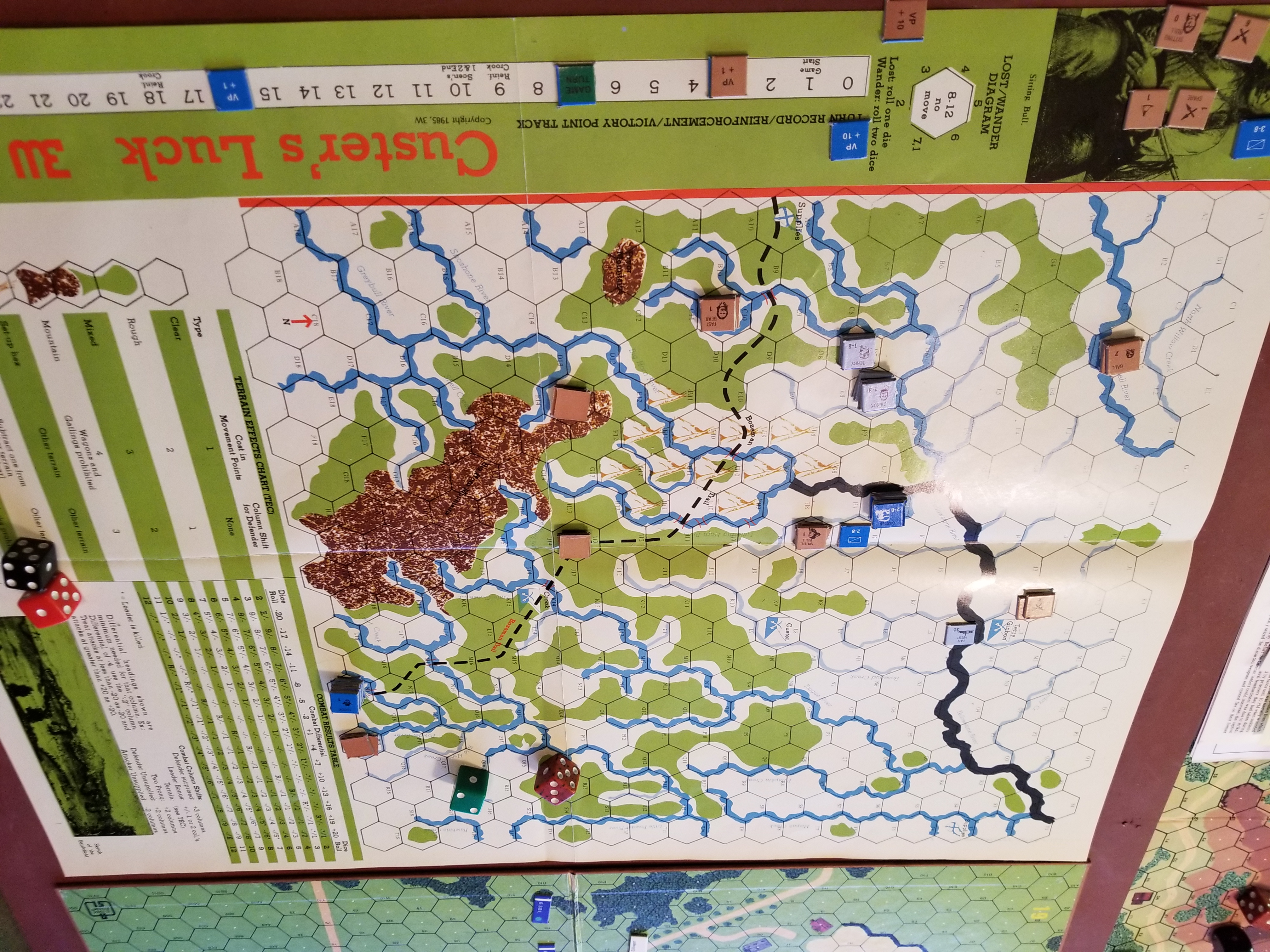
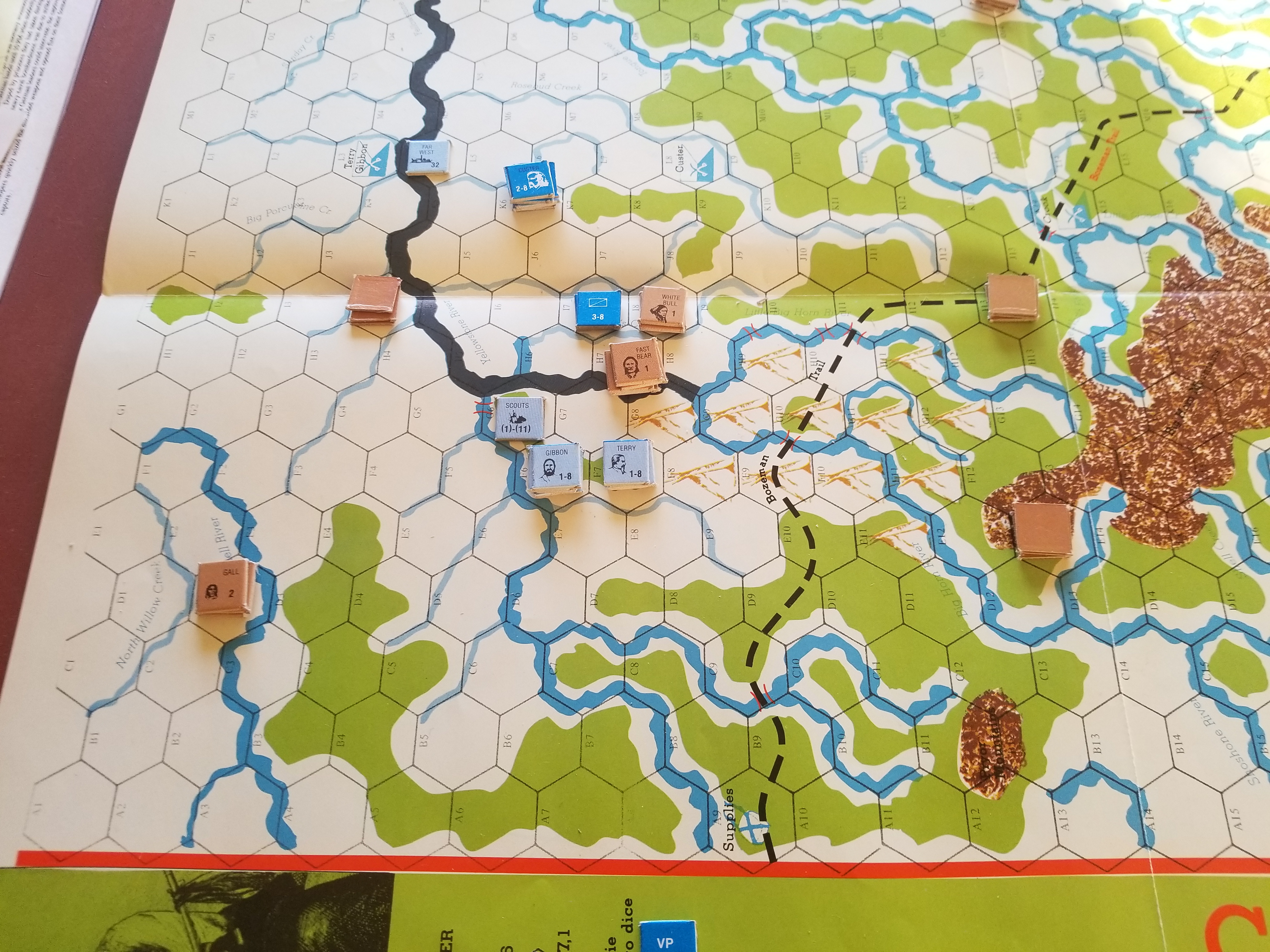
Turn 7 saw Terry/Gibbons’ continued success in the south and a lack of “Custer’s Luck” in the north.
Terry/Gibbons cleared all hostiles south of the Little Bighorn. But, Custer’s force was attacked and mauled by White Bear. Despite this loss, the Army now has 19 VPs, the the hostiles have scattered to the fringes of the map.
White Bear Attacks Custer’s Detached BattalionSituation At The End Of Turn 7
I probably screwed up the rules (shocking!) when it came to the requirement that hostiles retreat after combat (disregarding the 8-12 roles that called for them to remain stationary). Probably cost the hostiles some VPs, but it didn’t intefere with my enjoyment of the game.
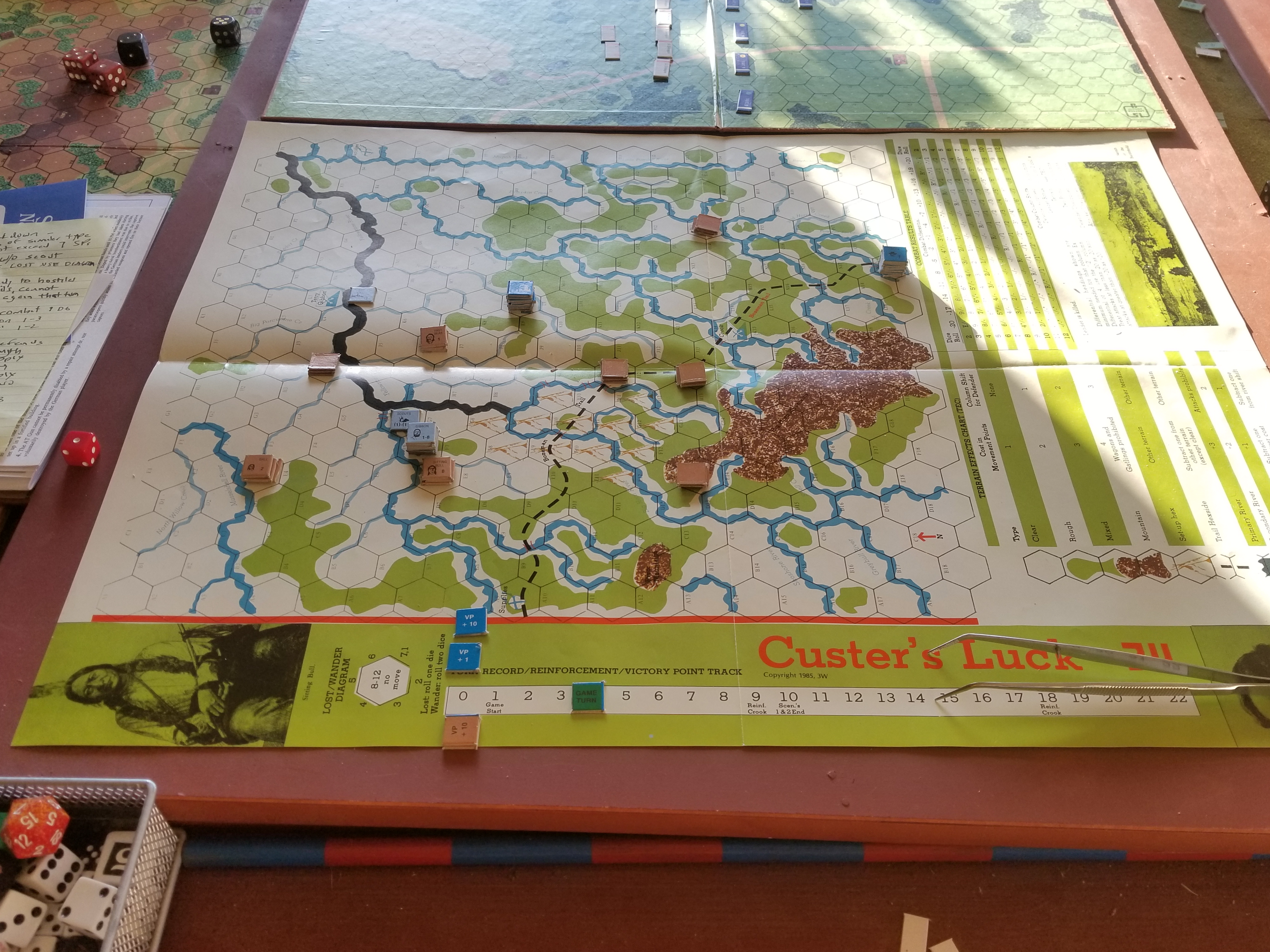
Going to pack this one up to make way for 1942. But, this isn’t because Custer’s Luck is a bad game. It’s fun; a good solo romp that has a quick set-up time, easy rules, and, yes, randomness.
You get a glimpse into the problems faced by the Army during these campaigns. “If only they’d stay still….we could get ’em.”
I’ll play it again.
Tim’s in this weekend for another go at Red Star/White Eagle.
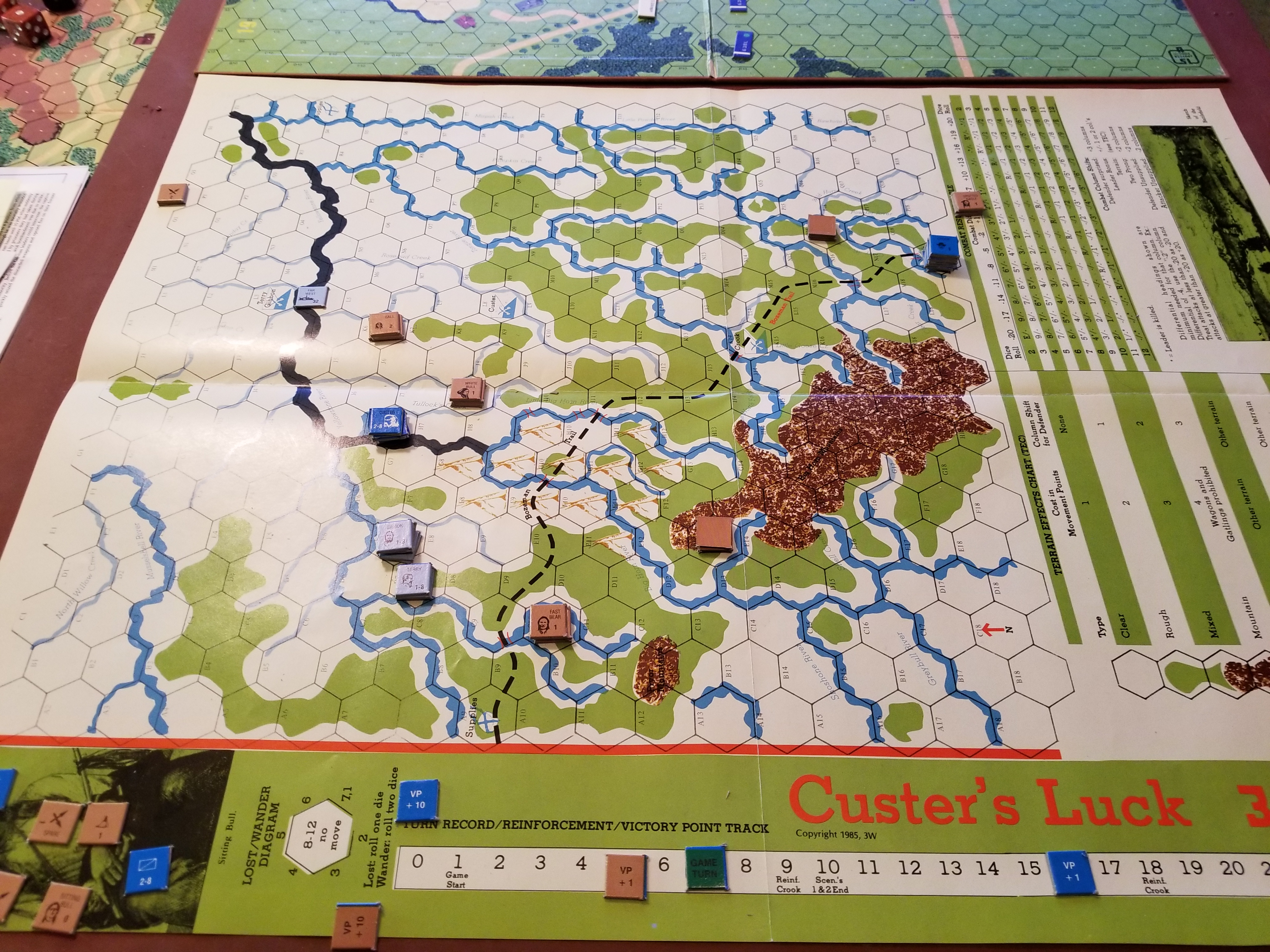
Custer attacks both Fast Bear and White Bull, causing casualties and forcing White Bull to retreat. Which may not be a bad thing.
Terry/Gibbon command keep grinding down their opponents, also killing Lame Deer.
Each command was able to find, maintain contact, use envelopment (in game terms “prong attack”) to attack, and inflict casualties. Doctrine in action (?).
The system’s randomness has created some interesting situations, with plenty of give-and-take. It really is fun, with the “Hostiles” bouncing all over the map.
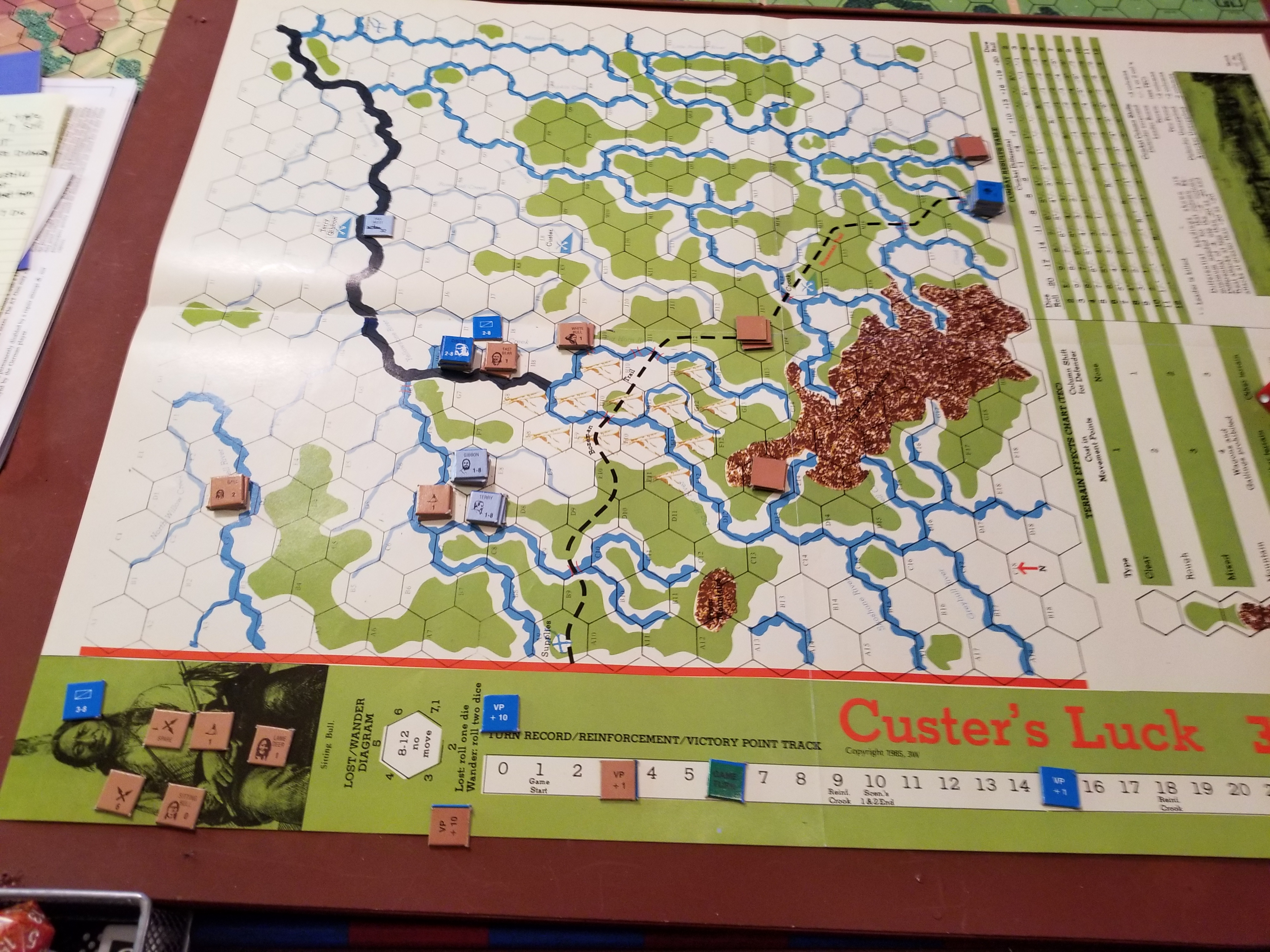
In Turn 4, Sitting Bull’s weak contingent attacks Terry/Gibbon’s combined arms force despite overwhelming odds.
During Turn 5, Terry/Gibbon maintains contact with Sitting Bull, while Custer envelops Little Bear’s force. Sitting Bull’s force is destroyed, and Little Bear takes casualties.
Later in the turn, Custer is attacked by Sioux drawn like moths to the flame of randomness. One of Custer’s battalions is destroyed.
At this point, who knows what the hell will happen. At the end of Turn 5, Army has 9 VPs, Hostiles 3.
1. Concentrate U-Boats. Downside is that ASW becomes more effective.
2. Concentrate in North Atlantic only if Convoy marker is there (Allied ASW typically concentrated in North Atlantic).
3. Keep Donitz in the Sub Pens (didn’t go into this in my initial review), because his presence reduces chances for ASW capability increases.
Author states that BoAT is a difficult game to win. He offers optional rules to help the Germans (see previous post).
The article includes rules clarifications and references an excellent review from WebGrognards.