Category Archives: Sessions

Mired and Dumb

Thrashing now.  Trying to reconcile the game system with reading Napoleonic tactics.  Disconnect with battalion/regiment frontages and depths.  Of course, all of these book dictates are conjectural, based on manuals, pundits, and the revisionist interpretations of manuals and pundits.

One hex in Squad Leader is 40 meters or just over 43 yards.  The hex width is 3/4 inch.  Counter frontages in System 7 are one inch equals 40 yards.  Battalion frontages were 75 yards.  Not a match, but close enough.

The real problem appeared to be  a company counter depth of 5/16 inches or roughly 14 yards in scale.  According to my interpretation of a Chandler, a six company battalion advancing in column would have an overall depth of 15 yards.  This is problematic, especially since according the rules, maximum stacking is two companies, which leaves a depth of 42 yards per battalion if attacking with two companies abreast.  All of that just doesn’t make sense and at this point I was dizzy.

Somehow came to my senses, looked a few more resources, had a pop…..ahhhhhh…the depth was 15 yards per company or  45 yards.

Heavy sigh……


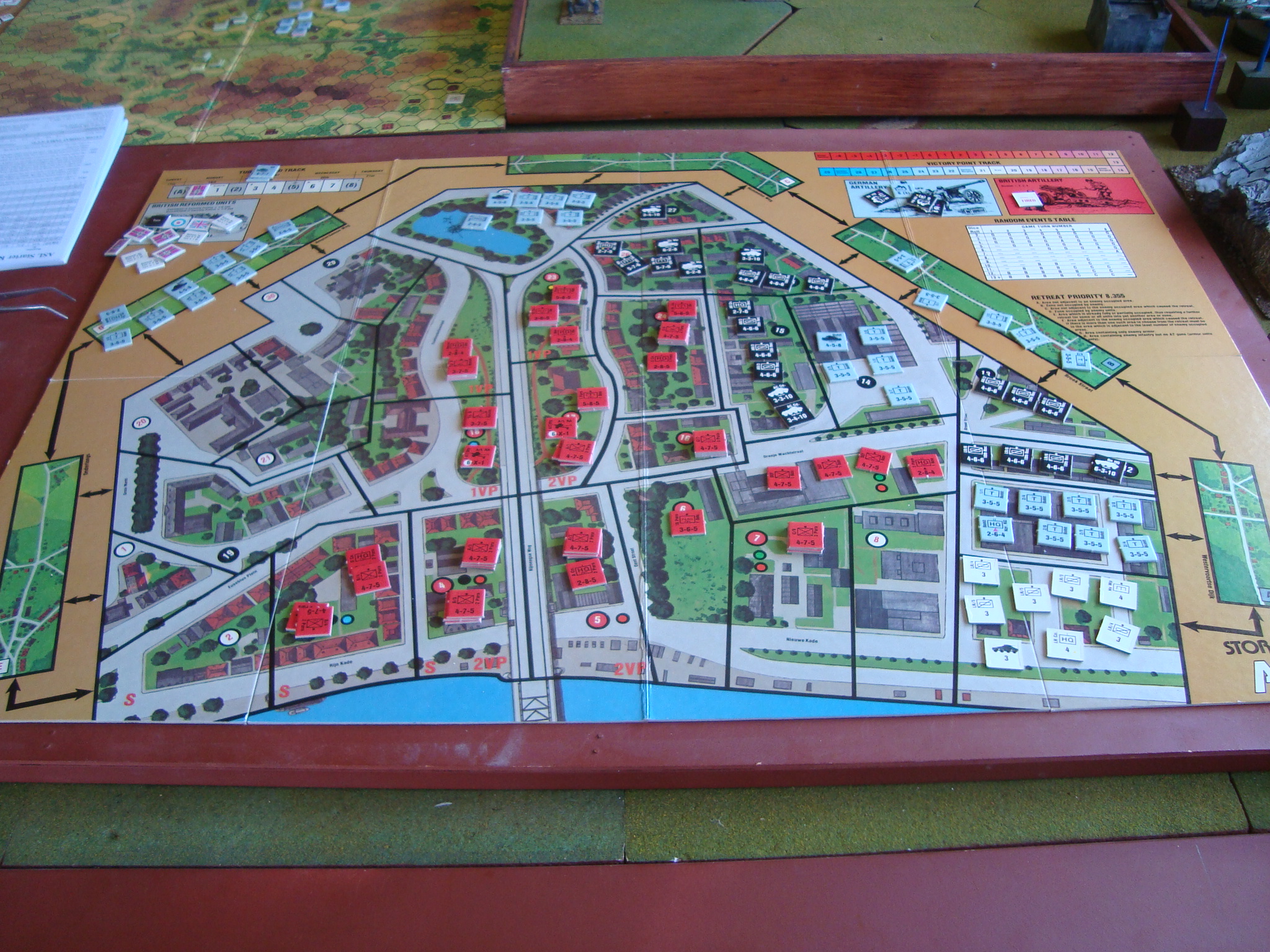
Storm Over Arnhem

I like this game……I really do.  But, for some damn reason I found it hard to start pushing the counters.

Some games you just can’t wait to get to the table and play the next turn.  Examples?  Can’t roll that one over in my brain right now,   have to focus on SOA.

A highly regarded game that has spawned a number of “Storm Over” games.  Great area movement map, big counters (no tweezers needed), rules are……hmmmm, well maybe it’s just my learning style.   Perhaps the problem is the chrome with tanks, reformed units, bren carriers, and setting fires.  This play aide found over at Boardgamegeek was very helpful.

I really like the  impulse turn system involving individual sectors,  and units becoming more vulnerable after they have either moved or fired.  This leads to a cat-and-mouse tactics (at least in my first play).  You don’t want to move/shoot a unit that would be “flipped” to a committed status with a lower combat/defense strength with a full-strength enemy adjacent to your area. On the other hand, an area can only be fired on once a turn, so one has to maximize an opportunity to attrit an opponent.

Close-combat is a separate phase with all  committed units flipped to their active side,  engaging in new combats with any enemies in their sector.

Outcomes are dice-tastic, but generally reasonable.  Lots of counter-punching (no pun intended) with one side reacting to their opponents preceding move.

Maybe what I like is the problem; yes isn’t that the way of the world.  Constant back and forth with no respite for the solo player.  It would  be really fun FTF, especially with RAW restricting the time a player has for each impulse.

In my first try I relied on the British set-up used in the Avalon Hill General.  My German tactics were relatively ham fisted, blasting away at British units, with results less than optimal.  Pretty sure the Brits will prevail.

But, we’ll never know.  Time to take it down and make way for System 700.  However, this quality game will be back on the table sooner rather than later.

Maybe I can talk Tim into playing……

By The General Set-Up. Very Nice Looking Components.


Tanks – BEF Breakthrough Pt III

Had too much fun yesterday with another session of Tanks.

This time it was the A-9s and A-10s (Cruisers) versus the Germans.  And, this was a wild one.

The Cruisers formed a box formation, veering to the West in an attempt to exit the map.  The Germans used their “Blitzkrieg” ability (can use the repair phase to make extra move, for a total of 3 moves in a turn), to get into the copses and prepare for stationary fire under cover.

The British engaged immediately, and managed to knock out the Mk III, as well as getting into a multi-tank and point-blank duel with a Mk IV.  After knocking out the Mk IV, the remaining British threw caution to the winds and took multiple moves, risking breakdown on a die roll of 6.

One Cruiser broke down, but the others were able to move off the board.

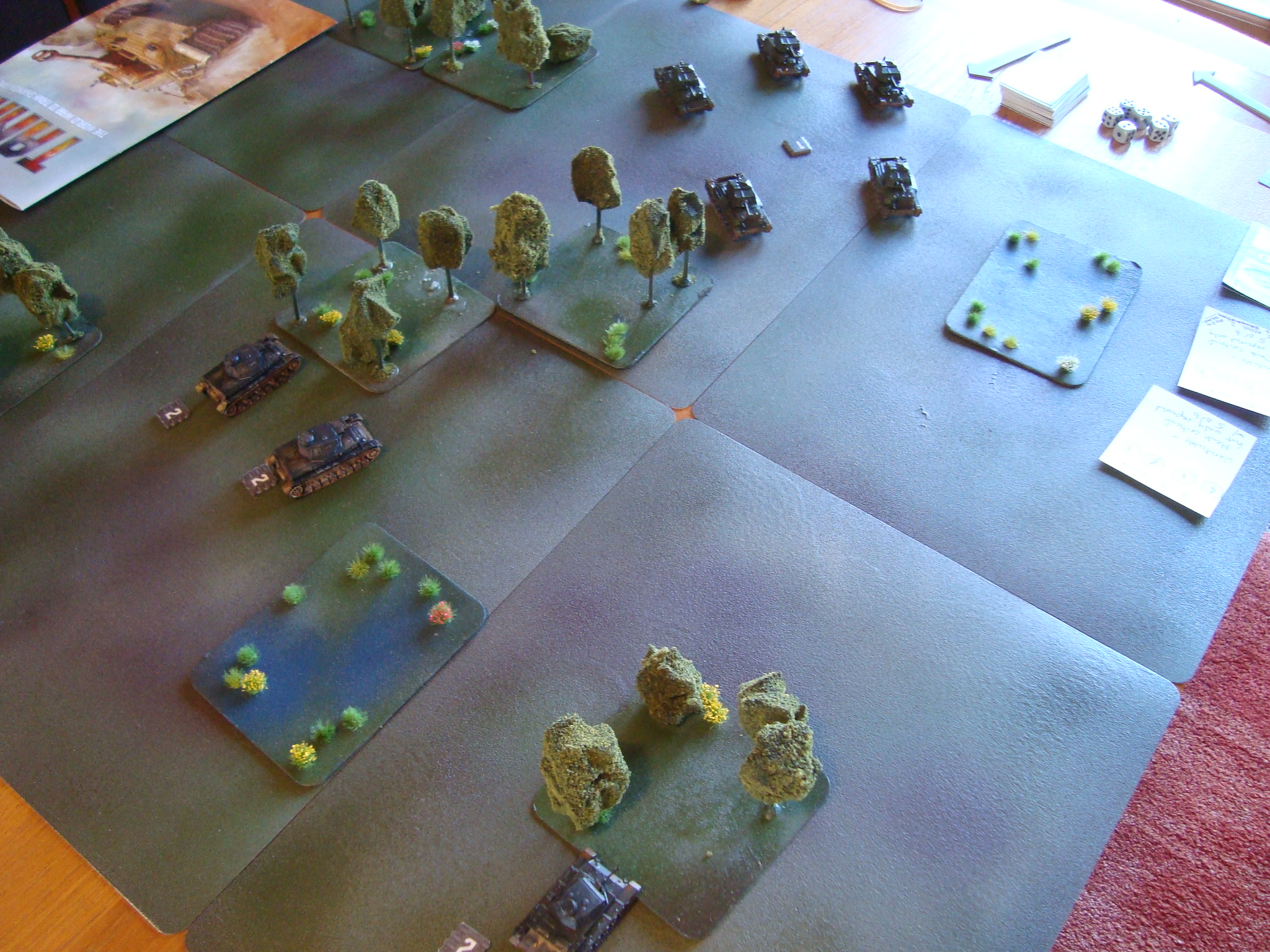
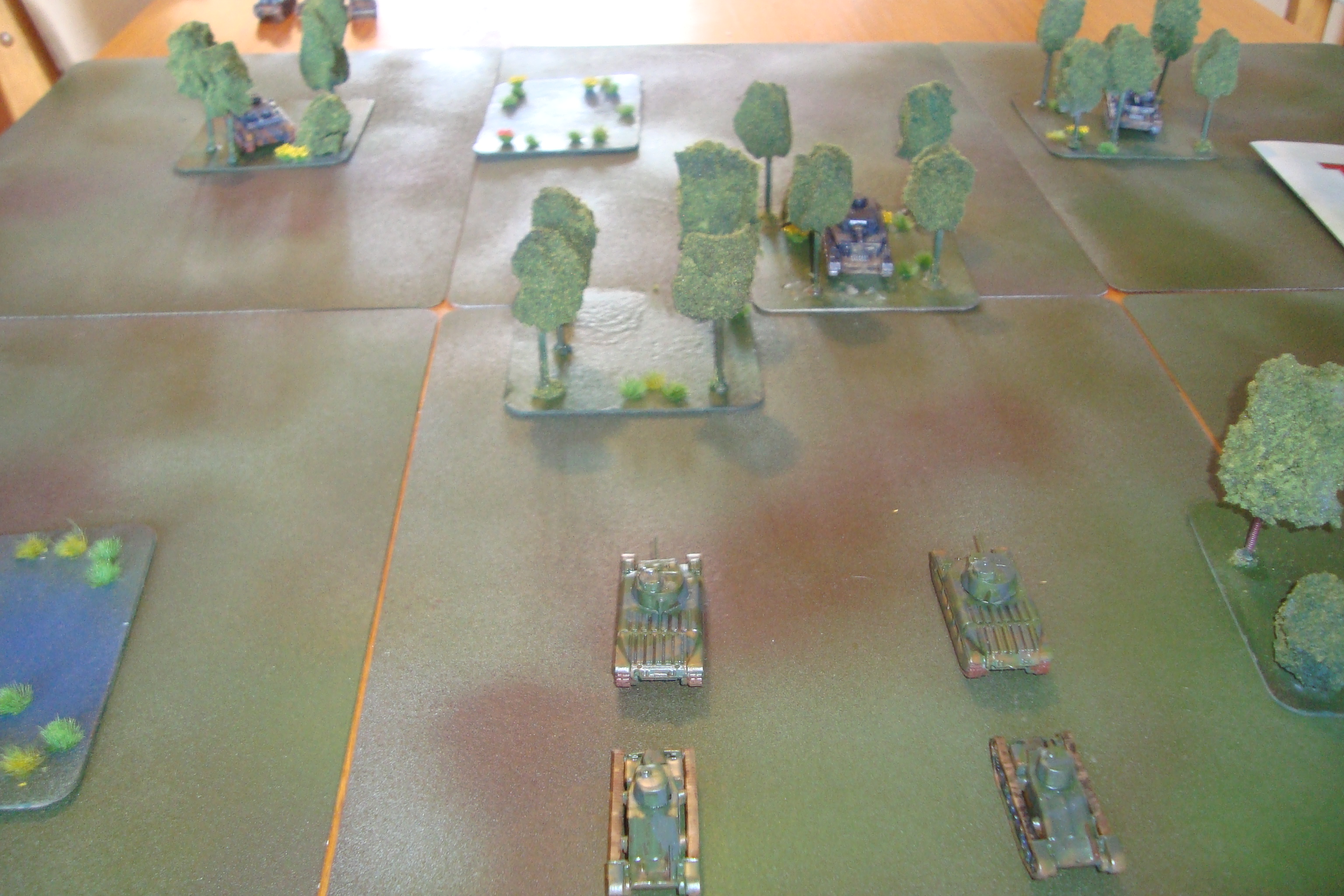
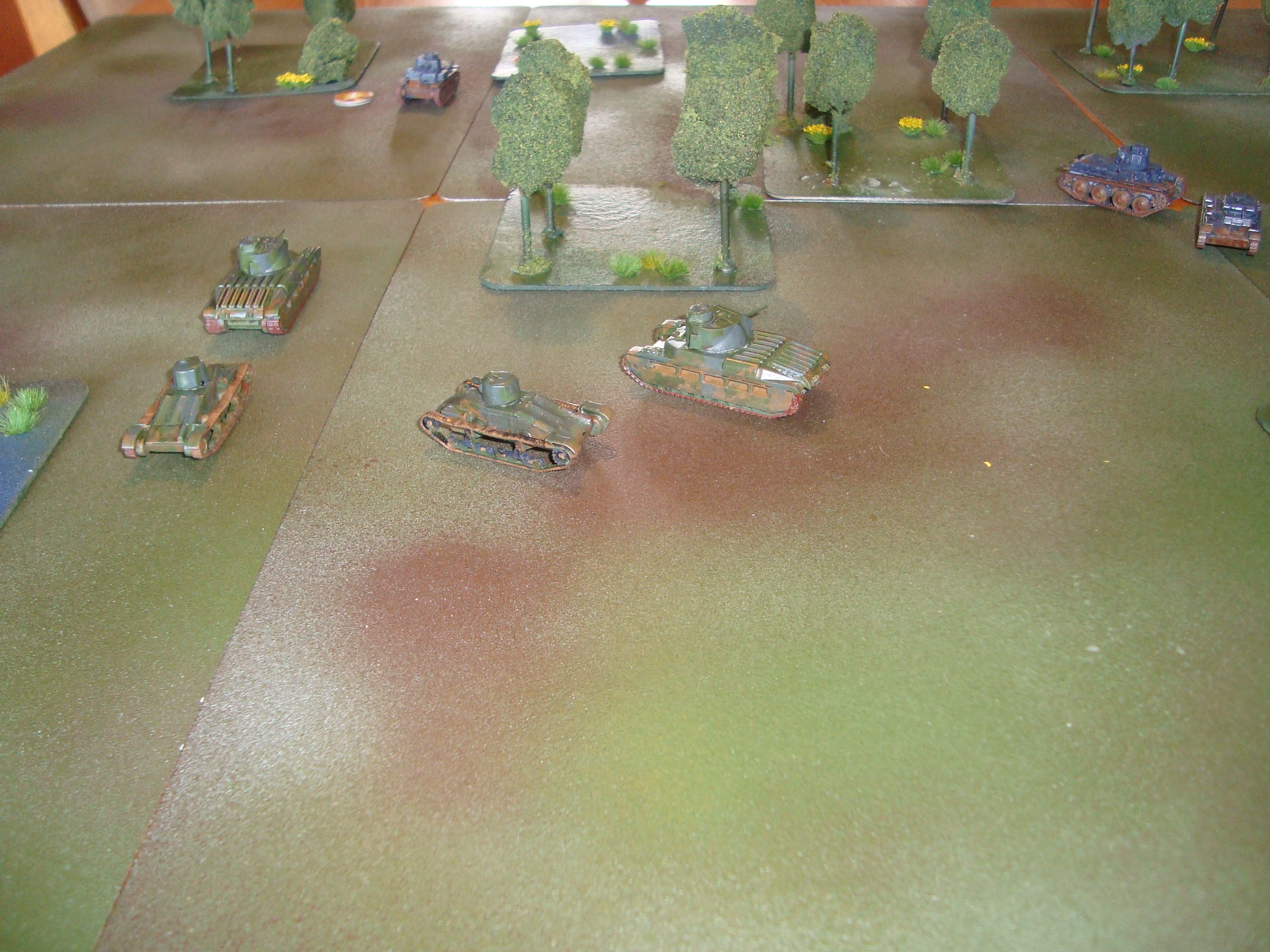
Cruisers Advance. Panzers will use their “Blitzkrieg” move to get into the woods.
Gunfight At Close Range
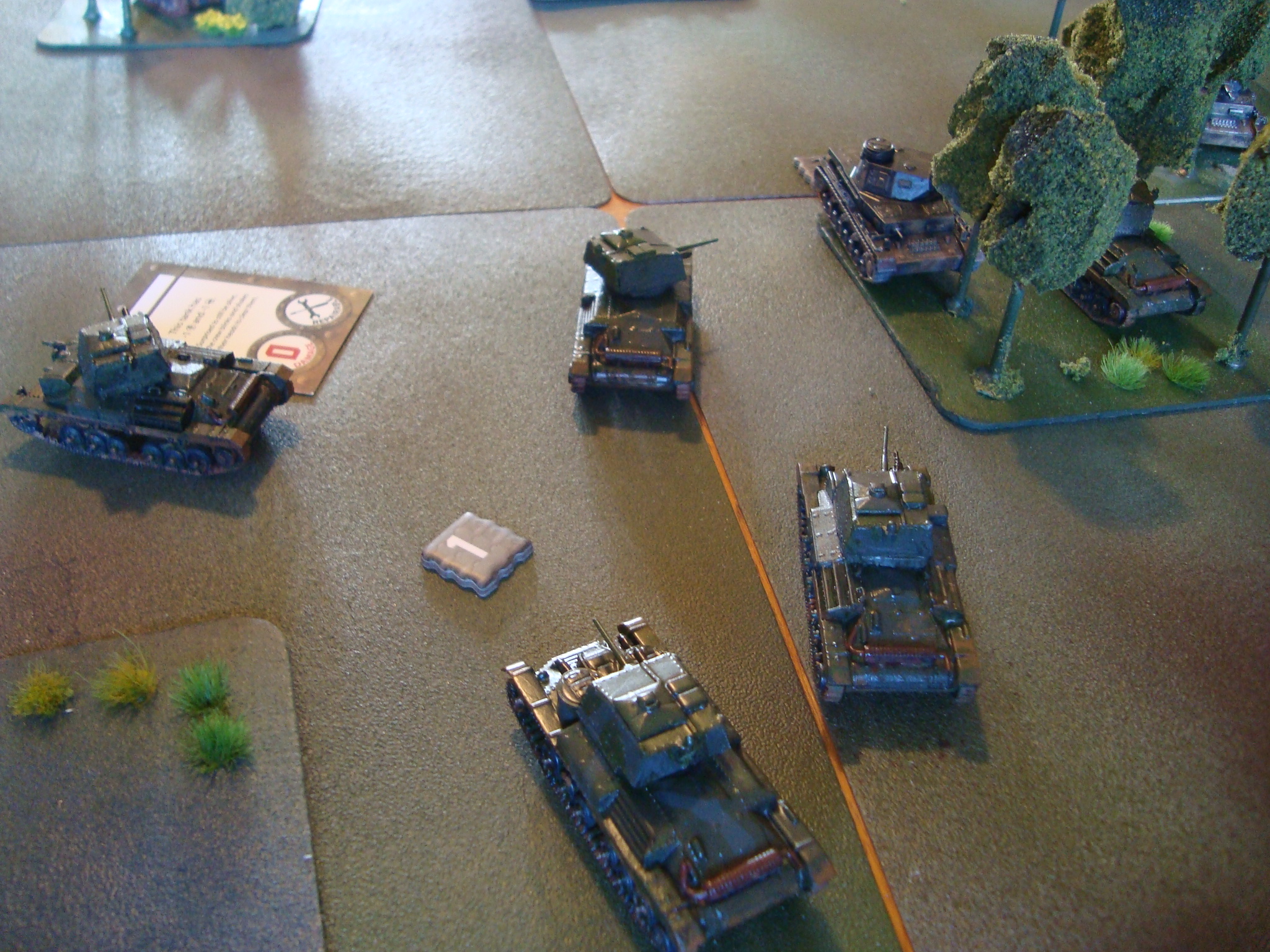
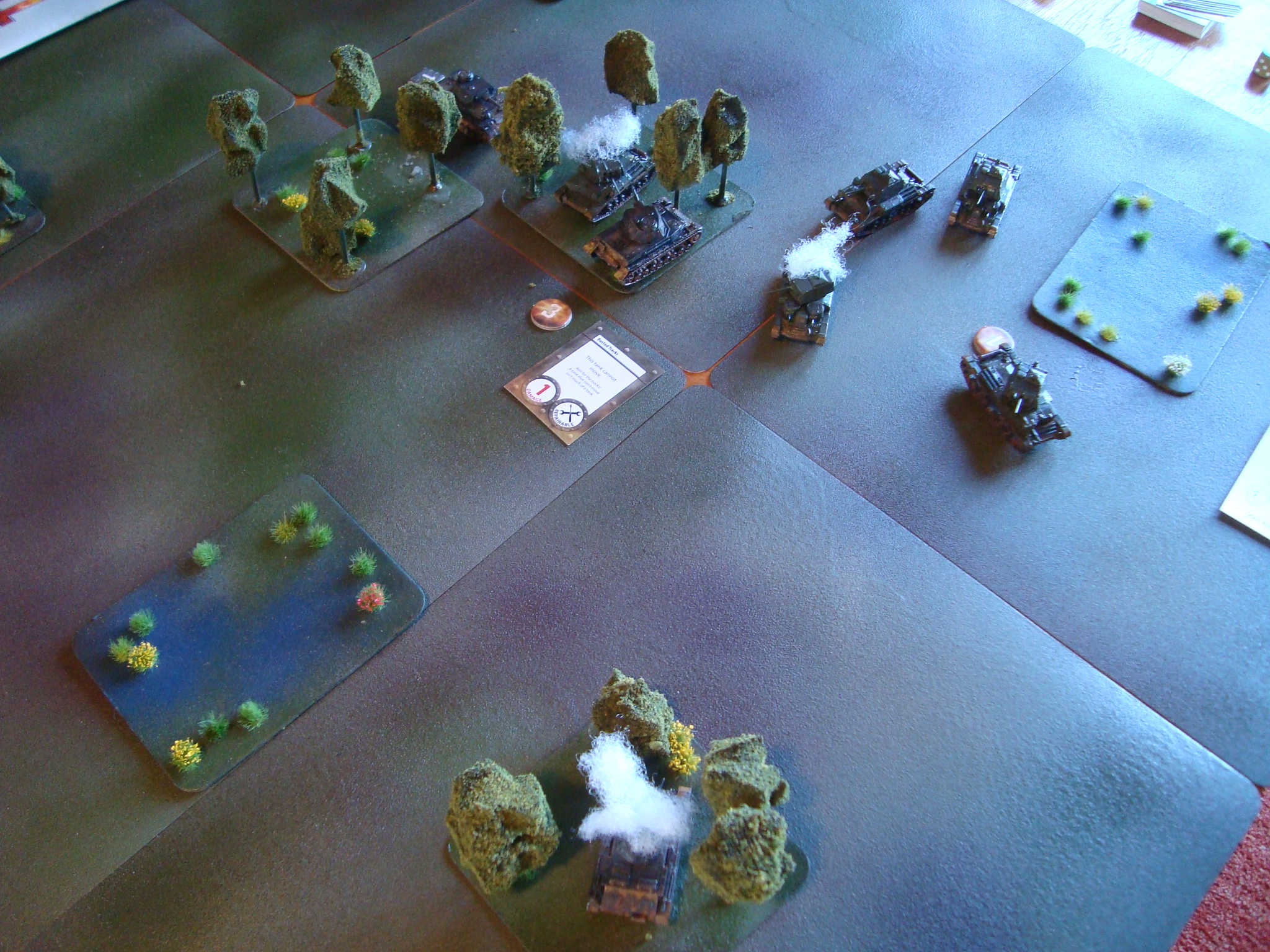
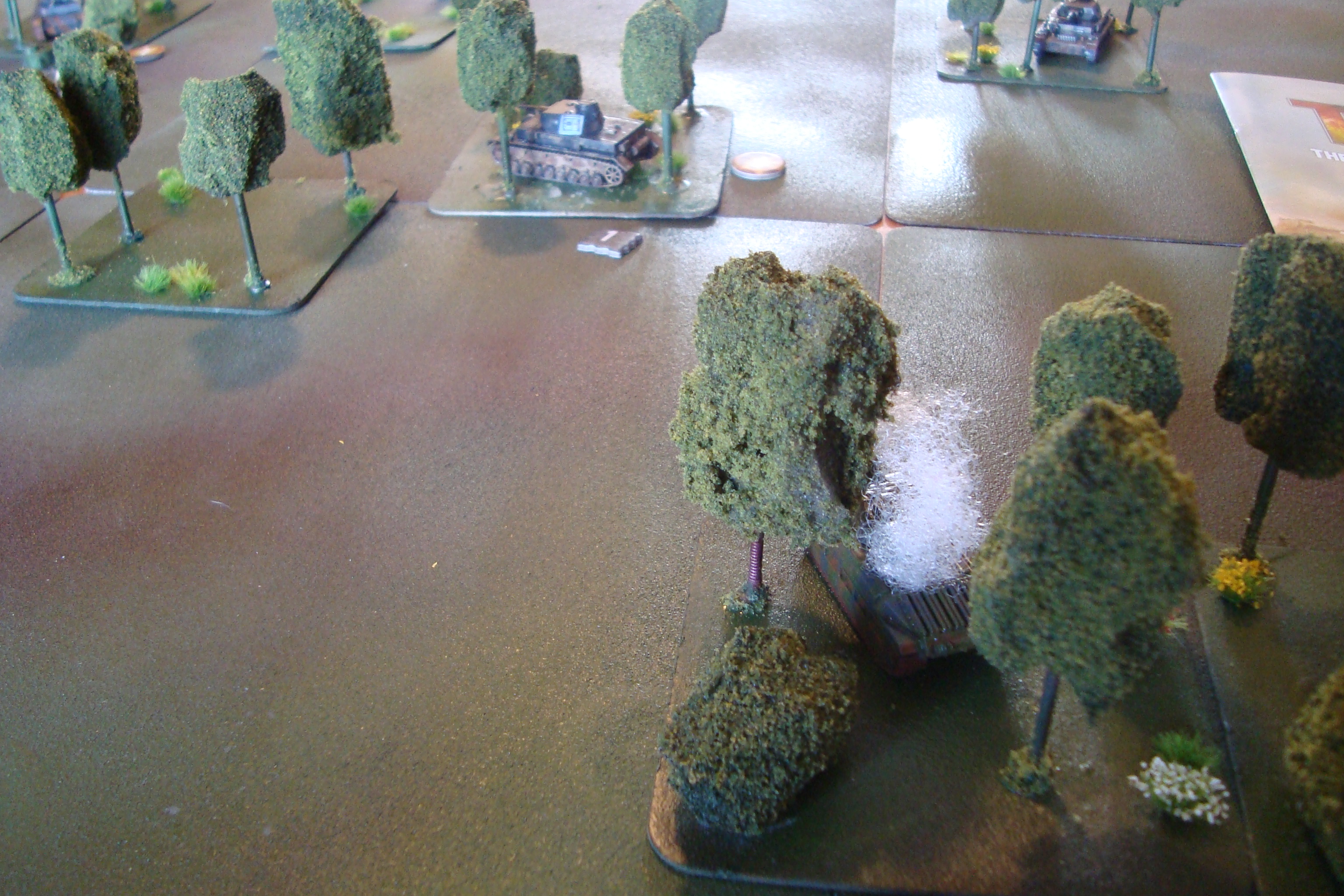
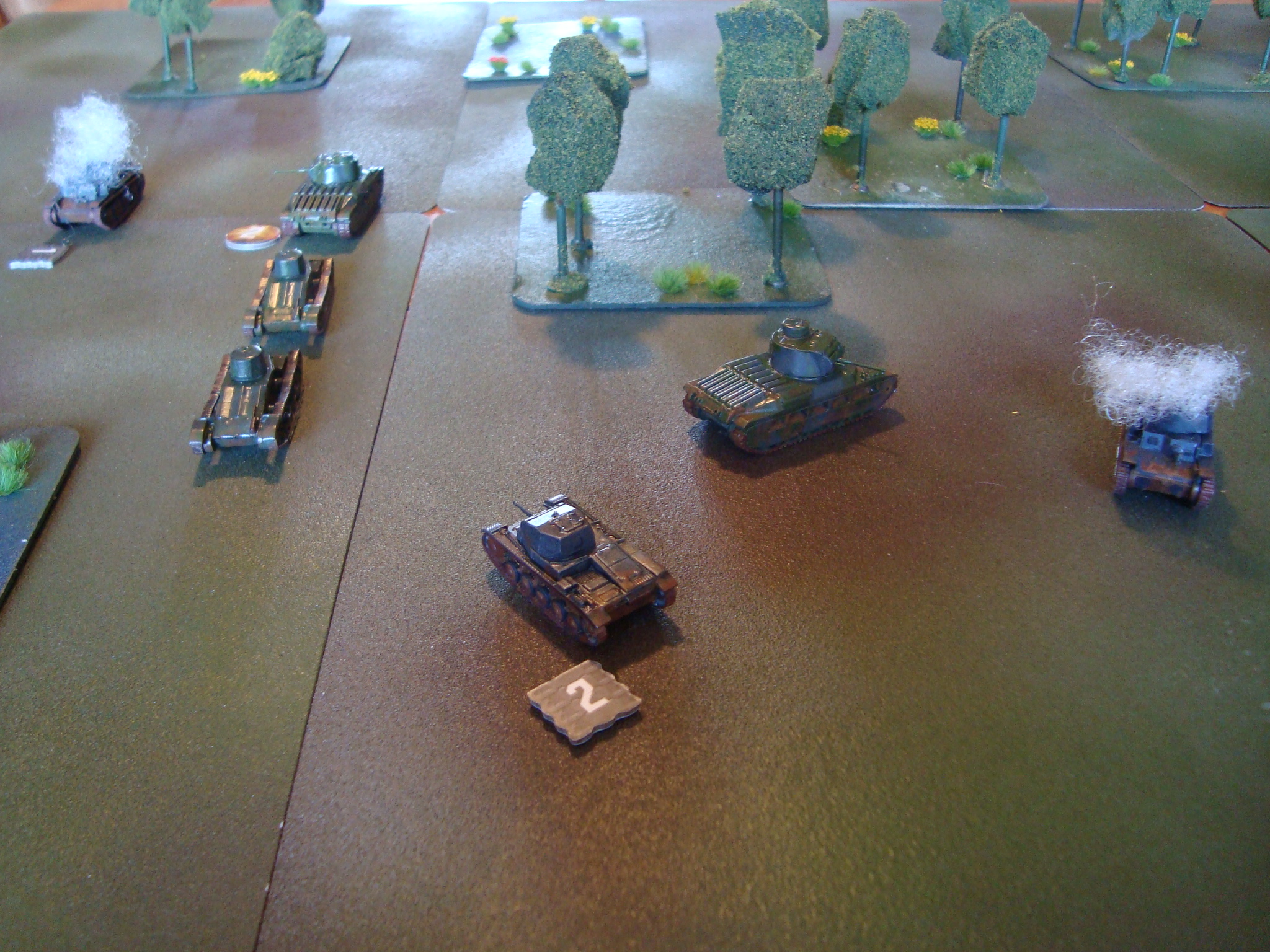
MkIII Knocked Out. Cruisers Maneuver Past A Burning A-9.  While An A-10 Brews Up In The Copse.  The Mk IV Will Get Theirs In The Next Turn.

That’s it for Tanks (for awhile).  Next up….Storm Over Arnhem.

Tanks – BEF Breakthrough Pt II

Pitted the Matildas against two Pz IVs (short) and a PZ III (short).

This time, the Germans opted to head for the copses, allowing for some stationary firing (can re-roll firing dice), as well as a modifier for cover.

The Matildas stuck to their earlier plan, with the Mk IIs providing cover for the Mk Is.

This time, the heavier guns of the Panzers brewed up one Mk II.  However, the other pair of Matildas threw caution to the winds and risked breakdown (die roll of 6) by moving two bounds in a turn.

Fortune was with the Matildas as their armor and luck allowed them to bypass the Germans and move off the board to engage the now  exposed Wermacht infantry units.

Panzers Take Up Stationary Firing Positions Ready To Engage Advancing British
Matilda Mk II Burns
Despite Three Hits, Matilda Mk II Braves Point Blank Fire.

Tanks – BEF Breakthrough Pt I

Decided to get on it and set up Tanks downstairs.  First chance to use BEF armor.

Threw out tiles and randomly slapped terrain mats down for a fight between Matildas and light German armor.

British orders were for the the Matildas to exploit a breakthrough (a quasi often gamed Arras maybe-it-would-have-been-something-decisive scenario).

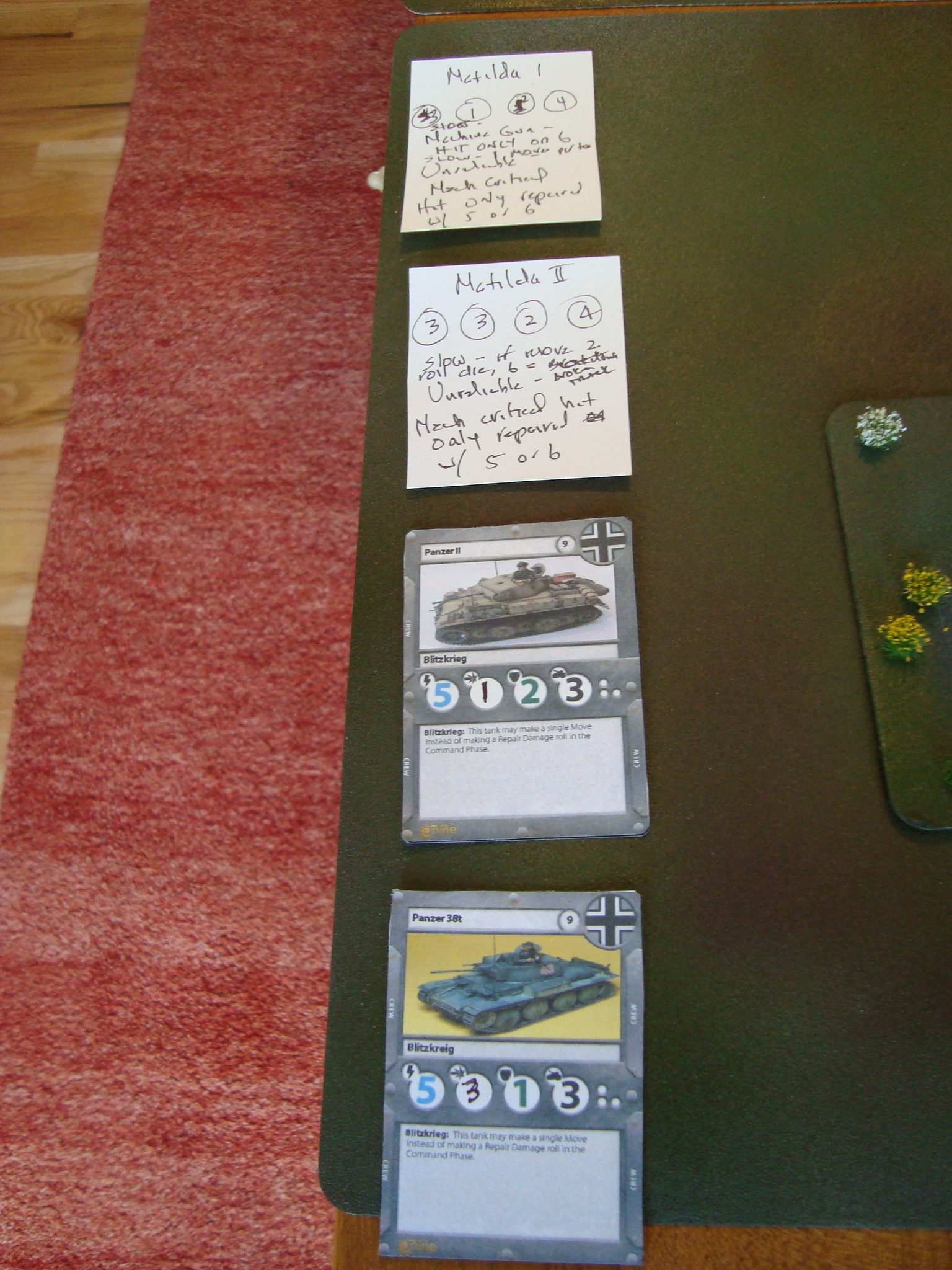
After much wailing and gnashing of teeth I settled on ratings for the Matildas.

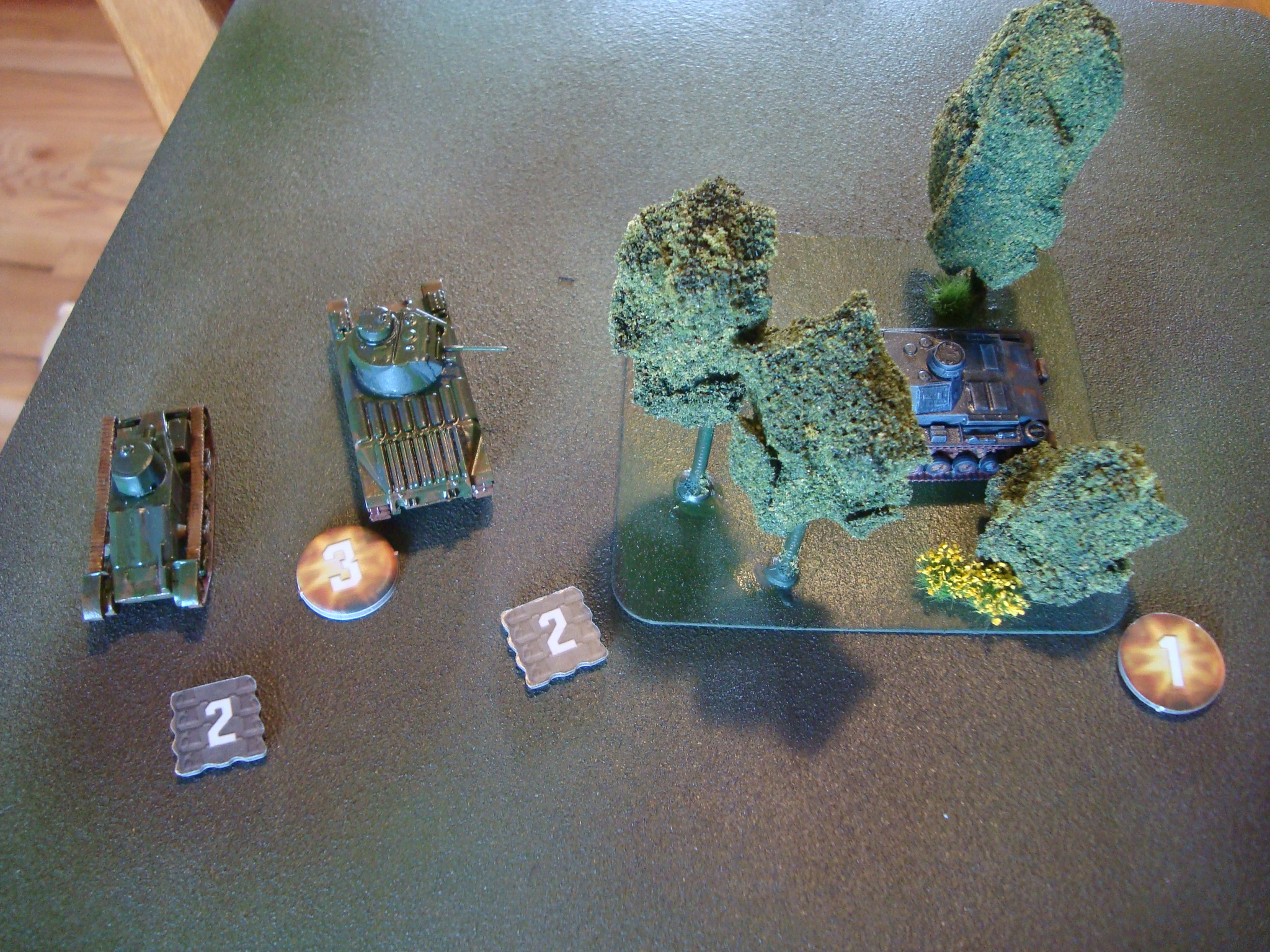
The Two Matilda Marks At The Top
The Pz II Defense Rating Should Be A “1”

The machine gun armed Matilda I is virtually useless against armor, but can hammer German infantry.  The Matilda IIs guided the little waddlers, while fending off the German armor.

The Panzers pressed their attacks, but the combination of British armor thickness and good die rolls were too much.

Matilda IIs Protecting The Little Matilda Is
Panzer 38ts Destroyed In Close Combat

Another fun, fast game.  Next up……Matildas vs. The Panzer Varsity (Mk IIIs and MK IVs).

Third World War -Tim’s Take

Here are his thoughts……

> 1)  I either should have reinforced my amphibious landing or withdrawn it.  I think it was a good idea, but the execution was a little flawed.  The Pact player has to take some risks to get across the Bosphorus.  Like the Rhine, it is almost impossible to breach using regular units.
> 2)  I wonder if it would be a good idea for the Yugoslavs to withdraw to Sarajevo and form a national redoubt.  they would probably last longer and tie down more Pact troops if they did.  I’m not familiar with Yugoslav defense planning in the 80s but I bet they actually thought about doing something similar (ie that plan might not be all that gamey…).
> 3)  My poor rolling on aircraft maintenance on turn 2 really hurt.  I was thinking about attacking Istanbul, but without air support, I had very little chance of taking it (basically I had to hope for an exchange).
> 4)  I wonder if it would be a good idea for NATO to use its air power in the first subimpulses of the Pact turn.  Pact units can’t attack during the second subimpulse if they’re in a ZOC and lowering the odds so attacks don’t succeed (meaning that the defenders don’t retreat) prevents units from being to move/attack in the second sub impulse.


Third World War

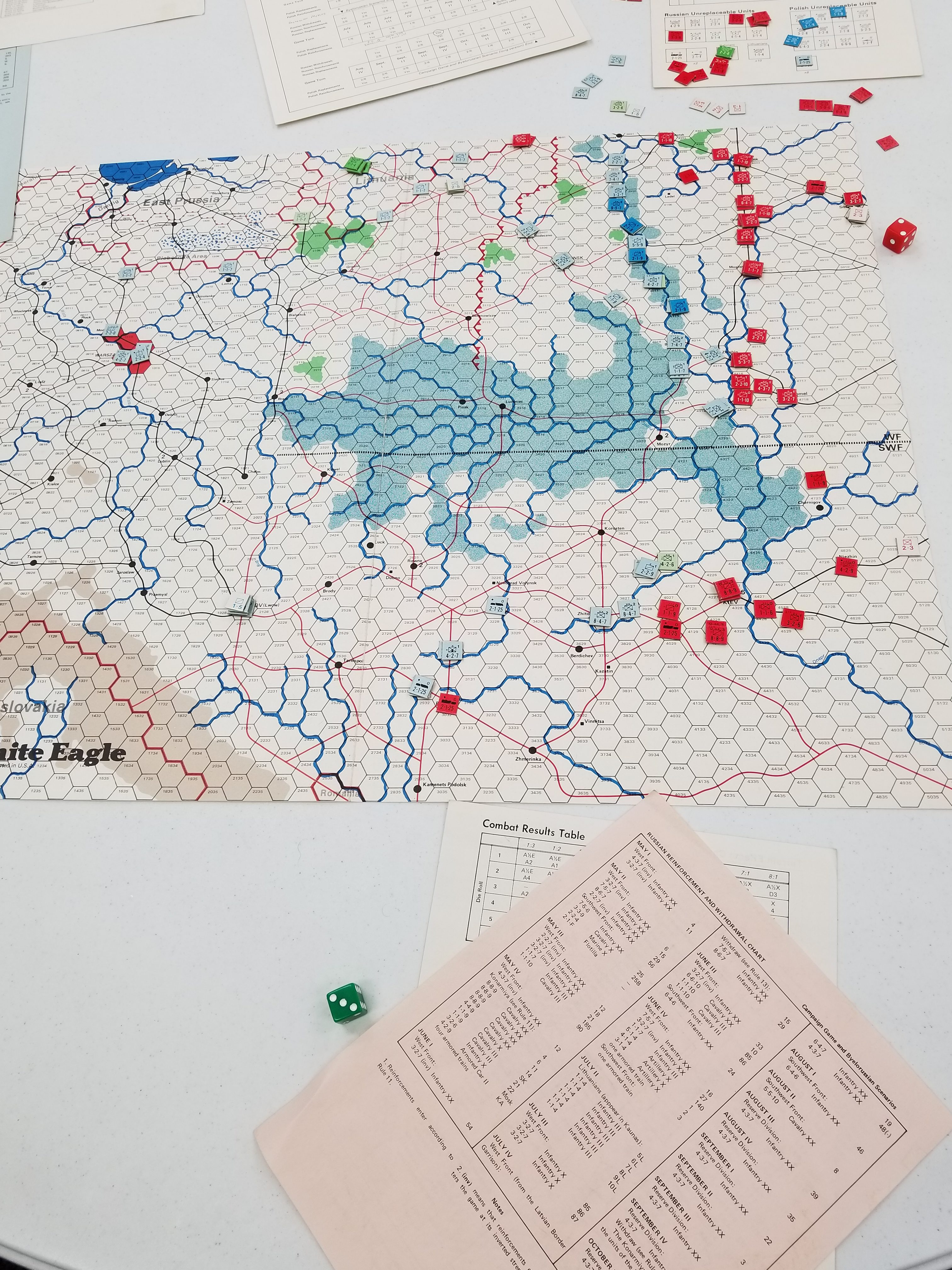
Played Southern Front from the old GDW Third World War series last weekend at Tim’s.

Much lower counter density than Battle For Germany, and with very tough victory conditions for the Warsaw Pact.

Victory points are awarded for controlling cities and ports, and the Pact must control almost every city and port in Yugoslavia (if hostile), Greece and Turkey to score a decisive victory.

The NATO player is outmanned and outgunned, and must grimly hang on during a seemingly endless series of Pact high odds attacks.

While the game is only eight turns long, each turn is lengthy and involved.

Aircraft maintenance and missions assignment occurs before any movement takes place.  Aircraft can fly deep strikes including logistical strikes (effecting supply status), runway cratering, or escort; interdiction missions resulting in additional movement costs and disruption for enemy units, as well as plain old ground attack and ground attack escort missions.

Movement and combat takes place in impulses.  The turn sequence is Pact First Impulse (movement and combat), Pact Sub Impulse (units not in enemy ZOCs may move and attack, with regroup), a NATO Reserve Impulse (units not in enemy ZOCs may move and attack, units may also regroup), Pact Second Impulse (same as first with two sub-impulses) , and finally a NATO First and Second Impulse.

A key element in this game system is Proficiency Rating.  Differences in ratings shift combat odds in the favor of the side with higher average proficiency.  The regroup phase allows players to “rebuild” units, recovering one proficiency step if the unit has not done anything in the previous phase and is not in an enemy ZOC.  Pact units can never be totally “rebuilt” and retain a one factor proficiency loss, regardless.

Yugoslavia is either neutral, an ally of NATO, or becomes a NATO ally during Turn 4.  This determination by a chit pull.

A special rule in Southern Front precludes any NATO deep strikes, cratering or escort missions during the first turn.  Also, the NATO initial ground dispositions are mandated.  The result is that the first Pact impulses result in significant attrition of NATO Turkish forces, with the Greeks taking some hits, also.  Not surprisingly, Turks and Greeks cannot cooperate or enter each other’s country.

In our game, Tim initially focused on Turkey, making an amphibious landing east of Istanbul, which is the bottleneck leading to Anatolia.   Despite severe losses, the Turks held  Istanbul and, with the arrival of reinforcement, destroyed the flanking Soviet Marines.  Tim’s attempts were handicapped by some horrific die rolling during the maintenance phase of Turn 2, which temporarily gave NATO air superiority.

Beginning with Turn 3, Tim’s attention  turned towards Yugoslavia (which had entered on Turn 1), and Greece.  When the game ended at Turn 5, the Yugoslavs were in disarray, with Pact forces massing for an attack on Greece.  However, Turkey was still controlled by NATO.

A good game.  I’ll post up Tim’s comments later.
Early War Tanks

Had a quick game this afternoon.

Used my draft cards for early-war German and Soviet armor.  They are a real beta given my lack of proofing and child-like work with the scissors.

A Pz-II and Pz-38t tasked with stopping a break-thru by a BT-5 and two Soviet T-26s.

Terrain was placed helter skelter.  Both sides used maximum maneuver to take advantage of terrain and the accompanying speed defense modifiers.

Fun little game.  Germans had an early edge using their higher initiative ratings, but just couldn’t put away the Soviets, especially with the Pz-II’s popgun of a 20mm worth only one die in the attack.  But, they almost pulled it off.

Here’s a few photos.

Early Maneuvering. Pz-38t Heads To The Woods.  New Card In Foreground.
Pz-II Sets Up For Flank Shot On BT-5.
Attacking The Pz-38t Now In The Woods.  German Wants Cover/Stationary Mods.
PZ 38t Leaves Woods Trying For Point Blank Flanking Shot On T-26.  Iron Dice Of War Say NO.
Iron Dice Of War Say BLAMMO! BT-5 Gets The Pz-II.
Pz-II Burns Unavenged While Its Kamerad Flees.  German Counterattack Fails.

Tim’s Take

Tim sent me his (always trenchant) comments.  Here they are:

    • I was curious about how much population is contained in city spaces (14).  In light of this weekend’s games, a good strategy for the US is to focus on pacifying the cities (14 x 2= 28) and keeping the commitment low (you had 22 available troops), as it is hard for the insurgent player to counter.  I had trouble moving guerrillas into the cities and keeping them alive…
    • A good counter to the above strategy is to kill off US troops.  I didn’t do a very good job of hunting them down (and you were good about not putting them in exposed positions).  I had hoped to run some bombardment operations but either my troops were in the wrong place or I had to do something else…
    • Another possible counter is the one I stumbled upon in the last game: the VC wins the hearts and minds of the countryside and just enough of the cities to get the win.
    • I was surprised at how the lack of resources really hampers the insurgent player.  I got a little frustrated during the first game because it seemed just when the NVA was ready to intervene, you would play an event card to either reduce or eliminate their resources.
    • The ARVN and VC were much more active in this weekend’s games than in our earlier games, which were dominated by the US and the NVA.  The VC ability to subvert enemy troops makes them fun to play (you showed admirable forbearance in the face of my constant cries of ‘terror and subvert’….).  The ARVN troops gave me trouble in the second game and played a big role in holding the line until you could bring your airstrikes to bear.
    • I missed a trick when I didn’t move the NVA troops into provinces that supported you.  I know you would have bombed them anyway, but the price would have been higher.
    • Did you know that NVA troops can be used for terror operations?  I didn’t notice that until midway through the second game (there is a lot of nuance in this game).  I wonder if it would be a good idea for the NVA to send in small groups of troops for terror ops and maybe picking off the occasional enemy unit.
    • Did you know that NVA guerrillas can set up in the south?  For some reason, I’d gotten it in my head that they couldn’t.
    • I kept too many units back to defend bases.  I probably should have pushed more units forward into the fray…I think it wouldn’t be a bad idea to put more than one base in area so as to cut down on the numbers of defenders.


Maximum Effort

Tim came over the mountain last Saturday for a weekend of wargaming.   Spent Saturday afternoon/evening catching up and turned to on Sunday.  Many Private Reserves and Blue Boars were consumed.

Completed two (yes, two!) games of the two-player version of Fire in the Lake.  Finished up at 2310.  How?  We actually stayed on task (no football, especially if you count The Pro-Bowl), and the Coup Cards popped up sooner rather than later.  Coup Cards determine the end of a turn and also the an accounting for determining victory points.

There were three consistent threads in our talks during the games.  The first was how different the character of each game was, and the accompanying re-playability.  It’s a spendy game, but sure worth it.

The second was how tough it was to play.  Not the rules, how the card flow created the decisions that had to be made under less than ideal operational conditions.  There never seemed to be a direct path to accomplishing mission goals.  Who was that, Wolfe?  “War is an option of difficulties.”

The third focused on how each of the four sides had conflicting goals, and the impact on operations and results.  This is a great four player game.  The problem is finding four players.

US strategy emphasized pacification (with accompanying support), using air strikes and irregulars to attrit communists.  This was accomplished using a minimum of US troops.  ARVN troops would sweep to locate enemy guerrillas, so they could be bombed, with ARVN Rangers raiding provinces to destroy guerrillas.  In both games, the South Vietnamese were used to attain US victory points.

Both communist factions are hampered by a lack of resources.  As a result, their operations featured taxes, but also using terror to reduce support.  Infiltration was another favorite tactic since ARVN troops or police could be eliminated or “flipped”.

Both games followed the historical pattern of the US/ARVN forces controlling cities and VC controlling the countryside.  The first game was a US victory, the second was a tie between  the US and VC.

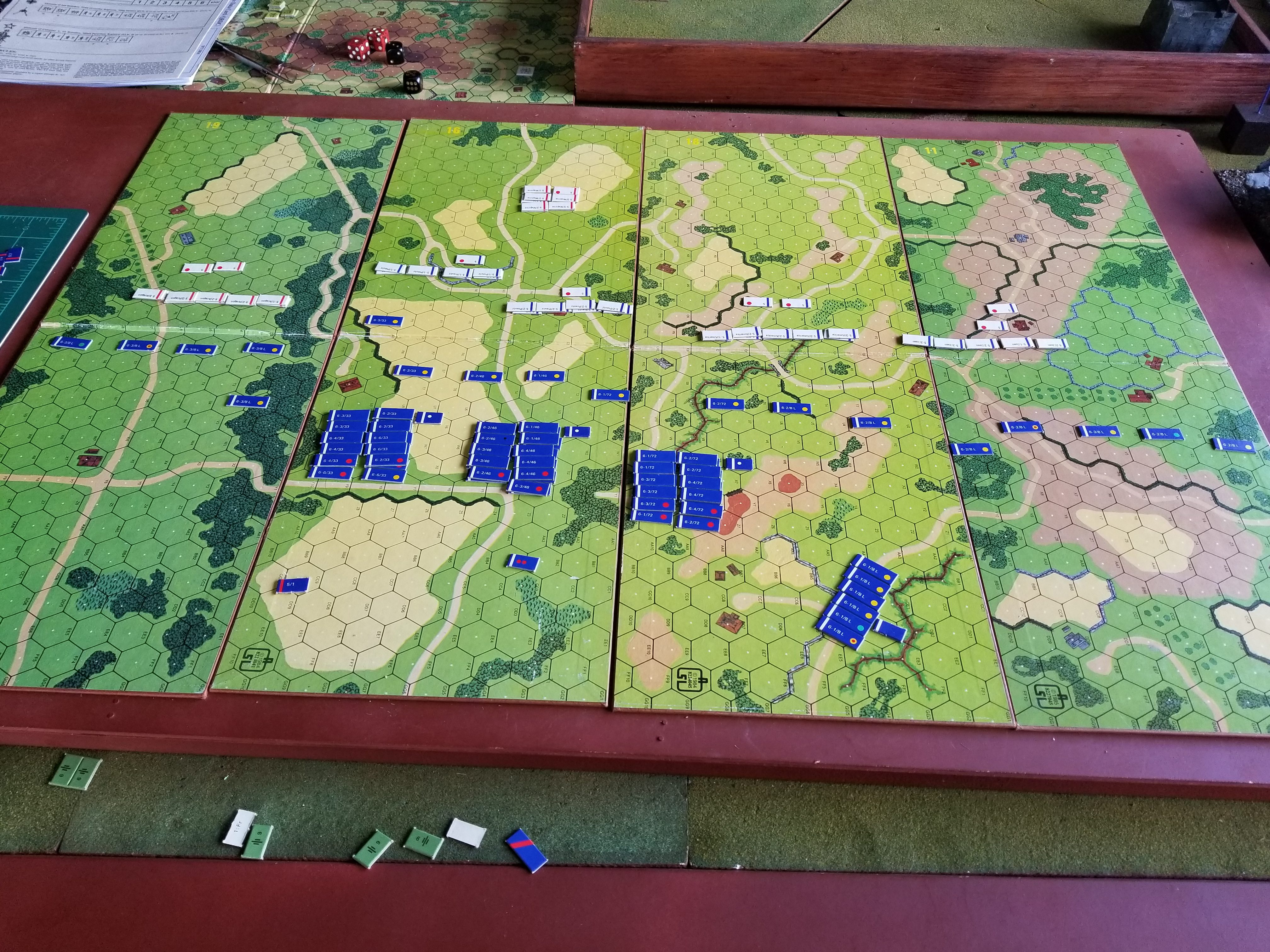
Great weekend of gaming with a great game.  Here’s photo of the end-game for game number 2.