Category Archives: Sessions

Early War Tanks

Had a quick game this afternoon.

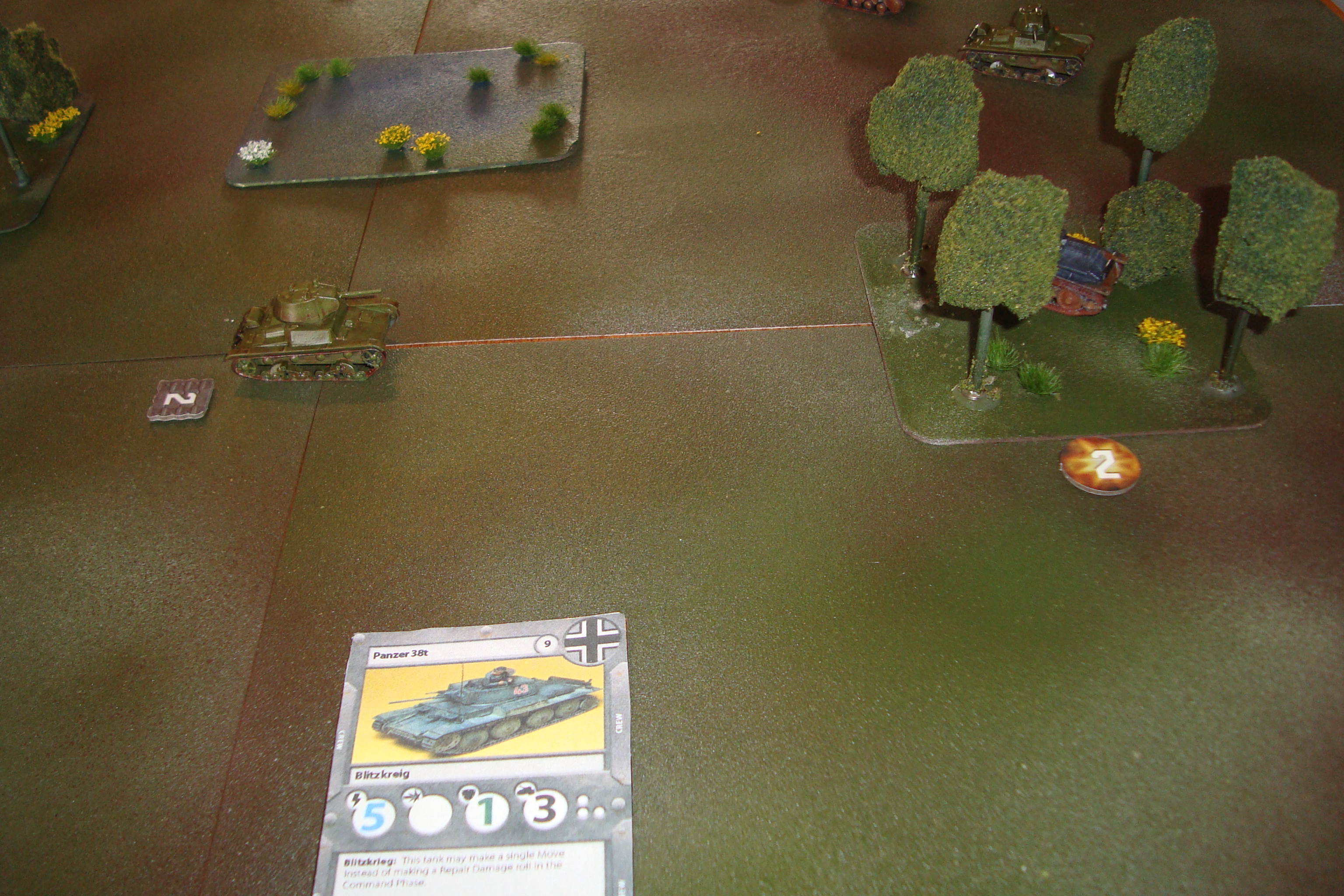
Used my draft cards for early-war German and Soviet armor.  They are a real beta given my lack of proofing and child-like work with the scissors.

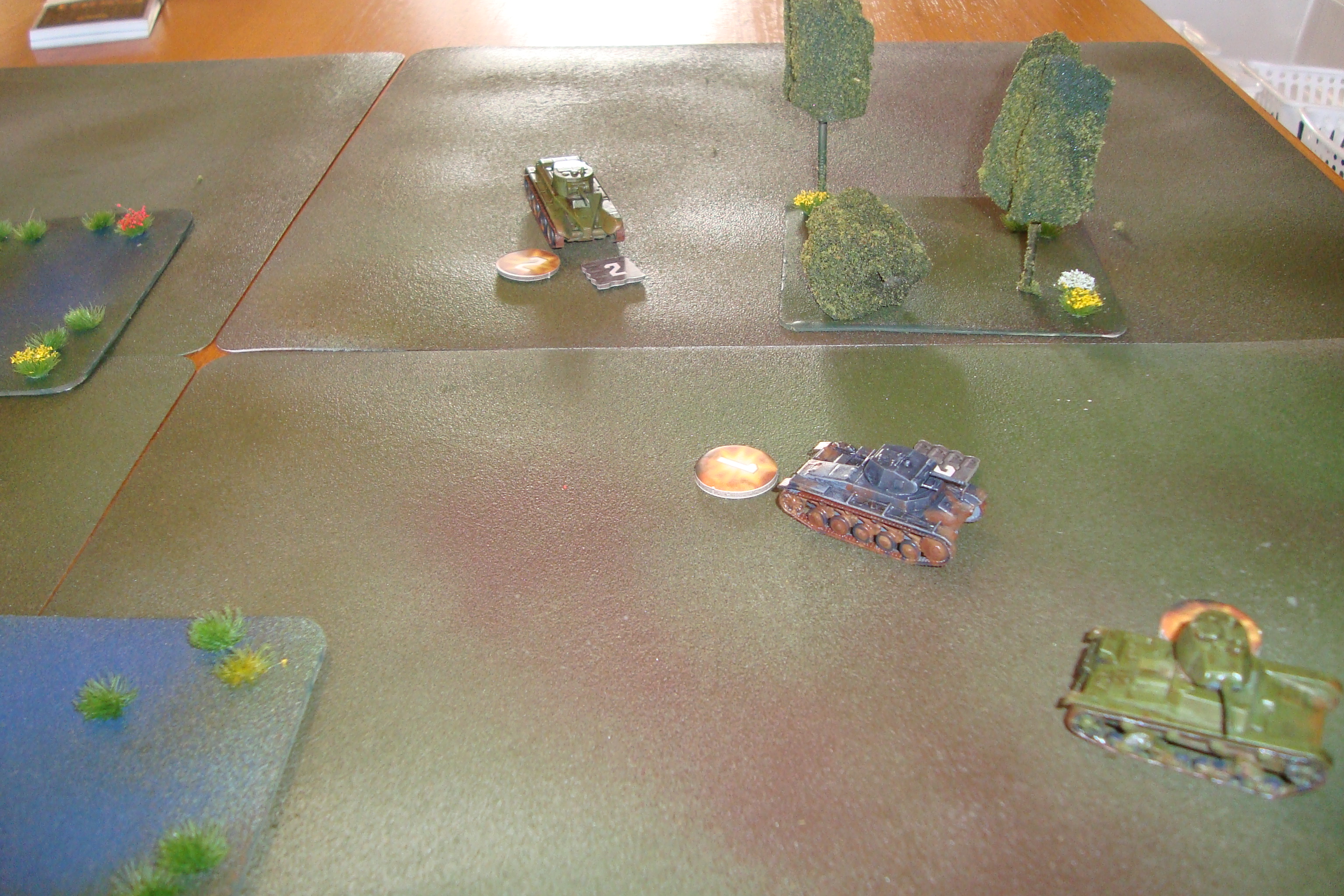
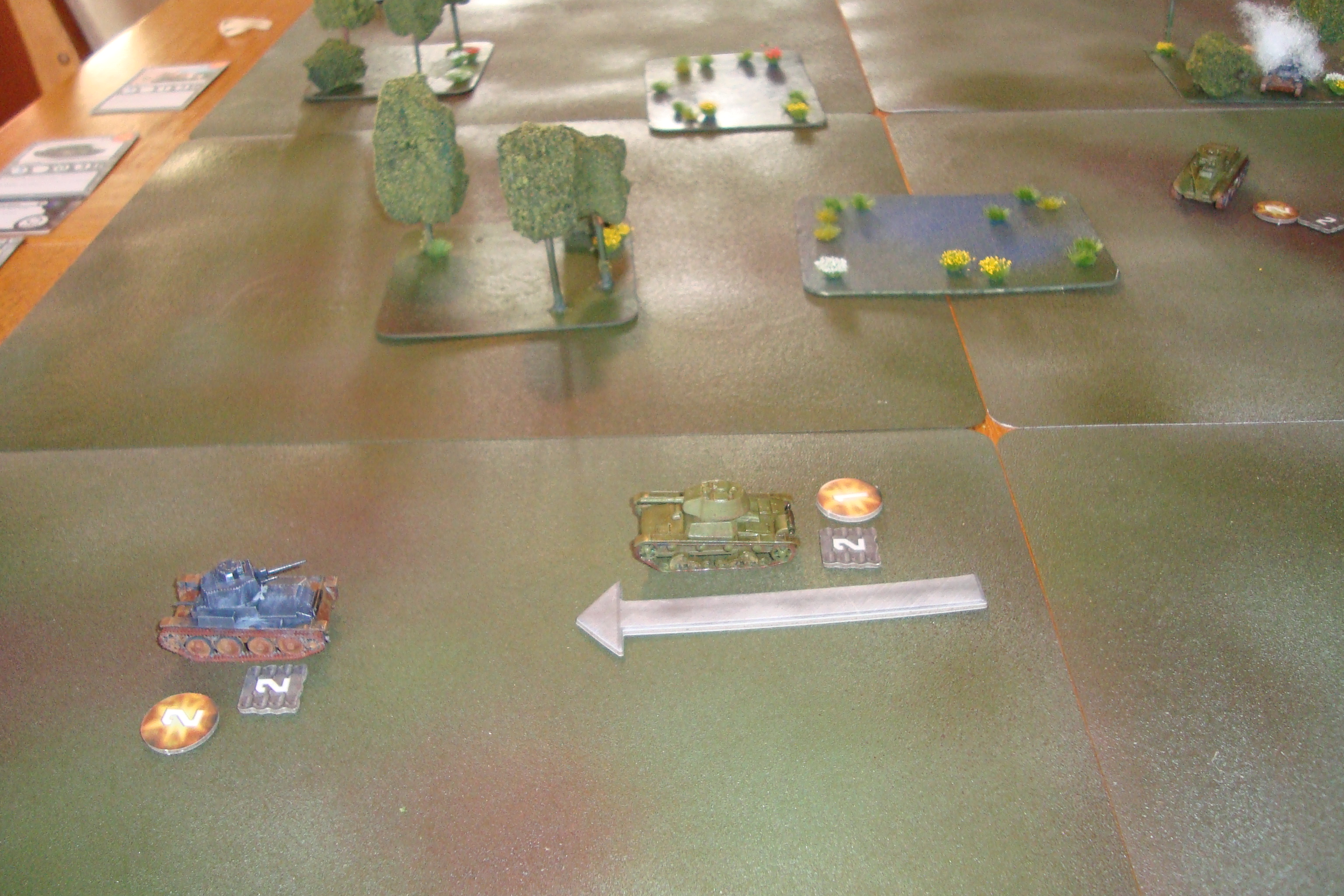
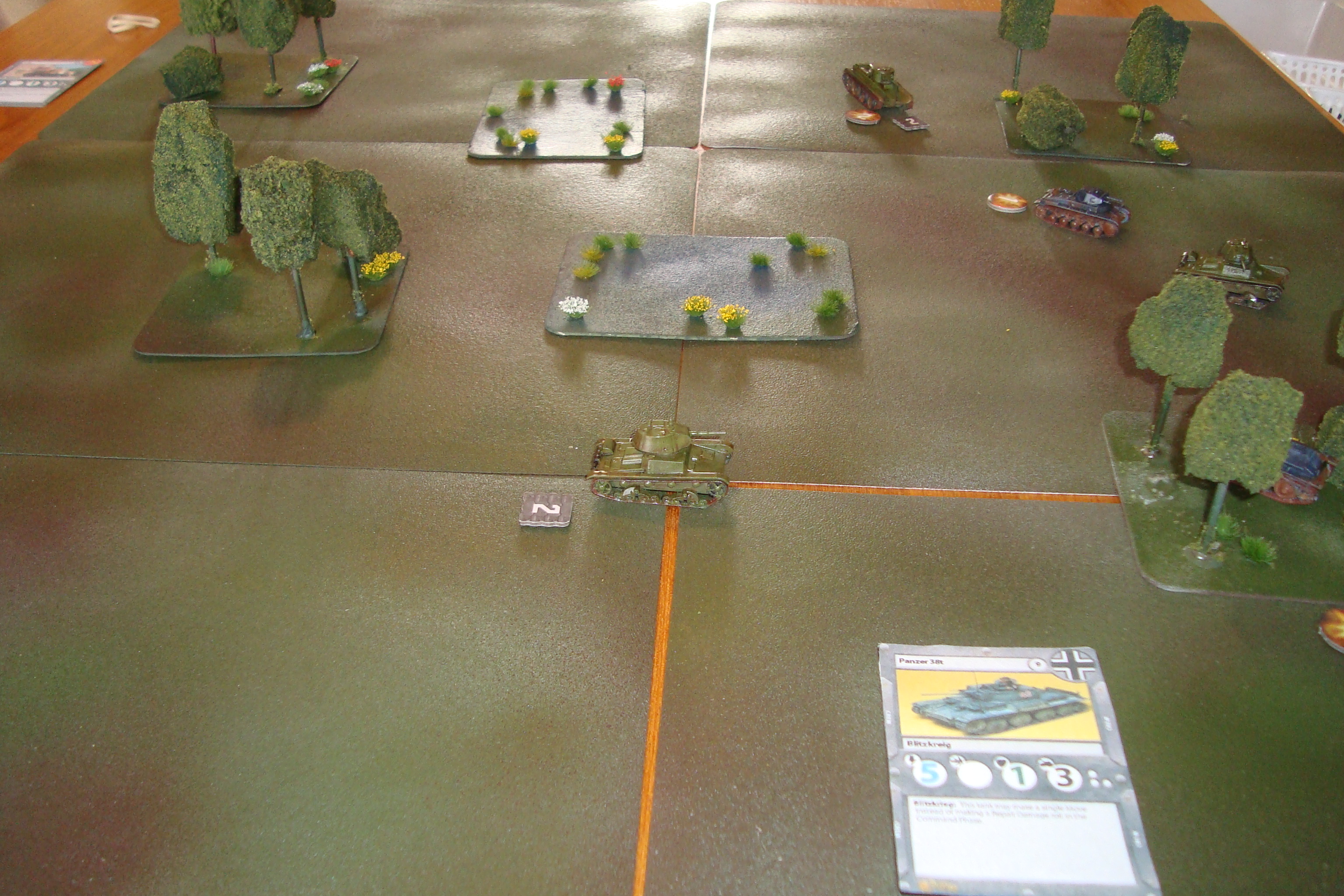
A Pz-II and Pz-38t tasked with stopping a break-thru by a BT-5 and two Soviet T-26s.

Terrain was placed helter skelter.  Both sides used maximum maneuver to take advantage of terrain and the accompanying speed defense modifiers.

Fun little game.  Germans had an early edge using their higher initiative ratings, but just couldn’t put away the Soviets, especially with the Pz-II’s popgun of a 20mm worth only one die in the attack.  But, they almost pulled it off.

Here’s a few photos.

Early Maneuvering. Pz-38t Heads To The Woods.  New Card In Foreground.
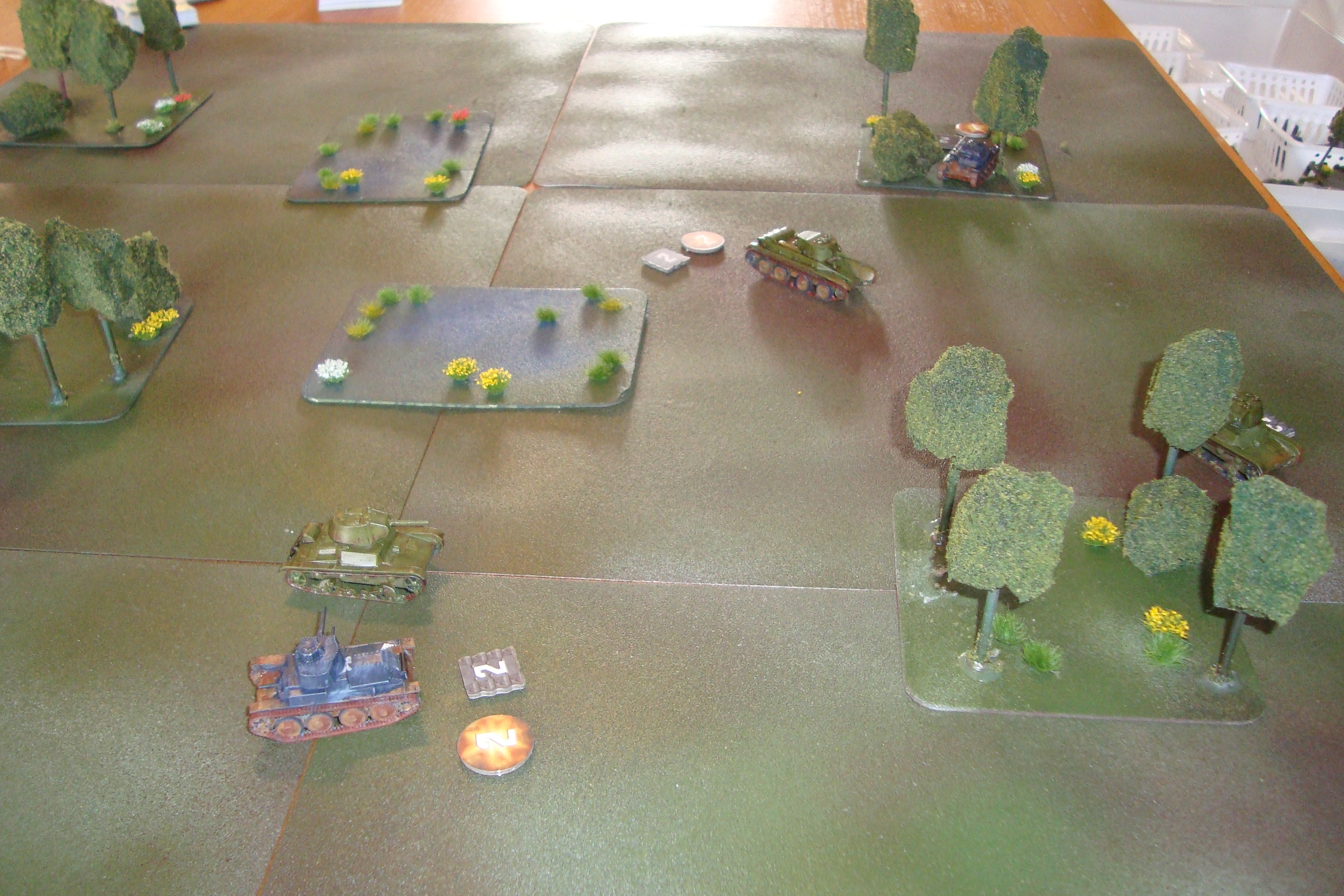
Pz-II Sets Up For Flank Shot On BT-5.
Attacking The Pz-38t Now In The Woods.  German Wants Cover/Stationary Mods.
PZ 38t Leaves Woods Trying For Point Blank Flanking Shot On T-26.  Iron Dice Of War Say NO.
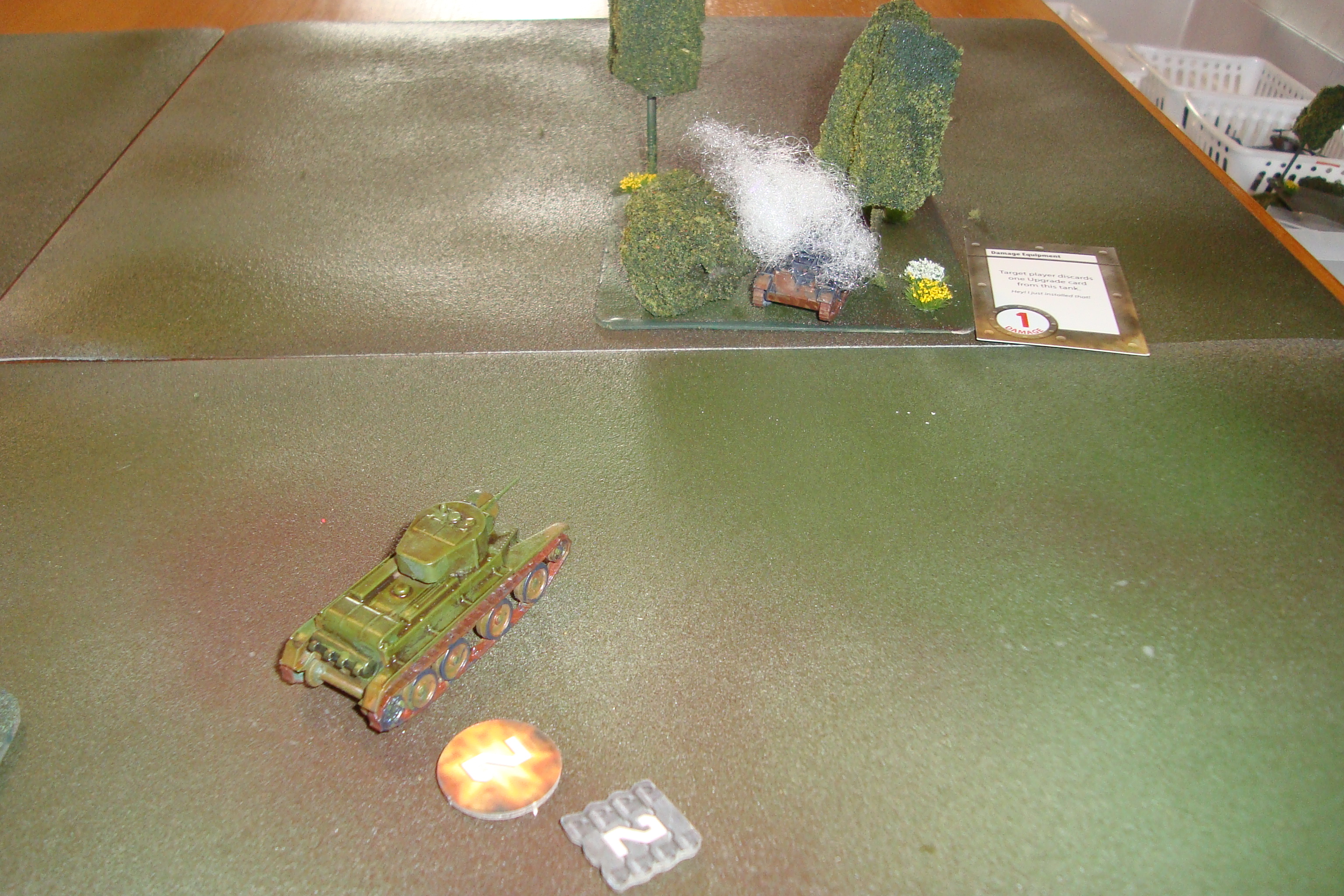
Iron Dice Of War Say BLAMMO! BT-5 Gets The Pz-II.
Pz-II Burns Unavenged While Its Kamerad Flees.  German Counterattack Fails.

Tim’s Take

Tim sent me his (always trenchant) comments.  Here they are:

    • I was curious about how much population is contained in city spaces (14).  In light of this weekend’s games, a good strategy for the US is to focus on pacifying the cities (14 x 2= 28) and keeping the commitment low (you had 22 available troops), as it is hard for the insurgent player to counter.  I had trouble moving guerrillas into the cities and keeping them alive…
    • A good counter to the above strategy is to kill off US troops.  I didn’t do a very good job of hunting them down (and you were good about not putting them in exposed positions).  I had hoped to run some bombardment operations but either my troops were in the wrong place or I had to do something else…
    • Another possible counter is the one I stumbled upon in the last game: the VC wins the hearts and minds of the countryside and just enough of the cities to get the win.
    • I was surprised at how the lack of resources really hampers the insurgent player.  I got a little frustrated during the first game because it seemed just when the NVA was ready to intervene, you would play an event card to either reduce or eliminate their resources.
    • The ARVN and VC were much more active in this weekend’s games than in our earlier games, which were dominated by the US and the NVA.  The VC ability to subvert enemy troops makes them fun to play (you showed admirable forbearance in the face of my constant cries of ‘terror and subvert’….).  The ARVN troops gave me trouble in the second game and played a big role in holding the line until you could bring your airstrikes to bear.
    • I missed a trick when I didn’t move the NVA troops into provinces that supported you.  I know you would have bombed them anyway, but the price would have been higher.
    • Did you know that NVA troops can be used for terror operations?  I didn’t notice that until midway through the second game (there is a lot of nuance in this game).  I wonder if it would be a good idea for the NVA to send in small groups of troops for terror ops and maybe picking off the occasional enemy unit.
    • Did you know that NVA guerrillas can set up in the south?  For some reason, I’d gotten it in my head that they couldn’t.
    • I kept too many units back to defend bases.  I probably should have pushed more units forward into the fray…I think it wouldn’t be a bad idea to put more than one base in area so as to cut down on the numbers of defenders.


Maximum Effort

Tim came over the mountain last Saturday for a weekend of wargaming.   Spent Saturday afternoon/evening catching up and turned to on Sunday.  Many Private Reserves and Blue Boars were consumed.

Completed two (yes, two!) games of the two-player version of Fire in the Lake.  Finished up at 2310.  How?  We actually stayed on task (no football, especially if you count The Pro-Bowl), and the Coup Cards popped up sooner rather than later.  Coup Cards determine the end of a turn and also the an accounting for determining victory points.

There were three consistent threads in our talks during the games.  The first was how different the character of each game was, and the accompanying re-playability.  It’s a spendy game, but sure worth it.

The second was how tough it was to play.  Not the rules, how the card flow created the decisions that had to be made under less than ideal operational conditions.  There never seemed to be a direct path to accomplishing mission goals.  Who was that, Wolfe?  “War is an option of difficulties.”

The third focused on how each of the four sides had conflicting goals, and the impact on operations and results.  This is a great four player game.  The problem is finding four players.

US strategy emphasized pacification (with accompanying support), using air strikes and irregulars to attrit communists.  This was accomplished using a minimum of US troops.  ARVN troops would sweep to locate enemy guerrillas, so they could be bombed, with ARVN Rangers raiding provinces to destroy guerrillas.  In both games, the South Vietnamese were used to attain US victory points.

Both communist factions are hampered by a lack of resources.  As a result, their operations featured taxes, but also using terror to reduce support.  Infiltration was another favorite tactic since ARVN troops or police could be eliminated or “flipped”.

Both games followed the historical pattern of the US/ARVN forces controlling cities and VC controlling the countryside.  The first game was a US victory, the second was a tie between  the US and VC.

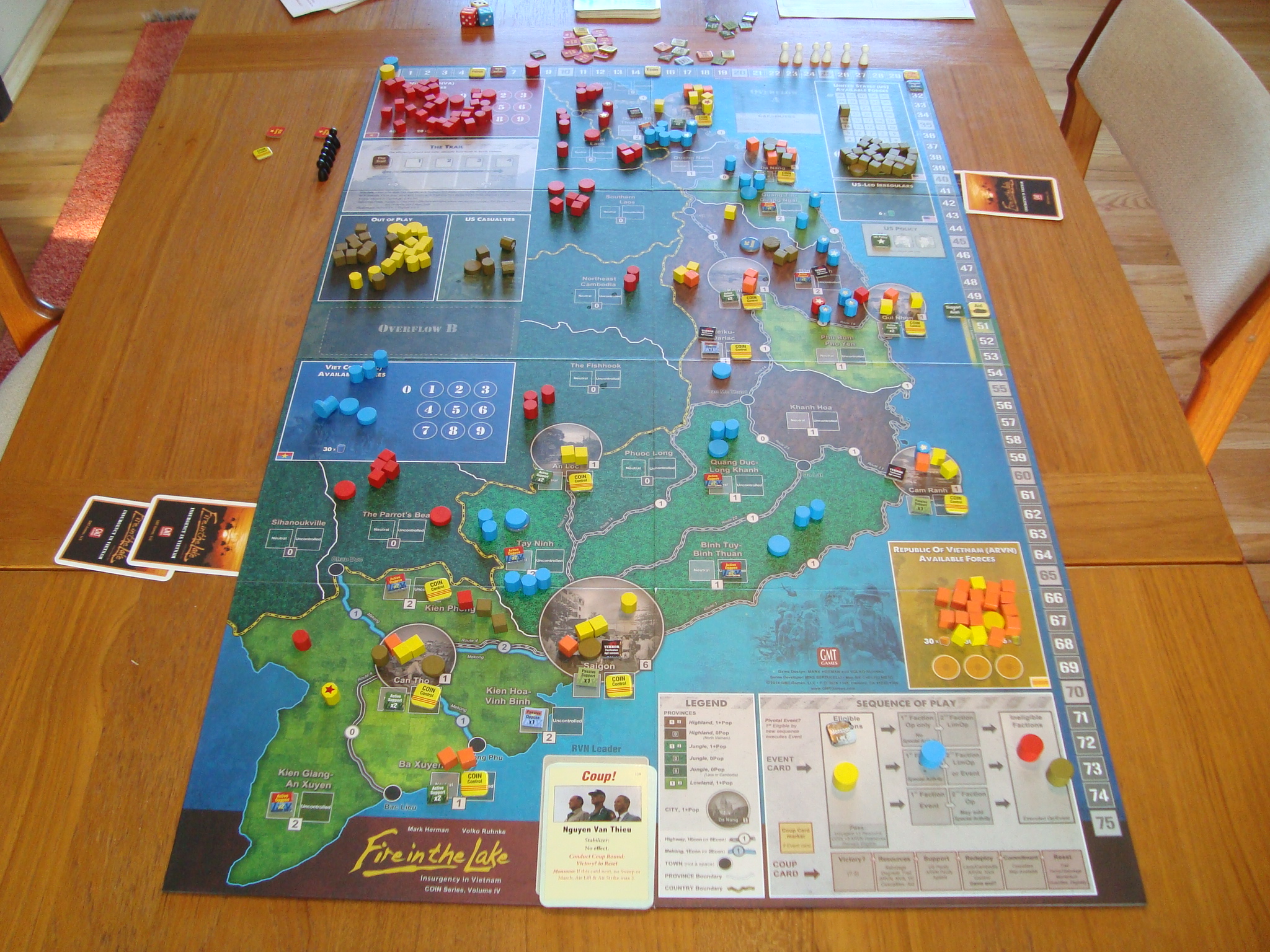
Great weekend of gaming with a great game.  Here’s photo of the end-game for game number 2.

Not For The Faint Of Heart

Been hacking away at D-Day At Omaha Beach by Decision Games.  Highly regarded over at Boardgamegeek.

Since it’s solitaire, several charts and card draws used each turn.  No dice, however.  Reminds me of RAF, and it should since it has the same designer.  Also reminds me of In Magnificent Style, as you take a beating, only this time on the beaches.  I’m just trying to keep all  the graphic Saving Private Ryan scenes out of my head (no, won’t insert a link to that).

Right now, the hacking part is playing through the rules, with little regard to tactics/beating the system.  Reading them is always the easy part.

The development team did everyone a favor by creating an introductory scenario using only the 1st Division and half the map.  While the separate color examples of play pamphlet is very helpful, it would be better to get the full GMT-Type Playbook treatment when beginning to play.

Seems to deserve all of the praise it’s received.  Will continue to split board game time with this and ASLSK.

Taking A Breather

Putting Irregular Wars away for awhile.  Good stopping point, with a need to determine the outcomes after the Battle At The Oasis Of Olufunke.

What happens to Lord Renaldo’s army?

1) Disintegrates/Retreats to coast; 2) Alliance with Natives; 3) Fight Natives; 4)Alliance with Bey Mahir to fight Sultan Efe.

What happens to the victorious Bey Mahir?

1) No further action; 2) Attacks Natives; 3) Alliance with Natives and/or 4) Attacks Sultan Efe:

What happens to Sultan Efe?

1) Decided after Lord Renaldo/Bey Mahir outcome(s).

Do Ming Chinese become involved?

1)  Yes/No; 2)  If Yes, how?

Do Natives become involved?

1) Decided after Lord Renaldo/Bey Mahir outcomes(s).

We’ll see…..


Carnage At Olufunke

Remnants of Lord Renaldo’s army have fled south after a stunning defeat at the Oasis At Olufunke.  The Bey’s army is too worn to pursue, having suffered heavy losses in a battle that had three distinct phases.

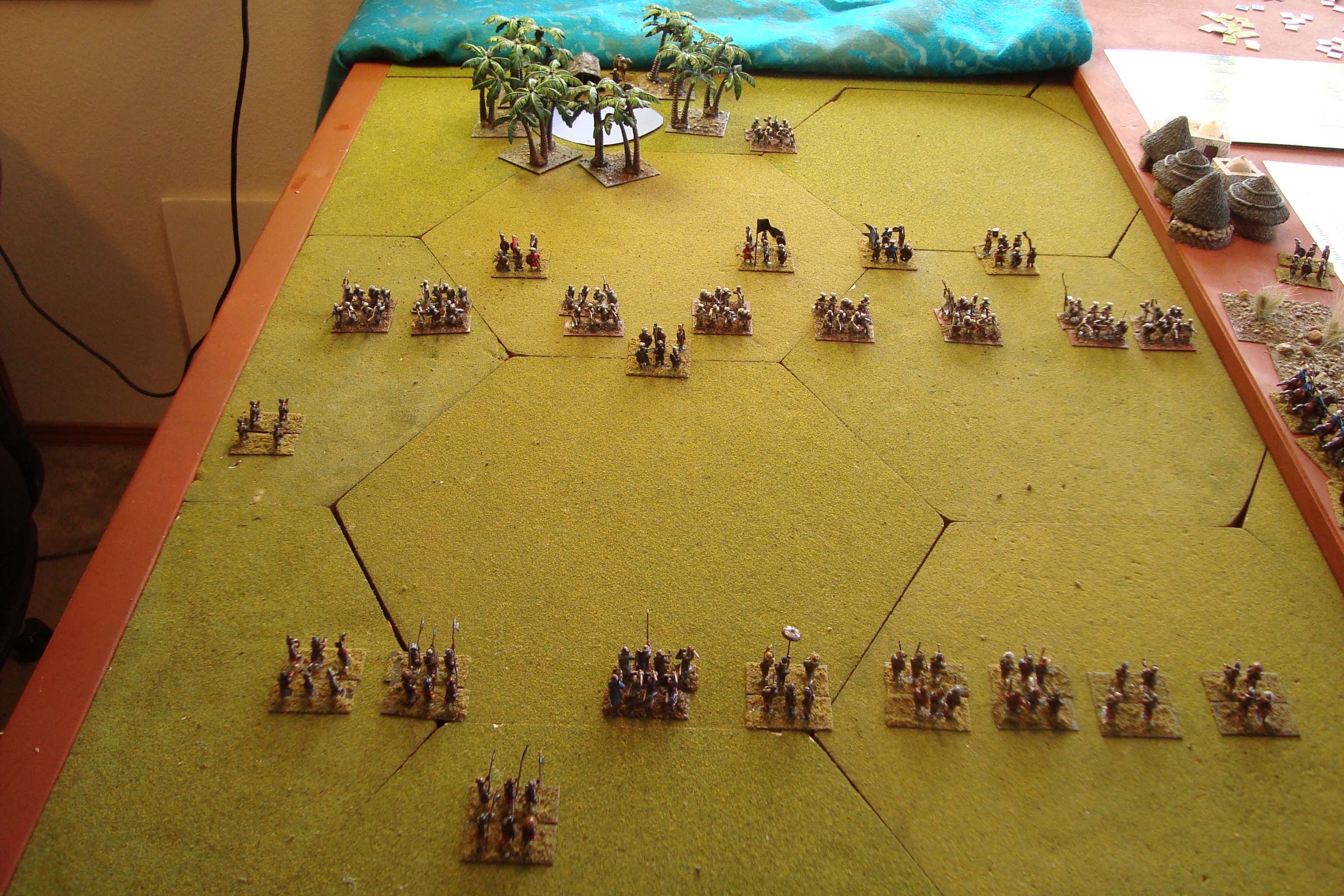
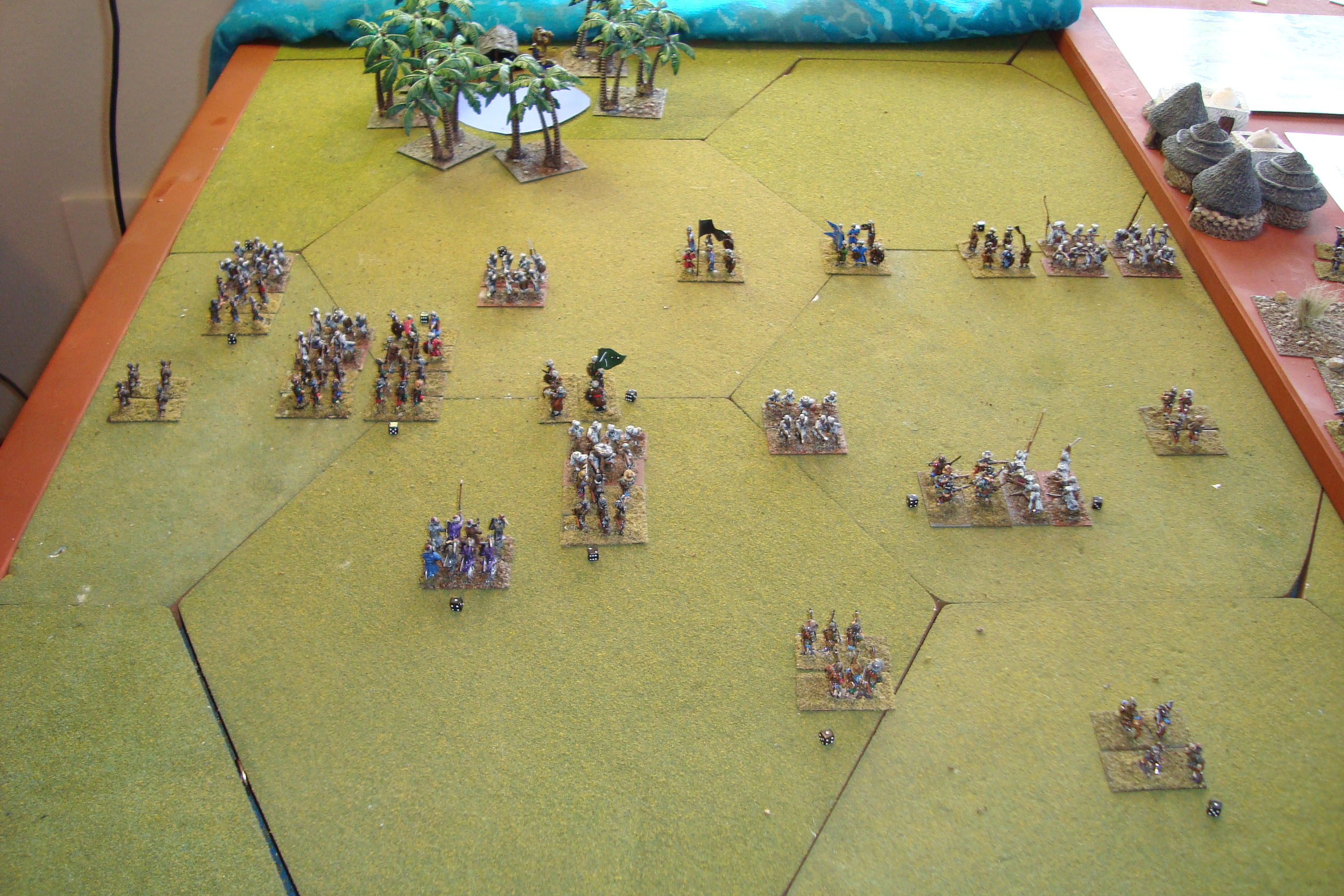
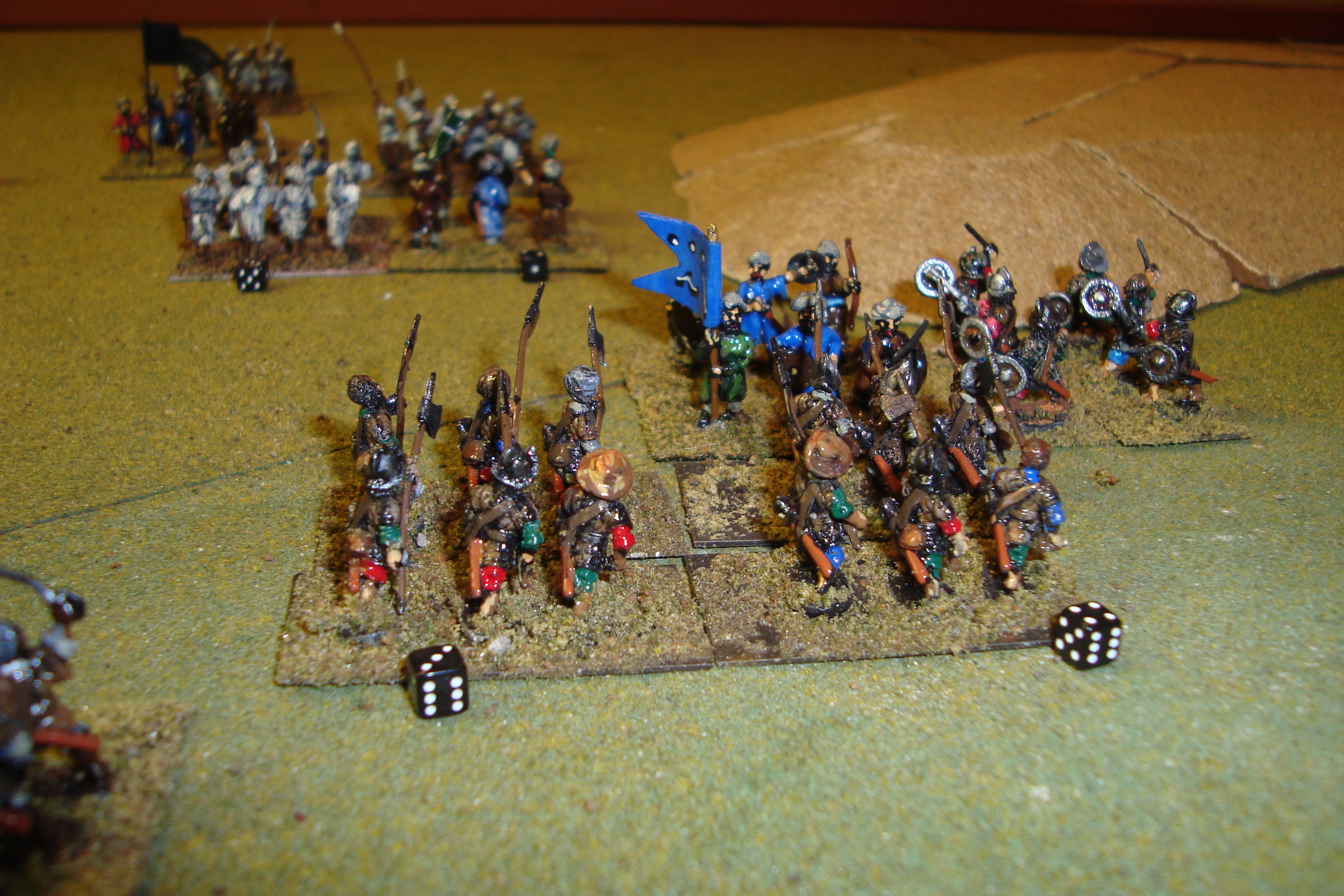
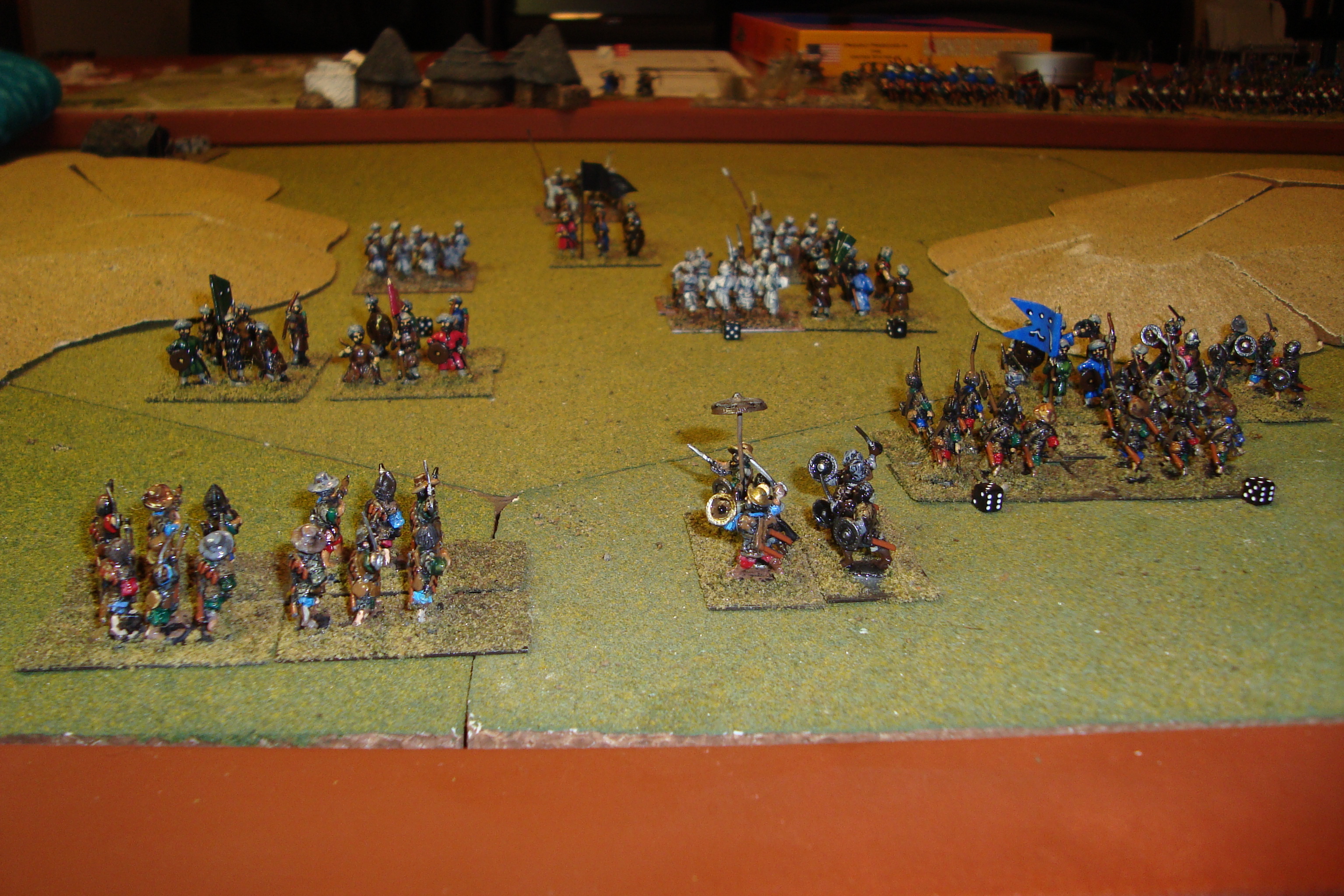
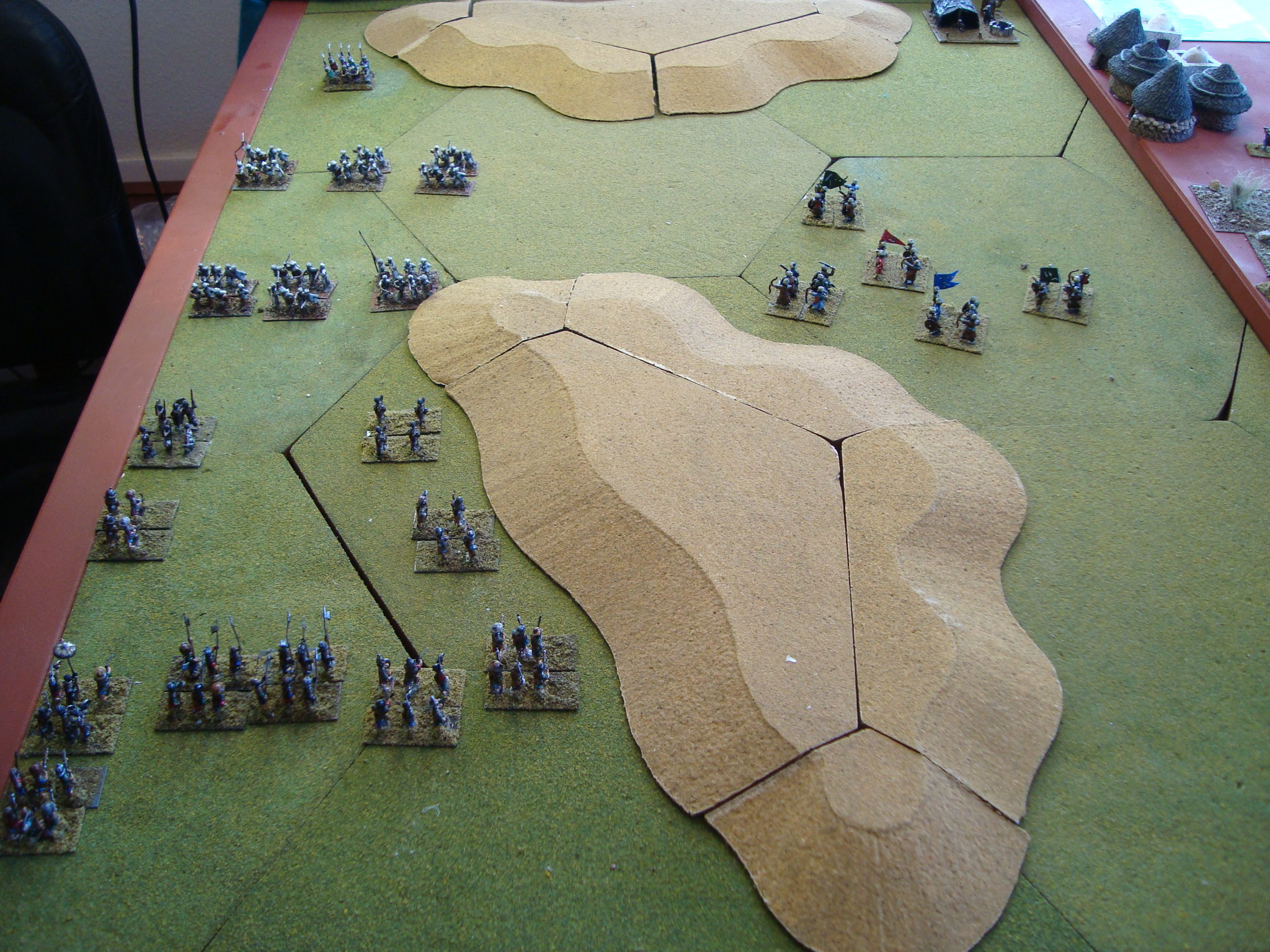
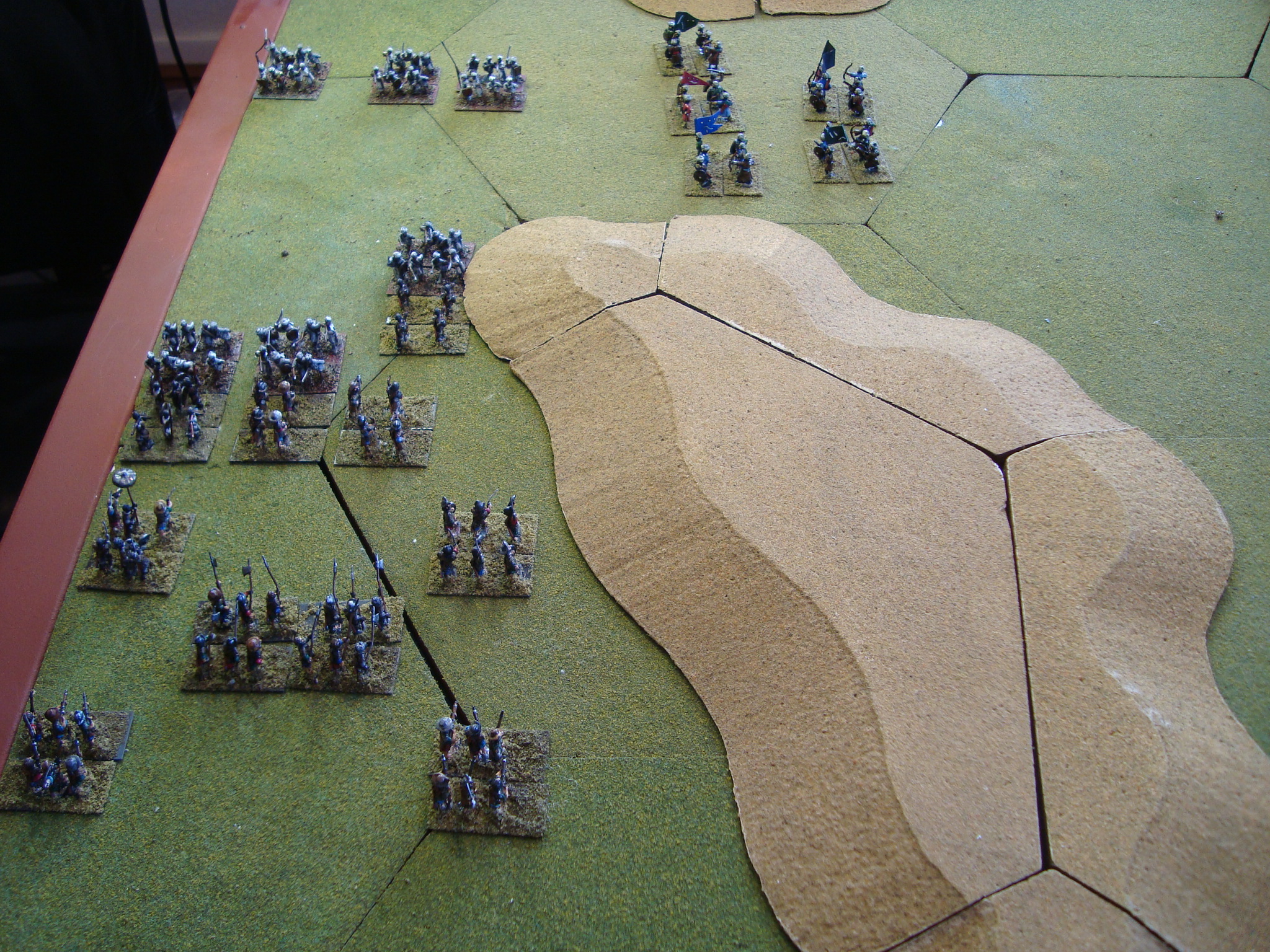
Bey Mahir’s defensive alignment was a variation of what he had used before.   His units were arrayed in a checkerboard along the entire plain lying south of the oasis.  His Civic Guard units were in front, with Tribal units some distance to the rear, but filling the gaps between Guard units.  This would allow any wavering guards to fall back unimpeded and tribesmen to counterattack.  Renaldo’s plan was use his Shot and Bow units as a screen on his right (Zanj left), while his Pike and Targeteer units concentrated on his left (Zanj right) to deliver a crushing blow to enemies to their front.

The Disease and Mishap rolls were not kind to the Zanj.  Four units lost resolve due to illness and two units were pushed out of position.  Once again, the skill of the Portuguese surgeon saved Renaldo’s army from any loss of resolve.

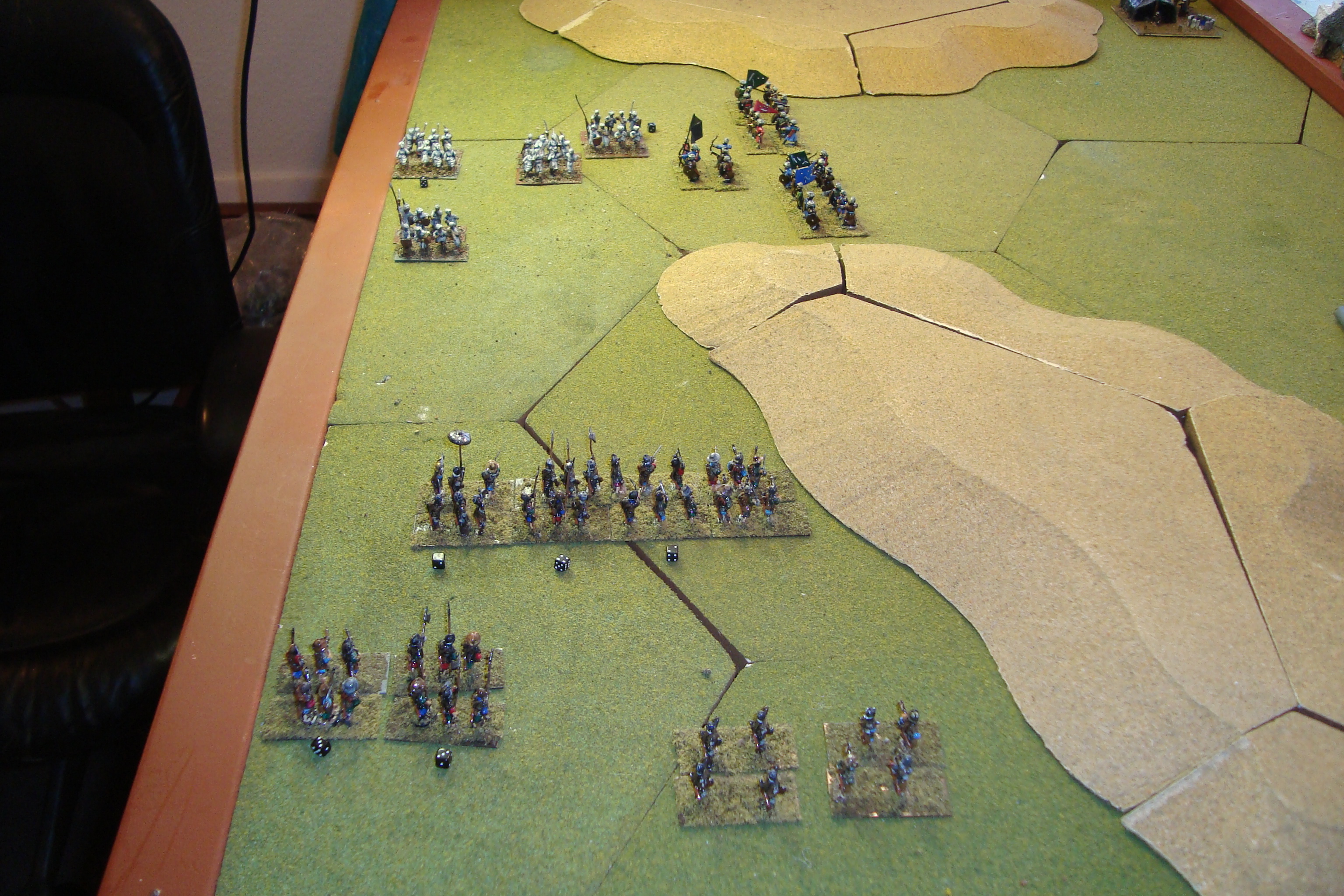
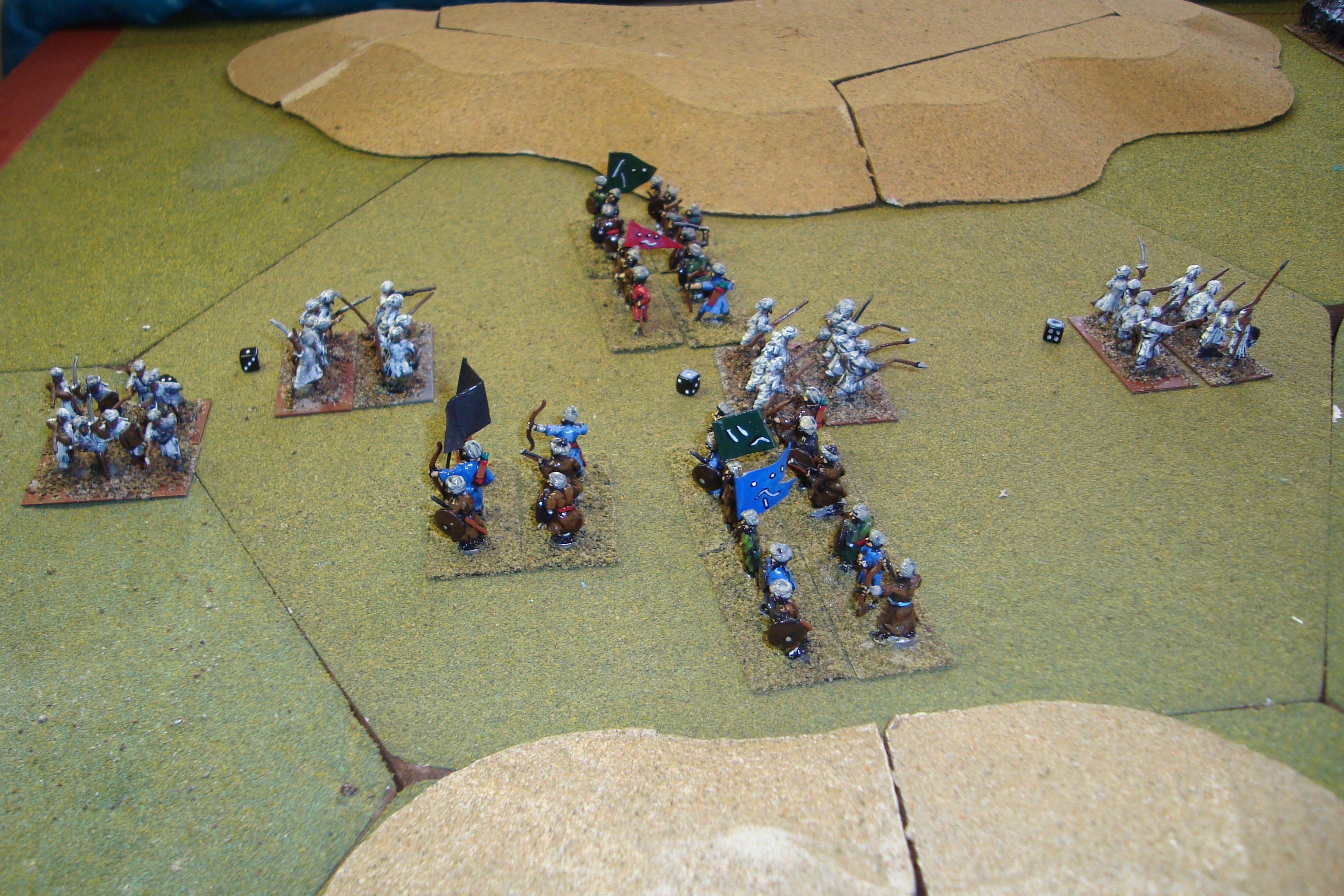
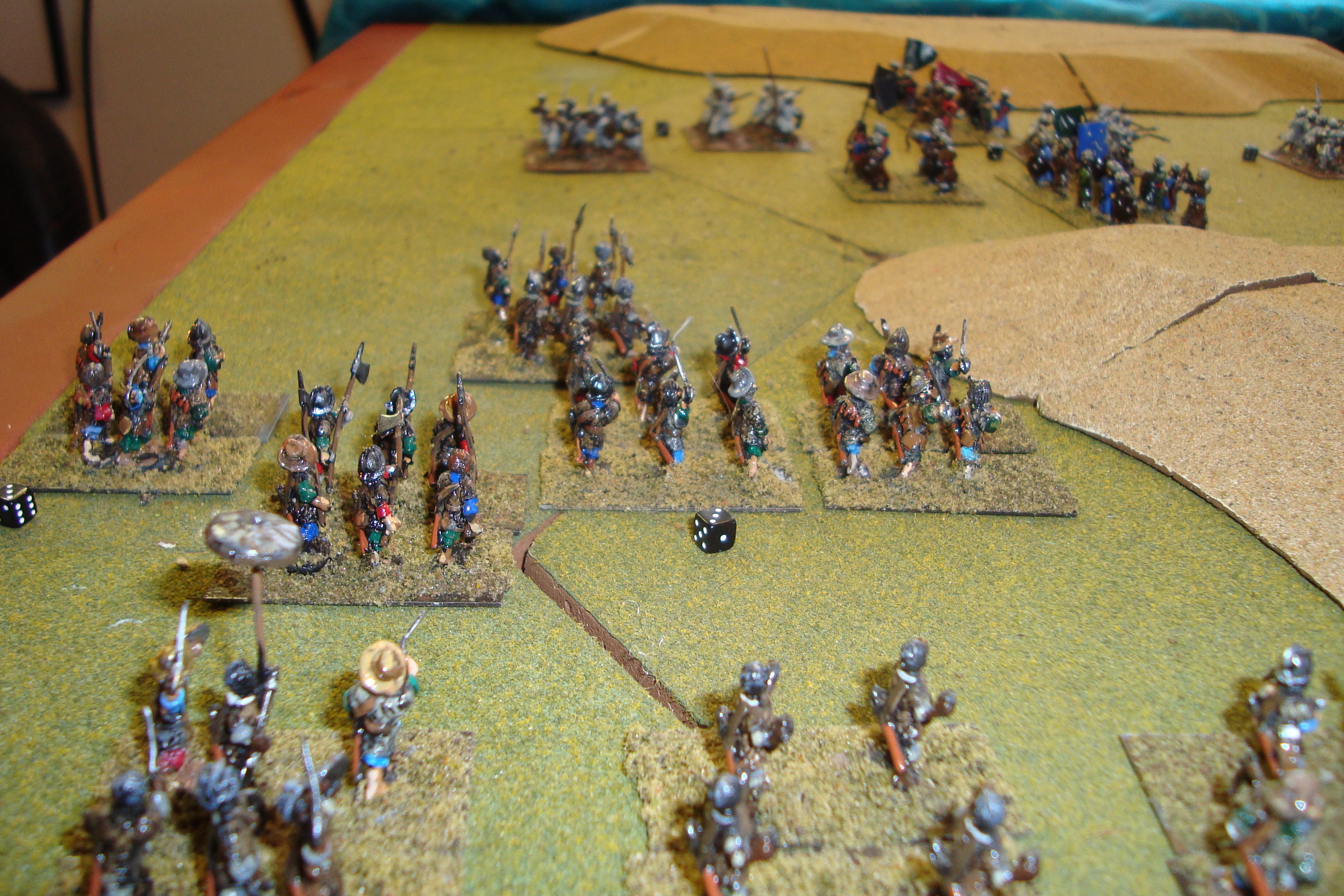
Opening Dispositions After Rolls For Disease and Mishaps.

First Phase:

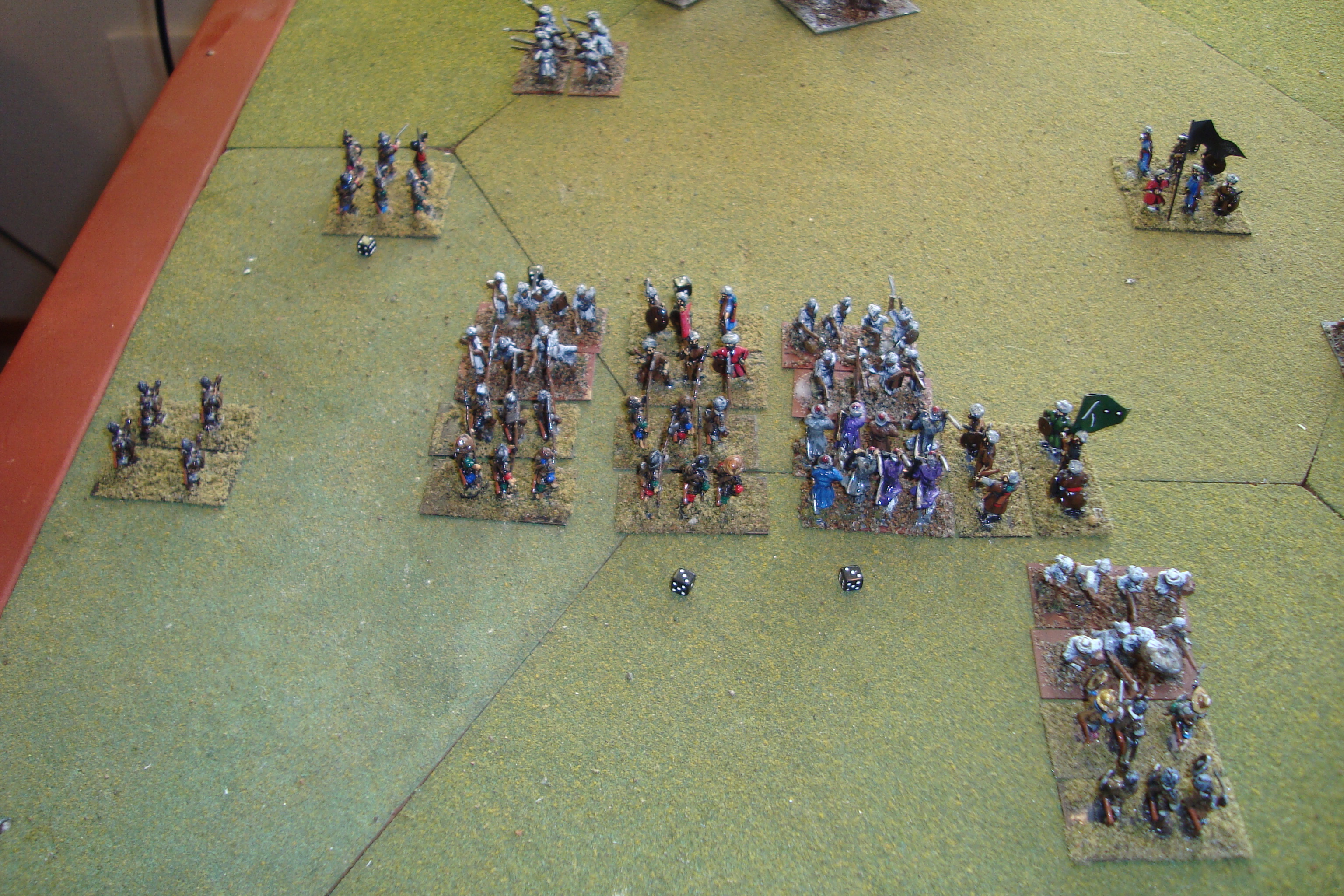
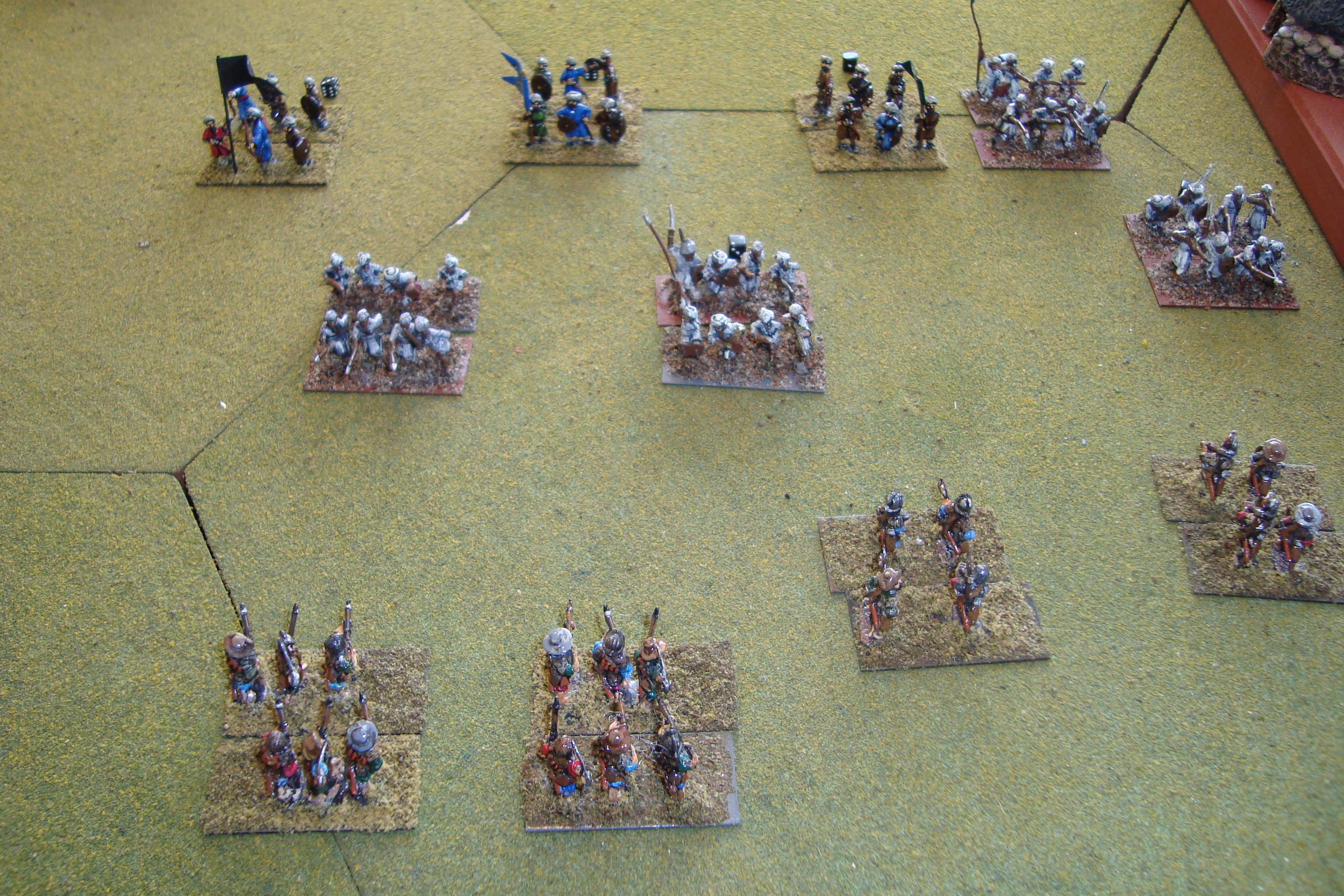
The Portuguese screening force was extremely effective, engaging the Zanj guardsmen at long range, causing most of them to scatter.  They could not close and melee with the weaker Portuguese.  More importantly,the guardsmen could not be rallied since their retreat drove them out of the Bey’s command radius.  However, the Bey’s forces on his right stopped the Portuguese Pike and Targeteer onslaught, locking them in attritional melees.  It was here that the effect of the earlier battle, which lowered the morale (and resolve) of the Portuguese, was critical.  The Portuguese were wearing down.

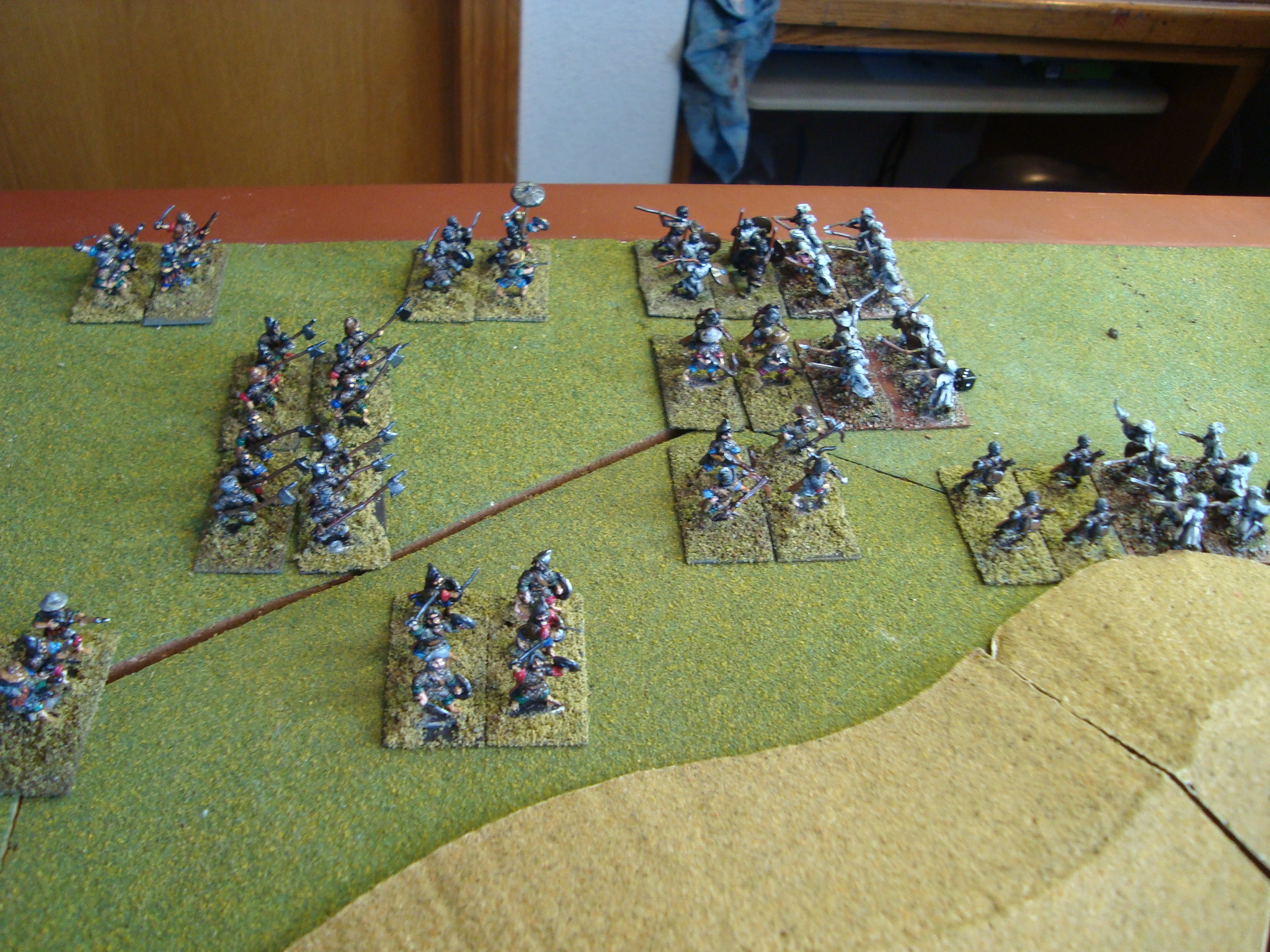
Melee On The Portuguese Left. Mercenaries Flanked. Civic Guard Unit Moves To Contain Portuguese Break-Through

Second Phase:

Desperate to break this deadlock, Renaldo ordered his Shot and Bow units to close to within short range of the decimated Zanj units. His hope was to gain the initiative on the next move.  If so, these units could deliver devastating volleys, scattering the Zanj units to his right, forcing a general withdrawal.  The Iron Dice Of War crushed his hopes.  The Portuguese lost the initiative, with Zanj units driving both Shot and Bow units back in disarray.

Portuguese Shot and Bow Move To Close Range

Portuguese Right Collapses. Lord Renaldo’s Personal Guard Attacks

Lord Renaldo launched a last ditch assault with his personal guard of Targeteers, scattering three Zanj units.  However, the outnumbered Zanj units somehow stopped the continued attacks of the Portuguese of the Portuguese Pike.

Third Phase:

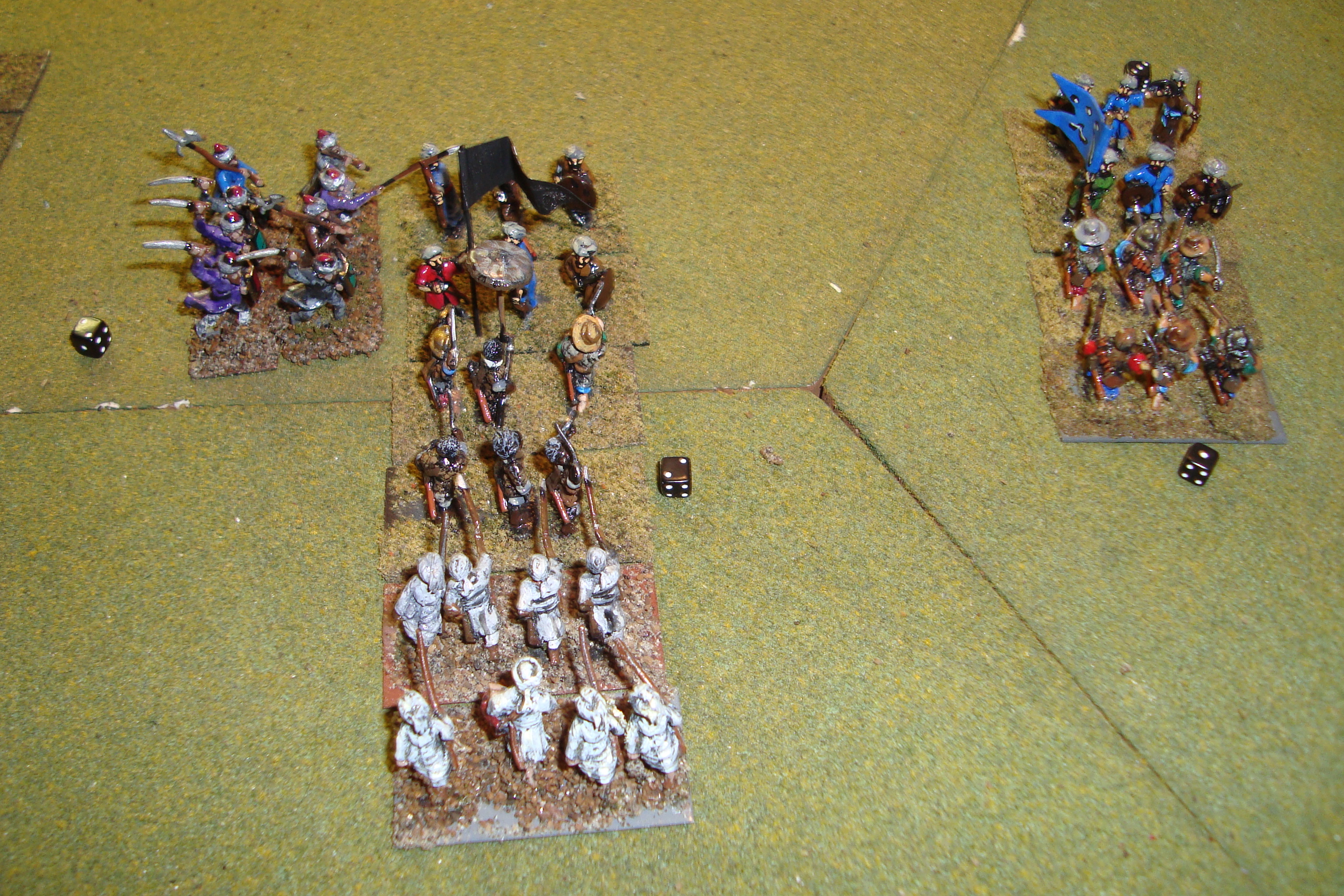
Now the desperate one, Bey Mahir attacked Lord Renaldo’s guard.  After a prolonged fight, Renaldo’s unit scattered opening the way for flanking attacks on his remaining units.

Surrounded, Renaldo’s Personal Guard Will Scatter

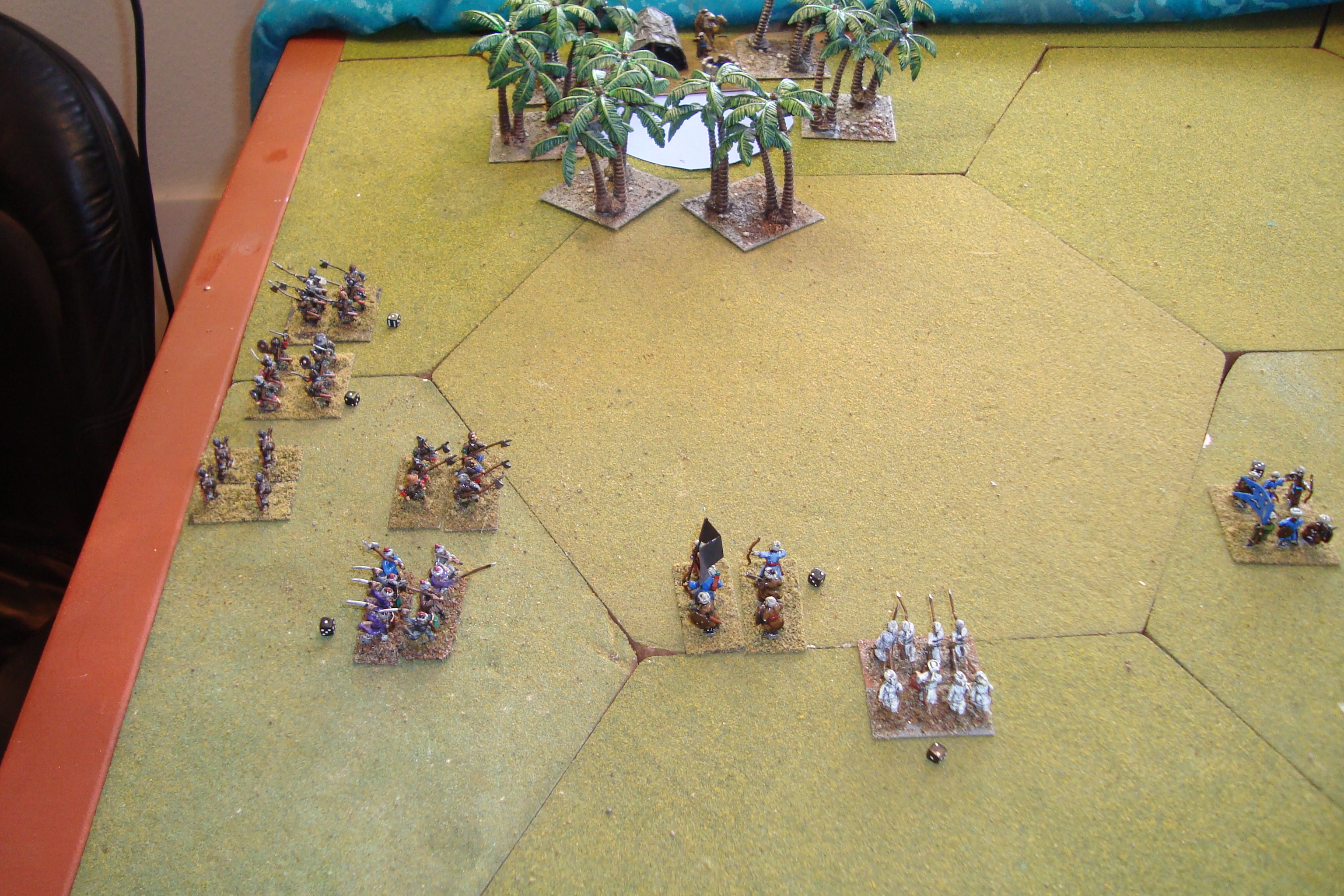
The Portuguese had no choice but to flee.

Portuguese, Covered By The (Now) Valiant Mercenaries Withdraw To The West

Battle At The Oasis of Olufunke – Preliminaries

The Bey’s instincts were correct.  He quickly raised four more Civic Guard units, giving him nine.  His Tribesmen were relatively intact after the battle, and add another five units to his army.  The Civic Guards confidence and resolve soared as a result of their staunch performance, and all units are now rated a “3”.  The Bey’s experience now allows him to have a command radius of six units.

The Portuguese were shaken  by the seeming setback at the Faragh.   The resolve of their Pike units has dropped to “4”, with the Musketeer units resolve now at “3”.   Lord Renaldo’s  negotiated settlement with the Persian mercenaries  is the one bright spot in this deteriorating situation.

A condition of employment was to reveal the ringleaders of their desertion from the Bey’s army.  That being done, Lord Renaldo personally executed them in front of his army.  Now “encouraged”, the Persians have a resolve of “4”.

The Bey’s forces have taken up positions at the Oasis, and the Portuguese approach.  The battle is at hand…….

Battle of Katlego Faragh – Pt 2

Lord Renaldo ordered his troops to by-pass the Zanj tribesmen now blocking the Faragh (gap).  Planning to take advantage of a screen of Musketeers and Crossbowmen, the Pikemen and Targeteers moved north.  But, with the narrow frontage, the Portuguese units blocked each other, offering the Zanj an opportunity to attack.

These piecemeal attacks were stopped, and Bey Iman Mahir ordered a general withdrawal to the east, planning to retire along a route parallel to the Portuguese advance, but separated by the impassable dunes.

Melee Combat
Zanj Orderly Withdrawal. Tribesmen On The Right Will Also Escape.

While the Bey might be criticized for not pressing home is attacks on the disorganized Portuguese, he was intent on maintaining his army, and most importantly, the high morale of his Civic Guard.  These untested units had acquitted themselves well in the battle.  Bey Mahir believed their success would allow him to recruit more Civic Guard as it was his belief more troops were needed to defeat the veteran Portuguese.  This was especially true since the mercenaries had failed miserably, and could no longer be counted on.  In fact,  there were rumors they might be bribed to change sides.

However, there was real risk in his strategy.  The city of Behefe was not defensible and could not withstand the shortest of sieges.  Its sole water supply was the Oasis of Olufunke, a 15 minute walk south from city walls.    The decisive battle would have to take place there.

What’s In A Number?

Through with Xmas visits/visiting so finally have time/energy/sobriety to post up about another Fire In The Lake game with Tim.

This will be a fuzzy-through-altered-memory overview of the game focusing on my experience, with Tim adding his thoughts in the near future.  As with last time, I had the NVA/VC forces.

First and foremost it was a lot of fun.  We decided to use the historical card option, which allows for a roughly chronological card sequence.  Coup Cards are randomly placed in 12-card groups using each of the three (1964, 1965 and 1968) decks.  There are six total groups to work through, with half of the cards from the larger 1968 deck.

Lesson learned:  When a Coup Card is drawn, get going during the current turn and get set-up to grab some points during the End Turn phase.  While somewhat “gamey” it does (in a way) reflect the chaotic situation that leads to a coup.  The US player cannot use air strikes during the turn prior to the coup (considered monsoon season), so the NVA/VC player can be aggressive without fear of devastating retaliation.

Lesson Learned:  Spend the resources necessary to keep the Ho Chi Minh Trail in good shape.  The source is a “times two the level” source of reinforcements.  This is, literally, a powerful force multiplier.

Lesson Learned:  The  NVA/VC will take casualties.  Inevitable if aggressive operations are launched.  However, casualties can be minimized by using the Ambush option.

Lesson Learned:  Occupying Lines of Communication (LOC) can result in victory points, or at least, tying down US/ARVN resources.

Lesson I Couldn’t Learn:  How to effectively get the VC into cities, where they can disrupt COIN control.  The problem is that they have to reveal their presence, which means they can quickly be “killed”.  Maybe it’s just a matter of using them to soak up US/ARVN options, or flooding a city with VC (Tet).

We managed to get through four Coup Rounds.  At the end of fourth, we discovered (to our surprise – or certainly to my surprise), that the RVN had attained victory by ONE STINKING POINT!  Not a BLAMMO by any stretch of the imagination, but a victory nonetheless.  The good news was that “victory” occurred at about 2200, so we could call it a night.

We’re planning on a another game in the near future.  We’ll switch sides and see what happens!
Battle of Katlego Faragh – Part 1

Jeez….what happened???

For me, writing a wargame after-action report is similar to waking up after a party and figuring out what happened.  It takes a while…….and may lack details.  I admire wargamers who can provide a detailed account of their games (not to mention high quality photos – definitely NOT a characteristic of this site).  However, I just can’t do it.  Why?  I get caught up in the game and am having fun. I don’t take notes at a party, and I just can’t do it consistently during a game.  So, what follows is a series of general impressions and game photos in a rough chronological sequence.

First, game-flow impressions:

  1. The Portuguese were able to gain the initiative for most game turns.
  2. The Civic Guard fought like lions, or the fabled “300”. They held off the Portuguese, lowering the resolve of every unit they came in contact with.  Yes, the narrow gap worked in their favor, and their initial resolve determining die rolls were good (and better than anticipated using a D4), but still, they outperformed expectations, retiring only when their resolve reached a wobbly “1”.
  3. The Portuguese couldn’t get sorted out.  Their hasty attack was probably a bad idea, and it was difficult after that to deploy the right combination of units (fire and shock) to attack through the narrow gap.
  4. They were also cautious.  Lord Eduardo Nicolau Rolando halted his assault to regroup and focus on rallying depleted units rather than continue to attack the weakened and withdrawing Civic Guard.
  5. The inexperienced Bey Iman Mahir did an excellent job of moving his tribal units initially deployed east of the gap, to a supporting role.  He also managed to extricate the Civic Guard units in good order.
  6. However, the Bey’s initial deployment east of the Faragh caused his Civic Guard to be beyond command radius and subject to the wackiness of the Impetuous Actions table.  Luckily for the Bey, he quickly moved west, and most of his companies did not act too impetuously before brought under control, although the Mercenary company “Ran Away” for three consecutive turns, and off the battlefield.  In fact, the initial disruptions in the Guard’s dispositions triggered an ill-advised (in retrospect) hasty attack by the Portuguese.

Now, some rules impressions:

  1.  The Disease and Mishaps roles at the beginning of the game are something.  The Portuguese launched their hasty attack because the Civic Guard units were in disarray, with rolls that either moved units forward, or behind their line of initial deployment.
  2. The Portuguese were literally “saved” by their expert physician.  No less than four units had disease (normally resulting in loss of resolve) rolls that were negated by expert medical care.
  3. My rules interpretation is that a unit contacted by an opposing unit (that opposing unit having the initiative) can, in their subsequent movement phase, attempt to withdraw from melee before the melee phase begins.  This ability to disengage can be a mixed blessing.
  4. It’s a mixed blessing because the attacking unit can roll to pursue.  If successful, the attackers gets a charge bonus.  On the other hand, this is a mixed blessing for the attacker because this impetuousness can disrupt a coordinated assault.  I didn’t grasp this dynamic until this game.  It’s a welcome discovery, as it adds an uncertainty that I fondly (ahhh, and not so fondly remember) from the old Gush WRG rules.  The only Civic Guard unit destroyed was a result of continuing to pursue a unit.
  5. You can’t interpenetrate in this game.  Keep gaps open.  Not only for movement, but because wavering companies (resolve = 1) that contact other units cause the contacted to lose one resolve.

Now, the game photos with narrative captions.

Portuguese Begin Hasty Attack. Tribesmen Begin Move To Support Civic Guard
First Contact! Tribesmen Have Closed The Faragh.
First Contact! Tribesmen Have Now Closed The Faragh.
First Contact, Looking West.
Both Sides Regroup.
Both Sides Regroup.
Civic Guard Withdraws Through Tribesmen.
Portuguese Begin Cautious Advance Towards Withdrawing Civic Guard
Portuguese Begin Cautious Advance Towards Withdrawing Civic Guard.