Category Archives: Sessions

Campaign Game – Renaldo’s Decision and Other Events

Well, Lord Renaldo’s wheels took a little longer to grind than promised.

The Zanj defeat raised several questions requiring resolution before the campaign continued.  These were 1) how much of the Zanj force was destroyed in the battle; 2) could the Zanj civic leaders be persuaded to provided the Sultan the additional resources to recruit more troops, and, if yes, 3) how many; 4) could the Sultan convince the Inland Natives to abandon their policy of hostile neutrality and provide assistance, as well as 5) convincing local Chinese merchants to seek Ming aide.

Answers to these questions were generated using the Campaign Table (which this process revealed to be flawed and in need of work), D6, and Yes/No/Maybe dice.

While the Zanj  fled the battlefield at Ejiro in great disarray, only two units had been shattered (D6/2).

The army conducted an orderly retreat to the south.  The Sultan hurried to Mwenye to implore local merchants and leaders to provide more support for his army, promising much (hopefully for him, he can keep those promises).  His entreaties were successful (re-roll on government support chart), and he was able to gain four units (D6) in reinforcements.

He also met with  local Chinese merchants, convincing them the Portuguese threat was real.  These merchants agreed to send a representative to the Ming leader in Aden. (Yes die rolls for the two questions).

The energetic Sultan Efe then contacted the leaders of the Inland Natives, requesting they reevaluate their position of hostile neutrality.  Again, making extravagant promises, he persuaded these leaders to at least be neutral, and to re-evaluate their position at an upcoming meeting of clan elders (re-roll on neutrality chart).

Hearing rumors of these activities, Lord Renaldo decided to turn north, and attack the port city of  Behefe.  The rationale is still to gain a victory over the weak defenders, gain a port, and let those results drive events both with his own government, and the local leadership.

His scouts are already determining the extent of the resistance…….

Fire In The Lake – AAR – Tim’s Take

Finally back from road trip.  Now I can post Tim’s observations about the game.  We have another session scheduled for Mid-December.

Here are my thoughts about Fire in the Lake-

  • We made a big mistake on the tunneled base rules.  They are much more difficult to remove than the regular bases.  I’m not sure it would have made a big difference in our game, but definitely something to note for future games.  BTW, I didn’t like the term ‘tunneled’.  I wish they’d used something different like ‘fortified’ or ‘entrenched’.
  • I wish I’d spotted the rules about South Vietnamese Rangers being able to raid across national borders.  It was really frustrating to watch the NVA building up in Laos and Cambodia.
  • The charts were very good.
  • I’m still laughing about the mistake of tracking ‘available’ units…We made that much harder than it had to be…:)
  • Very few of my units could both move and attack at the same time.  It felt like I was playing Paths of Glory!
  • Bombardment missions can really pay off for the NVA in the long run.  They provide a relatively cheap way of attritioning the COIN player.  I’m not sure if we removed to adjust ARVN aid to reflect US casualties (I think its something like -3 per unit killed– that adds up).
  • The VC need to adopt a ‘fleet-in-being’ strategy.  Admittedly the mistake about tunneled bases didn’t help, but they were rapidly wiped out in our game.  At one point you were using rally phases to make activate guerillas inactive.  It is really frustrating for the COIN player to see guerillas that have been activated by sweep operations go inactive during rally phases…A nice modeling of the frustrations of COIN operations.
  • On the rare turns when both of my factions started eligible it was a real dilemma whether or not to have them both run operations or have one pass so I would get a chance to respond to your moves during the next turn.
  • That game would play very differently with four players.  I don’t think the VC would let themselves get wiped out to the last man or the ARVN would let the Americans transfer large amounts of patronage to resources….
  • I kept forgetting to move the police out into the provinces, which hindered my pacification efforts.
  • Neither one of us did much fighting for the LOCS– I wonder if mass attacks on the LOCs would yield better results for the insurgent player.

Raid on St. Nazaire – Again

Started up another session.  Once again, discovered rules mistakes made during the last session.

The British can be attacked when in The Approaches, before movement.   And….the Germans have one searchlight operational for their first fire phase (a -1 on the to-hit die r0ll), and another searchlight becomes available for their second fire phase.

Fortunately for the British, the German die rolls were bad for their first fire phase.   However, the British Covering Fire was (again) useless, and the Germans could bring 6 firing factors to bear in the “A” zone during their second fire phase, which gave them twelve (!) attempts to damage British ships.  The result:  Bloodbath!

Still, the doughty Brits pressed on and are ready to land several intact teams of commandos.  Unfortunately, while the German Activation die rolls have been bad, the troops have been placed (by some strange hand of cardboard fate) right in or adjacent to their landing areas.

Should be interesting.

Fire In The Lake – AAR

Had a fun session with Tim this past weekend.  Full of fumbling and stumbling.

As discussed in an earlier post, this is a highly regarded game, with beautiful components.  And, as also discussed, for two old hex-and-counter Grognards, it promised to be a new experience, and not the type of card-driven game (Paths of Glory, Pursuit of Glory, Wilderness War, Wellington) we were used to playing.

This will be more an overview of the process, rather than a turn by turn narrative of the game we played.  I was so involved in figuring the damn thing out, that coherent recall much less thoughtful strategy was well beyond my capabilities.

First off, we really needed a picture of what the map board should look like when set up.  We messed up on where to put available cubes, what cubes to use as markers, and what counters go where.  It’s a new take on “idiot rules”, we need rules crafted for idiots.

The first difference we noticed between this and our previous card driven experiences was that each faction (USA, South Vietnam, Viet Cong, North Vietnam) cannot do something with each card.  Only two factions can play a card, and only one can play the card as an event.  Also, not only is the card in play turned up from the play deck, but also the next card to be played.  This forces players to anticipate how to react with two cards, not just one.

The deck itself is constructed differently.  In many games deck events and options are predicated on period of the conflict, or the play of a major event triggers the inclusion of more cards.  In FITL, the very large deck is initially split into six decks of twelve cards each.  A coup card is then shuffled into each deck.  Play commences with one deck, and after a Coup card is turned up and played, that Coup card is removed and the next deck placed under the remaining cards from the previously played deck.  There are a large number of cards that are not included in the six decks.  This must enhance replay.

Most card driven games involve reacting to an opponent’s play and  sequencing a group of cards held in hand.  This leads to a rapid sequence of play, with a card played quickly followed by another.  In FITL, the pace was less frantic, and steadier.  Maybe this was due to our inexperience.

The options for the first eligible faction (sequence of eligibility shown at the top of each card) are to pass (perhaps because of the next event) play the event, or play an operation (in multiple spaces), with or without a special activity. The second eligible player can pass, execute the event (if not done so by first player), or execute a limited operation.  Limited operations can take place in one space, only.  Only if the first two pass, can the third eligible faction act on a card.

We learned that Operations have complementary Special Operations, and successful play involved the ability to mix and match these operation types.  Also, the first eligible faction can really frustrate a stronger opponent by executing an Operation, only, after which the second eligible player can only execute a Limited Operation, not the Event.

All sides must be careful not to take too direct of an approach.  For the VC, taxing to raise resource levels or terrorizing the populace will alienate the local population, reducing support.  US airstrikes, while devastating militarily, are just as damaging to popular support.

While control of areas and provinces is the key to victory, each side has other activities,(not just destruction of enemy forces and many times in conflict with those of their “ally”) that contribute to victory.  For the VC and NVA, base building and maintaining the Ho Chi Minh trail must be a priority.  For the US, it’s ability to win is directly tied to reducing the number of troops being used.  ARVN forces gain victory points by siphoning off US aid into their coffers.

All of this maneuvering comes to a grinding halt when a Coup card is turned up.  The card in play is then considered to be a Monsoon card, which limits operational play options, and the Coup card is then the last card played.  After play for that card is finished,  victory points are calculated.  If a faction wins, it wins.  If not,  new aid and resources are distributed, and victory points are again calculated.  If one faction has attained victory, the other factions know it and the last deck is played.  An interesting way of changing play strategy and perspective.

Tim will be posting up his observations.

We’re playing this one again in December.
Campaign Game – Initial Encounter – What A Difference A Day Makes

Now that my rule gaffes have been corrected, I fought a brisk 60-minute action this afternoon.  Scenario and set-up were the same as described earlier.

The Portuguese were able to hurt the Zanj with missile fire before stopping their charge (the result of some consistent lucky rolls).   On the other hand, some poor die rolling contributed to a general weakening of the Zanj units locked in melee, with the Portuguese able to withdraw one crossbow unit, and plug its gap in the line with charging targeteers led by Lord Rolando.

This charge caused two Zanj units to scatter (one as a direct result of melee), with others’ resolve dropping to “one” (wavering) leading to a controlled withdrawal from contact.

A final volley by the (now) disengaged Portuguese muskets and bows caused the withdrawing Zanj to flee the field.

However, Sultan Jabir Efe was able to rally the bulk of his army withdrawing south towards Mwenye.  It is rumored  he intends to redouble his diplomatic efforts to enlist the help of the inland natives, as well as contact local Ming merchants to explain the catastrophic effect the mercantile policies of the Portuguese will have on their business interests.  He hopes the  merchants will ask Imperial forces located in Yemen to intervene

The Portuguese leader, Lord Ricardo Nicolau Rolando, must now decide whether to pursue Efe’s forces, or turn north and take the (now) isolated port of Behefe.  It is rumored that the town has only a small garrison augmented by a civic guard of uncertain size and quality.  Regardless of decision, Rolando is confident that another Zanj defeat will cause the inland natives to ally themselves with Portugal, providing supplies and troops.  And, a treaty with the natives promising gold, ivory and other exotic items, should convince his government to provide greater assistance.

Rolando’s decision will not be long in the making…..


Initial Encounter……Well, Never Mind.

After a break, I continued playing the initial encounter between the Portuguese and Zanj.

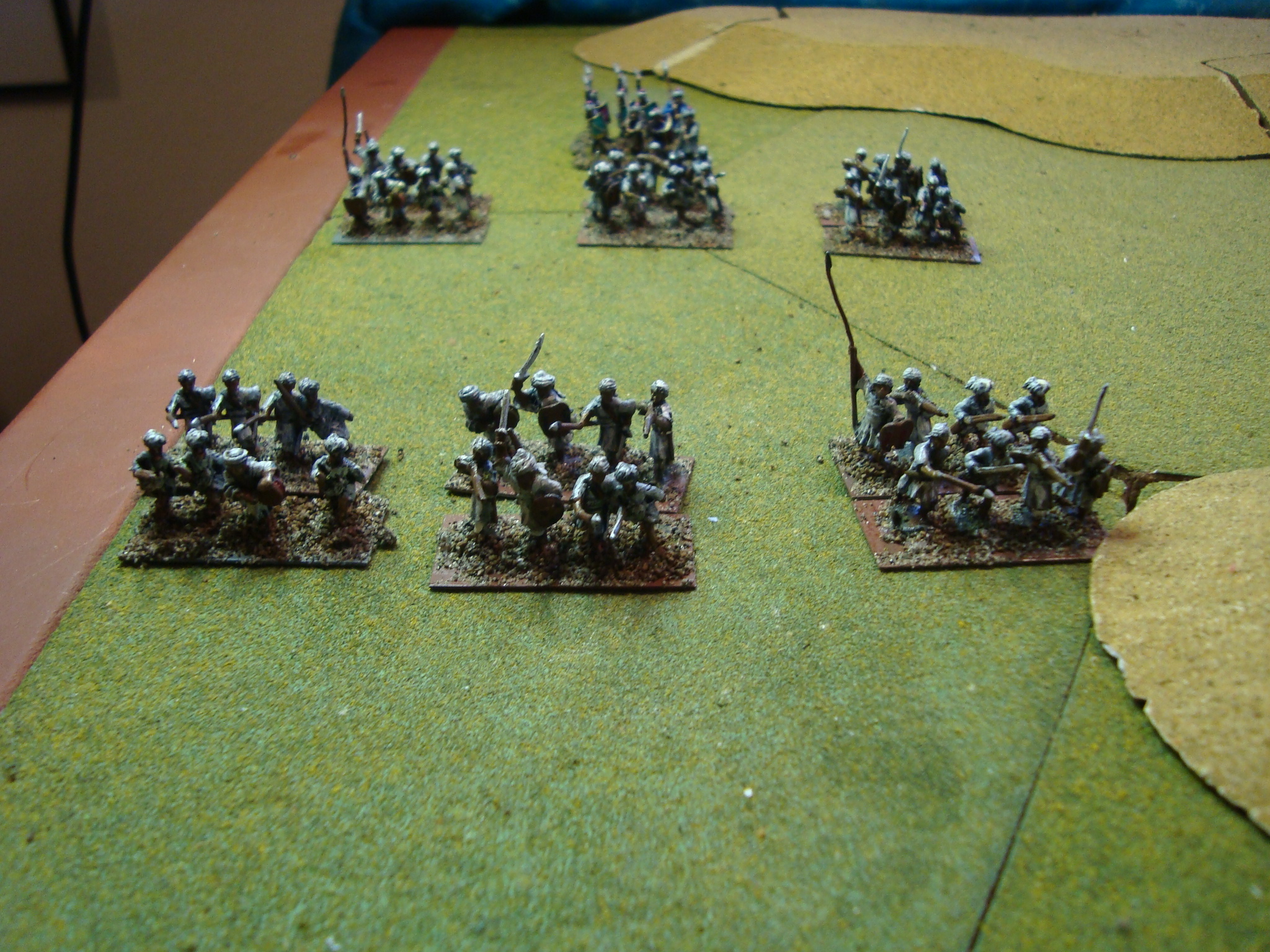
The battle turned into a real slug-fest, with the Portuguese Crossbowmen able to extricate themselves from melee, and the Targeteers, led by Lord Rolando, charging into the Zanj tribesmen.  On the left, the Zanj had enveloped a Portuguese Musket unit.  But wait…..there was something very, very, very wrong…….Take a look at the picture, which shows a real pounding in progress, but then read the caption.

Hey...All You "Ones", You're Wavering......Get Out Of There, Now!
Hey…All You “Ones”, You’re Wavering……Get Out Of There, Now!

Yes, I completely screwed up the rules (Shocking!).  Once resolve drops to a “one” a unit must withdraw 1d3 movement units directly to its rear, maintaining its facing, and cannot initiate melee until its resolve increases.  And, if this unit was in melee (as are all of these), its foe can attempt to pursue.

Oh My…….kind of changes the dynamics, doesn’t it?

Reset!

Campaign Game – Opening Moves & Encounter

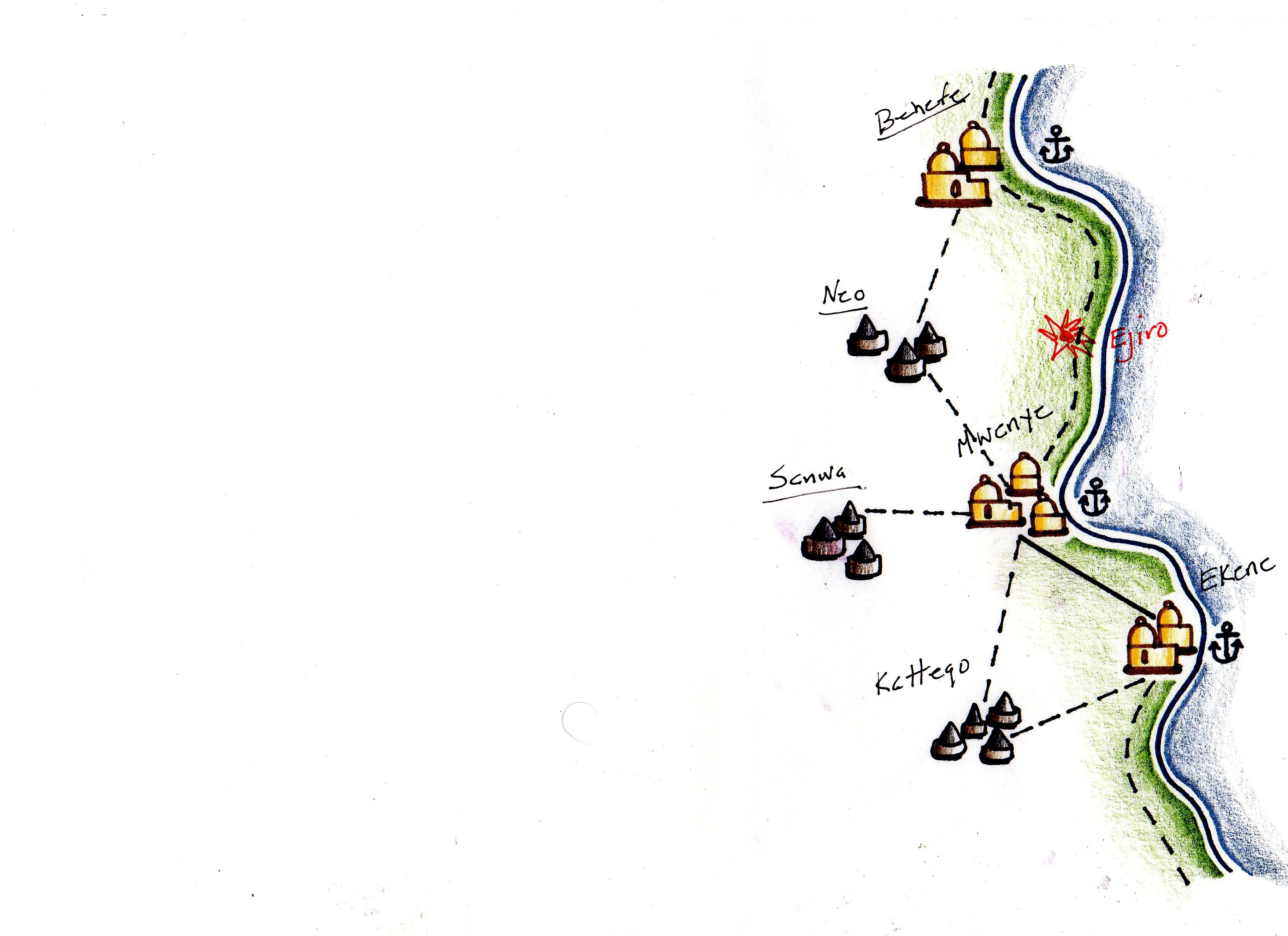
The Portuguese completed an unopposed landing, without loss, and advanced along the coastal track towards the northern port town of Mwenye (I used a random name generator which is found here).  Since the inland natives’ relations with the coastal Zanj are bad, the Portuguese inland flank is secure.

A Zanj force moved to block the advance, with the two sides meeting at the forest/oasis of Ejiro.  This would be  a set piece battle with the Zanj occupying a fairly strong defensive position.  However, some Zanj units were effected by an cholera epidemic.  As a result, their resolve was lowered, while skilled medical care kept the Portuguese healthy.

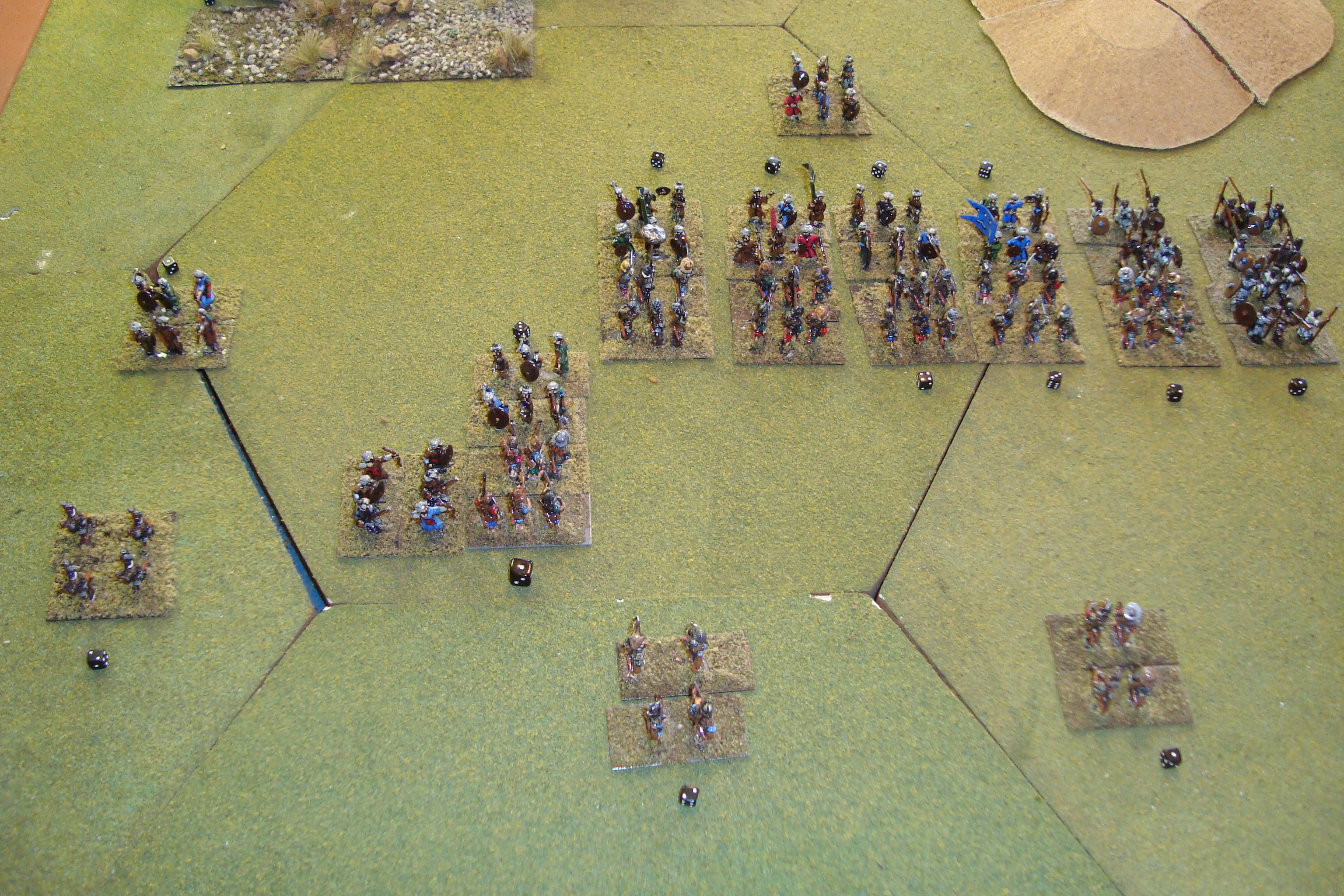
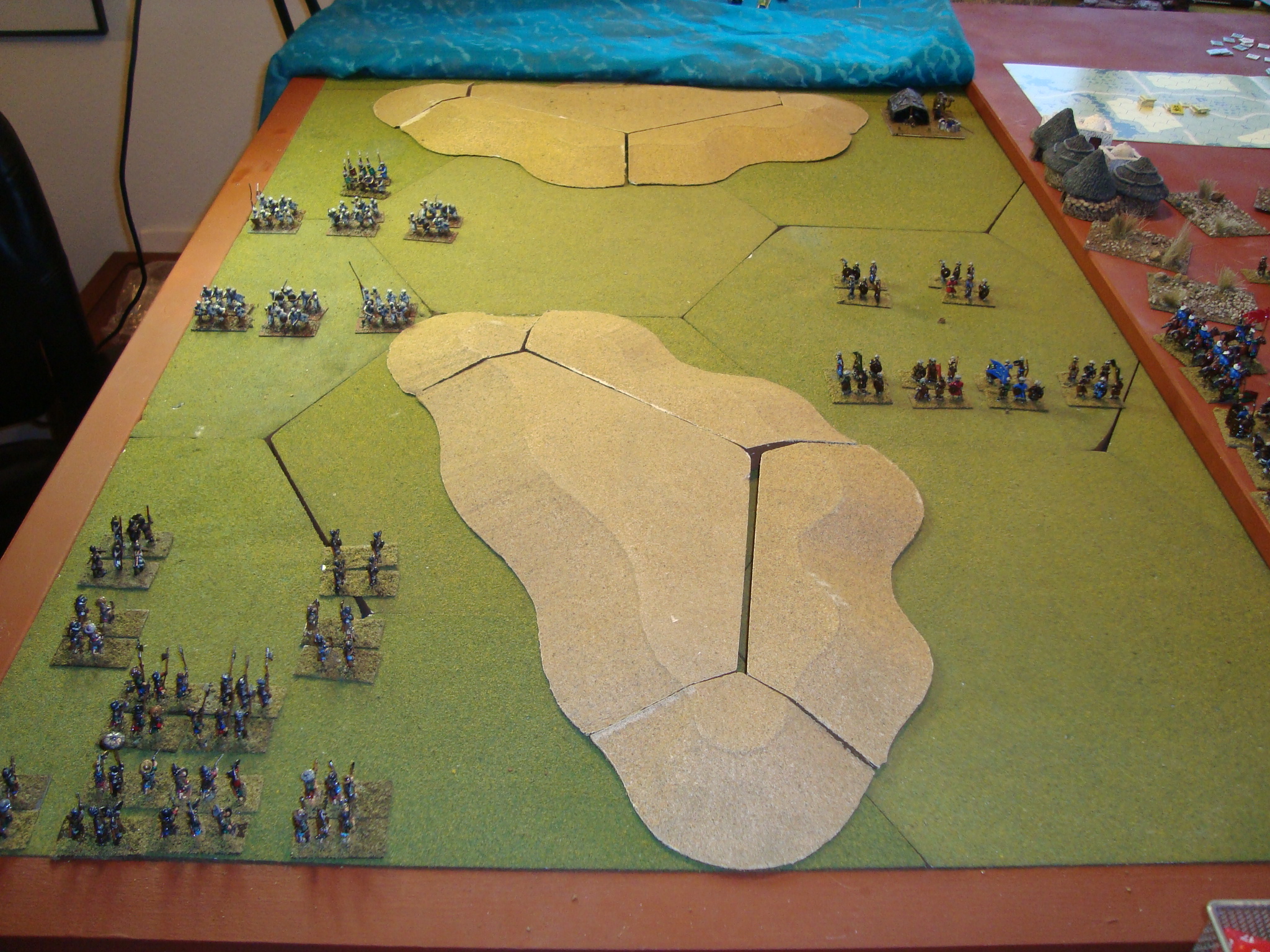
Here’s a pictorial overview of the initial stages of the battle.

Flanks Anchored By Rough Ground And Ridge, Zanj Tribal Warriors Await The Portuguese Advance
Portuguese Advance Begins
Portuguese Advance Begins.  Grenadiers On Left
Zanj Advance In Response To Portuguese Fire
Another View Of Zanj Advance
Another View Of Zanj Advance.  Interpenetration Not Allowed By Rules.

Campaign Set Up Moves Forward

Rolled for leader qualities and other parameters.  Rather than insult you with another scan of scribbled fragments of index card, I’ll post up a “clean” copy of the tables/charts used.  Tried to link the variables to the Irregular Wars Chance Cards, with outstanding aspects allowing for good DRMs, and poor aspects leading to bad DRMs.  Normal is just normal, with no DRMs.  Card use has been difficult to implement solitaire and I hope this is a viable alternative.

Ming Chinese:

Lei Qiu:  An inexperienced leader, but bold.  Staff includes a skilled logistician and physician.

Portuguese:

Eduardo Nicolau Rolando:  Experienced and inspiring leader.  Staff also includes skilled logistican and physician.  Also, the Portuguese have good local knowledge, which negates many effects of unfavorable terrain.

The Portuguese, facing hostility from the Coastal Arabs, have to decided to invade before the Ming can establish a military presence.  At this time, only Chinese traders are allowed in the area, and the Coastal Arabs will resist any attack by the Portuguese.

Zanj:

Relations with natives are bad.  They will fight if attacked.  There is internal dissent, and government support is weak.  This weak support limits their army to 10 elements.

Their leader, Jabir Efe, is inexperienced but bold.  Being the home team, they have good local knowledge.

Neither side was able to recruit any natives to augment their forces.

The respective armies are based on both Irregular Wars and DBR lists, given what I have available.  Oh My!  I’m not following an army list.  After years and years of therapy I’ve finally made the jump of just putting something together that has some historical basis and works.  Thank Goodness for that.