Category Archives: Sessions

War of Resistance – The Other Side Of The Hill

Tim posted up about our WOR session.  As always, astute and spot-on.  Here they are…….

Logistics are a major constraint for both sides. While the Japanese get more resource points than the Chinese, they have to pay RPS to buy extra naval transports and landing craft units. I spent at least one RP per turn for more shipping and still had extra units in Japan at the end of the game. You did a better job of using your HQs for suppy than I did– I kept forgetting that you can use HQs when you are attacking. I should have remembered– the same rule is in March to Victory.

I think we both fell into the old trap of using our air forces for either Ground Support or Defensive Air Support. Looking back, I should have started attacking your railroads sooner, especially the one high volume rail line. I’m not sure what the Chinese should do, but I think it wouldn’t hurt to try some naval patrol missions or port strike attacks. While their bombers aren’t very good making their chances of sinking Japanese naval units pretty small, this isn’t Second Front and the Japanese don’t have very many Naval Repair Points (especially if they are having to repair damanged LCs), so any hits hurt. Attacks on port capacity might be a good idea, too. I know I ran into issues with port capacity.

Weather plays a big role in the game. The rainy weather really hurt you in the Hong Kong scenario and the clear weather helped me. I think in the longer scenarios, the Chinese would be well advised to try to run out the clock until the arrival of the monsoon.

I need to spend some time looking at the interactions of various naval units. The Chinese might be able to use their naval units to impede Japanese movement along rivers.

I think you put too many of your good troops in Shanghai and neglected your flanks. I think it would be worth using your factional or unsupported units in the full or partial city hexes, in the hopes of getting some exchanges and trading easily replaced units for Japanese casualties. Like we talked about, it would be very worthwhile putting some supported units along the rivers to discourage amphibious landings (I also realized after the game that you can’t move along rivers if the enemy controls both sides of the river– I don’t think this would have changed our game).

Having said that, you did do a good job of defending Shanghai. I launched the amphibious invasion because it was going to take a lot of time to dig out your troops. I don’t remember how many factional units you had, but it would have been worthwhile to have left some of them behind in Shangai to act as a rearguard when you pulled out.

Using engineers to negate or reduce negative modifiers for city hexes is really important. As usual, neither side has as many engineers as they would like…

I misunderstood the international concession rules, thinking that the hex was off limits for all combat…It also functions as a port, that would have really helped the Japanese. I don’t know if the Chinese could get enough strength to make an attack on it, but it might be worthwhile to try.

I probably should have landed north of the Yangtse sooner. Opening up a second front helps to stretch the Chinese.

Whampa (the port NE of Shanghai) is a really important hex. I don’t know if you can set up troops in it or if you can use the first turn to move troops to defend it, but making the Japanese fight for it is a good idea. Taking that port really simplified my logistics.

War of Resistance – Hong Kong and Fate of Nanking Scenarios

Tim and I were able to get in three sessions of War of Resistance (WOR) on Tuesday afternoon and Wednesday. It’s amazing how some level of moderation in beer consumption, and  lack of viable evening movie options, can increase the time spent gaming.

We played two sessions of the Attack on Hong Kong scenario, with full Chinese intervention, and one using the Fate of Nanking scenario. I’ll use the “old” spellings throughout.

Hong Kong is referred to as the game’s introductory scenario. That’s true if you have never played the Europa system before. The Fate of Nanking involves all aspects of the Glory rules system used in WOR. I hoped my playing of The Damned Die Hard (TDDH) would prepare me for WOR.   That was not the case, as the supply/logistics,  guerilla, reaction and command rules are far more detailed and extensive than those featured in TDDH.

I played the Japanese in the first session, limiting the forces committed to attacking  Hong Kong to the OB’s designated assault force. Too many troops were allocated to defend the assault force’s flanks and rear from the two Chinese armies situated to the east and north, as well as the guerrillas located to the west. In addition, I left out one attack supply factor, which limited my full strength assault attempts to two (2).  The result was failure to take the city in the time allocated.

We switched sides for the second session. Tim loaded up his assault force and with a successful role for his reaction phase – which allows the non-phasing player to move and attack – during my first turn was able to take Hong Kong in two (2) complete game turns (because of the Reaction Phase and the Japanese player plays first, he had three (3) attack turns). My Chinese attack on his forces to the north had an initial success, but the game was over before they could attack again.

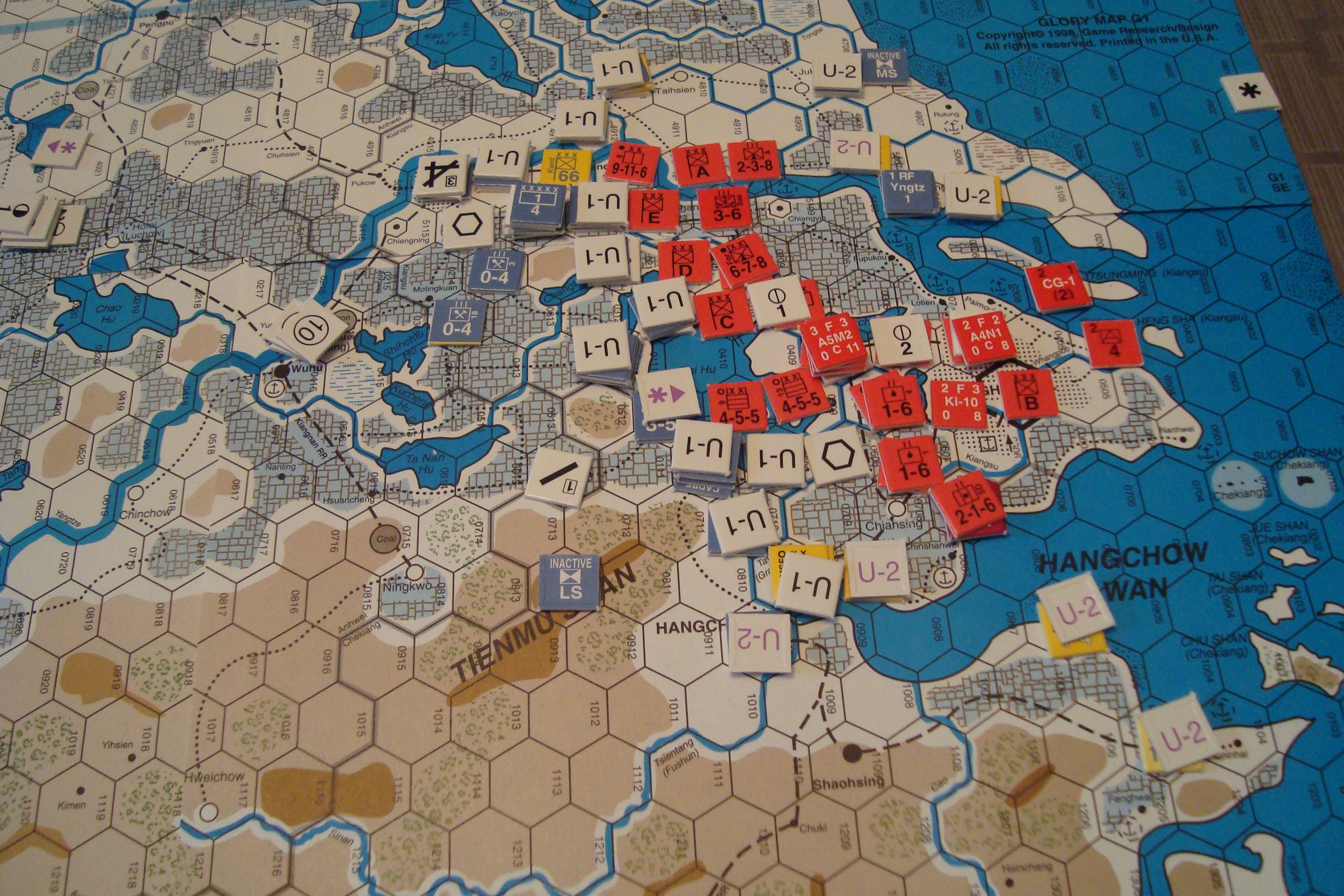
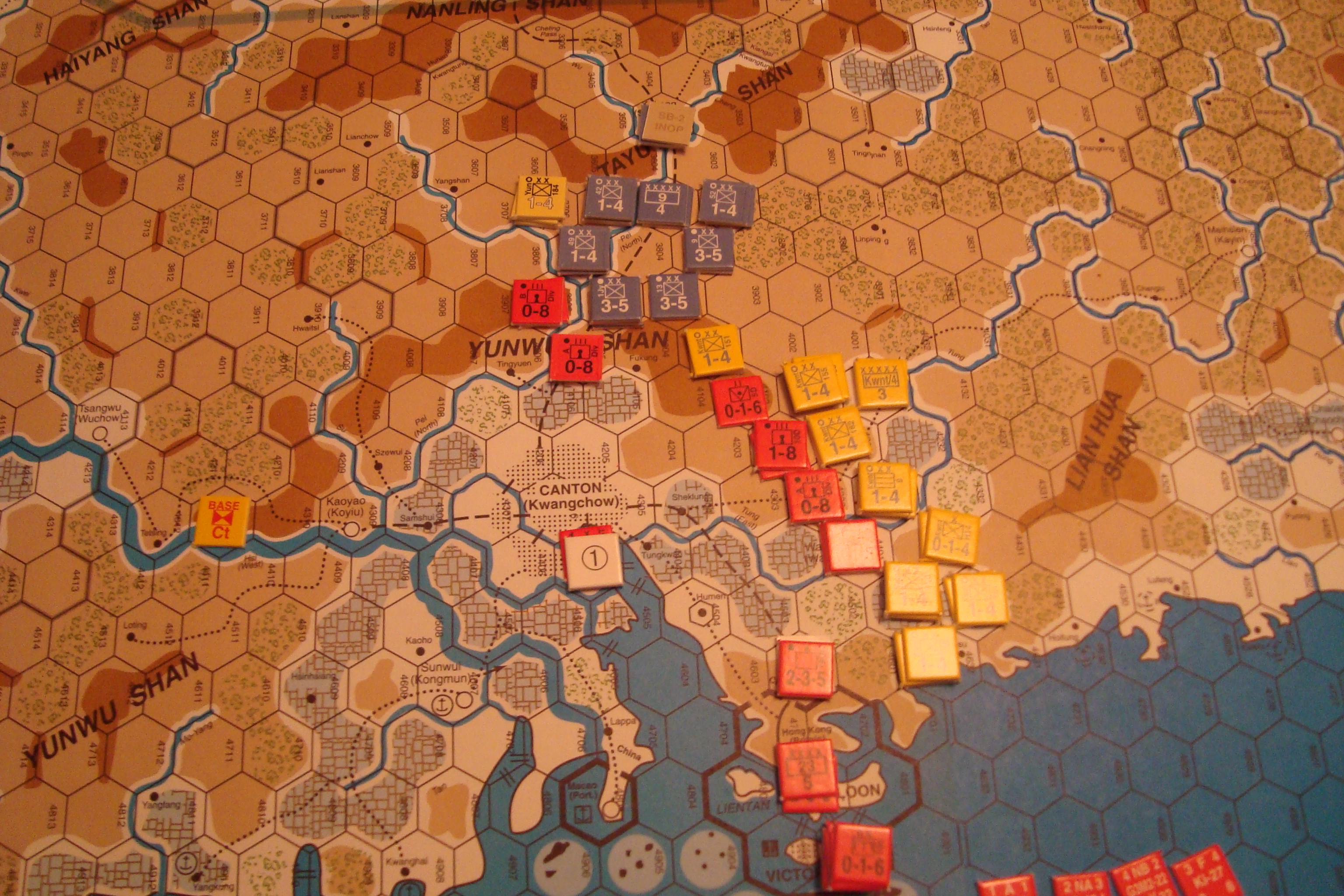
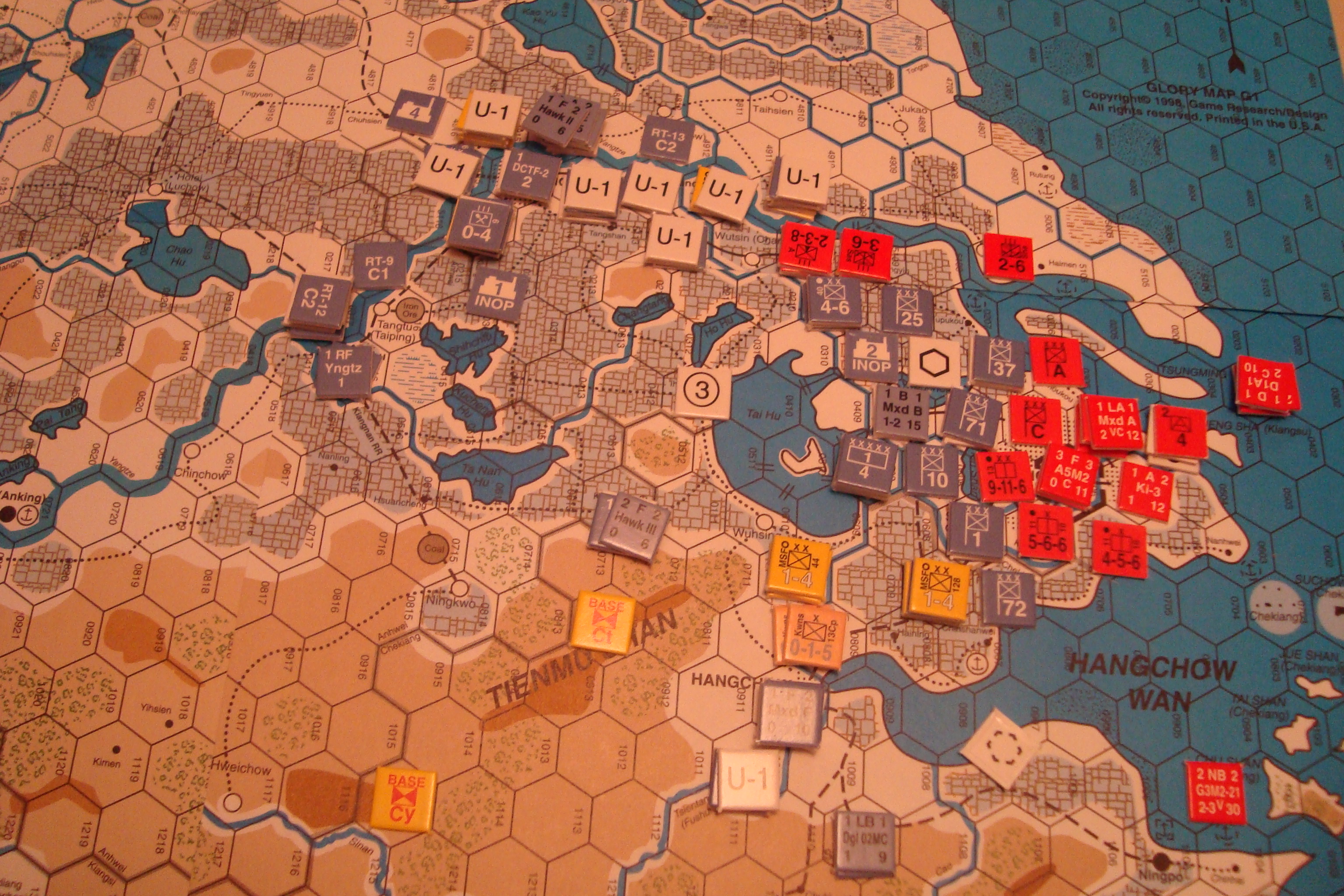
Japanese Take Hong Kong (Why Have I Circled The Wagons in the North?)

The Fate of Nanking was another matter.

The Japanese must land, assualt and secure Shangai, and then move west and take Nanking. The Japanese have significant, but management intensive, naval resources. The Chinese player has strong forces near Shanghai, but weaker forces in the Nanking area.

Supply management is critical for the Chinese player, he must juggle the need for attack and general supply, as well as utillizing resource points for construction and repair. This is a typical challenge in Europa.  But in WOR, the very limited number of resource points – which can be converted to attack suppy which, in turn, can be converted to general supply (yes, this is confusing… it confused the hell out of me) – combined with a problematic transportation network, has a direct and significant effect on what the Chinese player can and cannot do. Unless the player is thoroughly comfortable with these rules and their application, a disproportionate amount of time and effort is spent with logistics, with combat operational planning adversely affected.

Guerilla bases and units are another aspect of WOR that is a challenge. While these units were included in both scenarios, we didn’t use them. One reason was that we had our hands full with other aspects of the game. Another was that our games, for the most part, involved urban combat, and guerillas cannot enter cities. As we play longer scenarios, I’m sure we will start using bases to recruit guerillas, for attacking lines of communication.

Reaction can only be used if there is a Army (Japan) or War Zone (Chinese) command unit available. Each Army or War Zone has as command radius, and success die roll. If the die roll is successful, then all units within the command radius can move and fight in the reaction phase. This allows the non-phasing player to maintain momentum generated in his phase of the turn. Tim did an excellent job of applying continual pressure on my units defending Shanghai.

Attack and general supply points can also be stacked with a command unit. This is an effective way of efficiently using supply points, as the ratios needed are far less than the one (1) point per regimental equivalent (RE) typically used. Neither of us consistently took advantage of this capability to improve our logistical support.

With the exception of a small contingent stationed in the international section of Shanghai, all Japanese combat and logistics assets must be transported from Japan to China. The number of naval transports and landing craft vary from turn to turn. In addition, landing craft can be damaged during operations, and removed from further play. Tim said this was a constant concern, and limiting factor, in his operational planning.

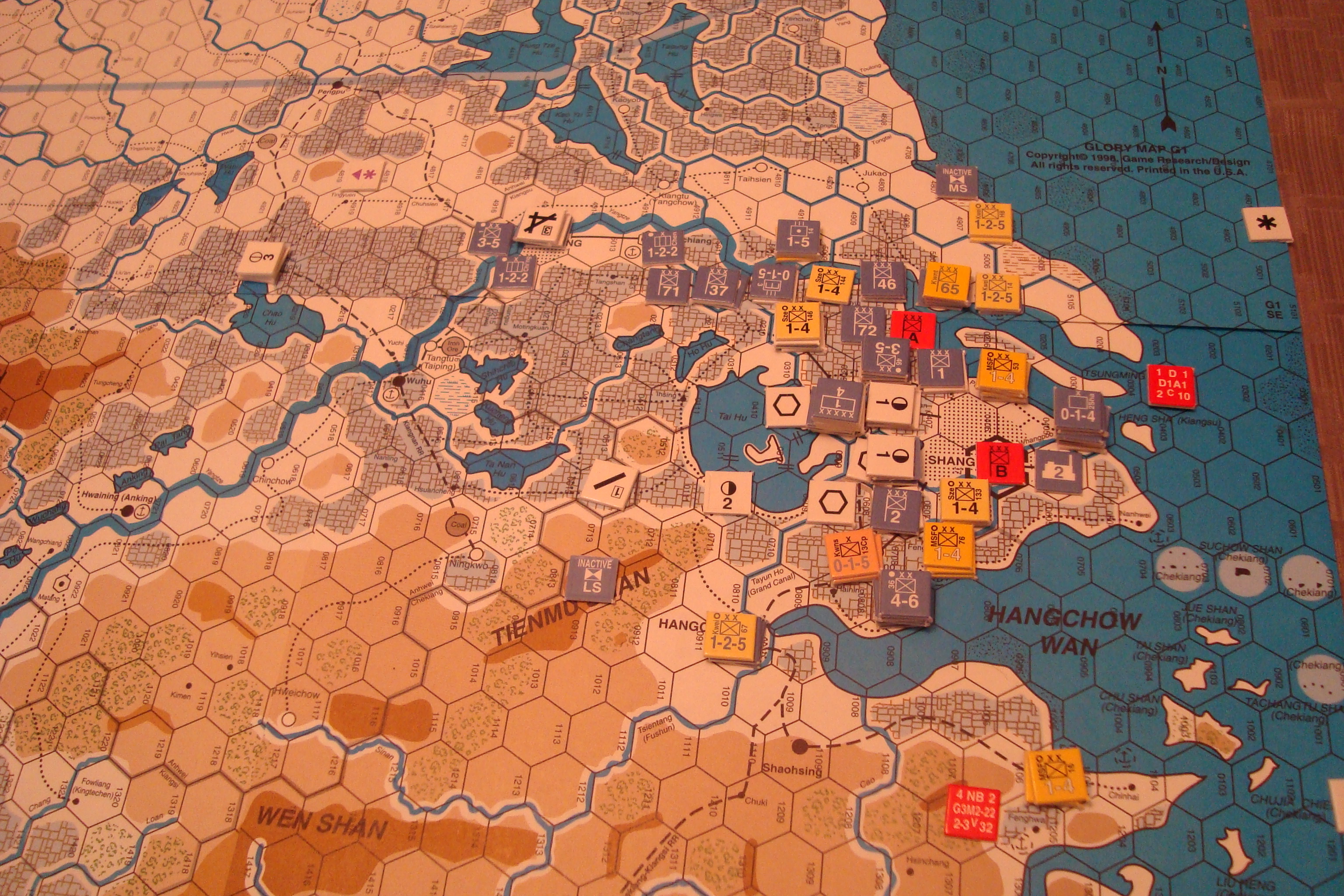
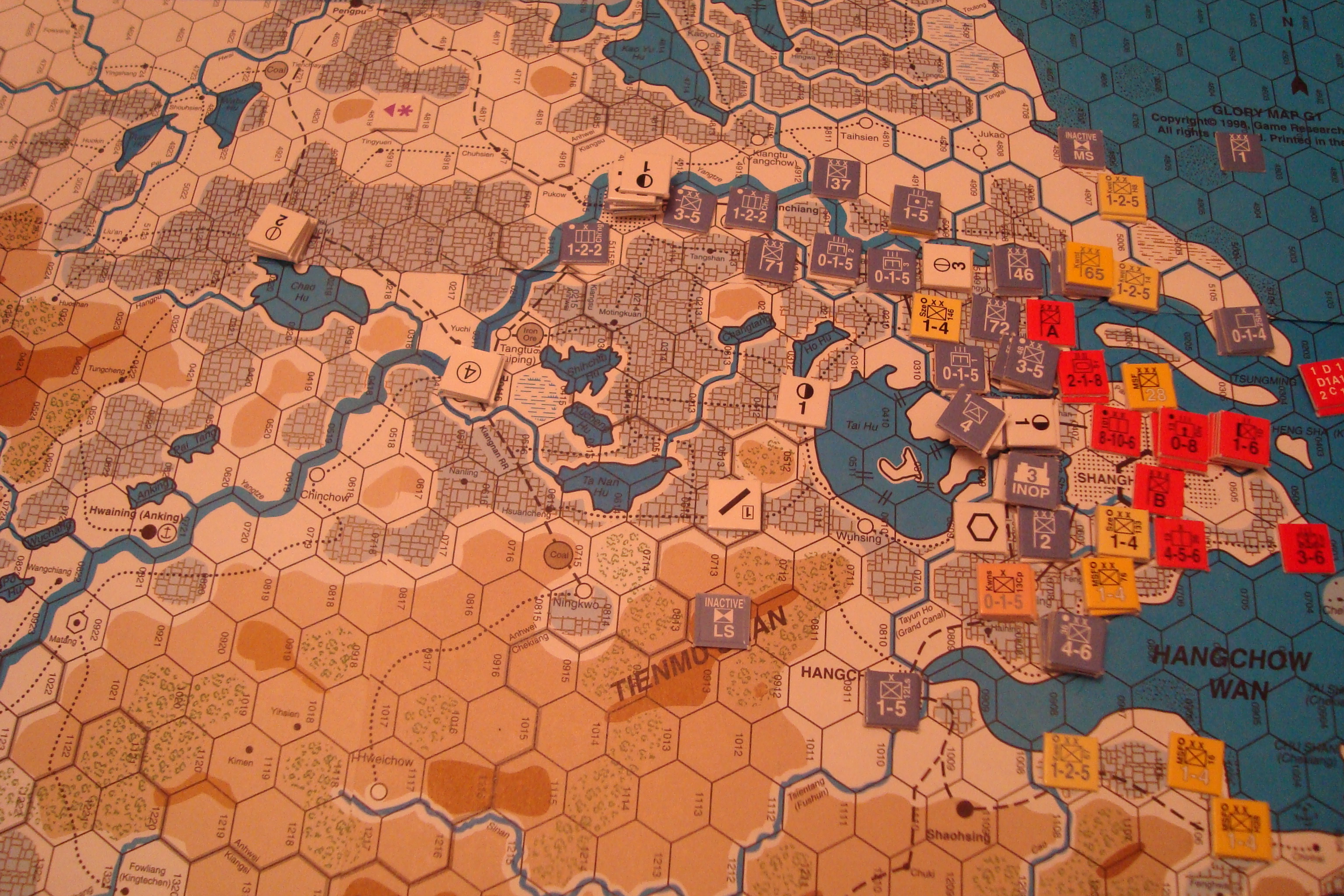
I decided to hold Shanghai in strength, which is what happened in 1937. Tim built up combat power in Shanghai and methodically attacked my units at odds of 3:1 or greater.

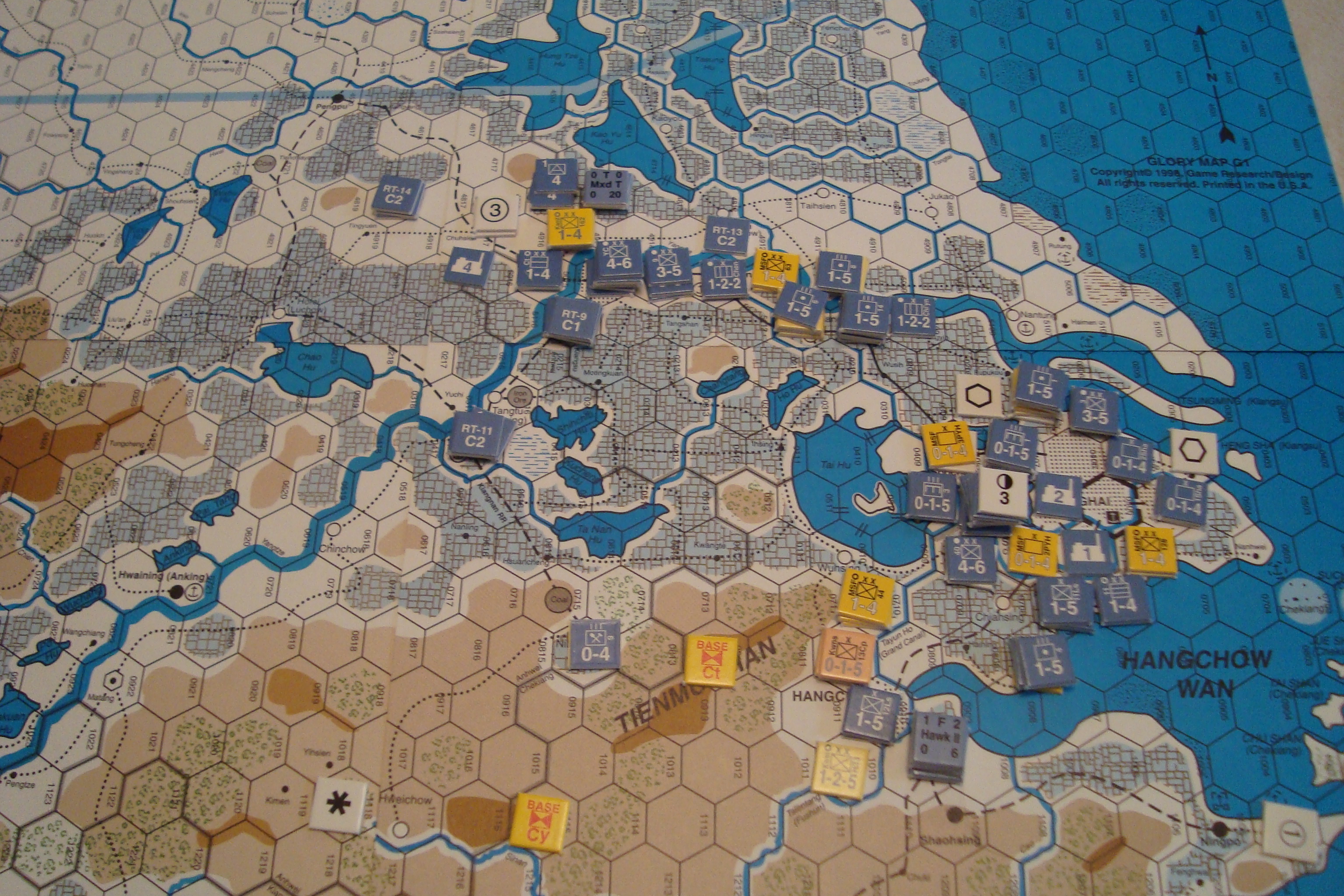
Initial Chinese Forces


Stalemate in Shanghai
Stalemate In Shanghai

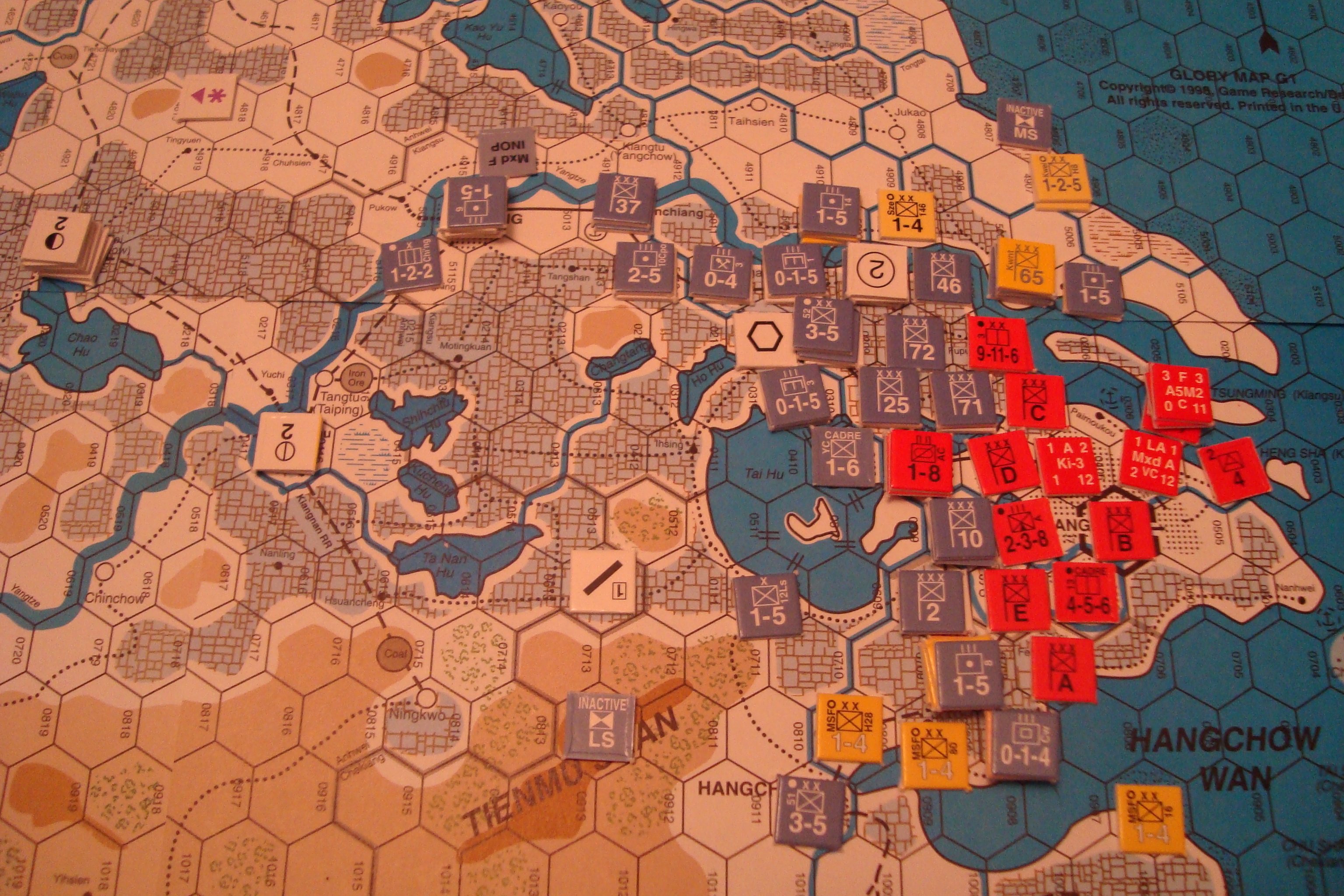
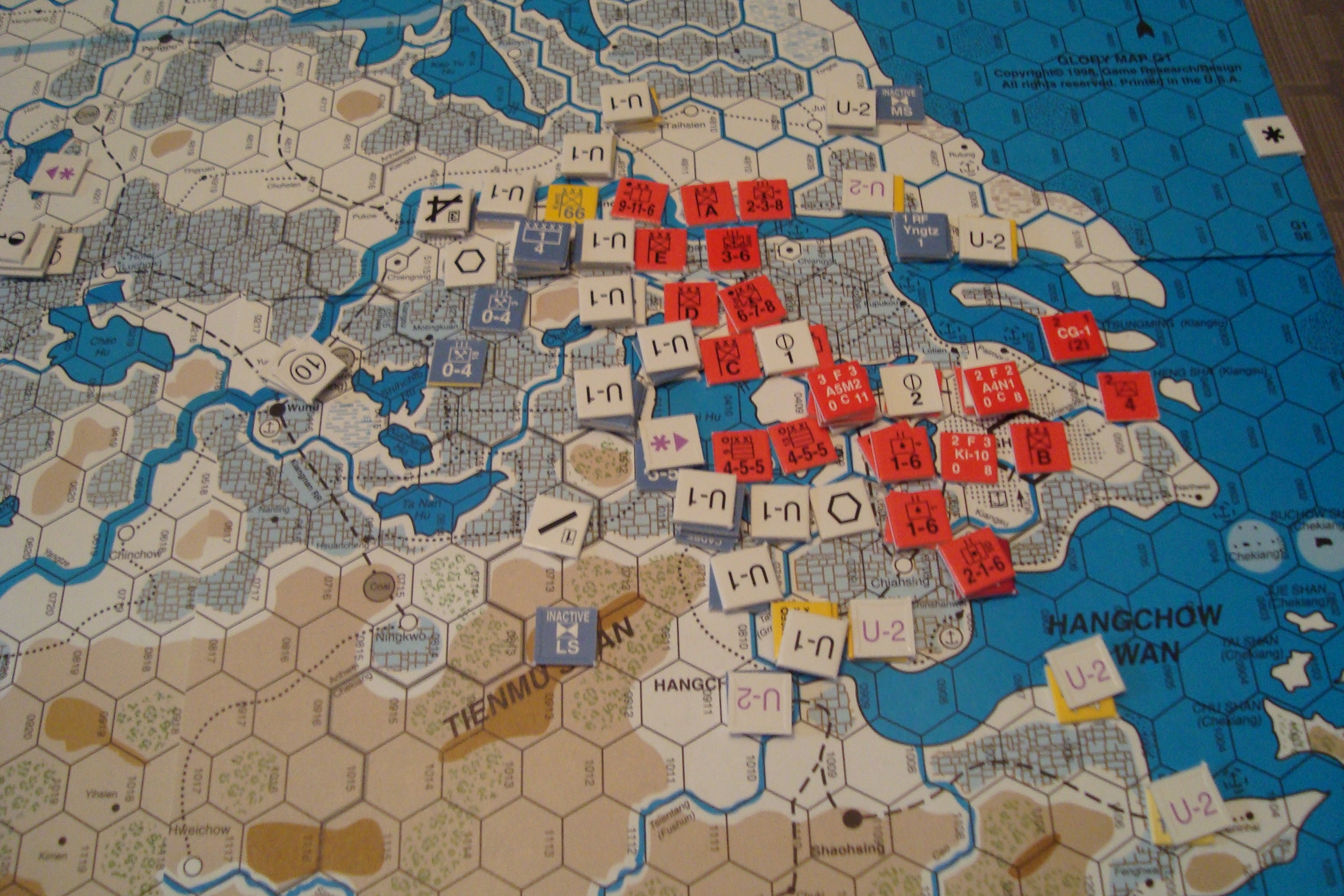
As the fighting in Shanghai developed into a battle of attrition, Tim launched an amphibious assault along the Yangtze River.  This prompted a long discussion on the rule limitations on naval transport, river movement, and amphibious assault. We’re still thrashing this out.

Amphibious Landing Along The Yangtze

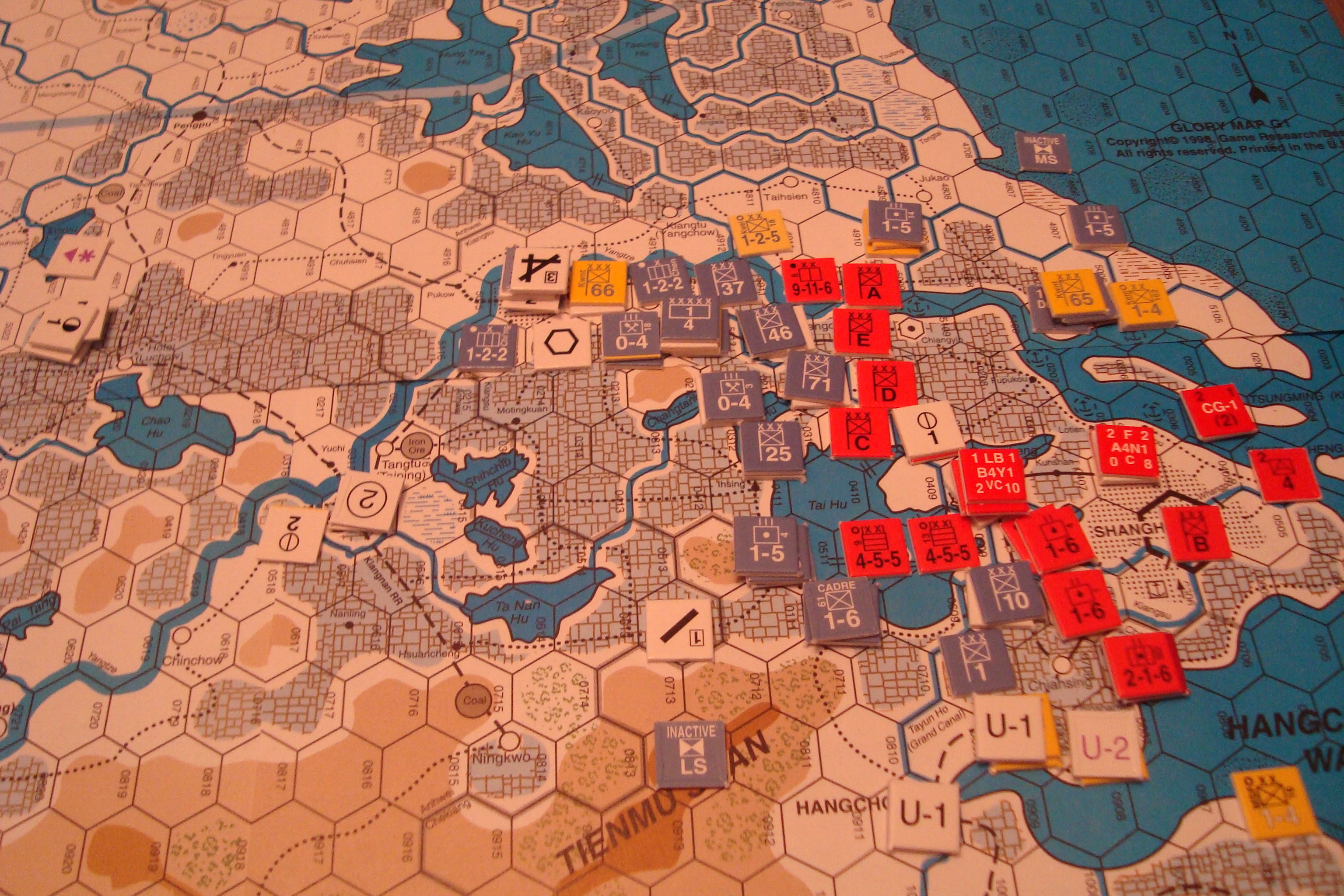
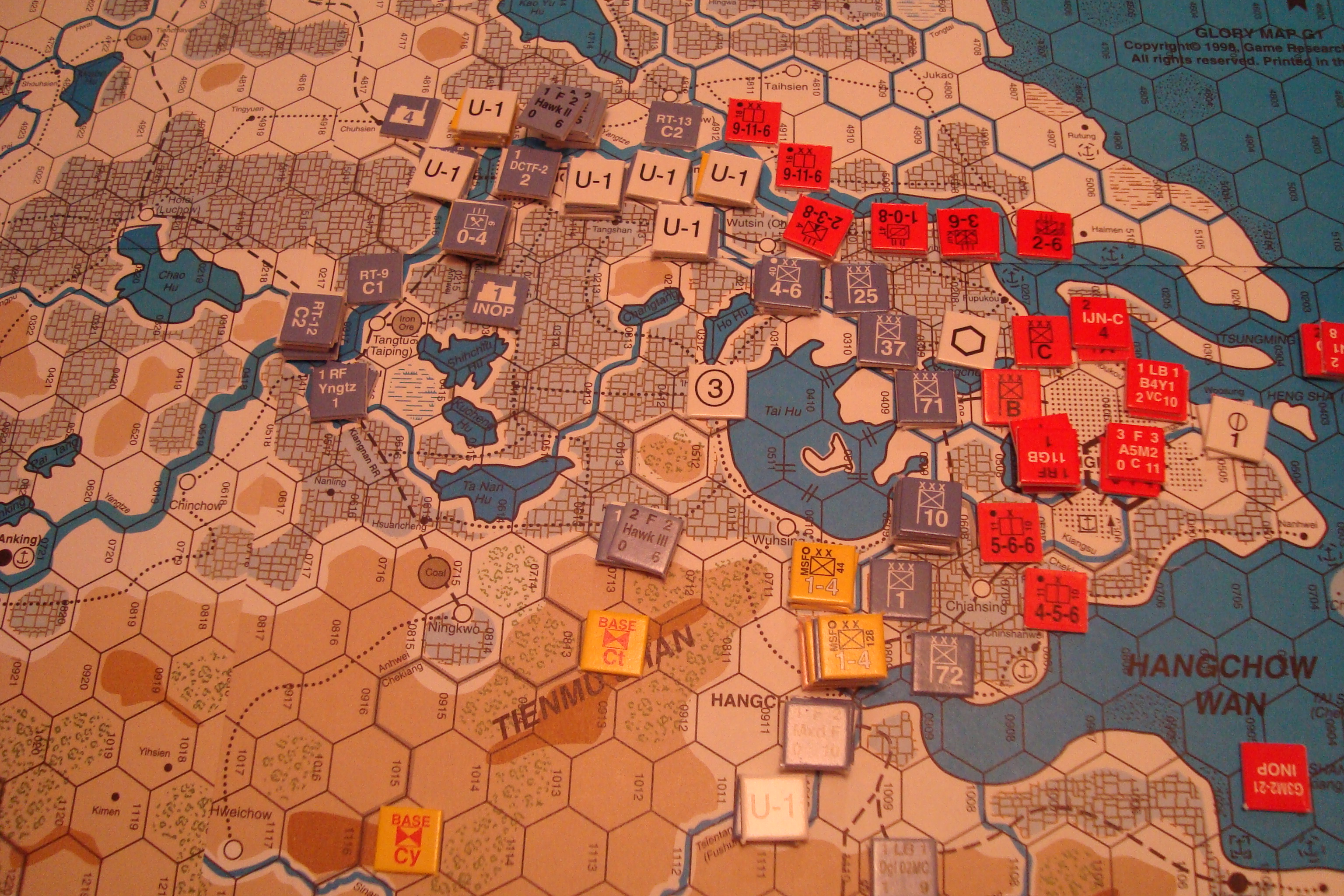
The game ended with Tim consolidating and building up his beachhead, and with me starting a fighting withdrawl from Shanghai to the west.

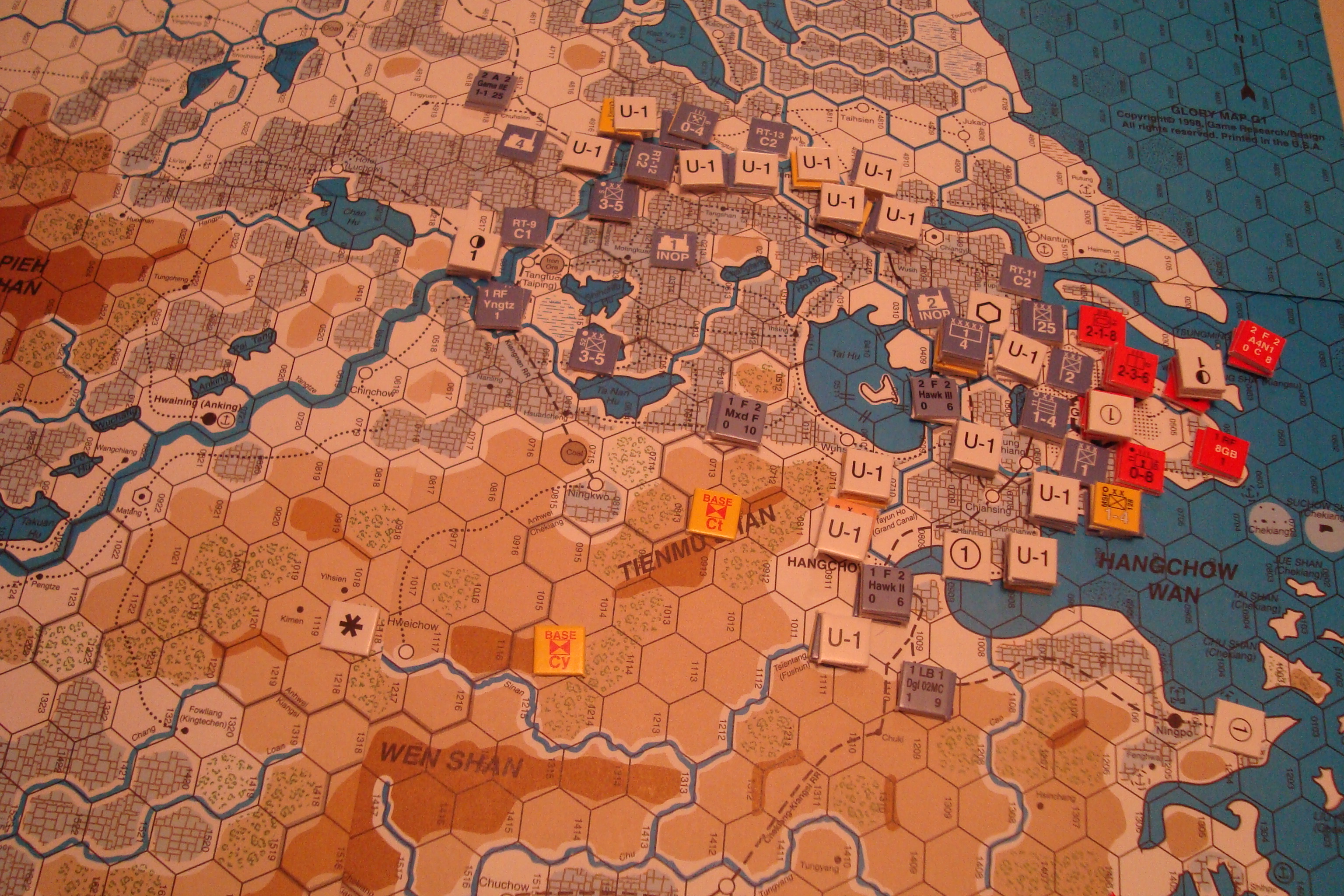
Japanese Advance Along The Yangtze & Chinese Withdraw From Shanghai
Japanese Advance Along The Yangtze Force Chinese Withdrawal From Shanghai

Lots of good game play and challenges. A fun time!  We’re planning another go at the Nanking scenario in early December.

Red Actions! Second Try

Really windy here, gusts up at 30 mph.  Riding out of the question, college football schedule marginal, and World Series doesn’t start until 1700.  Decided to get another game in.  Same scenario, and tactics, but with Reds being more aggressive.

An aggressive wargamer really needs good die rolls.  That happened for the Soviets.

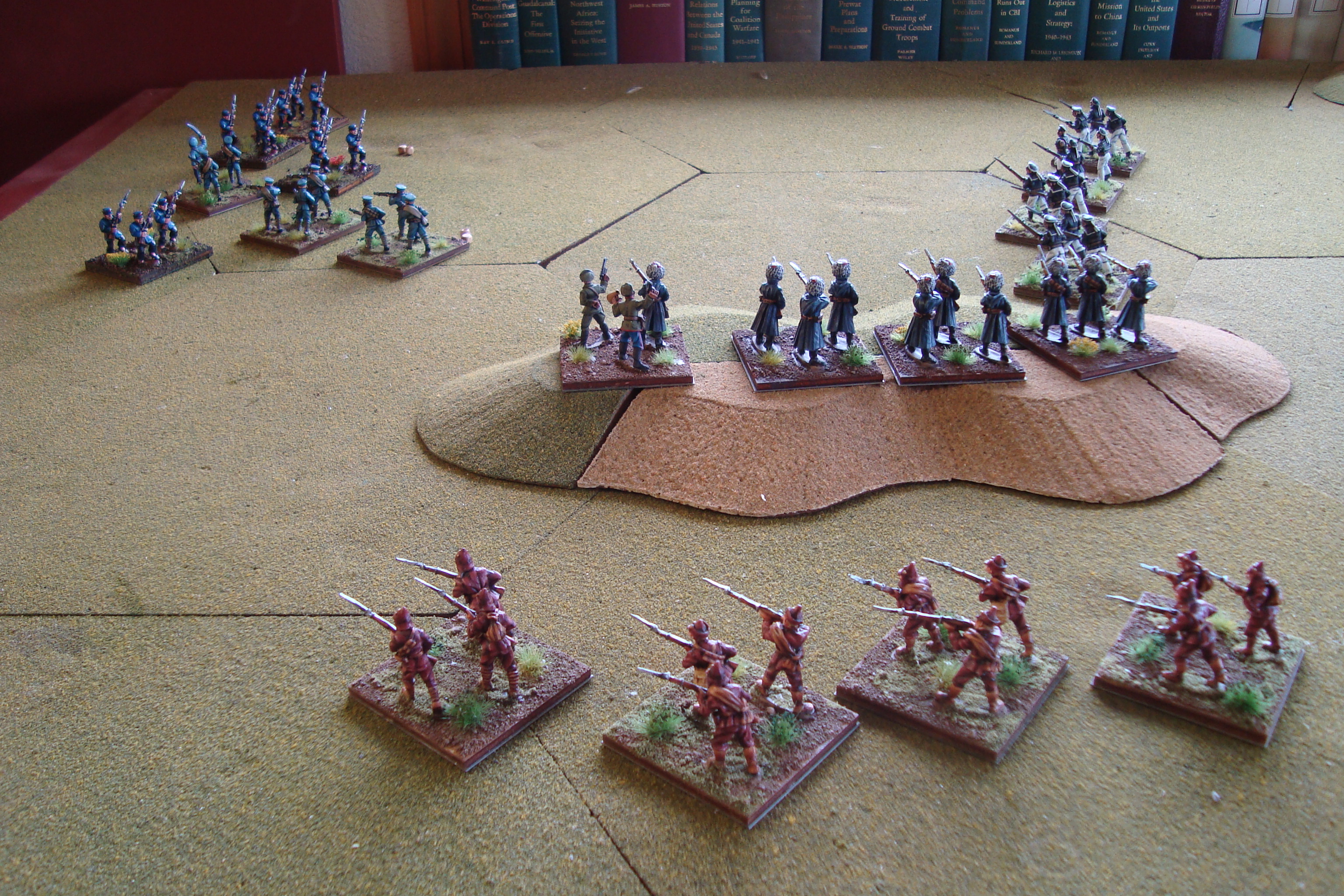
There was the usual push and shove between the Soviet company providing the base of fire and the Chinese regulars entrenched on the ridge.  However, the Soviet Sailor company advanced quickly  out of the woods and effectively attacked the Chinese Conscripts in reserve.

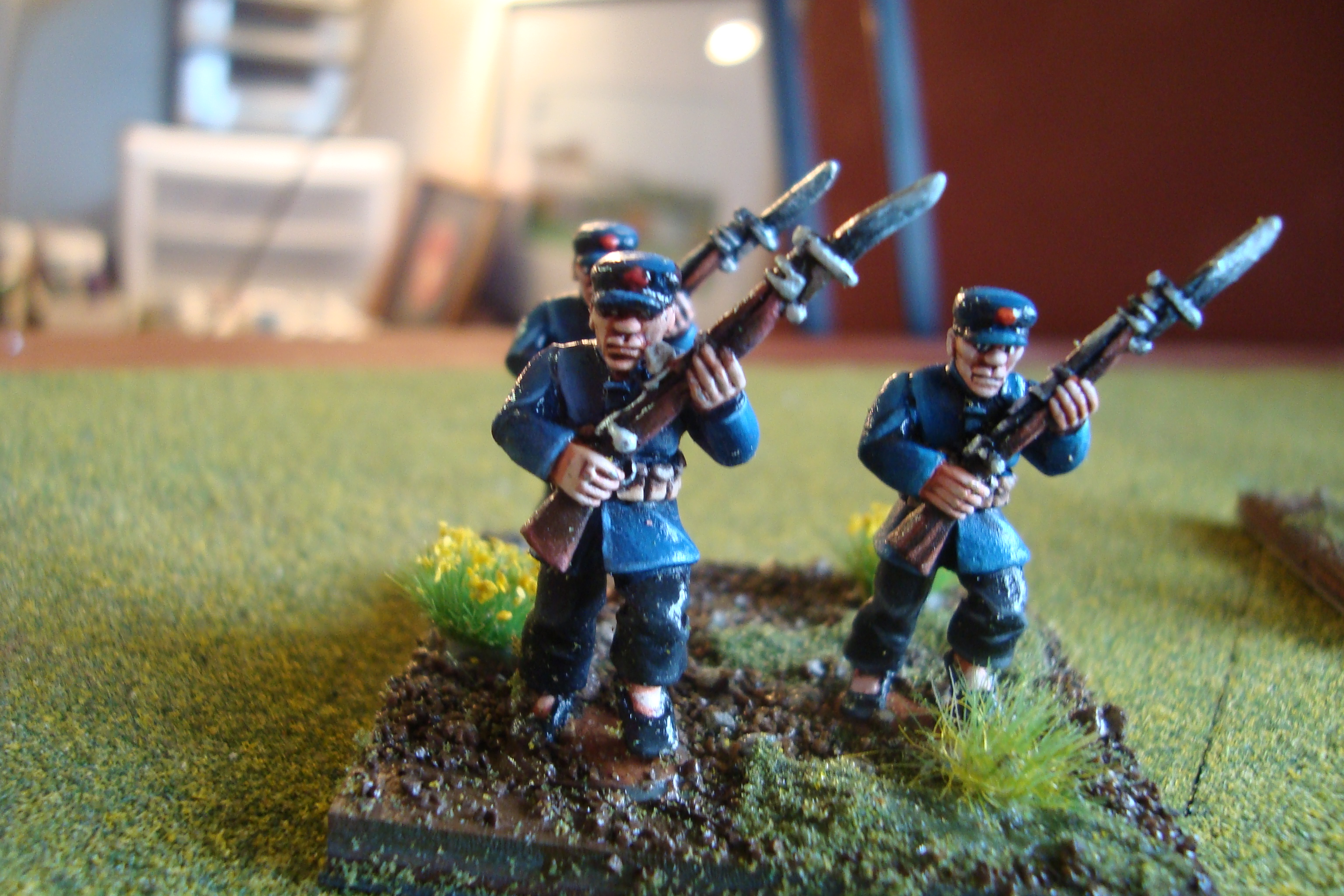
The Conscripts acquitted themselves well, maneuvering when called upon (they consistently rolled higher than two (2)),  shrugging off terror markers like regulars.  However, over time they were pushed back, losing one platoon.

Stolid Conscripts Supporting The Regulars

With the Chinese Regulars also pushed back, and with two (2) terror markers halving their fire strength, the Soviet Regulars advanced towards the ridge, supported by the Cheka company,  engaging in a firefight with the now weakened Chinese.

Cheka In Support
Cheka In Support

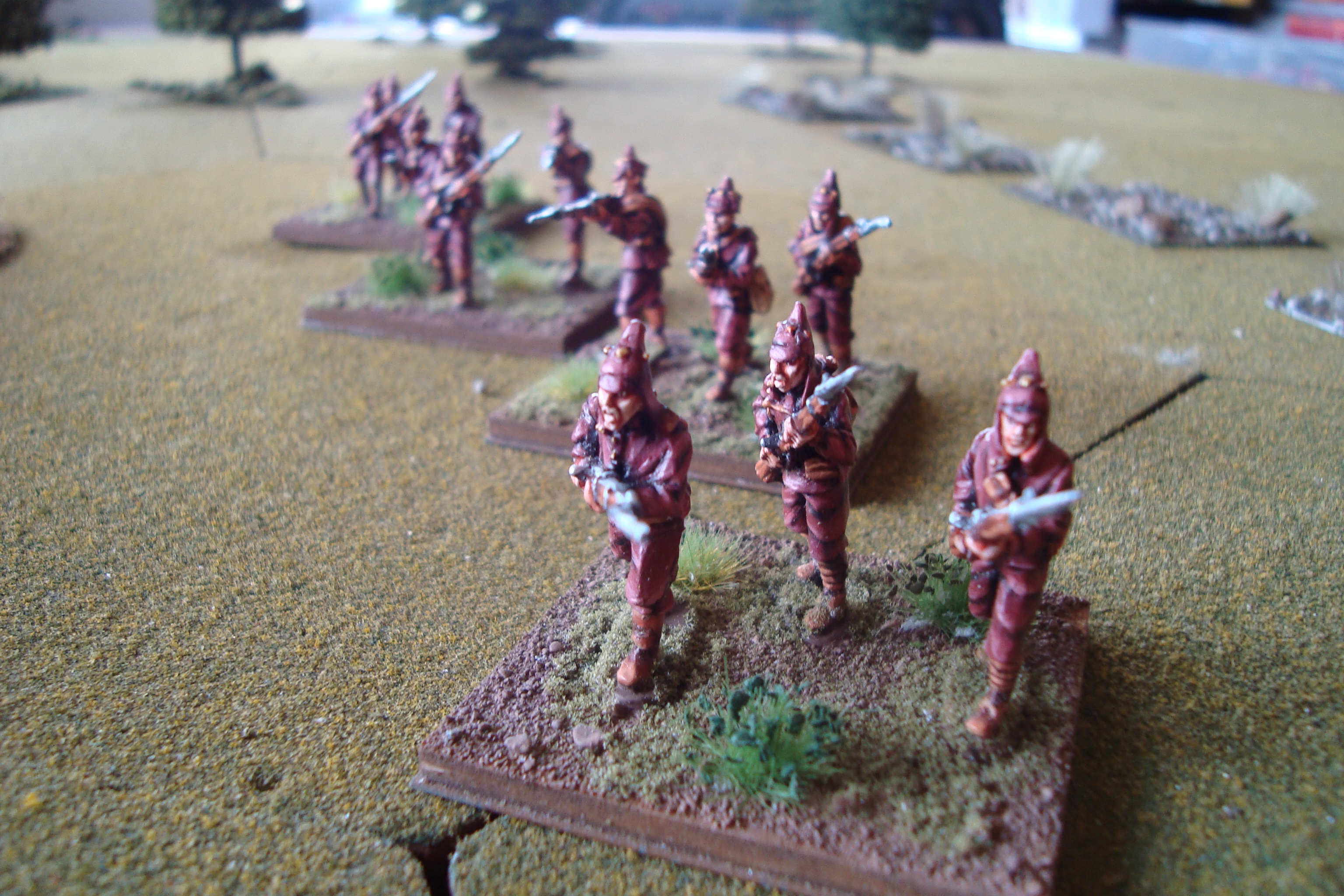
The overwhelmed Chinese had no choice but to conduct a fighting withdrawal, with the retreating Regulars covered by the Conscripts!

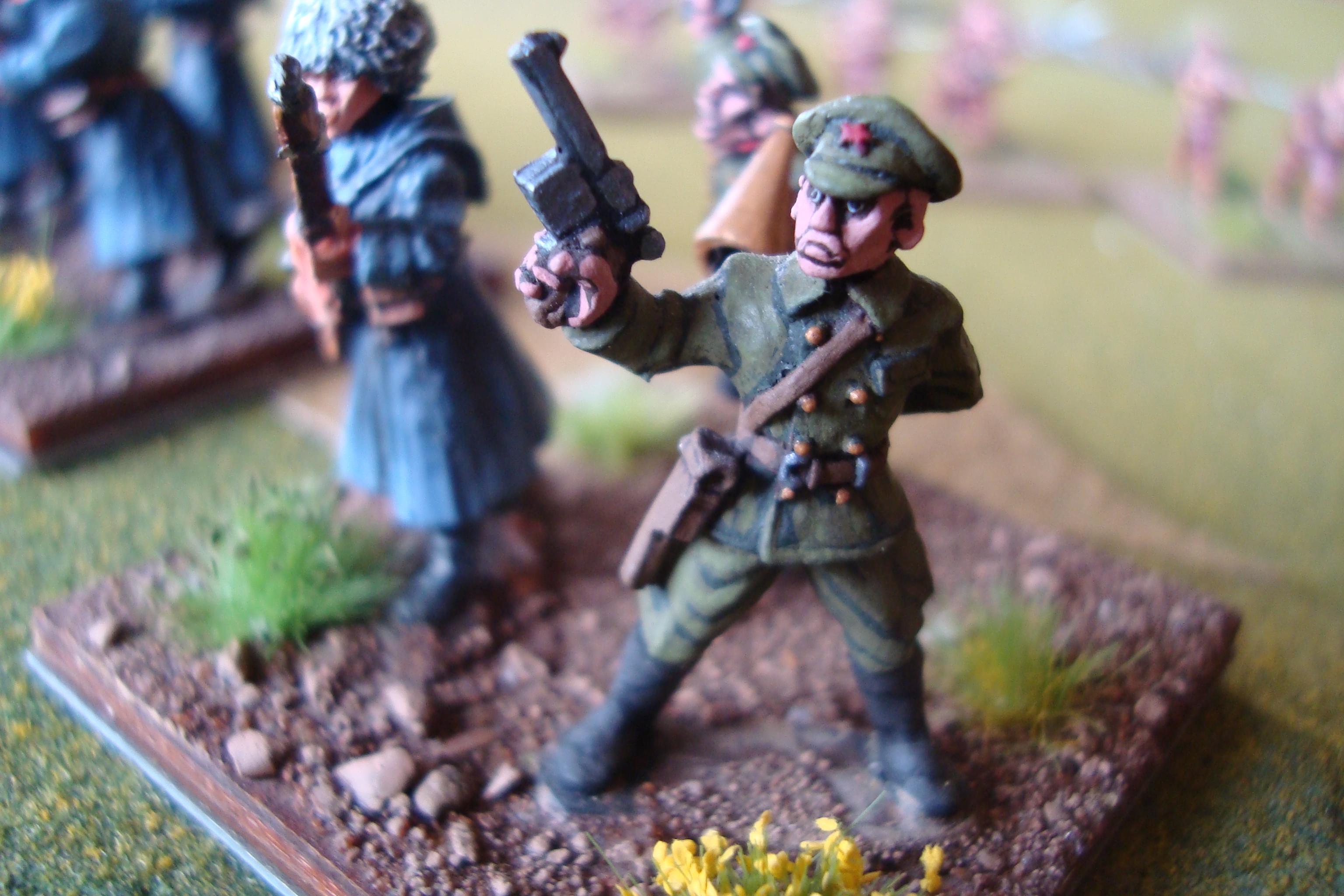
Soviet Leadership Comes From The Barrel Of A Gun
Chinese Withdrawl
Chinese Withdrawl

Good and quick game with plenty of action.

Next time, machine guns and artillery.


Mission Impossible?

Finished up my last play thru of the Luzon Scenario in The Damned Die Hard. Earlier sessions are described in a previous post. I played this scenario at least six (6) times, and in each playing the Japanese fail to make any appreciable progress towards Manila. Seems ahistorical.

However, there are administrative reasons for the first few failures.  Which is a polite way of saying I displayed some, well, incompetence.

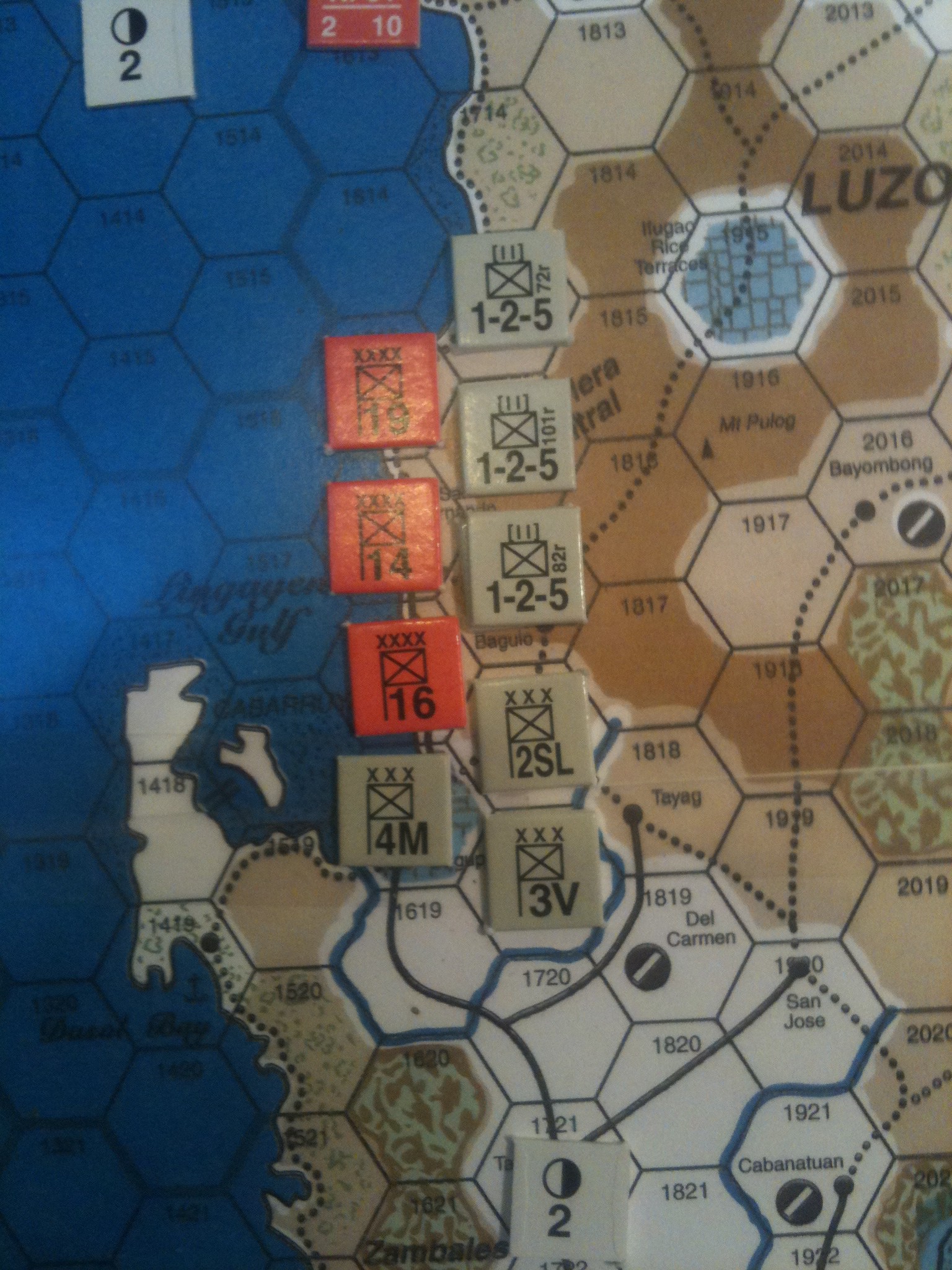
I neglected to thoroughly read the scenario rules. Not the first time this has happened. For the first couple of games I missed the mandatory US setup adjacent to the Japanese lodgment at Lingayen Gulf and then the mandatory two (2) regimental equivalents (RE) “within two (2) hexes of 1718”.  These constraints prevent any initial defense in strength along terrain blocking the axis of advance towards Manila,

OK, tried it again, assuming that “within” was inclusive of 1915. Once again, the Japanese made little progress. However, in the middle of the night it dawned (no pun intended) on me that maybe “within” wasn’t inclusive. In these situations I go to Experten, and the Experten in this case is Tim. His response was that “within” was not inclusive.

OK, tried it again, this time with 2 REs of units back from the MLR. Same bloody result.

OK, tried it again, this time making the assumption that units shown in T/O as “Battalion Groupings” were not “Small Battalions” that have lower RE strengths and reduce possible GS air strikes.  Same damn result.

There are several reasons for this. One, the best odds the Japanese can get are 4:1 on 1915, the hinge of the US defenses. This assumes that none of the Japanese forces are disrupted in the mandatory check before combat. Second, the impact of airpower is minimal since the rules limit ground support (GS) to one unit per two (2) REs, excluding artillery. Given the scale of the game, the Japanese have only 4.5 REs (exclusive of artillery) in their hex. Third, while the Japanese movement advantage in rough translates to a +1 to their die roll, it is negated by the -1 for the rough.  So, it takes a six (6) to blast a hole in the US line.


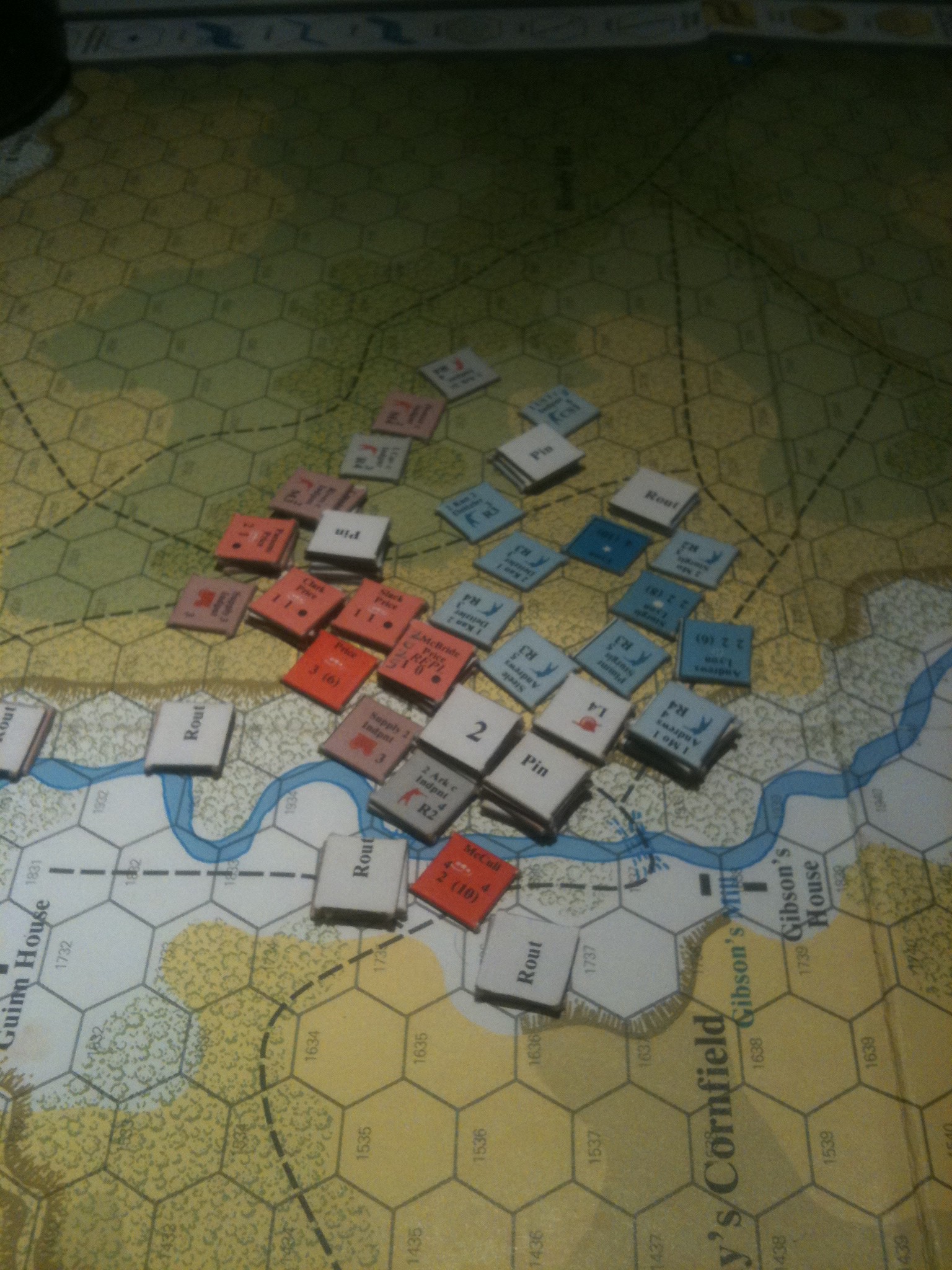
Initial Dispositions - See Next Photo For "Corps" Composition
Initial Dispositions – See Next Photo For “Corps” Composition


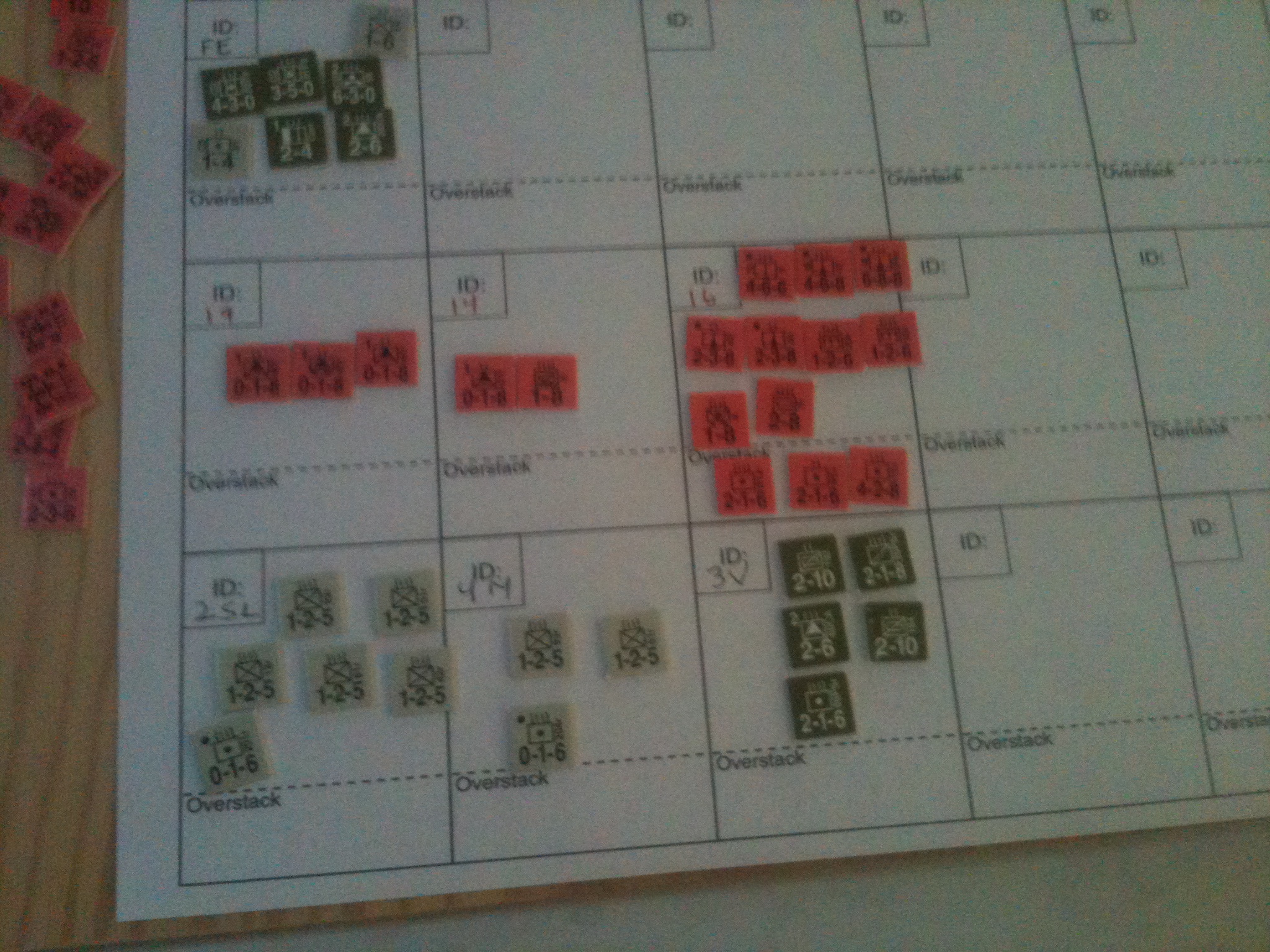
Corps Composition - OK, It Was Dark And I Was Using My Iphone
Corps Composition – OK, It Was Dark And I Was Using My Iphone

So, why the angst?

A successful disruptive Japanese attack during the first critical turn is highly unlikely.  Any result less than a DE allows the US Reserve Force (two (2) hexes north of Manila) to move up after the attack and plug any gaps as well as reinforce the MLR. The ability of the US player to begin assembling Philippine divisons and a light armor cadre further reduces the chance of any Japanese success.

According to The Fall of the Philippines, the official history of the campaign. The Japanese made significant progress before Jan 1, forcing the US forces to retire to Bataan. I confirmed this in the West Point Atlas of American Wars, which has several maps on the campaign. Based on my experience and reading of the scenario and rules, there is just no way this can happen.

Oh Well……My, My….

All told it was time well spent. I enjoyed the opportunity to really dig into the rules and replay a scenario several times rather than a more typical “one and done”.

I’m hoping this familiarity with The Glory game system will hold me in good stead when I travel to Portland next week to play the Hong Kong Scenario in War of Resistance with Tim.

Irregular Wars

Finished up my last game of Irregular Wars for awhile.  Another dust up between the Portuguese and Arabs.  This was a followup to an initial game, with the addition of chance cards and disease/mishaps.

The card draw effected the Portuguese.  They drew a weak leader, which is a -1 DRM to any rally rolls.  The disease and mishaps die rolls that take place for each unit right before the start caused a few units on each side to lose one resolve point.

This time the Arabs used their camel units to attack the crossbowmen manning the Portuguese right flank.  The crossbow fire was ineffective, and the camels closed with a +2 DRM for charge.  So, contrary to the  lessons learned in the initial game, camels can be effective.

The big take-away from this game was how an entire wing of your army can collapse after a series of melees.  This is a function of the game’s resolve (morale) mechanics.

When a unit’s resolve reaches one (1), it wavers.  A wavering unit must withdraw 1D3.  The opponent rolls for pursuit.  If allowed, it can contact the wavering unit again, receiving a charge bonus, if applicable.  If the wavering unit  contacts a friendly unit (no interpenetration in these rules), the contacted unit has an immediate loss of one (1) resolve.  When a unit’s resolve reaches 0, it scatters.  Any unit within two (2) movement units (2u in game terminology), suffers an immediate loss of one (1) resolve.  This can be quite a chain reaction, with waverers withdrawing into friendly units or being hacked at by pursuers.  Take a look at what happened to the Portuguese right flank.

DSC01187

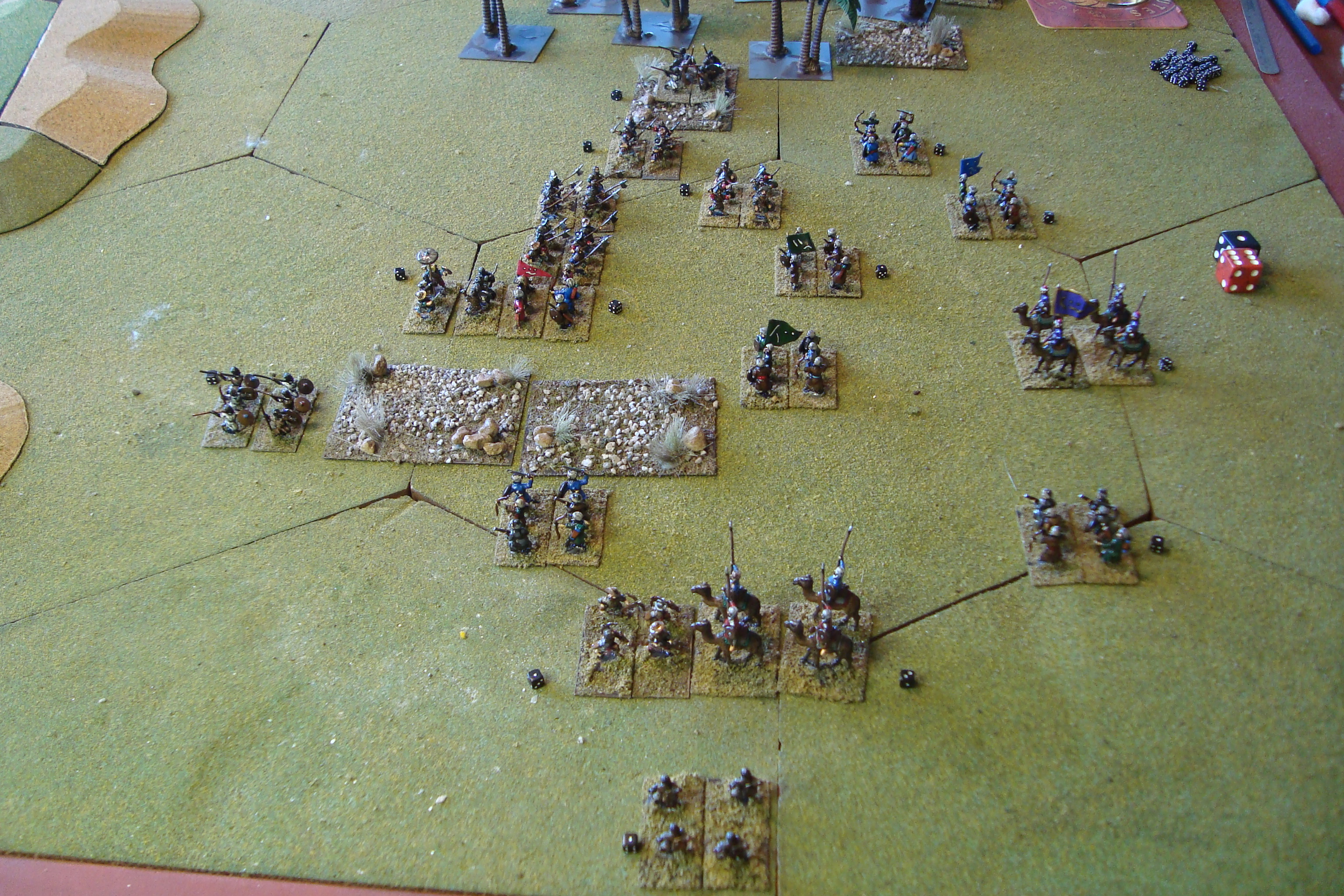
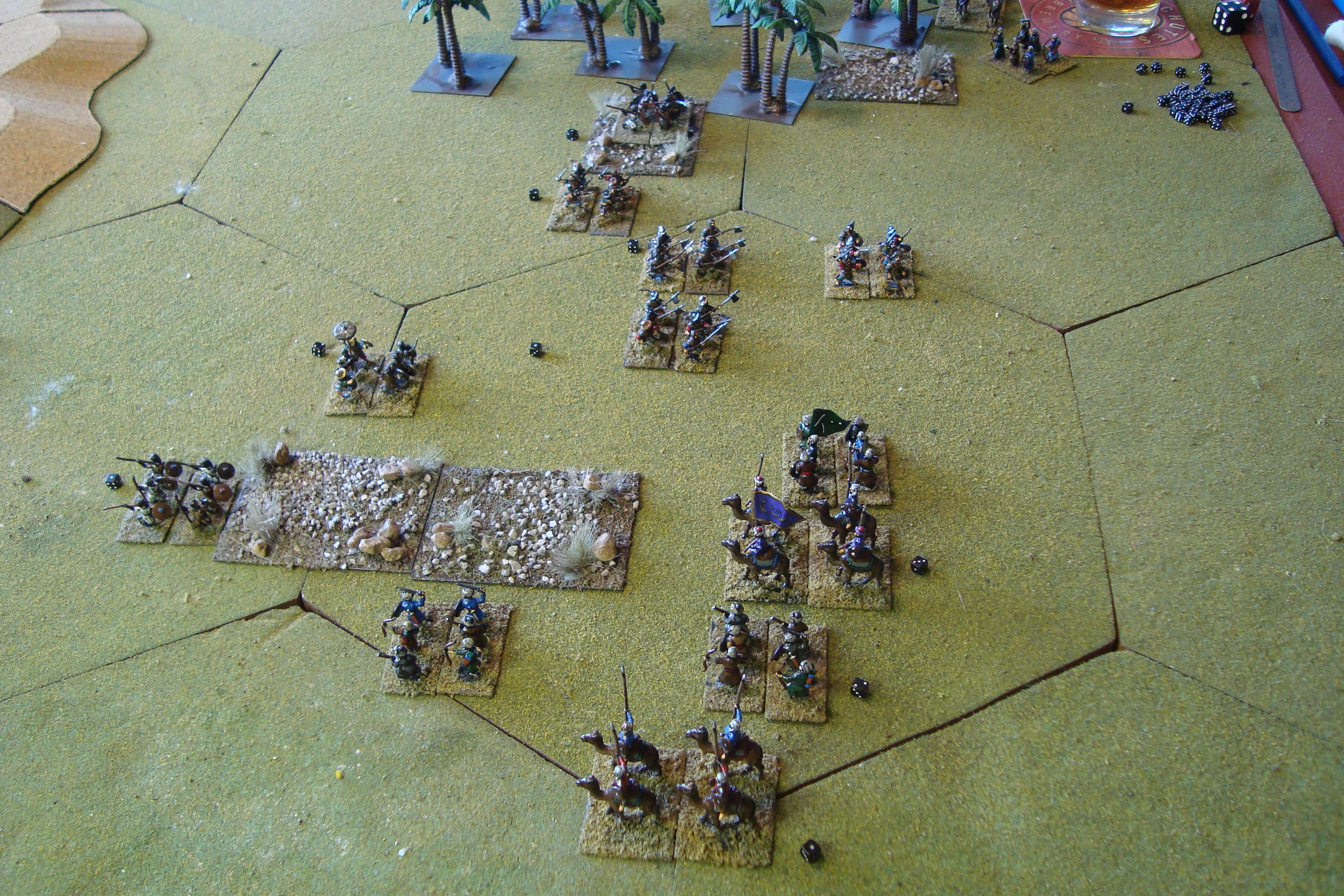
In the top photo, several Portuguese units have already scattered.  In the next photo, the entire wing is gone.  However, you’ll notice the Arab center is in very bad shape, also.  Quite a game!

DSC01190

As reported earlier, Irregular Wars will come off the bigger table to make way for Red Actions!  However, it will be played this Winter, because it’s just too much fun.

Doubleheader

She’s away with the trailer this weekend and my salmon hunting expedition postponed (the biomass has not moved into the Columbia yet), so I’ve set up two games on the dining room table.

The first is another try at the Luzon Scenario from The Damned Die Hard (TDDH).  The second is an old Europa Magazine scenario, Operation Icarus.

I found a nice TDDH series replay at a fellow Oregonian’s site.

The Icarus scenario is one that I’ve played before.  As Hitler is quoted in The Eagle Has Landed, it’s a “simple matter of logistics”.  How to get German units from Norway to Iceland, repair ports, build airfields, resupply what units you have, and, yeah…….stop the British.  If only I had one more para unit!

I’ll post a session(s) report later on.

Europa: Battle Of The Bulge Scenario

Finally getting around to posting up about last weekend’s Europa game.  It was a hard-fought contest, coming down to the last impulse.  The scenario uses a modified Europa turn sequence, with a non-phasing reaction phase placed between the phasing player’s movement and exploitation phase.  It’s air-on-demand, regardless of impulse.  The scenario involved the Dec I  through Jan II turns.

Victory points are awarded to the German player if able to exit units off the North map side (Brussels/Antwerp), or if the Allied player activates either the 9th or 3rd Armies.  For the Allied player, it’s simply a matter of avoiding German VPs.   We did not play the Boddenplatte option – which also involves VPs. Too much for the time available.

Tim’s axis of advance was South to North, using high-odds armored attacks to shatter outlying US units.  As Allied commander, I decided to activate either the 9th and/or 3d Army only as a last resort, way too many VPs involved.  The Allied reinforcement schedule is fairly generous, and it looked as though it was worth the risk to attempt a bend-but-not-break defense.

By mid-game, Tim’s pressure forced me to abandon Aachen in order to shorten up my defensive line, in order to create minimal reserves if needed to plug gaps of support weakened units.  The modified turn sequence saved me.  His January I attack attrited my unsupported southern units, forcing them to fall back.  However, during the reaction phase, I was able to reinforce these faltering units and seal off a penetration that would have given him access to the road grid leading to Brussels and Antwerp, and victory.

Early last week, Tim sent me an e-mail summarizing his impressions of the game.  Here they are…..

  1.   We forgot to halve the bombing factors of aircraft during the snow weather turns….oops…one for your rules screw-up files. We’d even talked about it during the set up.
  2. I wonder if it would be more useful to have the Luftwaffe fly harassment. They did help some on the attacks, but if they’d been halved, they wouldn’t have been all that useful (of course, they’d be halved for harassment, too). Making it harder for the allies to move up reserves would be a very good thing.
  3. I didn’t do a very good job of handling negative modifiers– I should have been a more cognizant of whether a defending stack was capable of AECD and if it wasn’t, used enough infantry to bring the attack below the threshold for ATEC. ATEC is very hard to overcome during bad weather. Of course, using more infantry lowers the German combat power. The other option, which I did use later in the scenario was to throw in more half capable units (I guess the Germans knew what they were doing when they made their panzer divisions into panzergrenadier divisions by detaching the panther battalions).
  4. I know we talked about it, but I was really surprised when you gave up Aachen. I was thinking that the allies would be very reluctant to abandon the first German city they’d captured and a west wall hex to boot. Given that the scenario didn’t penalize that decision, it was a good one.
  5. It was a bummer that my commandos got killed…I was hoping they would negate some of the negative modifiers from terrain and weather.
  6. I think I spent too much energy attacking the weak southern part of your line. I like to think I’m pretty good about focusing about what wins a scenario or a game, but not this time. In better weather, I might have been able to turn your flank, but its hard in the snow (and the axis fuel shortages hurt, too).
  7. I think you’re right that the Germans have to take some low odds attacks in order to try to crack the allied line.

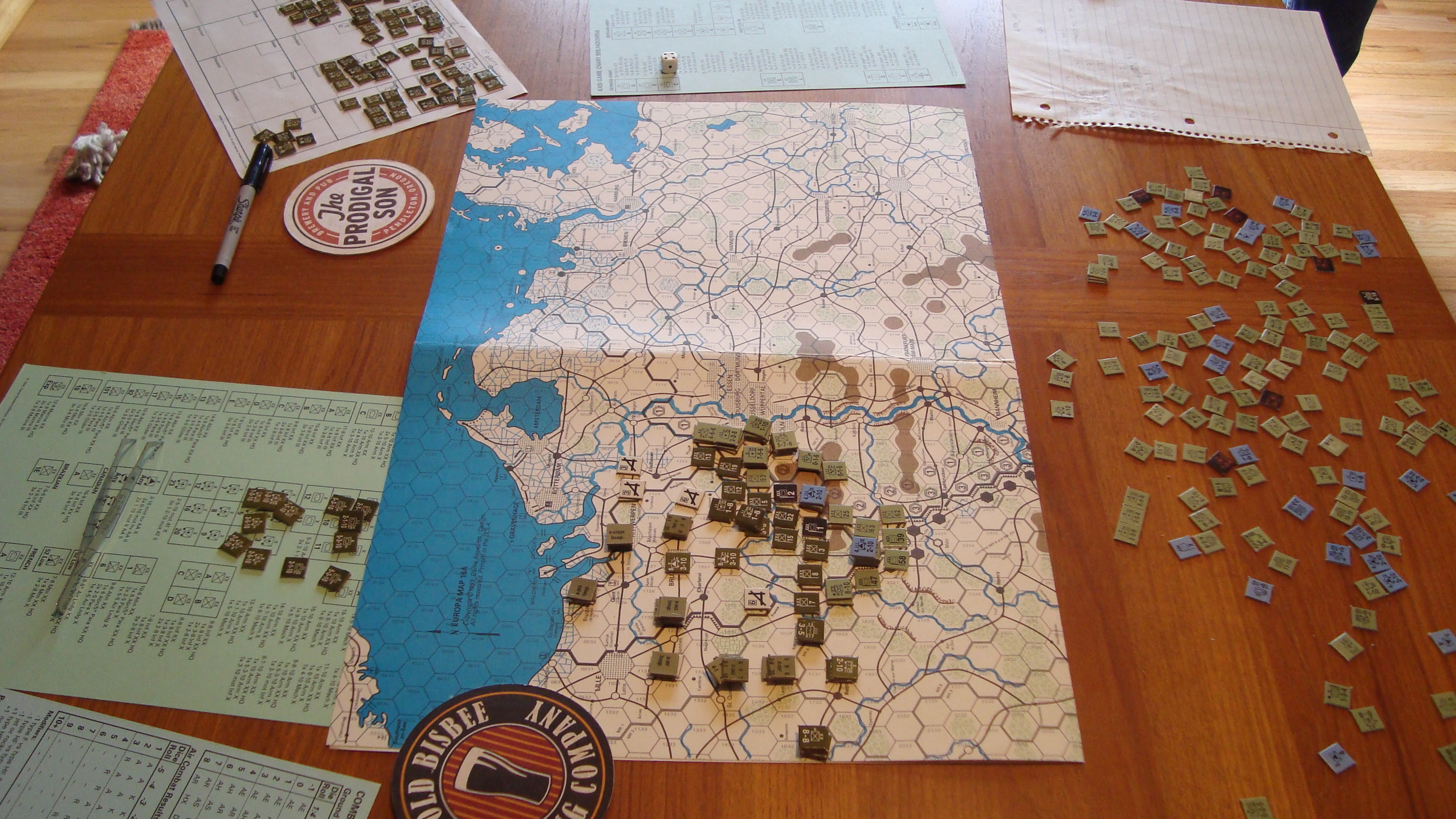
BTW, the game involves a lot of counters in a very small area.  Tim liked that.  We did not use the black and white larger hex insert that accompanying the magazine.  Here’s the usual crummy picture, shot early in the day, so the beer mats are not yet in use.


DSC01158

Fun game, Fun Time…….

War In The Aegean Redux Redux (Turn 5)

Well, kind of Turn 5.  Started up pre-turn sequence.  Rolled for day turn with only one impulse.  British had initiative, and then rolled to see of ACCOLADE (Invasion of Rhodes) would happen.  Rolled a one, so it will happen.

At this point I realized that I had spent way to much time on this game, and that I had to get ready for the arrival of my friend Tim, and an intensive Day+ of Europa.  So, I packed the game up.

I’ll post up what might pass for a review later.   Found this interesting discussion on the web and will use it as the basis for my review.  I’ll also correct that mutant picture I posted up yesterday.