Category Archives: Boardgames

Fall Gertrude – Another Variable

Have everything set up and ready to go.  The Neutral Order of Battle calls for Turkey to receive foreign aid in the form of replacement points for upgrading units.  The Allies historically provided aid to Turkey.

I’ll use the acceptance of this Allied aid as another pretext for invasion, but will only complete one-half the 1942 upgrades.

The overall effects convert infantry divisions from supported to non-supported, upgrades the 6-4-8 light armored division to a  7-10 armored division, and adds 1 ARP, as well as Hurricanes and P-40s to the Turkish air arsenal.

Fall Gertrude – Axis Order of Battle

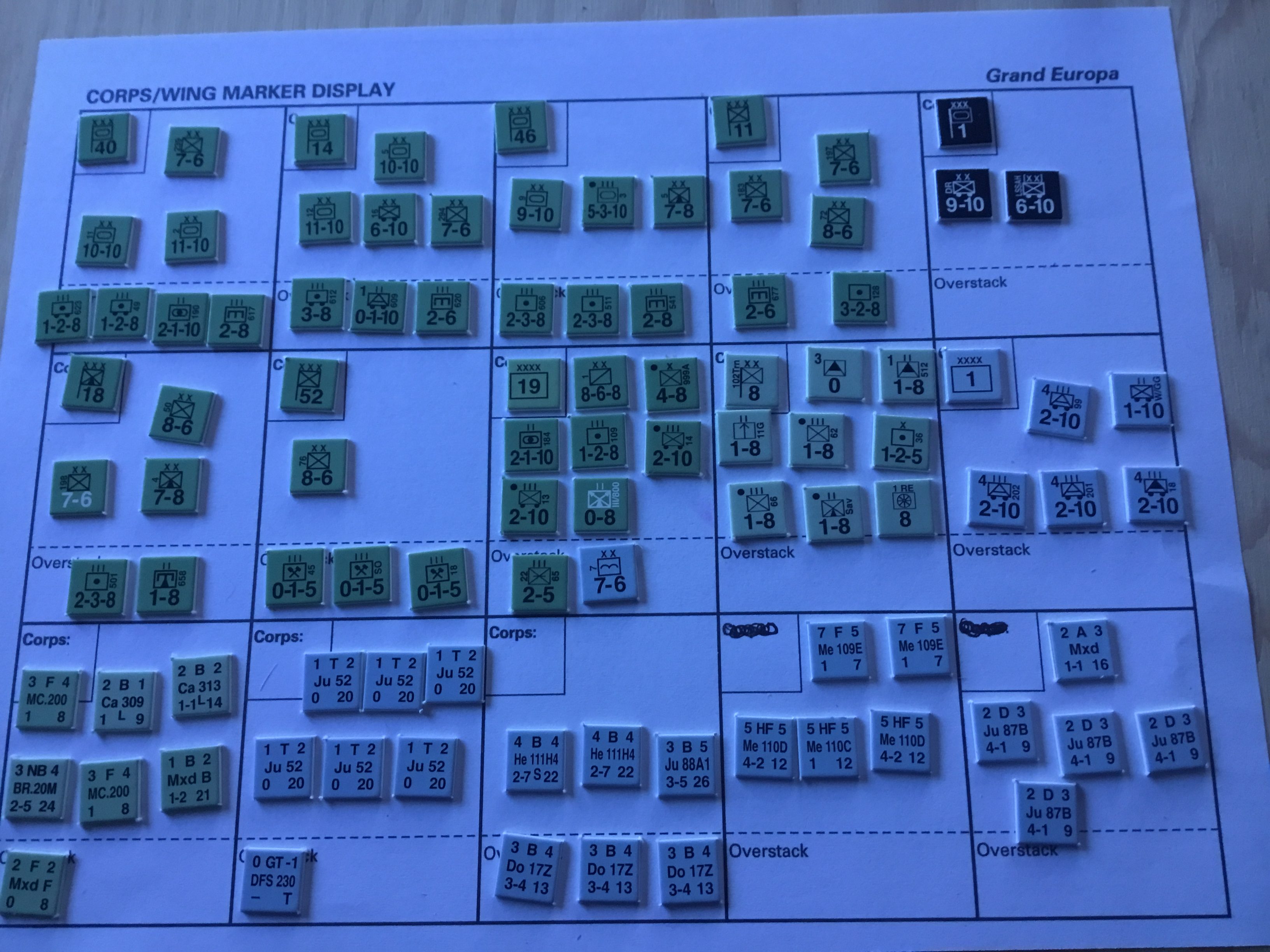
Added corps troops, with Army command retaining control of some assets, including the parachute division.  The Italians provide a weak “division” to be used for rear area security (RAS).  The weak German 52nd Corps, really a reinforced division, will perform RAS and airfield construction duties.

Due to the demands of other theaters, Fliegerkorps I contains a mix of older Luftwaffe assets.  The antiaircraft units’ primary mission is airfield security.  Aircraft mix and density is also driven by a weak air opponent and the need for maximum tactical air support.

One picture is supposedly worth a thousand words.

Jeez….I don’t live in the Blue Lagoon…..that’s a scary movie…..Ricky Schroeder and what’s her name who was also in Pretty Baby…..eeek.

Fall Gertrude – Force Composition

World At War Issue #49 provides the basics task organization for German forces deployed in either Bulgaria or Greece.  War In The Desert (WITD) contains Turkish units and their initial dispositions.

However, what about allies?

At first, I assumed Germany would call on its Bulgarian allies for significant assistance.  In addition, it’s possible that revanchist Greek and pro-fascist Yugoslavian units (Chetniks) might be formed.  While the latter would be of little value in the initial attacks, they could provide rear area/security forces.

On second thought, I decided not to use these forces.  Supposedly there was a good deal of pro-German sentiment in Turkey due to their close relations before and during World War I.  To invade with long standing enemies would eliminate the possibility of any support from the nationalist Turks, much less put them in a security role policing Turkish cities.   However, Bulgarian and Greek troops might be useful if massed at the border to tie down Turkish forces.

The Germans would be on their own, with limited ground and air assistance from the Italians, ever eager for a piece of any territorial or resource pie, but already stretched thin in North Africa.

I still have to figure out what assistance the Turks might receive from either the United States and/or Great Britain.  I am assuming that the Soviet Union will be too hard pressed by the Wermacht’s summer offensives and need to hold their portion of the Iranian oil fields to provide any help to the Turks.

The next post will cover the Axis forces in detail, plus a thrilling photo of initial Turkish dispositions.


Fall Gertrude – Conceptual Framework

Huge Disclaimer Primarily For Those That Were And Have Probably Been Involved In Flame Wars In Any Form Of Europa List Past, Present And Future……

This is not an attempt at crafting an A Strange Alternate History Scenario……..Just playing with counters and possibilities.


Every time War In The Desert (WITD) comes off the shelf, I’ve looked at all those Turkish counters, and what a waste it is  they remain neutral and unplayed.

Information concerning “Gertrude”,  the German plan to invade Turkey, seems scarce and vague.  Strategy and Tactics published a World At War game a couple of years ago.  I bought it, looked it over, and sold it.  Too much emphasis on special operations, which seemed strange for an operational game.  However, I did note their conjectural divisional/corps Axis force list as a starting point for Europa, as Turkish initial dispositions and reinforcements are in WITD.

Gertrude was considered an unnecessary diversion of resources, given the demands of other theaters.  Maybe the operation would have taken place if Hitler pursued a Southern Strategy.

Developing a context for invasion became an interesting thought exercise.   Plausibility of each of these factors is, by definition, subject to plenty of debate and/or outright dismissal.  However, I had to start somewhere.

During the process, I came to more fully appreciate how strategically important Great Britain’s operations during the Spring and Summer of 1941 were.  During this period, Britain quashed the Golden Square’s revolt in Iraq, invaded Syria to remove the collaborationist Vichy forces and, with the Soviet Union, invaded and occupied pro-German Iran.  These actions secured Turkey’s southern borders from possible pro-German military activities.

My framework assumes these operations take place, despite the interesting possibilities inherant in an invasion of Turkey involving Vichy, Iraqi and, possibly, Iranian troops.

The framework also assumes an invasion would not have taken place in 1941 after Marita-Merkur or before Operation Barbarossa.

This leaves Spring-Summer of 1942 as a possible time frame for invasion. However, German forces were stretched to the limit for Case Blue, with other assets committed to Rommel in North Africa.

To get around these limiting elements, my framework assumes the Germans pulled back from Moscow in late 1941, avoiding significant losses during the Soviet winter counter-offensive, with greater resources available in the East for 1942’s offensives.  Also, that units in France were available for use in Gertrude.  Operation Jubilee (Dieppe) did not occur until August.

Fall Gertrude would now be a pincer aimed at meeting Case Blue’s forces in the vicinity of Grozny, securing Turkish mineral resources and the  Baku oil fields.  The victorious German forces would now threaten British held Syria and, by extension, the Suez Canal.

It’s a start.  Accepting these highly arguable assumptions, the next step was to develop a German force list.
 

Lost Weekend?

The bad news came on Thursday.  Tim couldn’t make it to our annual Labor Day Weekend wargaming/college football blow-out.  His pup, Crater, was not doing well and putting her in a kennel was out of the question.

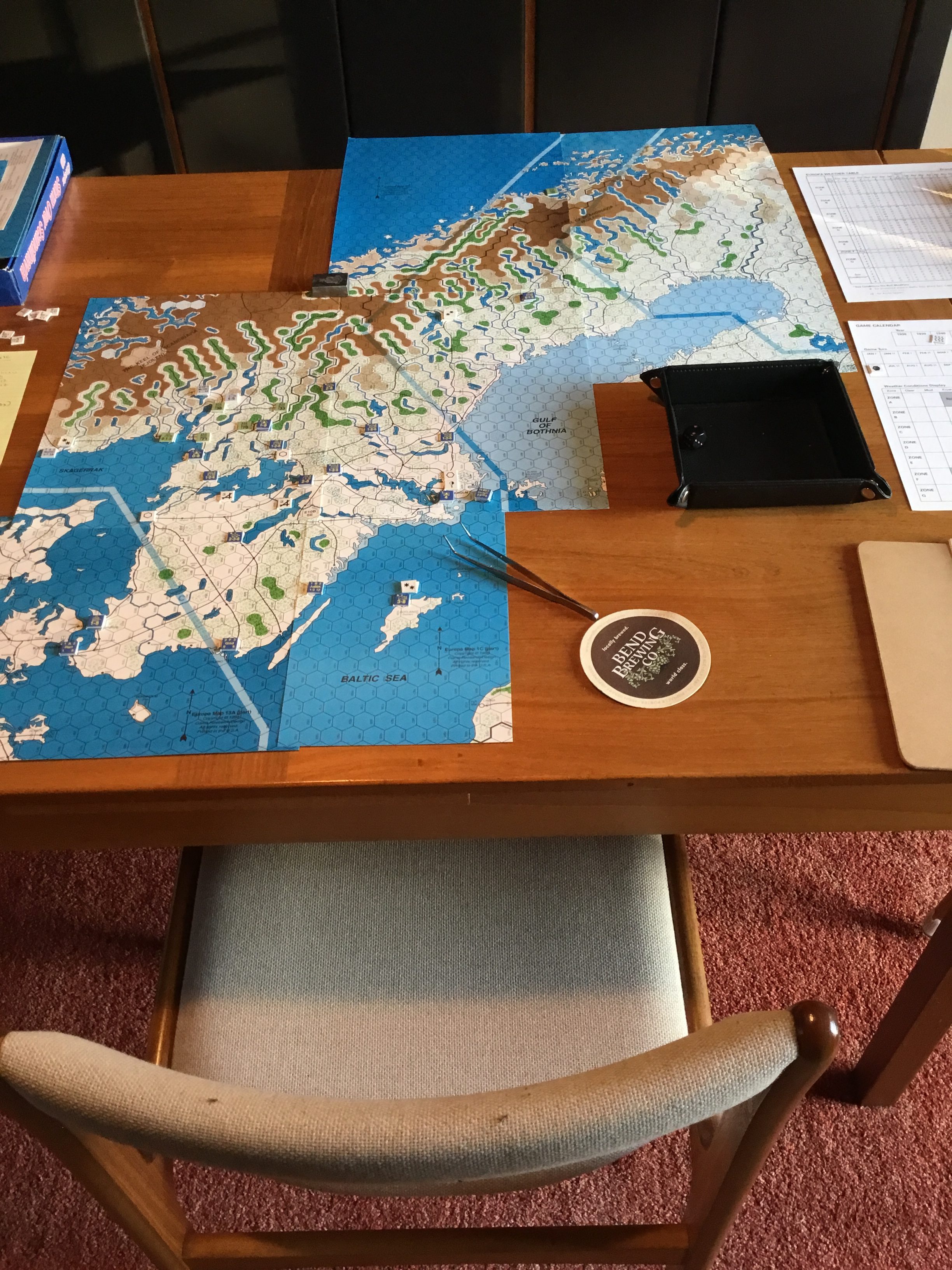
Had just finished setting up the maps and sorting the counters for Storm Over Scandanavia’s Campaign for Sweden Scenario.  Might as well make the best of it.

This is a hypothetical German attack after the Fall of Fance.  The timeframe is July-September 1940.

An infantry affair, with very limited armored resources for both sides.  The Germans do have air superiority and a wealth of General Support air assets.  This advantage is mitigated by wooded/lake terrain.  To make things even more challenging, much of the German commander’s combat power is in the extreme north of Norway, and will have to work its way south, or be railed to a more central position.

The Swedish set-up is mandated by their mobilization region (MR).  There are also garrisons in each region.  They are immediately activated once Germans enter the area, or activiated during the initial phase if the Germans are adjacent to the region.

All victory point calculations aside, the Germans must take Stockholm.  The Swedish deployment has made an amphibious attack (using rail ferries!), implausible.  As mentioned, a northern axis of advance will take too much time.  So the main effort, using three corps, will be through west-central Sweden with axes of advance channelized by lakes and terrain.

Should be interesting.  Here’s a quick photo of the setup.


PGG – Another Thought.

It’s a point-and-shoot.  Part of the appeal.  Germans barely stoppable, and the Soviet body count just grows and grows.  But they just keep coming…..and that changes the German commander’s view about four turns in.  How In The Hell do I stop them?  So you keep looking at the table twice a day.

That’s the other part of the appeal.  You appreciate Heinz G’s Quandry.

Here’s an excellent link.  I wish they had kept at it.

https://grognard.com/zines/sr/spi_no1.pdf


Finally…….

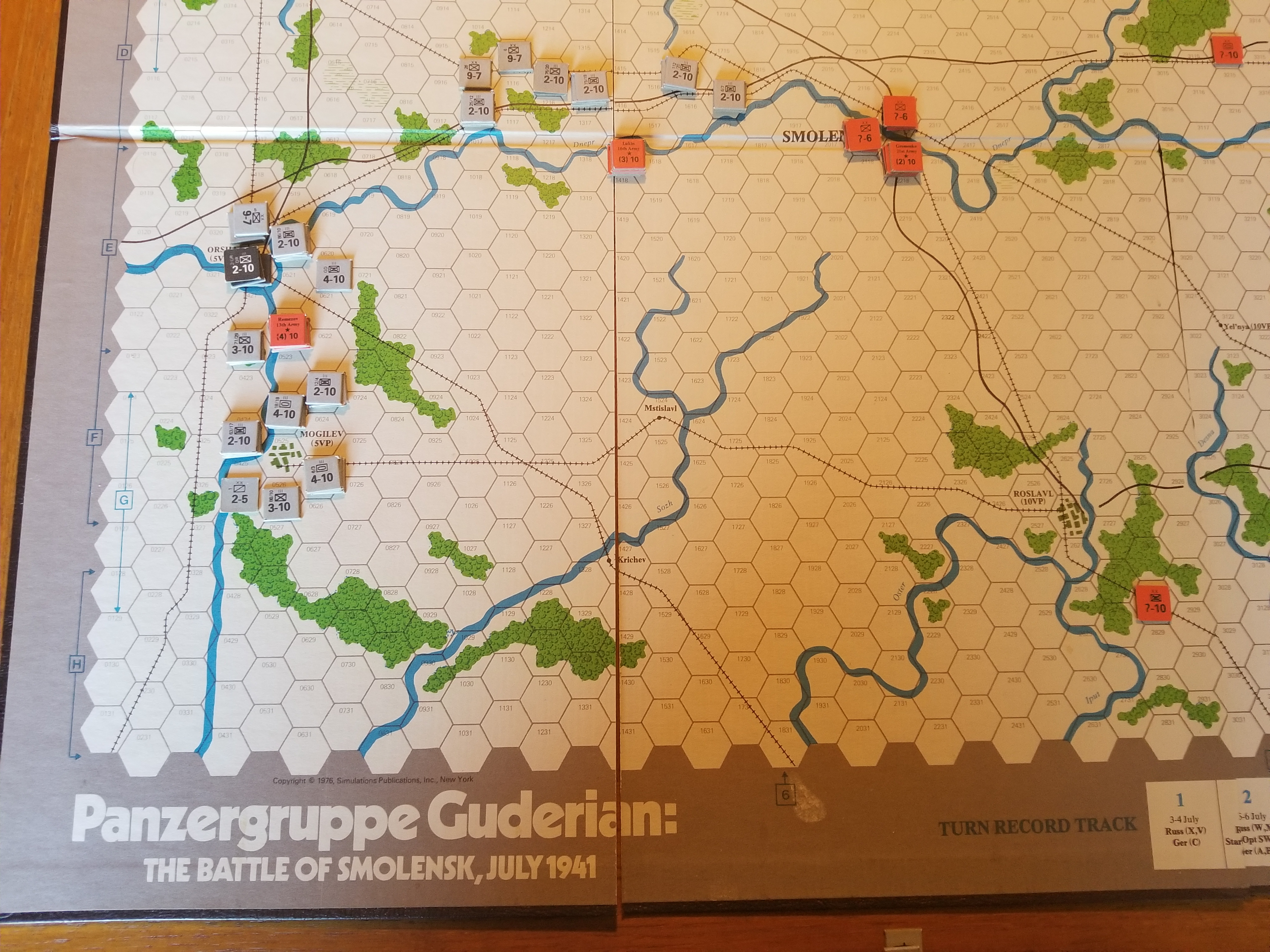
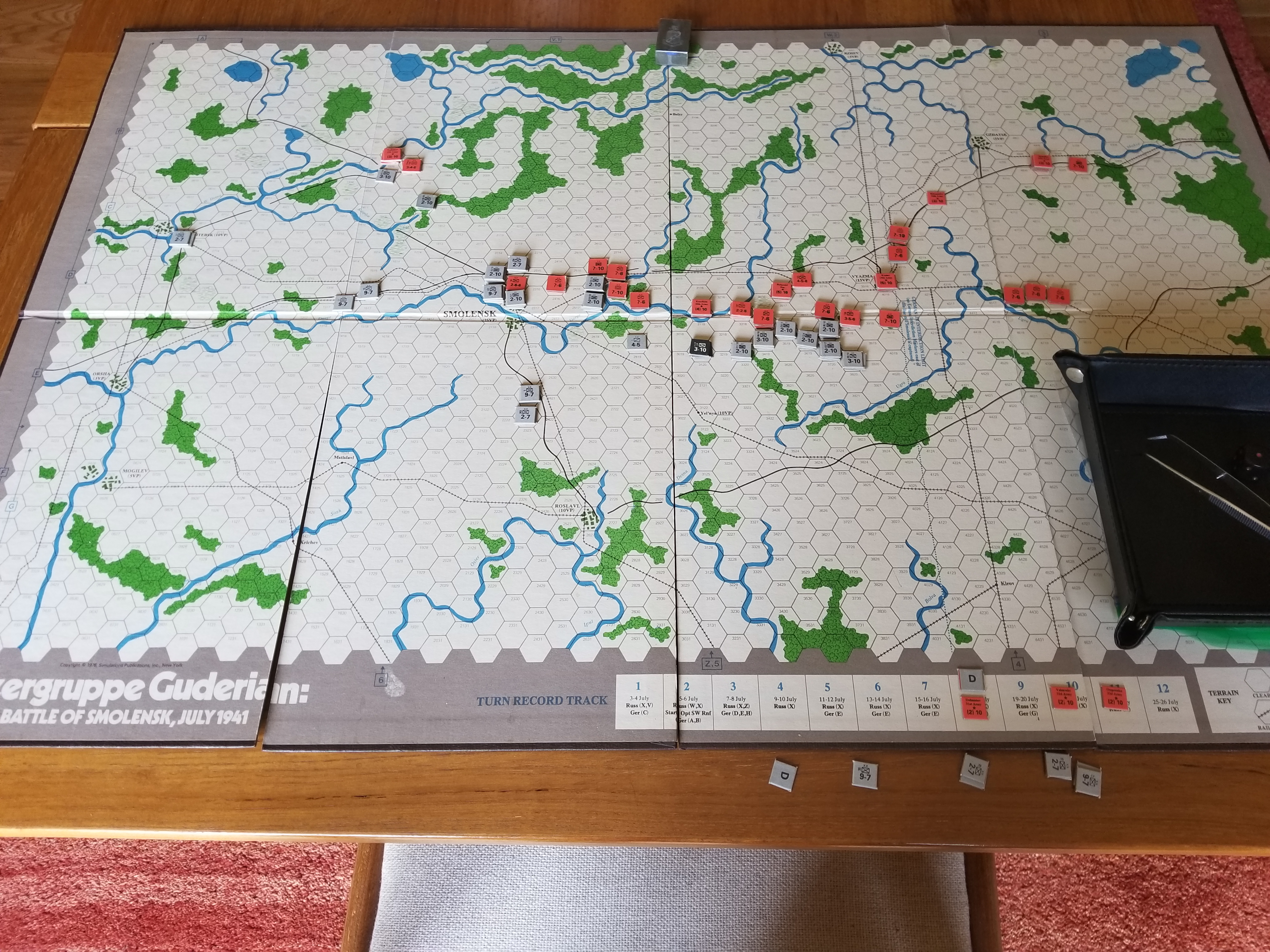
Finished off a long and torturous session with the venerable and highly rated Panzergruppe Guderian.

Getting it on the table was a lengthy process.    Purchased on E-Bay eons ago.  Arrived in fetid condition, probably stored in a basement in Missouri for the past 20 years.  No slur on The Show Me State, as  I lived there for 10 years, and had a number of games go bad in the humidity.

Game spent about 6 months in a car freshener laced garbage bag along with some really smelly Osprey Men At Arms books.  Rules had to be copied since the originals were falling apart.  Lucky the copier didn’t succumb.

It is a fun play, until the German player has to get involved in (I think unavoidable) attritional showdowns at or east of Smolensk.  

Opening


The unknown Soviet unit strengths make it a very good solo game.  The Soviets keep throwing units into hasty defensive lines, while the Germans try their best to outflank them, and wait for their infantry to appear,  sew up the pockets, and get the ZOC kills.  Unfortunately, the infantry units are a little late in getting on the map. 

My mistake was to leave armored units to seize Smolensk, rather than push them east.  Again, if I’d been more patient, the infantry would  eventually  have arrived.  But, time is of the essence in this game.

Also, once a unit is in contact, it is committed and  can only  leave its opponent’s ZOC through victory or an unfavorable combat outcome.  Panzer losses reduce the ability to attack at doubled strength.

So, why long and torturous?  Just couldn’t bring myself to get muddy and bloody east of Smolensk once the Soviet defenses had really coalesced.  Kept looking at the game table and finding beer to drink and/or  chores to do.

The key to this last defensive line was using Soviet commanders – who have a command radius allowing units to use full movement – as “shepherds” to help units into action quickly.  Rail movement is limited, and the German interdictions drastically reduce rail movement.  So, getting everyone moving west is a Soviet priority.

The Soviets also have a limited interdiction capability.  This is limited to twice a game, but given the German line of communications bottleneck, an interdiction  reduce literally all German units east of Smolensk to half strength during that turn.  Timing here is critical for Soviet success.  

By Turn 8, it was coming down to one turn of die rolls for the Germans.  Without a breakthrough, stalemate.  Rolled them, and the Germans remained locked up, with only a limited reserve  too weak to continue east.  

End Game

A marginal victory for the Germans.

Weekend At Tim’s

Real pleasant couple of days in Portland.  Hotter than Hell, but we stayed refreshed and hydrated.

Maybe that’s one reason not a lot of gaming took place.  Also a perceived need to view a few action films outweighed the desire to push cardboard.

We played “Operation Exporter” from  War In The Desert.  This is an operational simulation of the  Allied invasion of Syria.  Not exactly Tim’s cup of tea – low counter density, only a small portion of the map used and….gasp…..no real tanks (only a couple of Vichy light tank units with attack strengths of 1).  The Allies will win, it’s just a matter of time.  However, the victory point schedule makes time of the essence

Nonetheless, Tim did a great job as Allied Commander.  He used his one motorized asset to harass the Vichy flanks and optimized the use of his limited air assets and naval gunfire.  He also quickly assembled the two divisions available to him, with their enhanced combat power and zones of control.  The regiments and brigades that make up all the Vichy forces cannot be formed into divisions.

I played my part by having a (typical) cavalier approach to victory conditions.  While Tim didn’t win on VIPS, he certainly won the game.

I didn’t fare as well when we switched sides.

This is a good little scenario.  It’s viewed as excellent starter game as it has all of the Europa food groups, but without the counter density to make the experience overwhelming.

He’ll be out at The Pinecone Lodge around Labor Day for Storm Over Scandanavia’s hypothetical scenarios involving the invasion of Sweden.

Old Itch Scratched

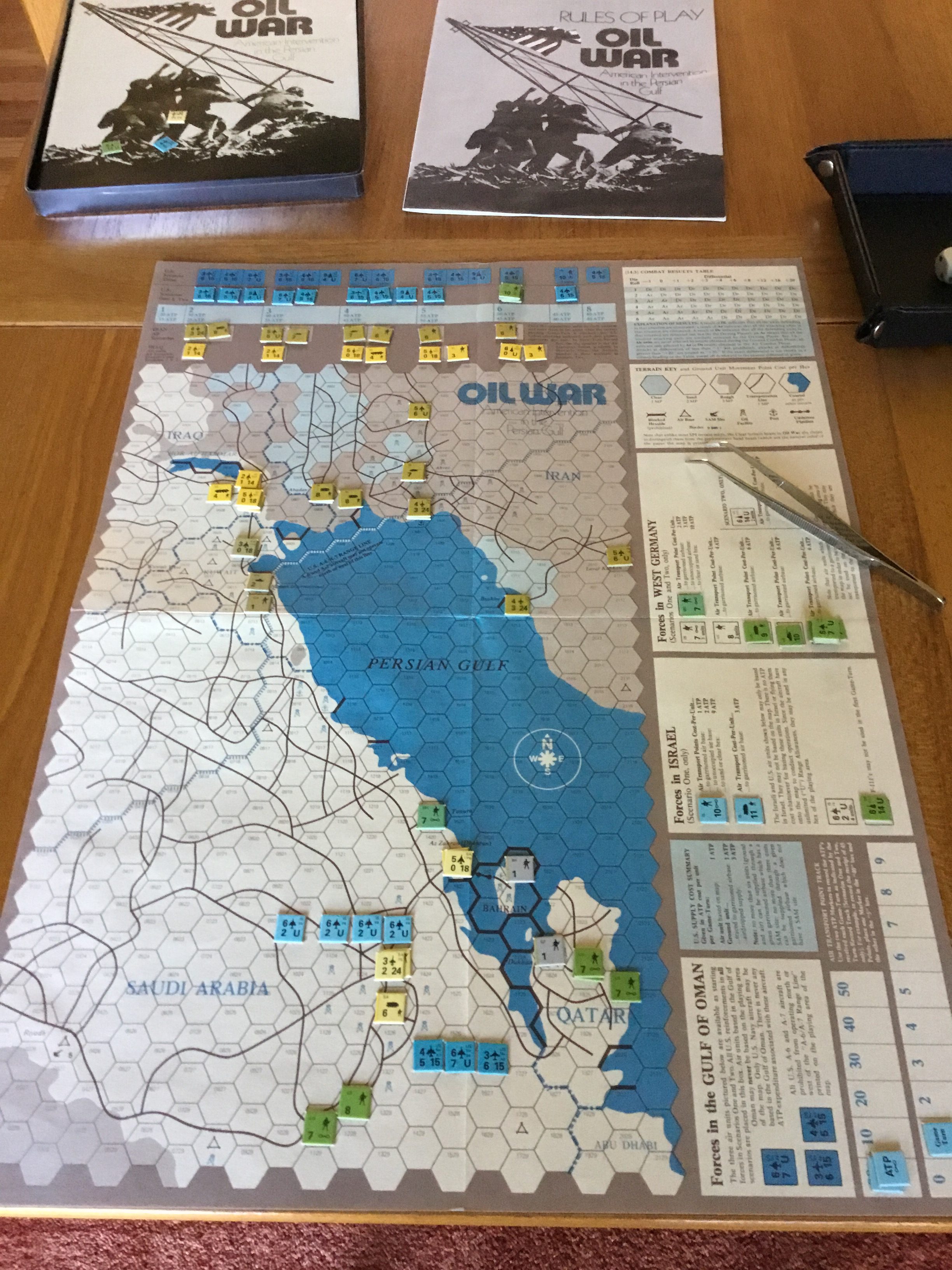
One of the lost games that I have fond memories of is SPI’s Oil War.  Don’t know where it went, but probably in a late 70’s purge along with the also lamented World War I.

Been looking for both on E-Bay but the high prices were off-putting.  Recently found a reasonably priced folio game and snapped it up.

Fairly quick to set up, moves along at a brisk pace, but there is one problem.  The Western nations have to really screw it up to lose.  Why?  Airpower.  Air attacks simply crush the combined Arab forces.  It will take time….but  victory conditions will be attained.

My approach was to establish airheads in southern Saudi Arabia, reducing logistical demands, snap up the Saudi oil fields, then gradually move north.  Yes, Kuwait has to be captured to assure a substantial victory, but that is an eventuality.

Arab forces need to defend airbases to deny the West their logistics benefits, and to give ground grudgingly, hoping that the game will end before losing the 25 oil fields signifying a substantial Western victory.

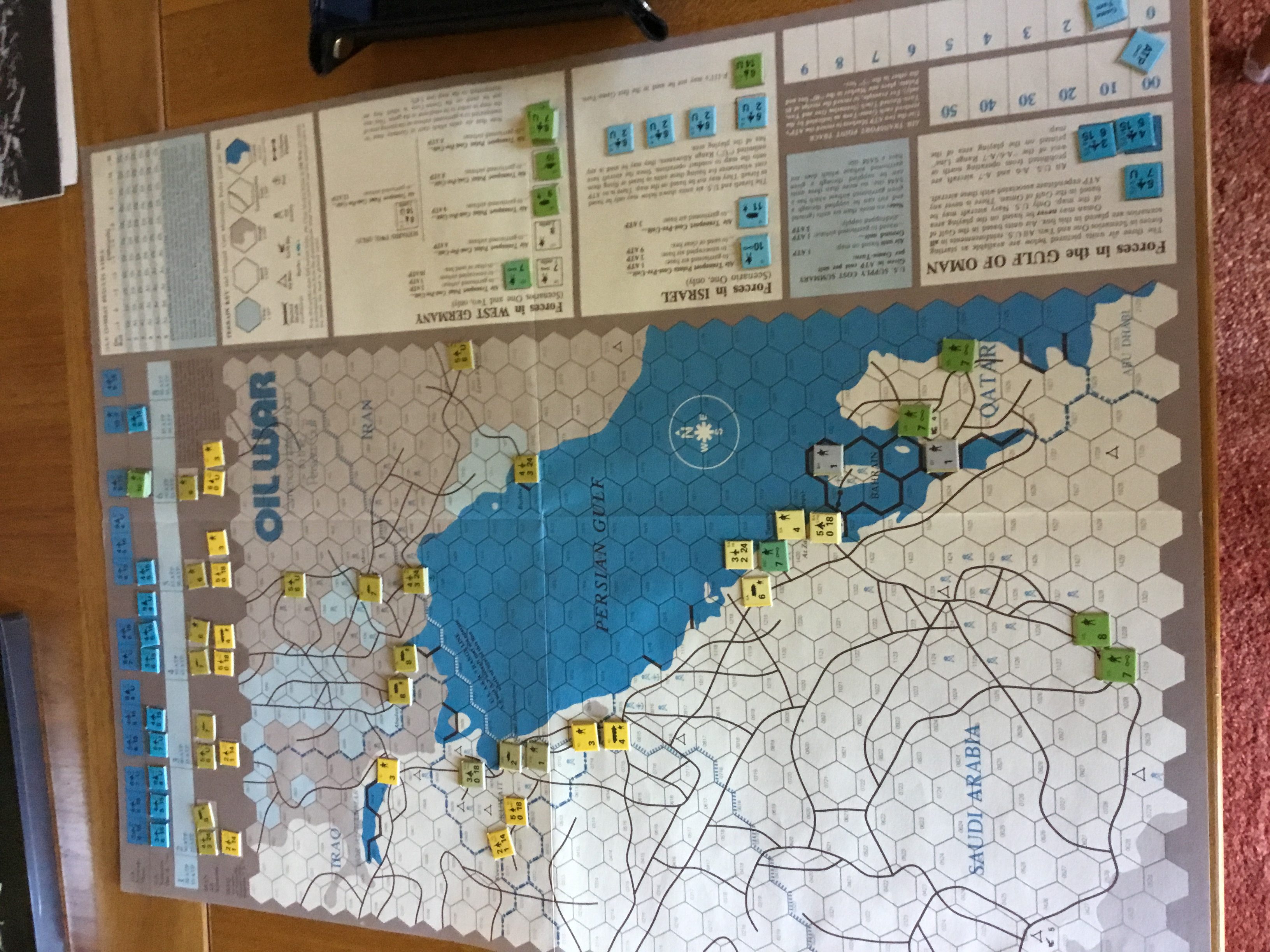
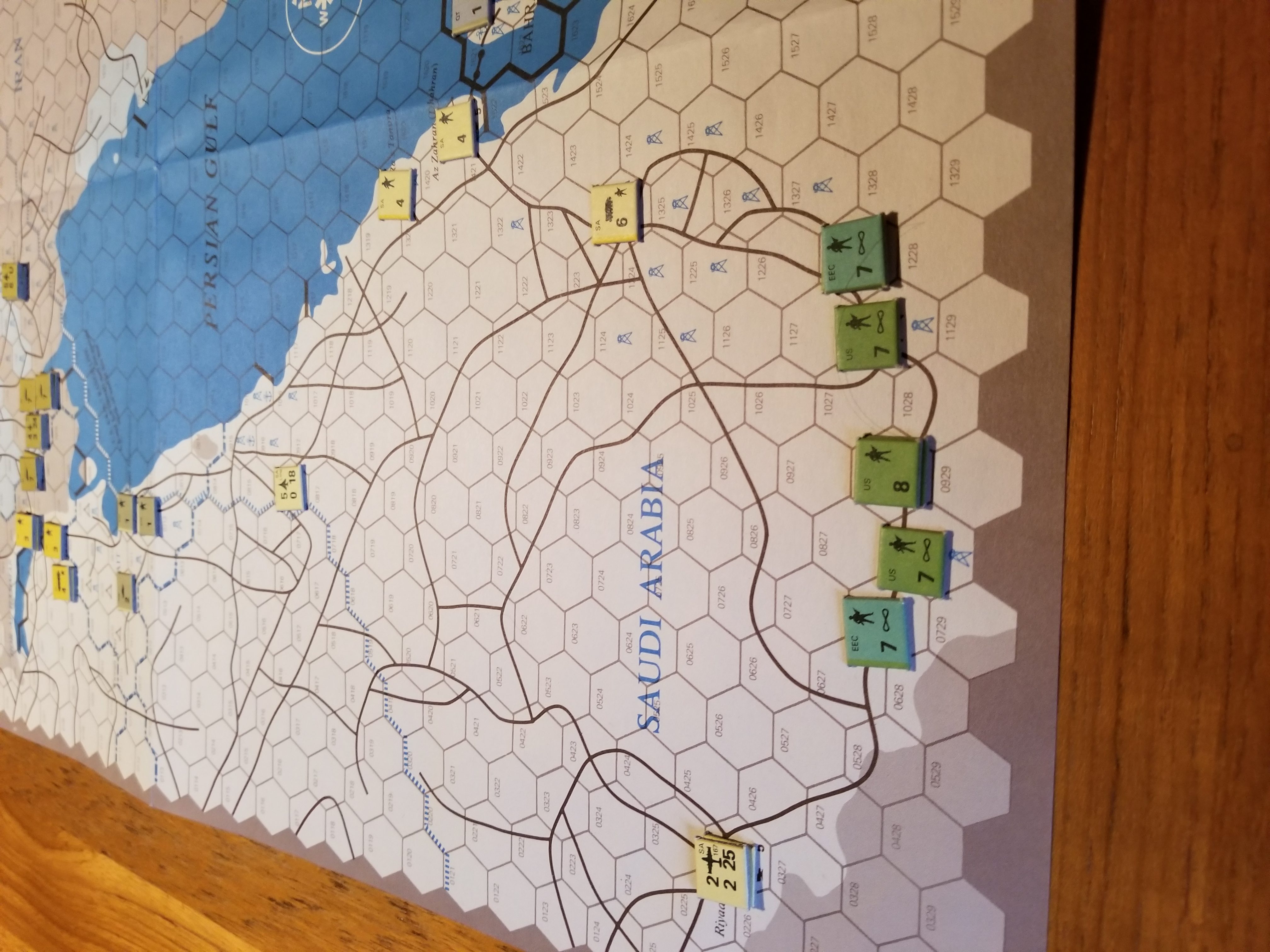
At the time, it was a challenging and fun game, dealing with a very current topic.  Now…..not so much, but I enjoyed playing it, and that’s the main thing.  Here’s a couple of photos.

First Time Through: Aggressiveairlanding  on the coast. Air units staged to savage Saudis defending oil fields. Significant assets attacking Qatar.
First Time Through: Too aggressive. Coastal unit just before ZOC kill.
Second Time Through: Slow and Steady.  No distractions and no sudden moves.


What’s Not To Like?…..Revisited

In May I posted up about my positive impression of Avalon Hill’s old Arab-Israeli War.

Since then, I’ve played a couple of the advanced scenarios and confirmed why the game isn’t that well regarded.

The first is line-of-sight.  It can be hard to envisage, especially if the player does not have any experience with map countours, military crest, reverse slope and dead ground.  For that player, it’s a puzzler.

The second is the slow pace of play.  Slow, if the Israeli’s want to win.  The Israeli’s have to advantage of the ground, and maintain their ability to stand-off and destroy the Arab units piecemeal.  This takes patience.  No charges up any valleys.  Slow and steady working on the flanks.

The Arab player’s best hope is to delay/defend and reduce the level of Israeli victory by having the game end before objectives can be achieved.

While not necessarily action-filled armor fun, this type of play makes it an interesting challenge for both sides.