Category Archives: Boardgames

Ranger

Took Ranger off the shelf the other day.  Had messed around with it about a year ago, after picking up the latest edition for practically nothing on E-Bay (bad box).

Each game consists of a mission.  The mission has two parts, planning and execution.  United States Army small unit doctrine for squad or platoon sized missions is used.  If you have had any exposure to this, learning the game is simple.  If  not, there is a very informative booklet included to help you learn the basics.

What’s fascinating is the few number of rules.  The platoon leader has to act like a platoon leader during the planning, briefing and rehearsal stages of the mission.  Determine your unit’s load, work out the route from your insertion point to the objective and then back to your pick-up point, plan for supporting fires, and manage your rehearsals.

Mission execution is accomplished using the programmed text.  While movement to the objective can be a little tedious, you can’t make a mistake, or something bad might happen.  Make sure your unit is in an appropriate tactical formation, call halts every 750-1,000 meters, and don’t get in a hurry.

One aspect of the programmed text that confused me at first was how to stop moving once my squad had reached the objective rally point.  Well, the answer was simple….call a security halt, and go to that paragraph.  The text options provide the prompts to start your actions at the objective.

To be successful, actions at the objective must comply with doctrine.  If you start free-lancing, bad things do happen.

This game has a very quick set-up, but preparation before the mission is lengthy, but an integral part of the game.  However, after a couple of missions, SOPs can be established, reducing planning time and increasing effectiveness.

Playing time for my first mission was about 1.5 hours, all-in.  This squad-size reconnaissance  mission is an excellent introduction to the game.  I look forward to moving on to Mission Two in the very near future.


Raid On St Nazaire – Again Pt II

Finished up the game yesterday.  A semi-tradition to spend a lot of time wargaming the day after Thanksgiving.

The British wound up with 60 VIPs, better than the historical outcome of 53, but less than the 70 needed to “win”.

If the British were to win, this would have been the game.  The German harbor defense and activation rolls were terrible.  Literally all the commandos were able to land, and faced only moderate opposition when ashore.

Still, over the 13 turns, the British assault fleet was reduced to kindling, with only four ship escaping, two of which were on fire.  The ML Falconar was able to return 6 survivors and Chant’s demolition team to the UK.  Nobody else made it home.

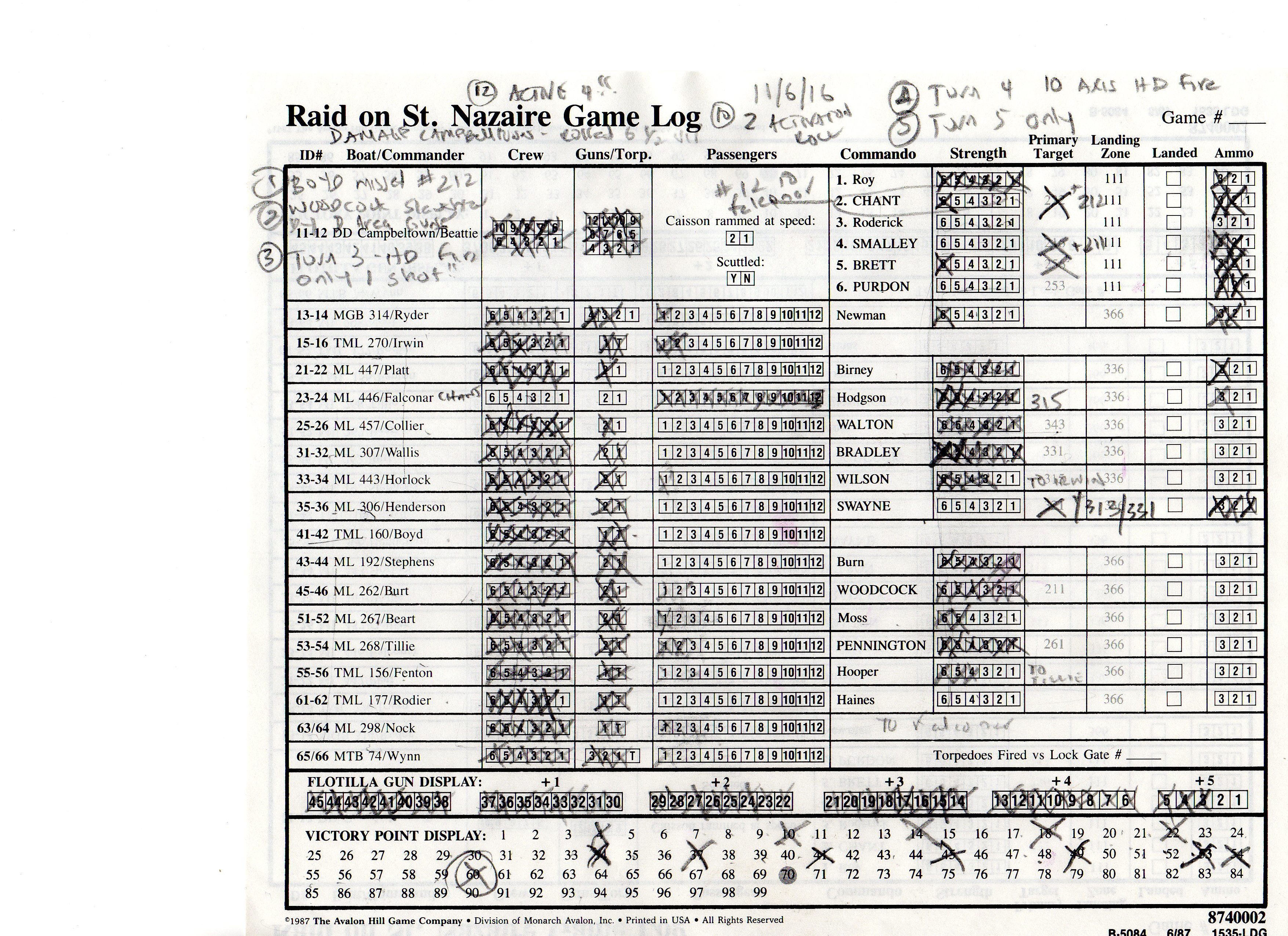
For once I should taken a picture of the end-game.  The surviving commandos were huddled around their point of debarkation, watching the remaining three MLs, and their hopes of making back, being blown out of the water.   As you can see from the Game Log, several of the commando units were still in good shape.

img095

The “star” of the operation was Swayne’s unit, which destroyed not only their primary target, but two others, accounting for 12 VIPs. Both Smalley and Chant’s demolition teams accounted for both their primary and additional targeted facilities.  The game score would have been higher but for a D6 roll of “6”, which damaged  the scuttled Campbeltown, but did not destroy it.  That would have brought the score to 66, or one target away from “victory”.

The only real bit of bad luck for the Brits was that the ships that were sunk on the run-in contained demolition teams.  That reduced their ability to gain VIPs.  Oh, yes, and my stupid decision to move one demolition team in a position where it could be engaged by not one, but three, flak emplacements.  Blammo!

Enjoyed playing this game.  Its well known virtues were evident throughout my two play-thrus.  I’ll certainly take it off the shelf again.

Into The Abyss?

A long, long time ago I played Squad Leader (SL).  Really into it.  Sorted all the counters into plastic containers, so typical for an SL Dweeb.  Then, for some reason, I gave it all away to a younger war gamer on a budget. Dunno……

About seven years ago, started buying up not only SL games on EBay, but also the all-consuming monster that is Advanced Squad Leader (ASL).  Scrounged through AH Generals for scenarios, copied them, and then placed them in a binder.  But, every time I looked at the monster rule book I just cringed, and satisfied myself with looking at the scenarios, and browsing through Mark Pitcavage’s wonderful Desperation Morale website.

For reasons that cannot be explained, I bought the Advanced Squad Leader Starter Kit (ASLSK) #1 a year ago.  And now, I’ve decided to start playing again in little, teenie, tiny baby steps.

What made this decision easy was the discovery of this.   Jay Richardson did a fantastic job putting together this guide.  It reminds me of how helpful the old AH replays were when you were learning one of their games.

Now, I’m going to hold off on the second and third modules for awhile.  It’s a progressive system, with successive rule books adding mortars/artillery and then vehicles.  What I really need is to find the third module’s rule book.  I’ve got plenty of ASL modules with counters and a gazillion scenarios, so there’s no real need for the counters/maps – I think(?).

Will start this up on T-Giving, after I finish up the latest iteration of Raid on St. Nazaire.

Fire In The Lake – AAR – Tim’s Take

Finally back from road trip.  Now I can post Tim’s observations about the game.  We have another session scheduled for Mid-December.

Here are my thoughts about Fire in the Lake-

  • We made a big mistake on the tunneled base rules.  They are much more difficult to remove than the regular bases.  I’m not sure it would have made a big difference in our game, but definitely something to note for future games.  BTW, I didn’t like the term ‘tunneled’.  I wish they’d used something different like ‘fortified’ or ‘entrenched’.
  • I wish I’d spotted the rules about South Vietnamese Rangers being able to raid across national borders.  It was really frustrating to watch the NVA building up in Laos and Cambodia.
  • The charts were very good.
  • I’m still laughing about the mistake of tracking ‘available’ units…We made that much harder than it had to be…:)
  • Very few of my units could both move and attack at the same time.  It felt like I was playing Paths of Glory!
  • Bombardment missions can really pay off for the NVA in the long run.  They provide a relatively cheap way of attritioning the COIN player.  I’m not sure if we removed to adjust ARVN aid to reflect US casualties (I think its something like -3 per unit killed– that adds up).
  • The VC need to adopt a ‘fleet-in-being’ strategy.  Admittedly the mistake about tunneled bases didn’t help, but they were rapidly wiped out in our game.  At one point you were using rally phases to make activate guerillas inactive.  It is really frustrating for the COIN player to see guerillas that have been activated by sweep operations go inactive during rally phases…A nice modeling of the frustrations of COIN operations.
  • On the rare turns when both of my factions started eligible it was a real dilemma whether or not to have them both run operations or have one pass so I would get a chance to respond to your moves during the next turn.
  • That game would play very differently with four players.  I don’t think the VC would let themselves get wiped out to the last man or the ARVN would let the Americans transfer large amounts of patronage to resources….
  • I kept forgetting to move the police out into the provinces, which hindered my pacification efforts.
  • Neither one of us did much fighting for the LOCS– I wonder if mass attacks on the LOCs would yield better results for the insurgent player.

Raid on St. Nazaire – Again

Started up another session.  Once again, discovered rules mistakes made during the last session.

The British can be attacked when in The Approaches, before movement.   And….the Germans have one searchlight operational for their first fire phase (a -1 on the to-hit die r0ll), and another searchlight becomes available for their second fire phase.

Fortunately for the British, the German die rolls were bad for their first fire phase.   However, the British Covering Fire was (again) useless, and the Germans could bring 6 firing factors to bear in the “A” zone during their second fire phase, which gave them twelve (!) attempts to damage British ships.  The result:  Bloodbath!

Still, the doughty Brits pressed on and are ready to land several intact teams of commandos.  Unfortunately, while the German Activation die rolls have been bad, the troops have been placed (by some strange hand of cardboard fate) right in or adjacent to their landing areas.

Should be interesting.

Fire In The Lake – AAR

Had a fun session with Tim this past weekend.  Full of fumbling and stumbling.

As discussed in an earlier post, this is a highly regarded game, with beautiful components.  And, as also discussed, for two old hex-and-counter Grognards, it promised to be a new experience, and not the type of card-driven game (Paths of Glory, Pursuit of Glory, Wilderness War, Wellington) we were used to playing.

This will be more an overview of the process, rather than a turn by turn narrative of the game we played.  I was so involved in figuring the damn thing out, that coherent recall much less thoughtful strategy was well beyond my capabilities.

First off, we really needed a picture of what the map board should look like when set up.  We messed up on where to put available cubes, what cubes to use as markers, and what counters go where.  It’s a new take on “idiot rules”, we need rules crafted for idiots.

The first difference we noticed between this and our previous card driven experiences was that each faction (USA, South Vietnam, Viet Cong, North Vietnam) cannot do something with each card.  Only two factions can play a card, and only one can play the card as an event.  Also, not only is the card in play turned up from the play deck, but also the next card to be played.  This forces players to anticipate how to react with two cards, not just one.

The deck itself is constructed differently.  In many games deck events and options are predicated on period of the conflict, or the play of a major event triggers the inclusion of more cards.  In FITL, the very large deck is initially split into six decks of twelve cards each.  A coup card is then shuffled into each deck.  Play commences with one deck, and after a Coup card is turned up and played, that Coup card is removed and the next deck placed under the remaining cards from the previously played deck.  There are a large number of cards that are not included in the six decks.  This must enhance replay.

Most card driven games involve reacting to an opponent’s play and  sequencing a group of cards held in hand.  This leads to a rapid sequence of play, with a card played quickly followed by another.  In FITL, the pace was less frantic, and steadier.  Maybe this was due to our inexperience.

The options for the first eligible faction (sequence of eligibility shown at the top of each card) are to pass (perhaps because of the next event) play the event, or play an operation (in multiple spaces), with or without a special activity. The second eligible player can pass, execute the event (if not done so by first player), or execute a limited operation.  Limited operations can take place in one space, only.  Only if the first two pass, can the third eligible faction act on a card.

We learned that Operations have complementary Special Operations, and successful play involved the ability to mix and match these operation types.  Also, the first eligible faction can really frustrate a stronger opponent by executing an Operation, only, after which the second eligible player can only execute a Limited Operation, not the Event.

All sides must be careful not to take too direct of an approach.  For the VC, taxing to raise resource levels or terrorizing the populace will alienate the local population, reducing support.  US airstrikes, while devastating militarily, are just as damaging to popular support.

While control of areas and provinces is the key to victory, each side has other activities,(not just destruction of enemy forces and many times in conflict with those of their “ally”) that contribute to victory.  For the VC and NVA, base building and maintaining the Ho Chi Minh trail must be a priority.  For the US, it’s ability to win is directly tied to reducing the number of troops being used.  ARVN forces gain victory points by siphoning off US aid into their coffers.

All of this maneuvering comes to a grinding halt when a Coup card is turned up.  The card in play is then considered to be a Monsoon card, which limits operational play options, and the Coup card is then the last card played.  After play for that card is finished,  victory points are calculated.  If a faction wins, it wins.  If not,  new aid and resources are distributed, and victory points are again calculated.  If one faction has attained victory, the other factions know it and the last deck is played.  An interesting way of changing play strategy and perspective.

Tim will be posting up his observations.

We’re playing this one again in December.
Waiting In The Background

Tim and I will be playing GMT’s highly regarded Fire In The Lake this weekend.  Bought it at Guardian Games last time I was in Portland.

My reaction during the first rules go-thru was an emphatic OMGIF(!).

This is not your usual card driven game, and it sure as hell isn’t anything like a hex and counter game.  It’s well….different.

The point here is that if I wasn’t playing FTF, I’d probably scan the rules, admire the beautiful components and put it back on the shelf.  Maybe, I wouldn’t have bought it at all.

That’s a good thing about having an opponent, it encourages you to play something different.  Sure, many times Tim and I will play an old favorite. I guess that’s the wargaming version of comfort food.  But, it is nice to try something different, no matter how much it bends your brain.

I’ll be putting together the usual AAR next week, along with Tim’s comments.   Have a lot of studying to do this week!

Raid on St. Nazaire – Turns 6-12

Decided to stop at Turn 12.  British ships that had been standing off the port waiting to evacuate commandos had been destroyed, the demolition teams had, for the most part, expended all their charges, and the German reaction forces were sealing off any other VP targets.  So, I blew up the Campbeltown and called it quits.

The tempo of the game really picked up with fewer targets and lower to hit DR for Harbor Defensive Fire.

Took turn-by-turn photos, but all they depict is the pummeling of MTBs by Harbor Defensive Fire, and gunfights between reaction forces and commandos.  The highlight was the Turn 8 destruction of the Northern Caisson by Purdon’s commando using their last charge, after being attacked.  They needed a D6 roll of “1” to do it, and they did.  That was 12 VPs!   On the other hand, Woodcock’s commando couldn’t destroy even one of the three storage tanks in Sector 1.  Each tank was 3 VPs, and would have put me in range of a decisive victory.

I’m going to play it again.  Here’s an overview of lessons learned and rules I need to pay more attention to.

  1.  Destroy searchlights and guns, or at least, hit the Power Station.  The illumination effects make the already murderous Harbor Defensive Fire even worse.    Grenade attacks on guns/searchlights are an excellent use of assault teams.
  2.  Do a better job of getting demolition teams to their historical targets.  I just whiffed on this one and if they attack their assigned target, it’s a +1 DRM for demolition attacks.
  3.  Pay attention to the rules on ammunition depletion when a commando loses a strength point.  This effects grenade/demolition capabilities.
  4. Try to get the Wynn to accomplish its historical mission of destroying lock gates.  I had to use other boats for this.
  5. Don’t assume that the German reaction will be as slow and weak as the last game.  Lots of D6  rolls of “6” really restricted reaction movement, and low rolls for activation reduced the number of German units.

Raid on St. Nazaire – Turns 3-5

Rather than grind through the move-by-move, here’s a few overall comments about the game play using the rules as a guide.

German Harbor Defense:  Has been effective, especially during Turn 3, when 9 targets were hit using D6 to hit roll of 5 or less.  The maximum possible is 12.  Change to less/equal D6 of 4, literally saved the British.

Covering Fire:  Useless for the British. Need a 2D6 of 8 or less, and I’ve been rolling 8+.  Also, the mods due to loss of flotilla gun strength has not helped my rolls.

Dockside Defensive Fire:  A mixed bag for the Germans.  Some successes, but limited.  Not the weapon that Harbor Defense is.

Open Sea Combat:  So far, one British ship has escaped without contact.  More to follow.

Scuttling:  I scuttled the Campbeltown on Turn 4 and took off the surviving crew.  While this will help with VIPs, it severely reduced the flotilla firepower (see Covering Fire, above).  BTW, the Campbeltown took very little punishment before ramming the Southern Caisson.

Torpedo Attacks:  Despite low probabilities (1-2 on D6), torpedo boats knocked out two swinging gates, for 8 total VIPs.

German Activation/Movement:  Started slowly, but more and more Germans are available.  Unfortunately for them, I’ve been rolling D6 6s, so only those units with a strength of 6 can move.   This has severely hampered the reaction forces.

British Land Movement:  Managed to foul up the objectives for some units, so some moves have been counterproductive, and have effected the ability of units to quickly get to lucrative targets – especially the 12 VIP Southern Caisson.  I’ve not done a good job of mixing and matching assault (small arms and grenades) with demolition units, especially when attacking flak positions.

Grenade Attacks:  Once I figured out that assault units can do these, they’ve been fairly successful taking out flak positions.

Demolition Attacks:  Success on first try has been 50-50, with the key being to have the demolition unit end their move at the target and not take the +2 modification for entering the area during the turn.

German Ships:  Haven’t messed with them.

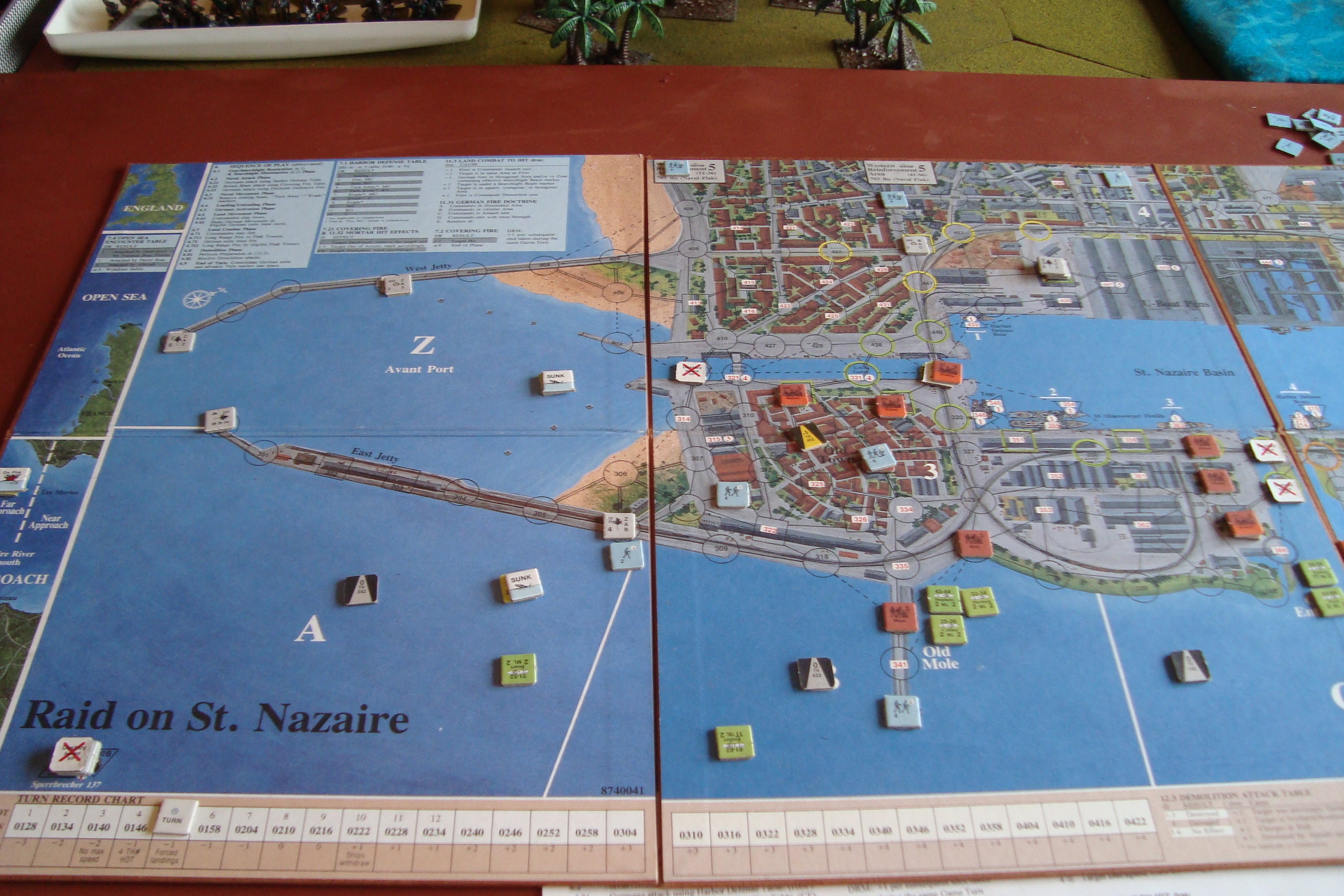
End Turn 3 Western Half of AO
End Turn 3
Western Half of AO
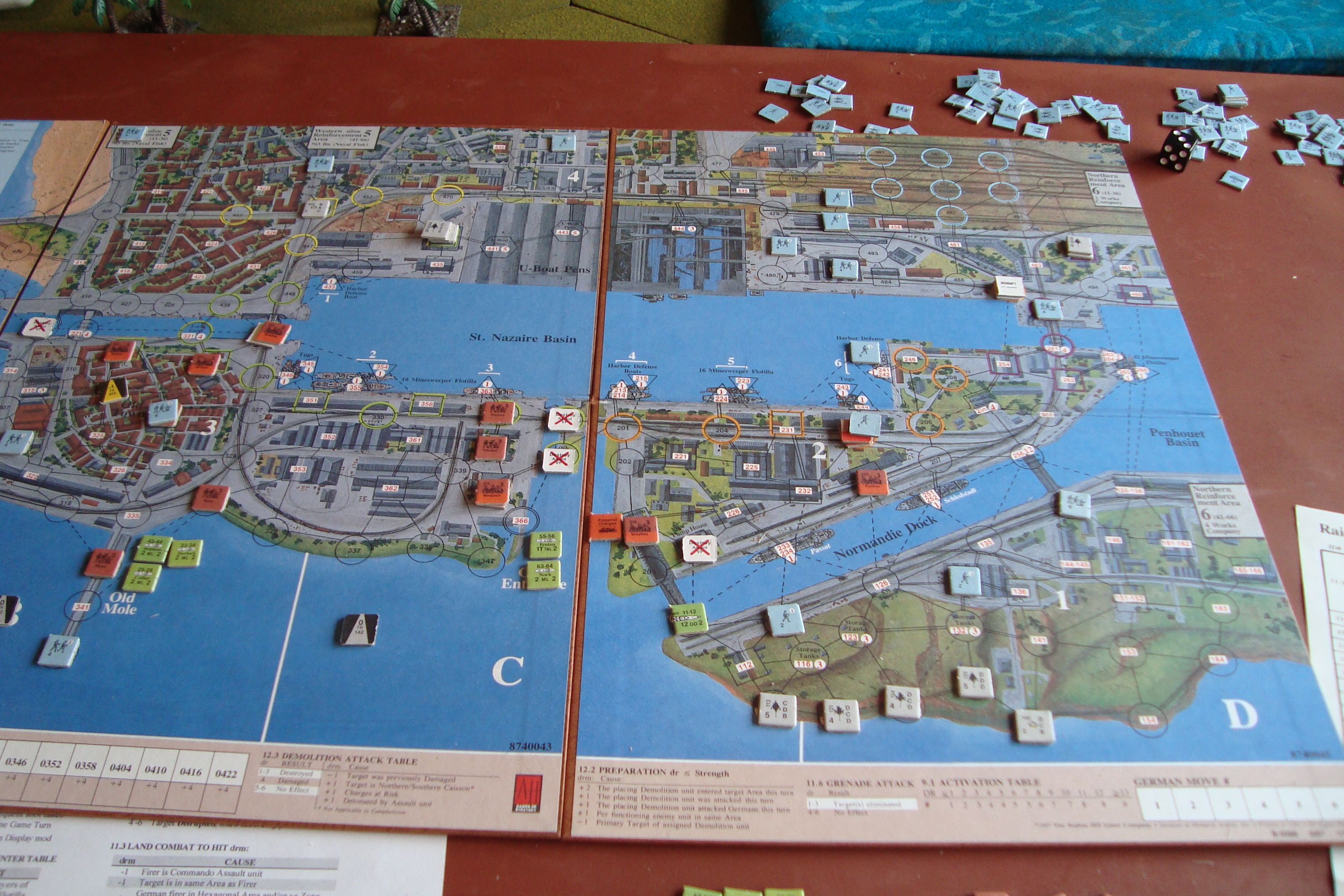
End Turn 3 Eastern Half of AO
End Turn 3
Eastern Half of AO

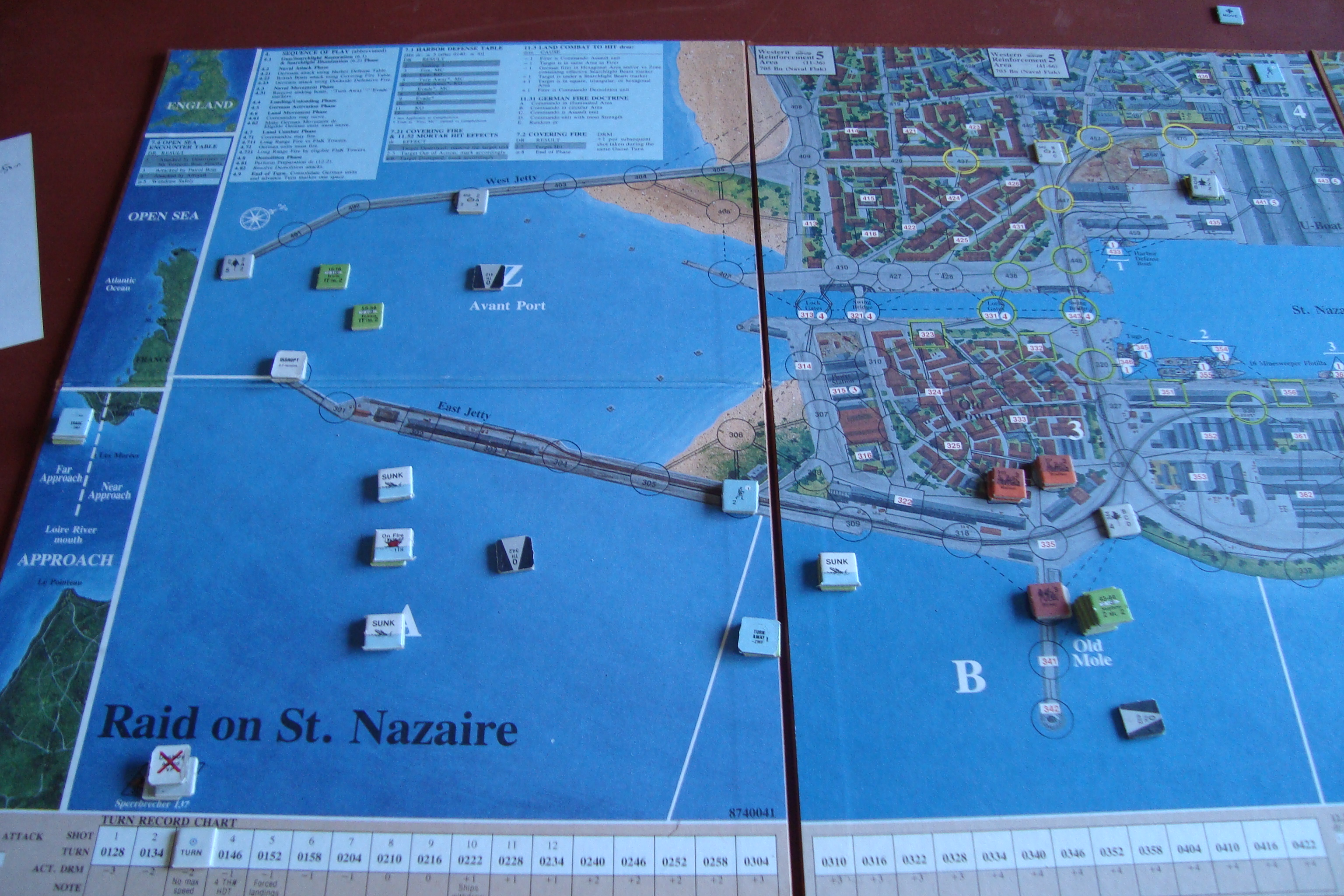
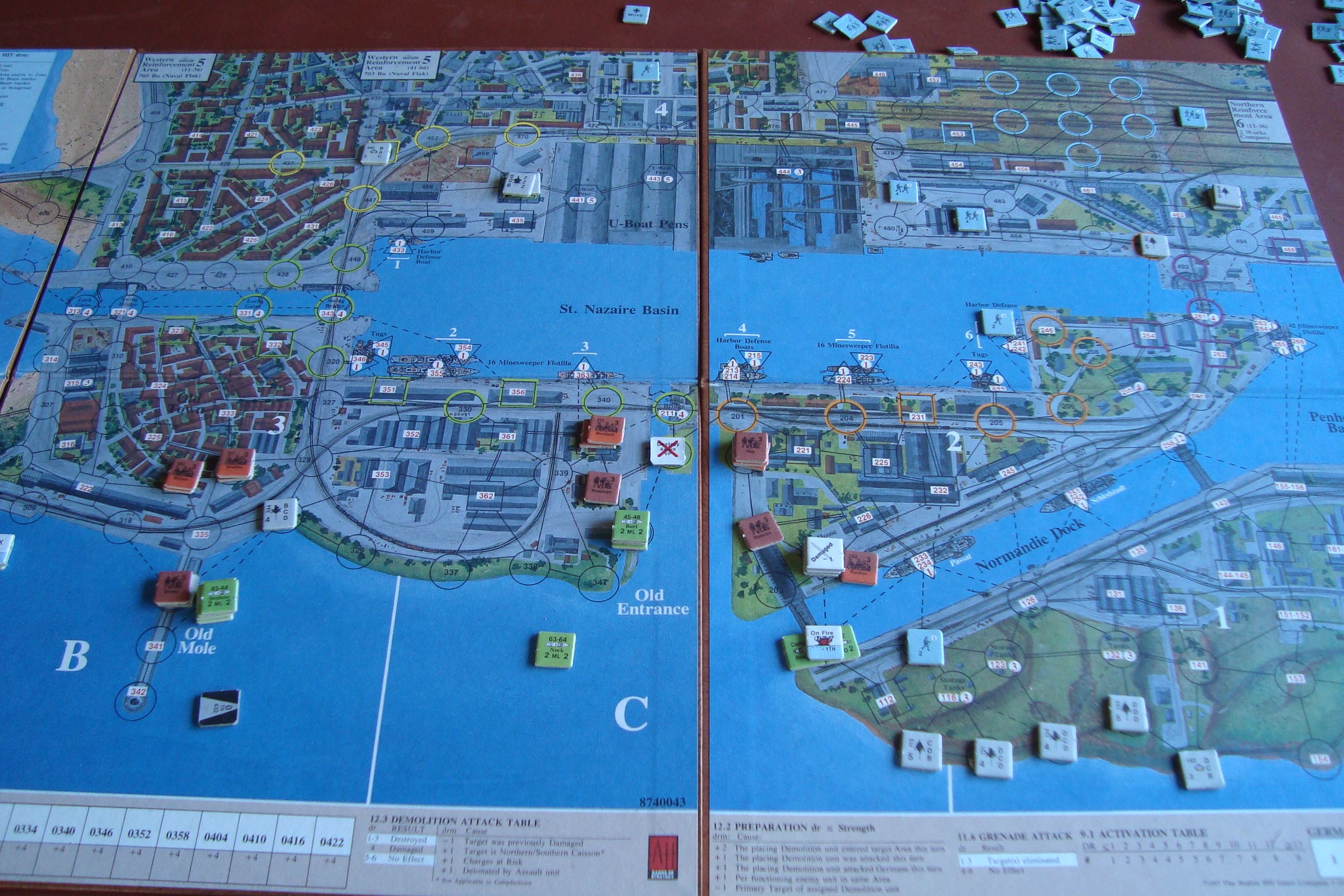
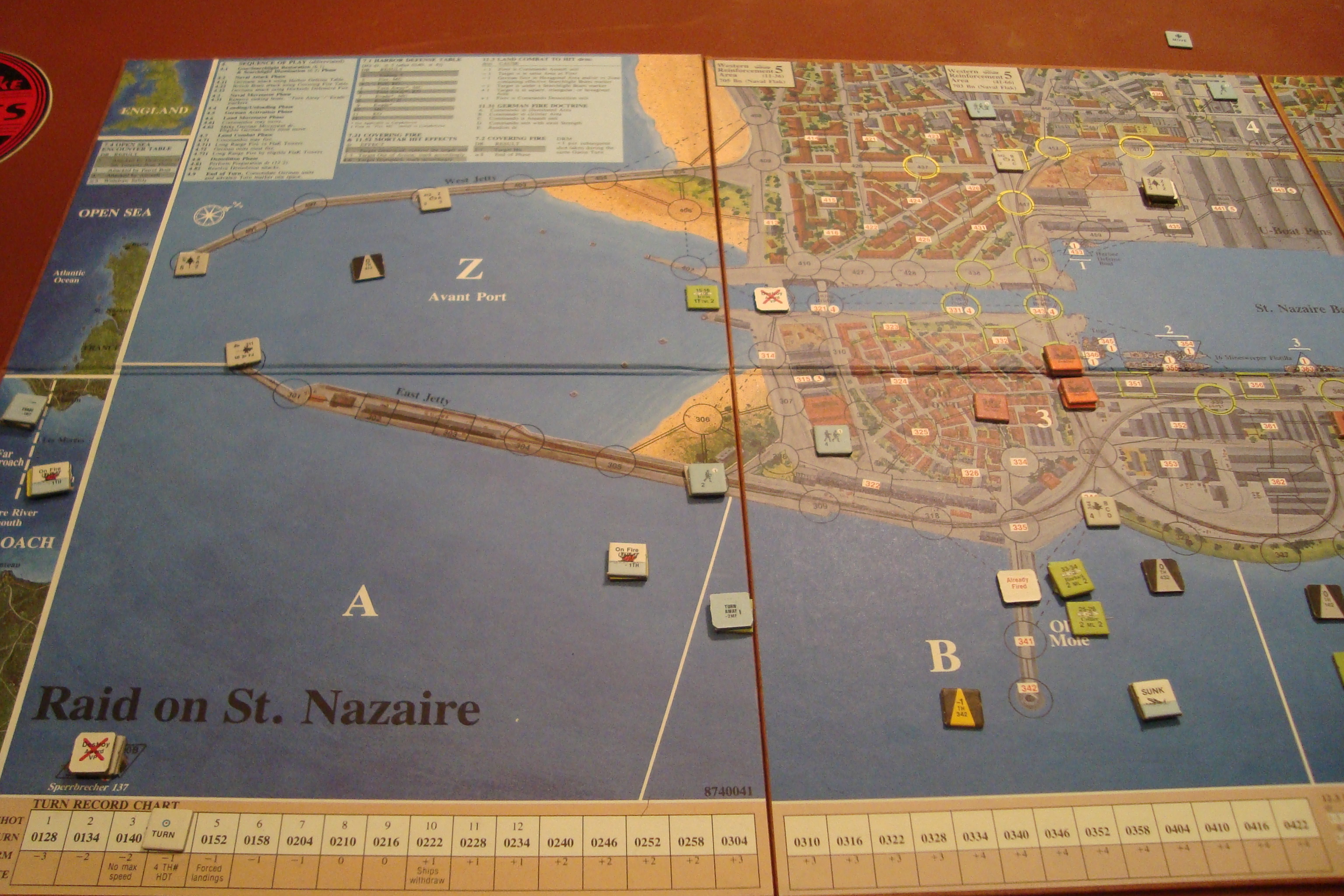
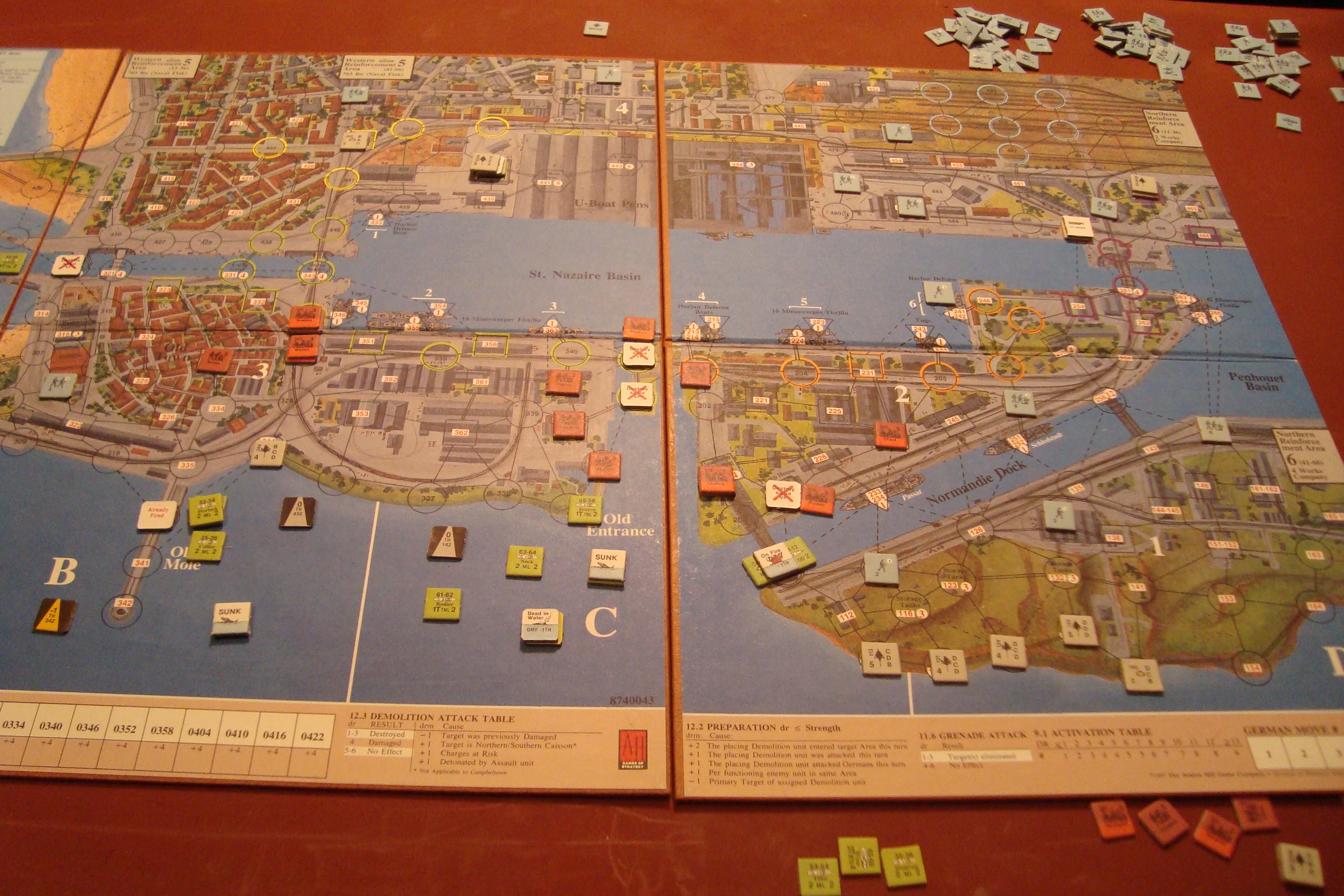
Started landing during Turn 3.  Sent two MTBs into the Avant Port (Zone Z) to attack gates.  Plenty of carnage from Harbor Defensive Fires.

Turn 4 West Half of AO
End Turn 4
West Half of AO
Turn 4 East Half of AO
End Turn 4
East Half of AO

Carnage in Zone B and C, but most Commandos ashore with attacks developing with some successes. Effects of German reaction are minimal.

End Turn 5 West Half of AO
End Turn 5
West Half of AO
End of Turn 5 East Half of AO
End of Turn 5
East Half of AO

Started evacuating troops back to England, moving back to Zone A.   Commando attacks spreading out, more targets destroyed, but German reaction is becoming a problem, with more troops flowing towards the assault and demolition teams and, especially, those moving towards the South Caisson.  I have a few boats lurking at the embarkation points anticipating debarkation there.


Raid on St. Nazaire

Finally started playing this one.  Read about it over at Boardgamegeek.   I also downloaded the indispensable  Avalon Hill General V0l 24, Issue 4, for explanations and a very helpful replay.

Just getting started is one of the toughest aspects of wargaming.  Sometimes, reading the rules (or just skimming them) seems to be an end in-and-of itself.  What a trap!  No, you have to play the damn thing, and the first two turns will be laborious with the rules in one hand, and charts in the other,  but, if it is a good game, you’ll start looking forward to playing it.  If it’s not good…..either another try sometime in the future, or recycle it.

Had one very abortive half-turn, and then finally figured a few things out.  Again, the replay really helped.

Took relatively few casualties on Turn 1 (and this game goes for undetermined period of time – until the last British unit is eliminated and/or withdrawn).  This is part to two luck hits on German defenses.  The Campbeltown is burning (inevitable), a few boats had turn-away results, but only the Falconar is on fire.  The Boyd badly hurt the German defenses by  managing to sink the flak ship Sperrbrecher, with its two cannon batteries.  I’ve got four boats, and the Campbeltown moving towards their landing areas.

Not a bad start.  Will start Turn 2 after today’s ballgames.