What Was I Thinking?

Fortify Montreal……Fortify Montreal.  The object of the game is to prevent Montreal from being captured…………

If you ever play this game, please, please, please fortify Montreal.  Here’s why…….

The British have the strategic advantage, with the ability to advance on five fronts simultaneously . However, the French have the operational advantage in that they can attack both during their phase and the British Advance phase . Tactically, it’s a push. Both sides have special tactical cards which influence not only tactical advantage but also the total number of battalions used in the battle.

Tactical advantage is critical . The side with this advantage toss their “bucket of dice” (one die per battalion in the fight) first with any enemy casualties (battalions) removed immediately . In many cases the side without tactical advantage is simply wiped out before being able to inflict casualties of their own. While this system has its shortcomings, it is appropriate in a game of this scope and size .

During my first real play thru the British were hampered by a lack of leaders, advancing on two fronts and making it easy for the French to use their action points not only to stop any advances, but also construct Forts and Trading Posts .

Trading Posts provide the French with valuable replacements each turn. While Forts prevent the use of light troops for tactical advantage and offer an advantage themselves.
Once there were British leaders for each of their five axes of advance towards Montréal, the French were hard-pressed.

Just as the British were ready to enter Montréal , and end the game, I drew the Montcalm Leader Card.

Montcalm has extraordinary capabilities , and almost turned the tide for the French. But the simultaneous advance of the British armies , combined with some less than favorable die rolls, resulted in the eventual removal of Montcalm and two other French leaders. This re-opened the door to Montréal. And, of course I made it just that much easier by not placing a fort there.

Game Play was relatively smooth . It took a while to figure out which cards to trash and which to discard, rather than place back in the recycle deck . It also took two turns to figure out that the recycle deck is shuffled into the active deck at the end of each turn , or in what is called the Housekeeping Phase.

This is fine addition to the States of Siege series . While the playing time is extended compared to other offering, this trade off is well worth it in terms of depth of play .

Getting It

Worked my way through several turns of Empires In America.  Getting the hang of it.

Once again, the only way to learn the rules is to play the rules.  Only way to see the method in the early-play-madness.

The French player is stretched thin, especially if the British can conjure up leaders for each theater and apply constant pressure from each of the tracks leading to Montreal.

Going to re-set and have another go.  This time I’ll get the play of fortresses and auxiliary troops right.

Back At It

Down south coaching baseball for the past month.  No chance to wargame.

Starting off new round of games with Empires in America by Victory Point Games.  Solo game for the American Revolution.

It’s very highly rated and considered more involved than the typical States of Siege game.  Have it set up and am grinding through the rules.

Rules……once again they’re a problem.  That old learning style condition, again.  Still, I find placing the  optional rules as sidebars and only limited examples of play to be problematic.

My other early complaint is that I had hoped to get another of those fun “jigsaw” maps.  No, a two piece card stock map.  Pretty, but hard to keep aligned.

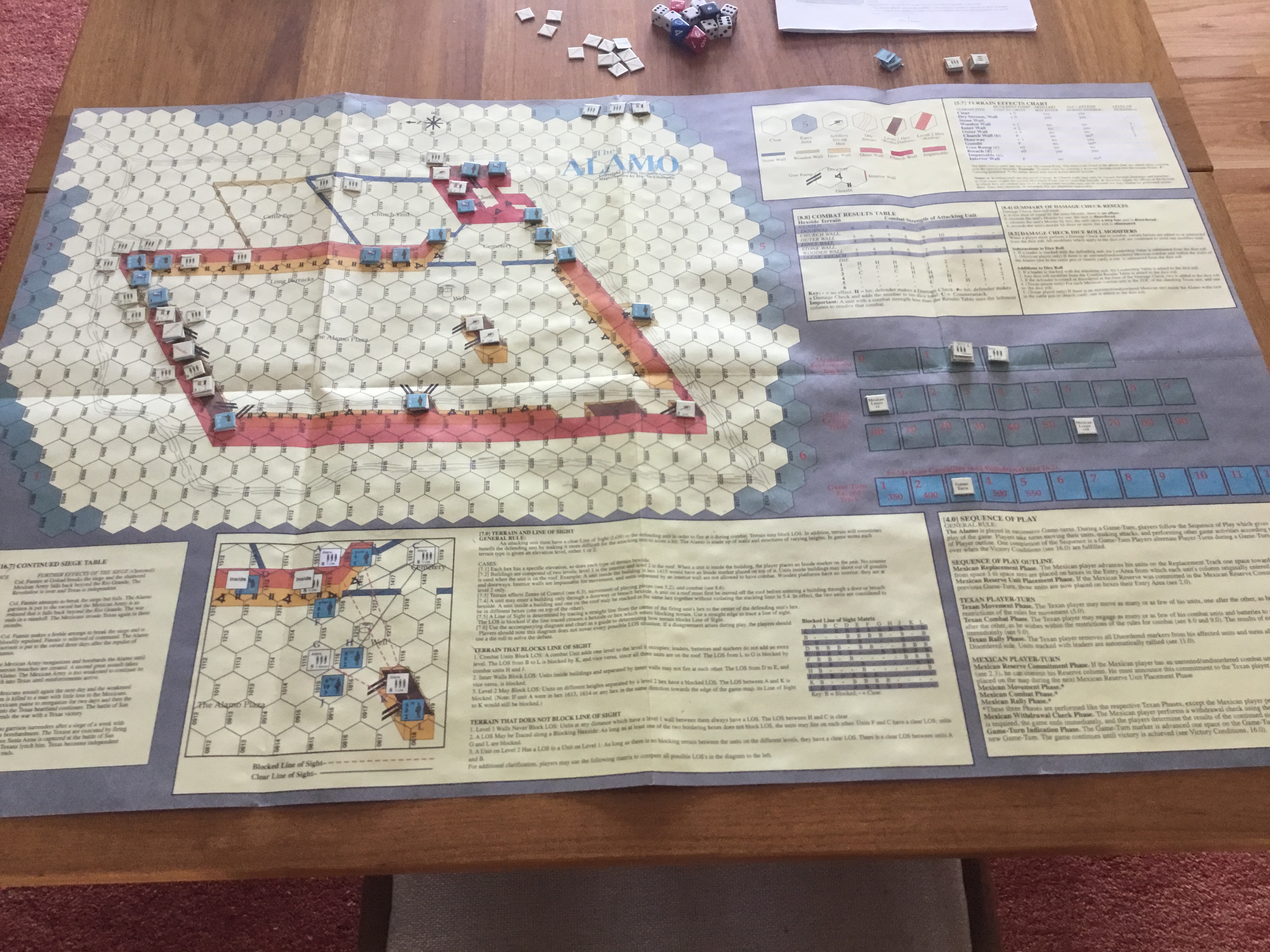
Small complaints.  Nice components.  Here’s a picture of the set-up.


Finnished

My first try at Finnish Civil War ended a Red marginal victory. Nothing went right for the Whites. Random events were usually bad, and they never made the necessary progress on the Peace Negotiations track. This progress leads to a withdrawl of Soviet forces and German intervention. The Finns needed both because the Red Guard units just keep coming and coming in the reinforcement phase and the Soviets have mobility, and the ability to coordinate multi-hex attacks.

Planned on writing a summary of the last three Brian Train designs played, but FCW is just too different to lump in with Freikorps and Konarmiya. So that will wait.

One reason is scale. Nothing but ants. And, that’s OK. But, restrictive terrain, and the requirement for all units to perform the same action in each segment, leads to an entirely different operational mindset. Oh, and did I mention the need to make bloody low-odds attacks? If you wait for a juicy 3:1 or 4:1, you will just have to wait and wait. And if you don’t get that progress on the Peace Negotiations track?

Higher odds attacks take time to develop. Both Red and White Guard units cannot move through woods until after the Spring Thaw. They are restricted to clear hexes and rail lines. Any envelopments, which also require an adjacent headquarters , can only be conducted with Finnish National Army (FNA) or Soviet units. At best, these envelopments are local because axes of advance are channelized by forests.

The great force multiplier is artillery (or armored trains if using optional rules). Each artillery counter adds/subtracts one from the die roll (as appropriate). There is no restriction to the number of artillery units that can be brought into play as reinforcements. Each unit with an attack factor can have an accompaning artillery counter.

Good game. Plan on playing this again after TAD.

Update

Noted wargame designer Brian Train was kind enough to post up with a rules clarification.  He also provided an update on the new and improved versions of Konarmiya and Freikorps.  Here’s what he said.

“…updated and significantly revised and overhauled versions of both games are available, or available soon.
Konarmiya was revised as Red Horde 1920, and it’s available from Tiny Battle Publishing.  Freikorps has been revised as Strike for Berlin, and will be the magazine game in Yaah! magazine #11 (February or March 2018).  There are rules for linking the two (updated) games in Strike for Berlin.”

I plan on picking them both up later this Winter.


Finnish Civil War

Set up and have started playing another Brian Train post-WW1 game, Finnish Civil War.  Good game.

It’s a smaller scale game, focusing on companies and battalions. There is a separate set of rules for regiments/brigades, but the former best fits the conflict. While it follows the rules template used in Konarmiya and Freikorps, there is conflict-specific chrome.

The Events Phase not only has a die roll for random events, but also a determination for peace talk progress between the Soviets and Germans. The progress of these talks can trigger German intervention, or Russian withdrawl.

The Operations Phase uses chit pulls, rather than I-Go, U-Go based on highest morale initiative. Each side gets three operations segments. Units may either move overland, use rail movement, or conduct combat. Overland movement is very, very slow given weather and terrain.  Zones of control only effect rail movement.

As with the other games, Political Rules effect morale which, in turn, effects operations and combat.

The companies have low combat strengths. So far, developing high odds attacks has been difficult. The Finns can use replacement points to build battalions. This should be a real advantage, and one I am looking forward to seeing in action.

Victory is determined by which side controls the most cities and towns.

Here’s a picture depicting the start of Turn 3.

Time Won’t Let Me

Great song……where is the horn section?

My attempt to combine Konarmiya and Freikorps can now be considered a failure. But, not from a lack of trying, no matter how misguided my obstinance was. In Freikorps, the game begins on the August 1 weekly turn and assumes Warsaw has fallen, with only scattered remnants of the Polish national army still fighting

The problem was Warsaw. Never captured it. The Poles held out, and with only four turns to take Germany, it was just too much. I did advance the Konarmiya Cavalry to the German border, but it wasn’t going to be enough.

There were Spartacist uprisings, and the French forces were withdrawn by a skittish government. A German advance into Poland was forbidden as a condition of Entente involvement. Despite these favorable outcomes, the Soviets just didn’t have the time.

Too many Soviet units were still falling back from the North, and also trying to hold off desperate bypassed Poles trying to get to Warsaw, or just west of it.

Their one excuse is that the Polish units, though out of supply, retained their full defensive factors. There offensive strength was halved. As long as they didn’t attack, remained stacked and were able to skirt Soviet units, the Poles had a good chance of making their way west. With the bulk of the Soviet army surrounding Moscow, the outliers just didn’t have the strength for attacks greater than 2:1, and lacked the number of units to surround and prevent retreats.

Still, an interesting exercise and one that I will try again.

Freikorps Map is the “inset” bottom left. Used Warsaw as common point of entry, along with hexes to the North. Konarmiya units advancing to Posen. Warsaw holds out, and stragglers head West.

Warfighter vs. Ranger

Title reminds me of…….

Enjoying another session with Warfighter.

Started thinking about one of its modern tactical mission predecessors, Ranger.

What a difference, and not just the programmed text aspect of Ranger, but in the treatment of mission planning and execution.

Warfighter focuses on team selection. Sure, Ranger has that planning aspect also, but it goes into greater depth as the soldiers literally “acquire” skills during their pre-mission refresher training. In Warfighter, they come with their skills.

Ranger’s planning phase also involves route selection, and not simply blind movement to contact. Warfighter’s card allocation and flow allows little in the way of route planning. You can avoid a certain piece of terrain or place, but at the cost of time loss. That’s an acceptable abstraction, but Ranger focuses more on avoiding contact. After all its subtitle is “Modern Patrolling Operations.”

Warfighter is all about combat. As one reviewer over at Boardgame Geek put it, and I quote rather loosely, it’s “the analog version of Call To Duty”. Ranger’s combat is not as involved or relentless.

The tension in Ranger is “what might I run into next”. The tension in Warfighter is “how many of these bastards am I going to have to shoot next”.

Apples and Oranges. But, wouldn’t it be nice to combine the two?

Grinding Again

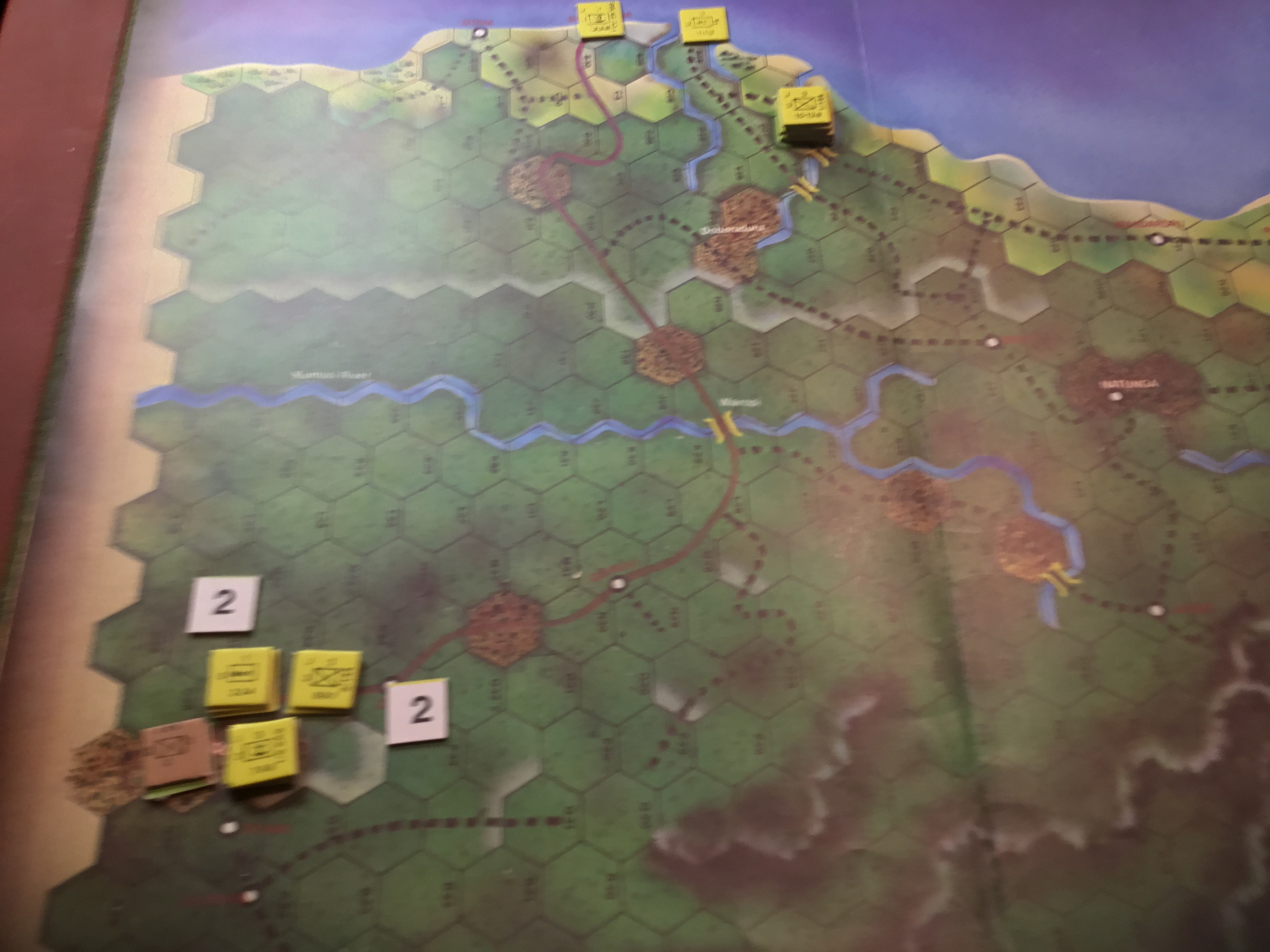
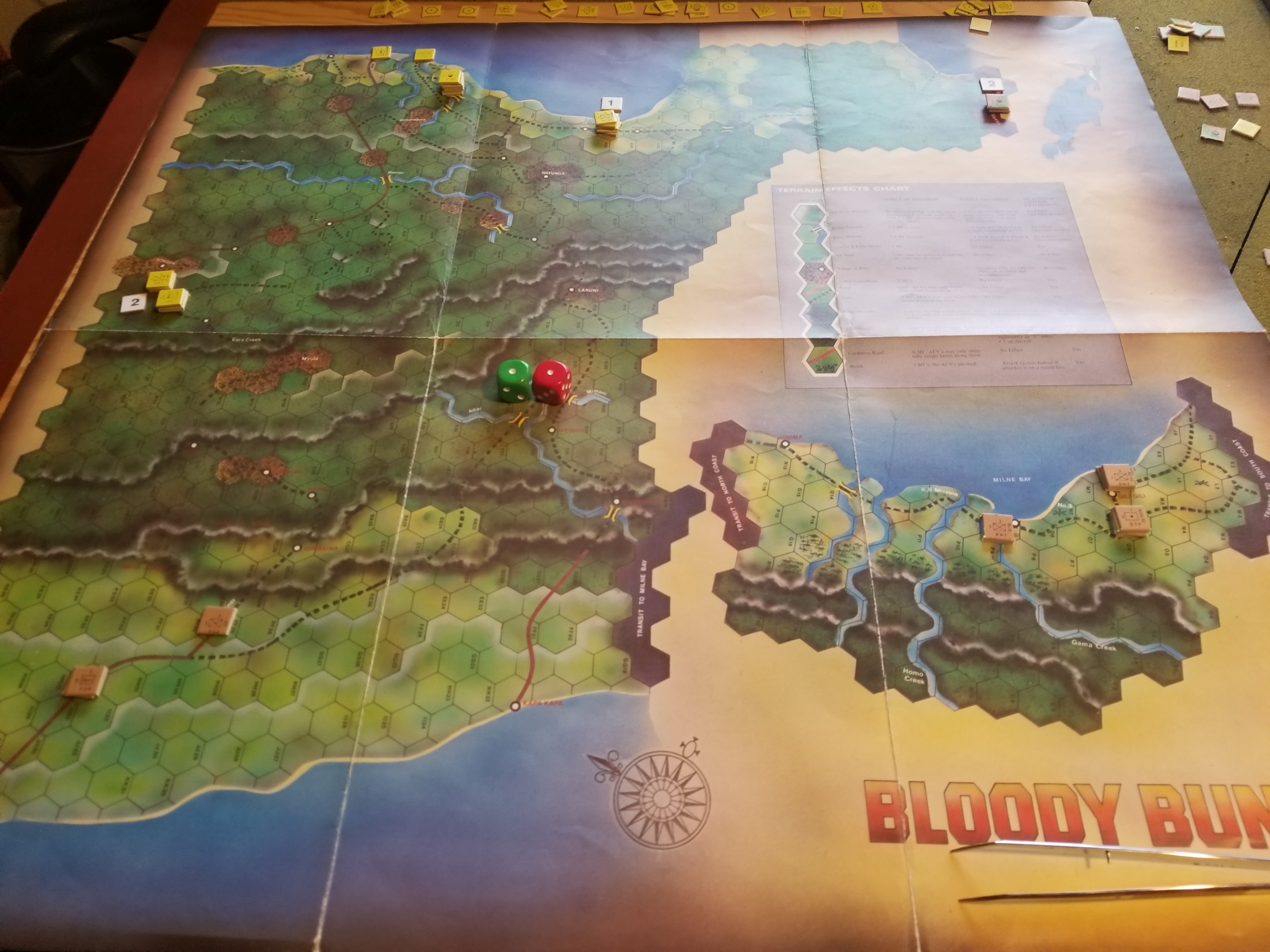
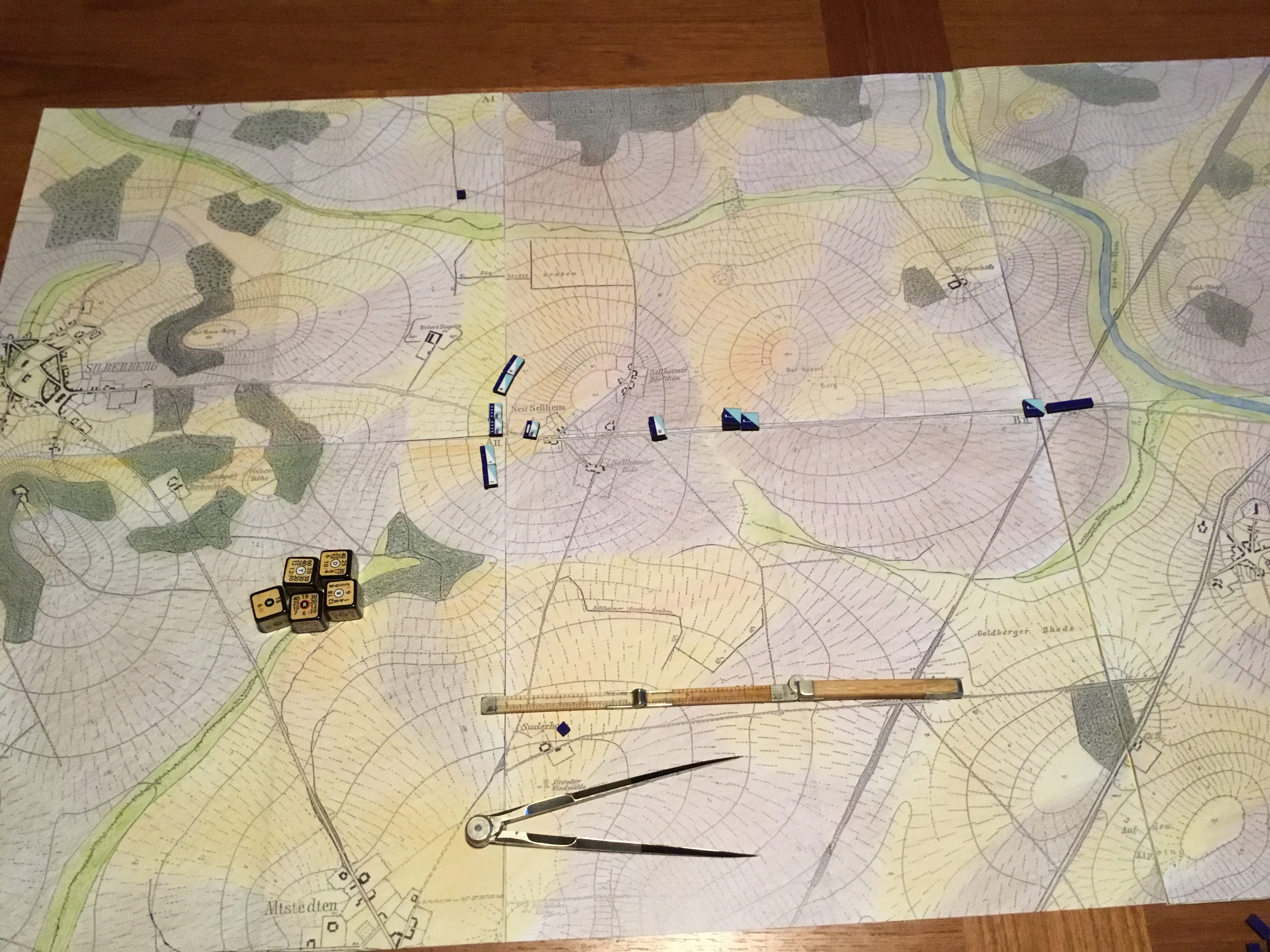
Have also set up Bloody Buna. This treatment of the New Guinea Campaign appeared in The Wargamer Magazine way back in 1979. The game has a primary map covering the main area of operations, and then a secondary map covering the Milne Bay area. Units can move between the two utilizing Transit Boxes.

The rules address the salient characteristics of the campaign: horrendous terrain and weather. Supply and movement are defined by both.

Each time a unit attempts to move more than one-half of its allowance, it must take an Attrition Check. On a die roll of 1-4, everthing is fine. However, roll a D5, the unit loses a strength (or “hit” according to the rules), but can proceed. Roll a D6, lose a “hit” and no more movement. In addition, during rain turns, units add a +1 modifier. Only jungle qualified units receive a -1 modifier when attempting an Attrition Check.

Supply is also limited by terrain and weather. Supply line length varies by type of supply unit, and whether at full or half strength. Supply units can provide support for a limited number of turns. Units operate at full strength for three turns, supporting a maximum of 5 combat units per turn, and then at half strength for another three turns, with, again, a maximum of 5 combat units supported.

Artillery can attack alone using indirect fire, that strength varying by range but limited by line-of-sight.

There are also rules for air support, airlift and amphibious landings. Haven’t dug into those yet.

There are three scenarios, as well as a full campaign game. I’m trying the smallest, which focuses solely on the Japanese advance on Milne Bay.

More Russo-Polish

Finished up Konarmiya.  Was playing for an intended outcome, because I want to play Freikorps, Konarmiya’s sequel.  Decided to focus on attacking from south, with forces in the northern portion of the map tying down Polish units around Minsk.  Result was a marginal Soviet victory.

Freikorps assumes Warsaw has fallen, and the Soviets invade Germany.  Well, Warsaw didn’t fall, but it is under siege, and that’s a good enough place to start.

The rationale for continuing play is a situation so dire the victorious Entente Powers will ask for German help in stopping the Godless Red Hordes,  and the Soviets have enough troops and material to mount an invasion while besieging Warsaw.  Why Not?

Basic rules are the same for both games, with slightly different chrome.

I have to pay more attention to the reinforcement rules.  I allowed Polish National Army brigades to arrive next to a headquarters.  Wrong, only Polish Legion units can do that.  The former must arrive in cities/towns.  This helped the Poles recover from continuous Soviet attacks.

Also messed up the retreat rules.  Had periodic lapses where retreating units were not disrupted.  Disruption is nasty (cannot attack or move and defend at 1/2 strength), and hard to  shrug off (die roll of 6 with minimal mods).  Again, this oversight benefited the Poles.

Here’s two afterthought photos.

Soviet Offensive Develops Turn 6
Warsaw Besieged. Polish Units In North Pull Back. Northern Soviets Stare Slack-Jawed.