Post Card Games: Marschall Vorwarts!

I’m putting away the house for Winter. After three days of 90 degree heat with high humidity, it’s rainy and 65. So, why not play a fun game that doesn’t take up too many brain cells between mundane household tasks?

I’ve always liked ATO’s post card games. Paul Rohrbaugh has creatively adapted a basic card draw/dice system to a number of historical scenarios. A list of the games he’s been involved with can be found here. In most cases, his system is ideal for solitaire play.

These games have been offered as inserts to Against The Odds magazine games, or have just somehow appeared in my gaming collection. I have copies made on card, so I keep the original post card intact, hacking my way through the copied components using spasmodic scissors.

Today’s game was Marschall Vorwarts!, one of four games depicting the Battle of Leipzig.

The French player has a classic delay/defend mission. The Allied (Prussian/Russian) commander must press home attacks to seize a key French depot, while ignoring losses and counting on (literally) the luck of the draw.  So Blucher!

It’s a fun little game, and while you can gripe about combat resolutions that favor low odds attacks, it has an ebb and flow that is certainly entertaining.

Mission: Grenada (Pt 4)

Final Thoughts on Mission Grenada.

Intriguing Operational Scenario. The US play has to be perfect to win.

Action Points are an effective way of creating operational constraints, especially given the movement penalties for terrain and contour lines.

An accessible simulation of joint operations and the use of combined arms.

Low counter density helps make it a quick game.

“End Game” tough for US. Cannot get sloppy and lose a unit. However, this end game is anti-climatic after the assault and rescue operations. It could be a scenario in itself.

Really, really, really needs a new map. Would be a fun project.

Simple air rules may seem wrong at first, especially the lack of defensive air support, but they work within the overall design of the game, and that’s the important thing.

I’m glad I bought this game. At $5 plus shipping, it’s a lot of game and fun for the money.

Mission: Grenada (Pt 3)

Friend gone, weather bad, so why not another try? Set up same as before, except this time the C/G mechanized unit is adjacent to the airfield.

After Action Report

Turn 1 (Night)

SEALs land and spirit away the Governor-General. I can’t see how the C/G forces can prevent this given initial set-up restrictions.

Rangers conduct a night drop to avoid C/G units moving onto or adjacent to the airfield and really making things difficult during daylight. The Ranger drop is good, only the mortar platoon scatters. It lands on top of another unit and is disorganized. The drop is opposed by AAA fire (which increases drop DRM to -2). Because of this, the AAA units are revealed and attacked by air, but with no success.

C/G forces counterattack the Ranger company stacked with the disorganized mortar unit. The assaulting mechanized and motorized units can attack at full strength, with the infantry launching a hasty assault at half strength. The C/G mortar unit supports this 2:1 attack. The US player is lucky, with a D1 result rather than R, which would have left the C/G player in control of the field.

Turn 2 (Daylight)

The SEAL unit lands to rescue the students at Prickly Bay. No luck, it’s a dummy counter.

The Rangers counterattack one of the C/G units. C/G AAA is extremely effective. Odds are reduced to 6:1 with two shifts left for vegetation. The result is a D2. The C/G unit is disorganized and must retreat one hex. The Ranger company reorganizes, the mortar platoon does not.

C/G units retreat from the Ranger ZOCs and will now have to be spotted. Militia units move to occupy the two northern hexes containing students (or dummy students).

Turn 3 (Daylight)

The Rangers attack the disorganized C/G unit. AAA fire attrits supporting air (More 6s!!). However, the AAA units are now revealed and a follow up strike destroys one AAA unit. The Ranger attack works out as a 4-1, with one shift left. The die roll is a 5, for a D result, which eliminates the C/G unit. Meanwhile, the SEALs have located an unguarded student group at Anse Bay. They are airlifted to Salines Airfield. The Ranger mortar unit now reorganizes.

C/G units launch a furious counterattack with all available units. The target is one Ranger unit. The odds are 2:1 with two shifts left for vegetation. The die roll of 2 has no effect on the Rangers. The surviving AAA unit retreats northwest.

Turn 4 (Daylight)

The students are airlifted from Salines. The tireless SEALS land at St. Georges, moving to the north of the two C/G units babysitting the students. The Rangers move to attack C/G units north of the airfield. Since the Rangers are moving to contact, the C/G units are considered to be spotted. AAA fire attrits three out of the eight attacking aircraft units. The 3:2 odds are shifted two left due to vegetation. The attack results in a Contact, which halves the C/G units’ action points. Elements of the 82nd Airborne land at Salines Airfield and move towards the C/G units.

The C/G mechanized, motorized, AAA and mortar units withdraw up the coastal road to link up with units co-located with the students. One 2-4-4 unit is left to delay the US forces. However, the ever-dangerous AAA unit can now support the units guarding the students.

Turn 5 (Daylight)

The SEALs locate the last student group and attack. This is a hasty attack, but with overwhelming air support.  For once, AAA fire is ineffective. The C/G unit is eliminated, without the students being harmed. The students are evacuated to Salines Airfield. The C/G player should have moved into the jungle to take advantage of the terrain. The Rangers, reinforced by the 82nd Airborne, ZOC up the delaying unit north of the airfield, and attack at 4:1, with two shifts to the left due to vegetation. The result is a Contact.

The C/G commander leaves the delaying unit to its fate, and moves his mechanized, motorized, AAA and mortar units to Fort Audodat. The two surviving militia units move north towards St. Georges. With the airfield taken, Governor General and students evacuated, all that is left to the C/G commander is to buy time and lure US forces into an ill-advised attack. The loss of one US unit will make this a close game.

What might pass for analysis will follow…..

Mission: Grenada (Pt 2)

You have to play the game to learn the game.    So…..Oooops!

Can’t run airstrikes against Cuban/Grenadian forces on Turn 1 because they have to be spotted.  In order to spot CG units,  the US player has to be fired on, move towards with intent to attack, or have a CG unit move adjacent to it.  Don’t know if the “move towards” could be stretched to include aircraft attacks, but that doesn’t really make sense.

Will have the chance to try this one again later this week after company has left.  Will do it.

Mission: Grenada (Pt 1)

Finally set up and played two turns. Used the alternative Cuban/Grenadian OB discussed in Seth Owen’s excellent review of the game. The link over at Boardgame Geek is:

http://www.boardgamegeek.com/thread/302464/mission-grenada-reviewed-and-revised.

He also posted up background information on the invasion. That link is:

http://www.boardgamegeek.com/thread/318194/grenadas-scrappy-little-army

Rather than try to improve on Seth’s fine work, I’ll simply comment on a few rules aspects that were interesting to me and then provide a general after-action report of the game’s introductory scenario which involves the first six hours of the invasion.

I’ve always been interested in this action, especially after listening to a Marine Captain describe how, as a very young Lieutenant, he landed armed with his personal weapon,  a 1911 Colt with a bad slide so capable of only one shot at a time.  Fortunately, the only resistance his platoon encountered was a couple of wild pigs, quickly subdued,  and used to supplement their MREs.

Rules Comments

This is the first time I have played a game that uses action points. Each unit counter has a designated number of action points to use for movement, combat or combat support during an Action Phase. Mechanized units have more action points than leg infantry. But, their action point costs are higher. One thing I missed in my early readings of the rules was that artillery/mortar units are considered mechanized, because of the number of action points printed on the counter. These points can be expended at any time during the owning player’s Action Phase. There are no set movement/combat sub-phases.   This gives each commander tactical flexibility, as units can typically perform two or more actions in a phase.

Another interesting aspect is the ability of units to make hasty or full attacks. The cost of a hasty attack is one-half that of a full attack. In many instances, this is the only way a unit can move and attack in the same Action Phase.

One aspect that is somewhat unusual is that supporting arms can only be used in the offense. A unit is on its own when attacked.

The map graphics could be much better. However, I do appreciate having many of the essential charts on the map. Unfortunately, the action point costs are only found in the rules.

If I was going to play the game again, at another time, I’d probably compare map and rules booklet for charts, and put together a “cut and paste” chart sheet to augment the map. This is nothing more than making copies of the appropriate charts, cutting them out, and using scotch tape to paste them on a blank sheet of paper, and copying that sheet. Crude, but it works.

After-Action Report

Turn 1 (Night)

US air assets attacked a mixed bag of units located on the high ground overlooking Salines Airfield as well as a motorized unit in close proximity to the Governor General. These night strikes were unsuccessful. Grenadian antiaircraft fire was ineffective.

The SEAL unit landed north of St Georges, and was able to locate and move the Governor General to a beach hex for extraction the following turn. However, before that could happen, the SEALs had to withstand a hasty attack by a motorized unit located in St. Georges. The result was a defender retreat, but the Grenadians lacked the action points to continue the assault.

Cuban/Grenadian units occupying the high ground north of the airfield edged south anticipating a US airdrop.

Turn 2 (Daylight)

The Rangers parachuted into Salines airfield later that morning. A daylight drop reduces the chance of scattering into the Caribbean. The drop was successful, and three Ranger companies, supported by a mortar platoon, took control of the airfield.

The drop was preceded by another series of airstrikes. However, this time antiaircraft fire was extremely effective, with five (!) of the US assets having their combat power halved. As a result, Grenadian units remained at full strength and ready to attack the invaders.

One Ranger company was attacked by Cuban/Grenadian units supported with mortars. At odds of 2-1, the attackers rolled high and forced the Ranger unit to retreat three hexes. The retreating Rangers were able to take advantage of their misfortune, and displaced back to a hex containing a group of students. The students are represented by four counters placed face down at designated hexes on the map. Two of the counters are dummies.

The US forces were well on their way to a decisive victory. At the end of two turns they had taken the airfield, and rescued the Governor General along with one group of students.

This was a lot of fun. I’ll reset the game, and play through several turns over the next couple of days.

East African Renaissance Campaign

Started working on my 15mm Turks last Friday.  Most of them are old Tabletop Miniatures.  These castings are deceiving.  At first glance, they are less than underwhelming, but they paint up really well.  Here’s a link   http://www.15mm.co.uk/collections/altuos-15mm-renaissance?page=3.

First started buying Tabletops when I lived in Iowa.  They had an outlet – with the molds – in an low density industrial complex just outside of Des Moines.  Used them for my Dark Ages Campaign.  There was a problem with relative scale, especially the European Renaissance figures.  Some seemed more like skinny 10mm than 15mm.  I still have some 12th century knights stashed in the shed.

I’m halfway through the 48  infantry figures.  I’ll finish up the mounted when I return home.  Just one step closer to the start of the East African Renaissance Campaign, now set for Thanksgiving.   More on that later.

I’ll try to set up Mission: Grenada, tomorrow.

War In The Aegean (Pt 2)

Played two turns over the weekend.  Unfortunately, the real action starts with the arrival of significant German reinforcements in Turn 3, and I’ve got to pick the game up because of my trip.

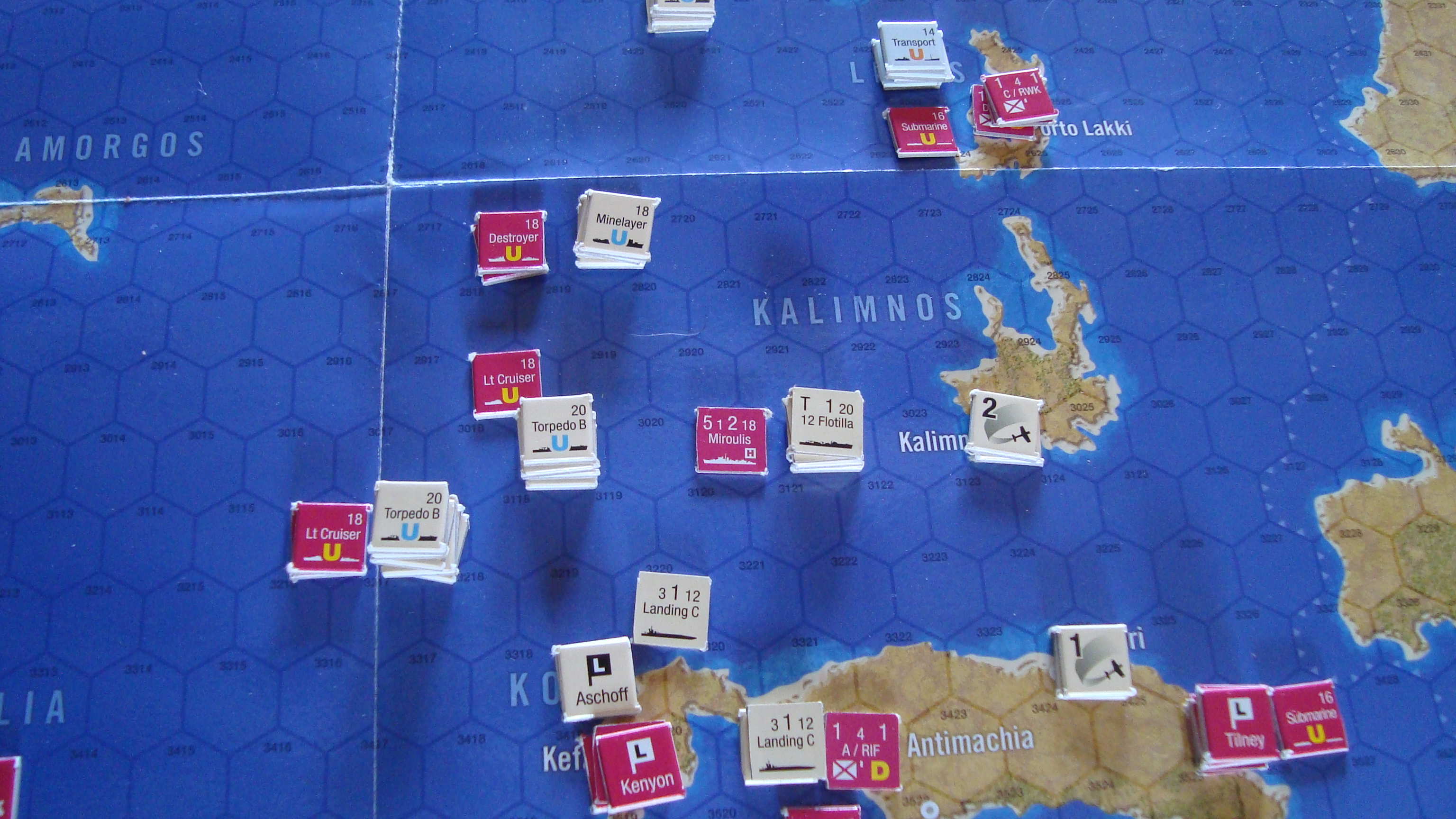
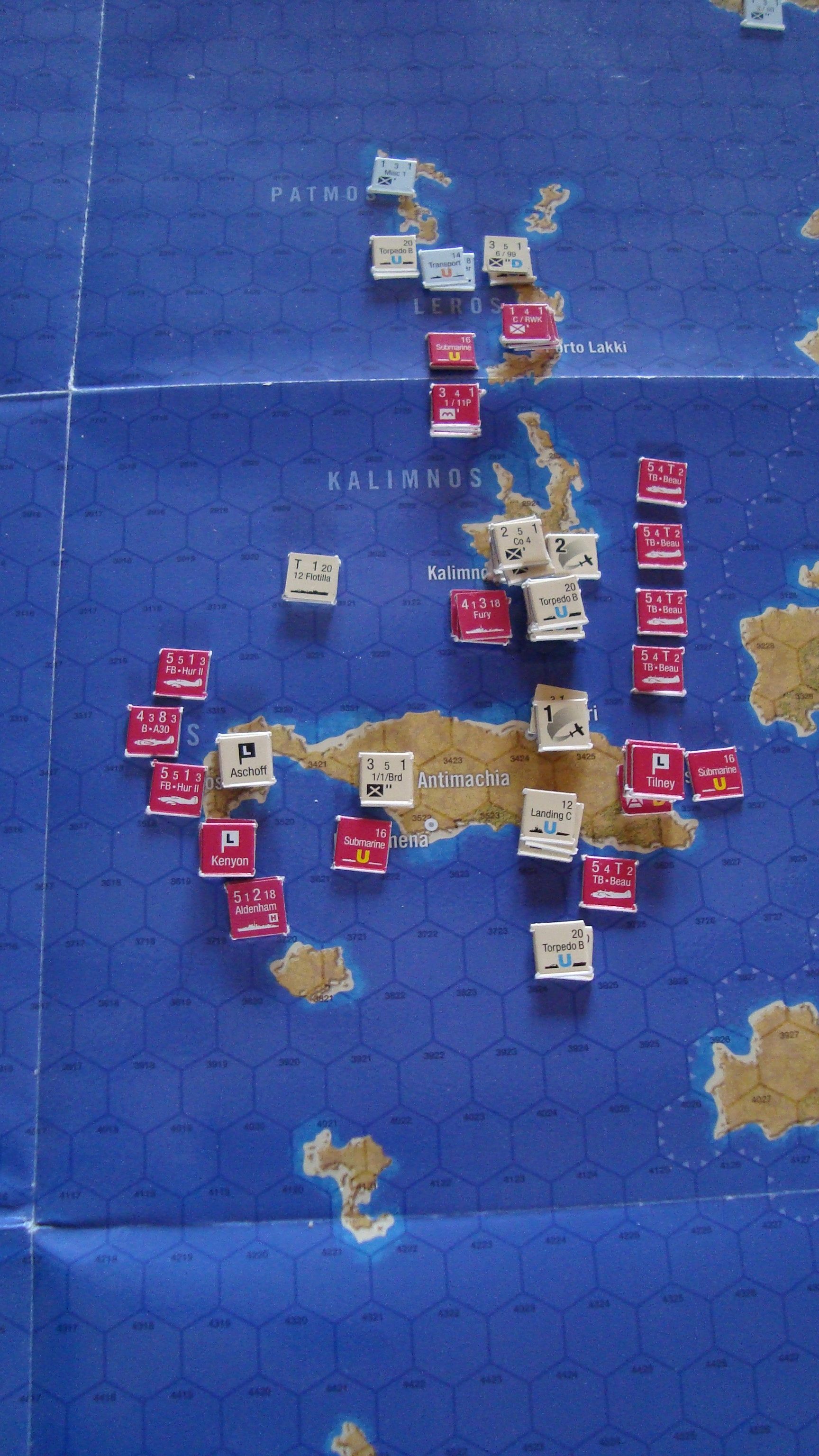
During the remaining impulses for Turn 1 and the four impulses of Turn 2, the Germans kept pounding British ground units, although their aircraft availability was horrible – I kept rolling 5s and 6s for flown aircraft.  The British infantry crept across Kos – only one hex movement per impulse, and their shipping huddled off-map to avoid the Luftwaffe.

Despite the slow pace so far, I like this game.  The impulse system, variable Luftwaffe availability and rolling for serviceable aircraft provide an uncertainty that is great for a solitaire game.  The RAF has some real challenges with their reduced combat strength when flying from off the map, and it will be interesting to see if the RN can intercept the German reinforcements.

I’m taking the game with me and hope to continue it over the next few weeks, if only to play out an invasion of Rhodes.  That should be interesting.


War In The Aegean (Pt 1.5)

Sidetracked by ESPN baseball, so only part way through the first impulse.

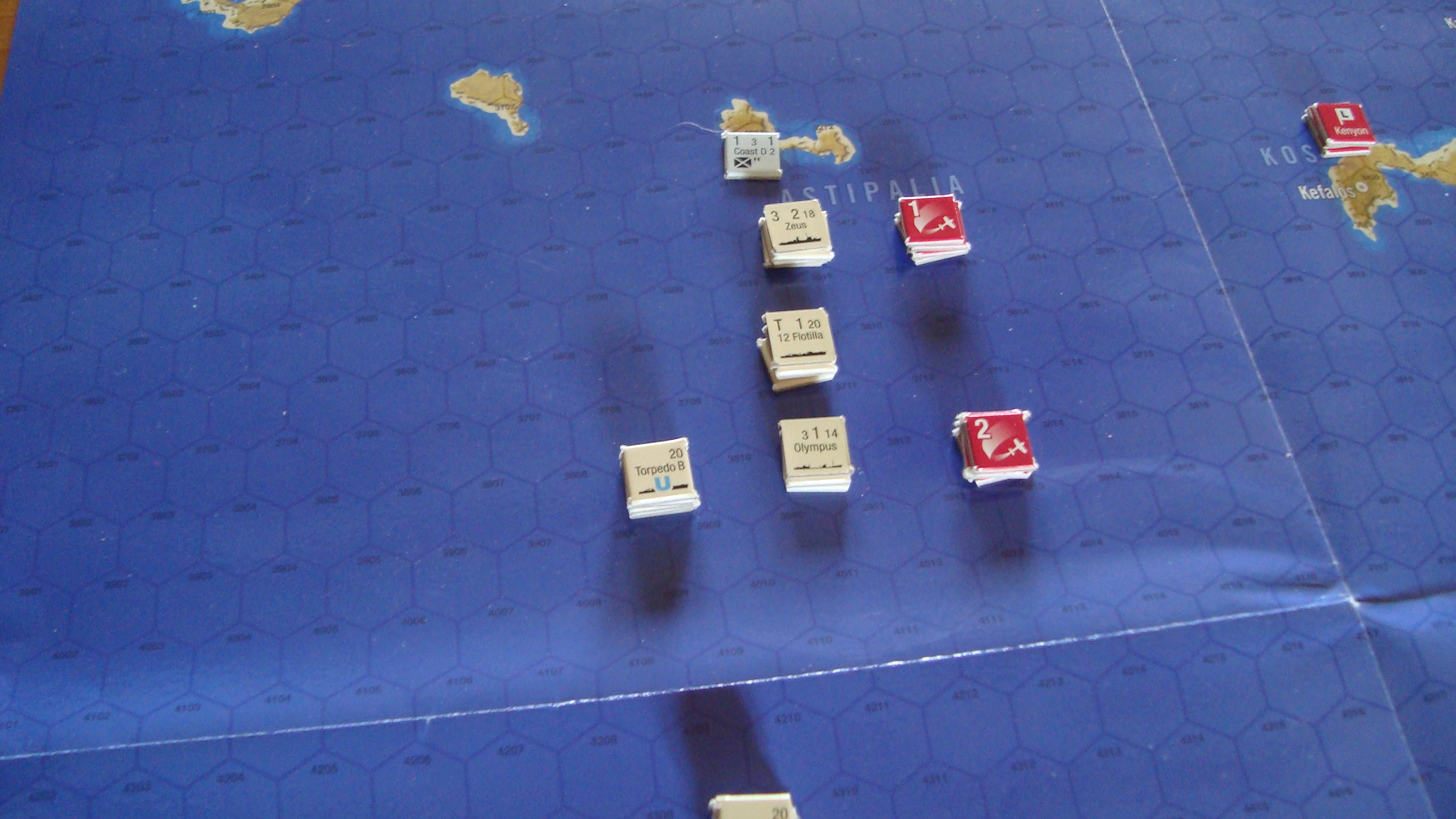
British had the high roll for initiative and established themselves on Leros and Kos, with no resistance by the Italians.  The RAF remained at their off-map bases.  British destroyers took station to the west of these islands in the hope of intercepting a German amphibious counterstroke.

The Luftwaffe opened the German part of the impulse by attacking the destroyer screen using all their JU-87 and JU-88 assets.  The results were only three hits spread among three destroyers.    And then Pittsburgh started their 10th inning rally…..

Another Army To Paint

Spent part of Sunday prepping 48 Ottomans for my East Africa Renaissance campaign game.  My plan is to paint them while I’m taking care of my Mother for the next few weeks.  I’ll still have some cavalry to paint when I return, as well as an Abyssinian force.

The campaign involves the Ottomans, Portuguese, Ethiopians (Abyssinians), Arab City States, Native Tribes, as well as Manchu Chinese.  The Manchus are  a quasi alternate history element, assuming that dynastic leadership encouraged, rather than forbid, further exploration.  I’ll rely on the Irregular Wars rules rather than DBR or DBA.  My initial one-off games using IW have gone fairly well.  But, more on that later….

War In The Aegean (Pt 1)

Finally set up this Against The Odds magazine game from December 2005(!).  The magazine includes an excellent article on the genesis of this historical campaign, as well as the actual fighting.  The mini-game Assault on Narvik is also included in this issue.  I mention this only because the rules for Narvik “wrap around” the Aegean rules. I often found myself referring to the Narvik rules, instead of those for War In The Aegean.  Disorienting.

This game features joint British and German operations (and technically combined operations since there is a limited US air presence) over a three month period in 1943.  The nature of the campaign requires rules for air, naval and ground forces, along with special rules to reflect the presence of Italian forces.  I’ve played Europa for a number of years, and Perry Moore’s rules are reminiscent of that operational system.  In fact, I’ve toyed with the idea of playing the game (and still might) using Europa rules.  In fact, a scenario was published for the Aegean.  I never played it because the scale just didn’t seem right, and Europa’s naval rules are, well, inadequate.

Moore uses a variable impulse system.  A die is rolled for the number of impulses in a turn.  The players then roll to see which side has the initiative and goes first during the impulse.  Air missions are flown, then naval operations and, finally, ground operations.   Naval forces enjoy hidden movement until spotted.  Stacking is unlimited, and units are always in supply.  Ground units have a movement allowance of one (1) hex per impulse.

The Allied forces are hindered by aircraft range limitations and overwhelming numbers of Ju-87 Stukas based in Rhodes that can fly anywhere on the map.  However, German off-map aerial are resources are limited, and are determined, by-turn, using a die roll.

Allied forces start the game with a number of task forces on the map, poised to land at Kos and Leros.  Additional task forces can be formed later in the game, or determined by a separate set of solitaire rules.  The invasion of Rhodes is possible beginning on Game Turn 5 and, again, is dictated by a die roll.  The Allied player can force an invasion, but at a significant cost in victory points.

The map’s dark blue sea makes reading hex numbers difficult.  The counters are just fine, but the cardboard “chads” have me thinking about buying a counter cutter.

Victory conditions for the Allied player are daunting.  The Allies must control literally every island on the map if the invasion of Rhodes does not occur, and Rhodes is strongly defended by German and “assimilated” Italian units.

I’m looking forward to starting the game later today!