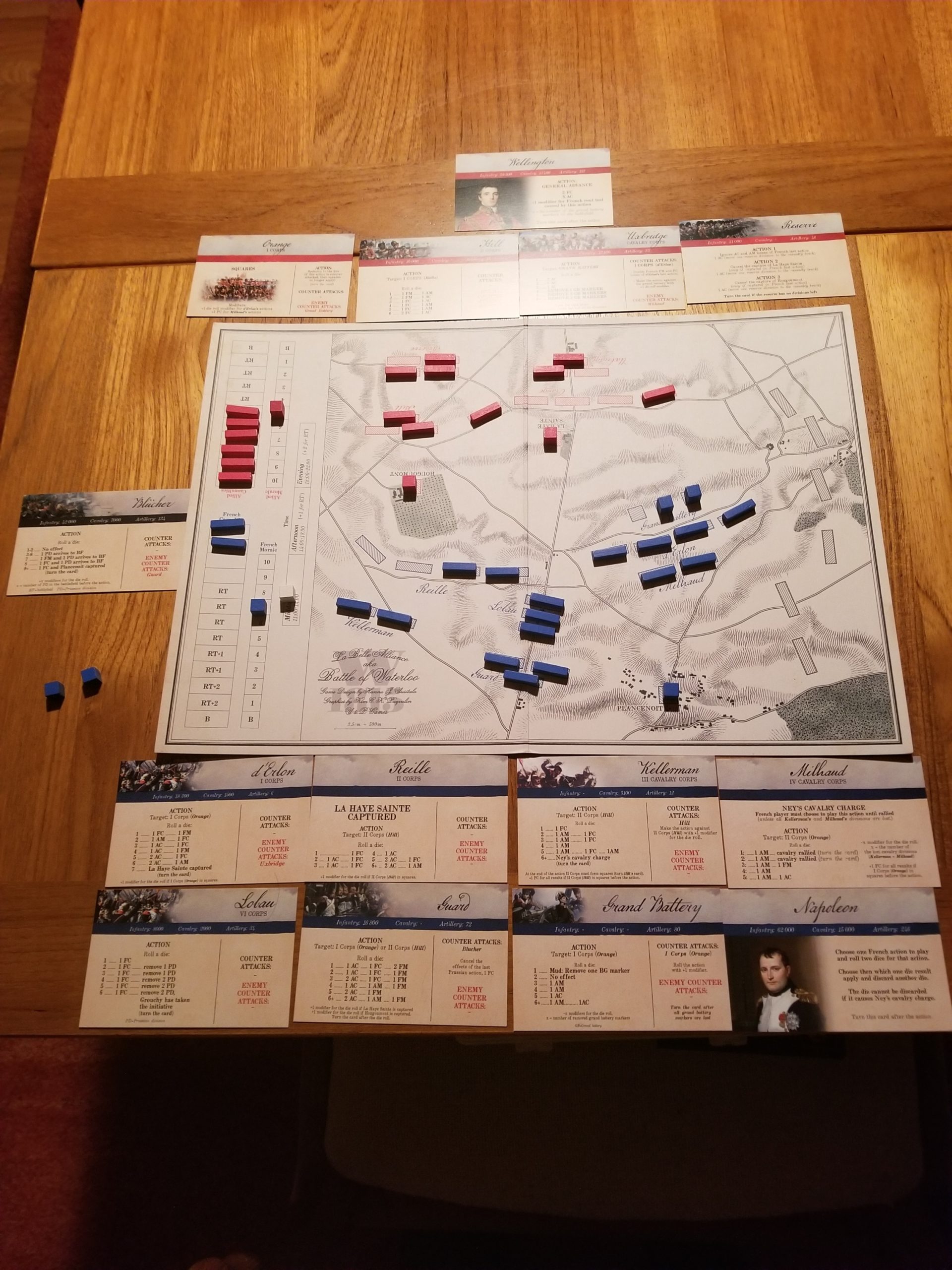
Woke up very early this morning. After a round of depressing internet reading, I decided to get W1815 (The W is for Waterloo) up and running. I was having problems comprehending the rules, so it seemed to be one of those cases where the only way to learn the game was to fumble and stumble through a session.
And fumble and stumble I did…….but I had some help.
W1815 has a real following over at Boardgamegeek. The comments and reviews are positive and I liked the Kriegsspiel/Table Battles blocks, quick-play and period topographic map. So, I pre-ordered the 2nd Printing. Forgot all about it, until I received an email in January that it was shipping.
The “help” was significant card errata. Cards drive the game, so these errors changed the game. Still, I had fun playing, unaware at first that there might be problems. But, the game played wasn’t the game as designed.
I hope to receive the replacement cards in the mail sometime soon. Until then, I’ll make do with these.
* Is it “impression” or “impressions”? Re-reading this I think it should be “impression”, because I really limit any opinion about the game to a product of deep thinking of the deepest type “fun”.
Since World War One is no longer trending, the contrarian in me says it’s safe to start playing this operational series.
I’ve purchased several of the titles, and have been waiting for some time to engage with, get comfortable with the rules, and play a bunch of them. What initially attracted me to the series was the number of East Front games (now consolidated into a single package) and its coverage of the Ottomans. I also picked up the Italian Front game (really cheap on E-Bay) for when I feel like just bogging down in attritional nihilism.
Each game comes with a copy of the basic rules, along with scenario(s) specific rules
At first glance, this appears to be a typical hex and counter operational series. Railroads enhance movement, headquarters effect supply, supply and supply lines effect combat, units have zones of control, fortresses and trenches aide the defender, and artillery units have special rules. Turns are monthly, with each month starting with a trench completion and initiation phase, and then four phases per side. Both players have reinforcement arrival, movement, combat, and replacement/recombination phases. Reinforcement schedules are shown along with the initial orders of battle.
But, there are two major and one minor differences from other operational games.
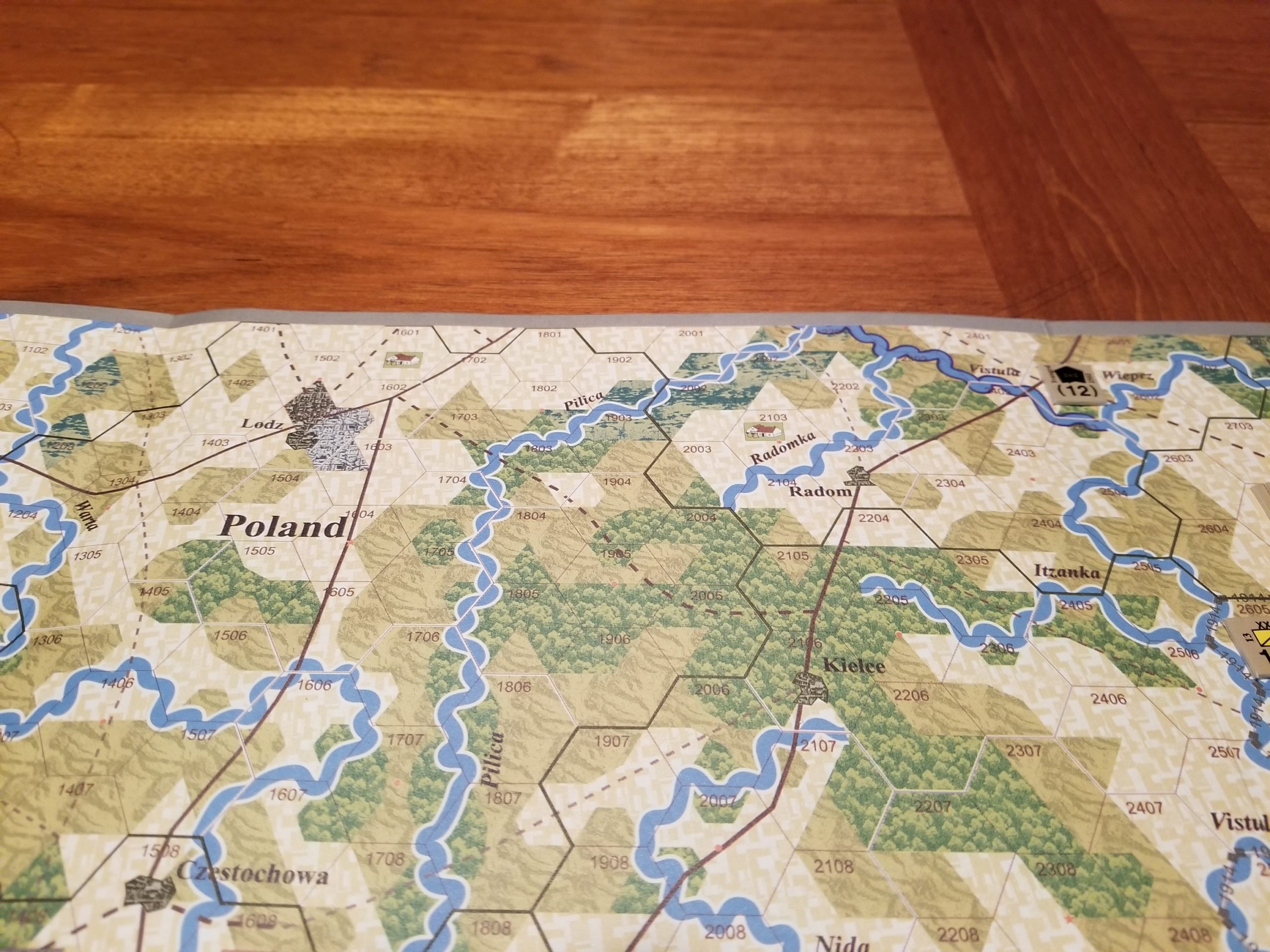
The first involves terrain. Each hex side can have multiple types of terrain. The defender is allowed to choose the terrain through which he is attacked. For example, if the attack hex side has both clear and rough terrain, the defender can choose the rough terrain, and enjoy the appropriate combat modifier. Terrain also effects movement, in that the player can “weave” his way through clear or lower cost hex sides. To me, this non-linear “weaving” is like following a valley that twists between hillsides.
Closeup Showing Multiple Terrain Types Per Hex Side
The second difference involves combat. The attacker uses a standard means of calculating attack strength; adding attack points and modifying for (defender chosen) terrain. A single die is rolled and cross referenced with the Combat Results Table (CRT) Before any losses are taken, the defender can choose to retreat one hex and reduce his losses by 1/3. If not, the defender counterattacks. The defender totals his strength points, multiplies them by three (artillery only doubled), and makes the appropriate adjust for terrain (that he initially picked). The effects are again cross referenced on the CRT. The triple strength counterattacks can really give the attacker a bloody nose.
The minor difference is how replacements are handled. Replacement points are received, but must be formed into “battalions of march” and either marched or railroaded to a headquarters for integration into a co-located unit. Recombination is simply combining two co-located below strength units into one.
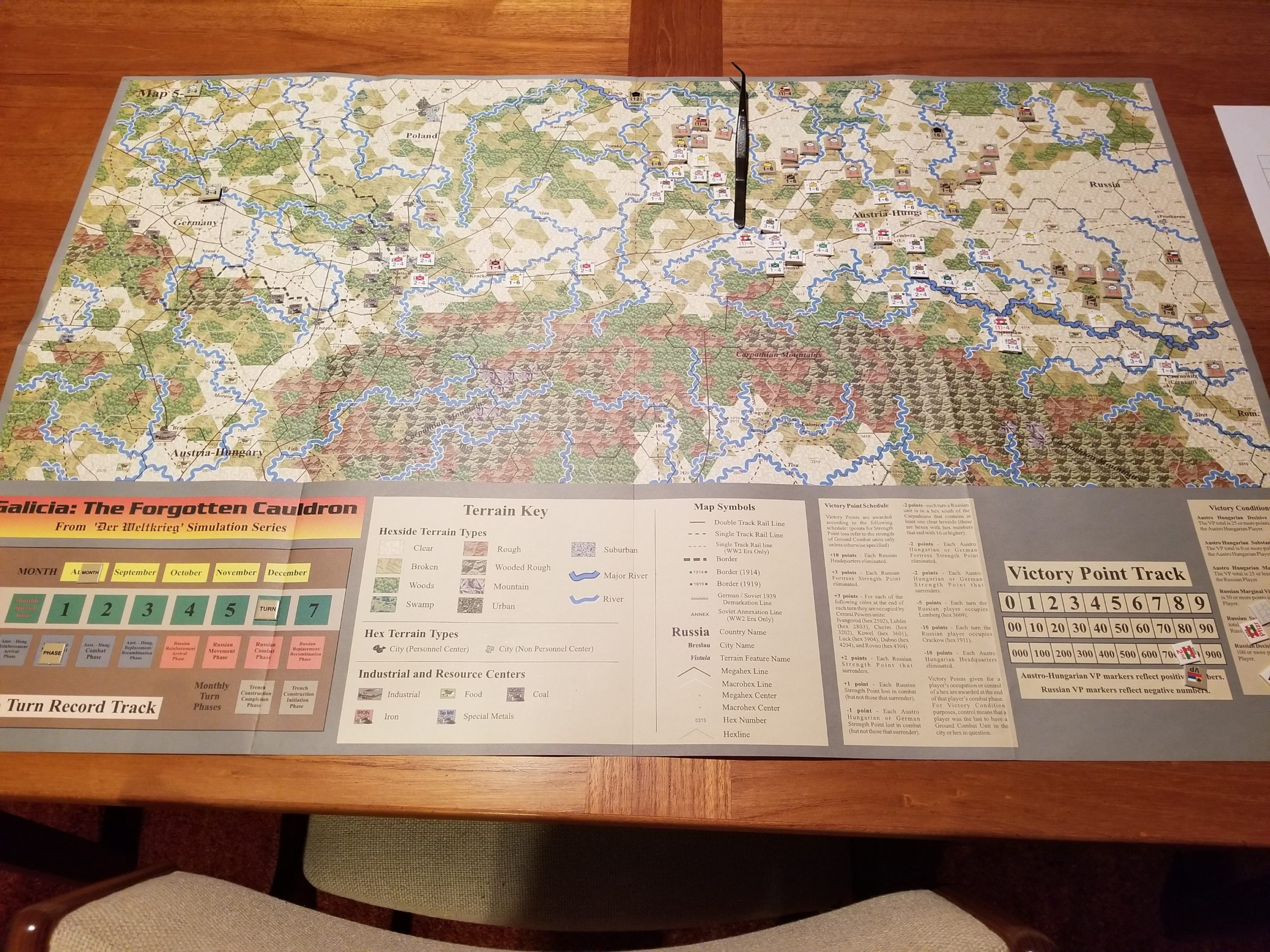
I’ve set up Galicia: The Forgotten Cauldron twice now. Both times on surfaces that had to be cleared to accommodate guests. This time it’s going up in “my” room and it will be completed. It is also to enjoyable and educational to follow the narrative of both Collision of Empires and Written In Blood on the maps. I was able to pick up both titles on Kindle for $1.99 each last Fall. The only problem is that some of the towns in the narrative are not represented in the game battle maps.
Initial Set Up. Pre-Mobilization August 1914.
I really like what Designer David Schroeder has done. He still maintains a website, but the series is now distributed by Decision Games.
It’s a point-and-shoot. Part of the appeal. Germans barely stoppable, and the Soviet body count just grows and grows. But they just keep coming…..and that changes the German commander’s view about four turns in. How In The Hell do I stop them? So you keep looking at the table twice a day.
That’s the other part of the appeal. You appreciate Heinz G’s Quandry.
Here’s an excellent link. I wish they had kept at it.
Want to take a minute to extoll the virtures of this ruleset. Is it the greatest ever……well, no. But, it is what it is and an excellent value.
The rules are just a part of what you get. There is a whole series of stand-alone scenarios, characters to develop, diagrams of buildings, and another set of scenarios that can be combined in a campaign game.
Everyone has there preferences, but I have no desire to try another of western skirmish rules.
TAD at The Sunfish Capitol Of The World. It’s a holding area for some of my older AH games. Never know when there will be a couple of boring rainy days.
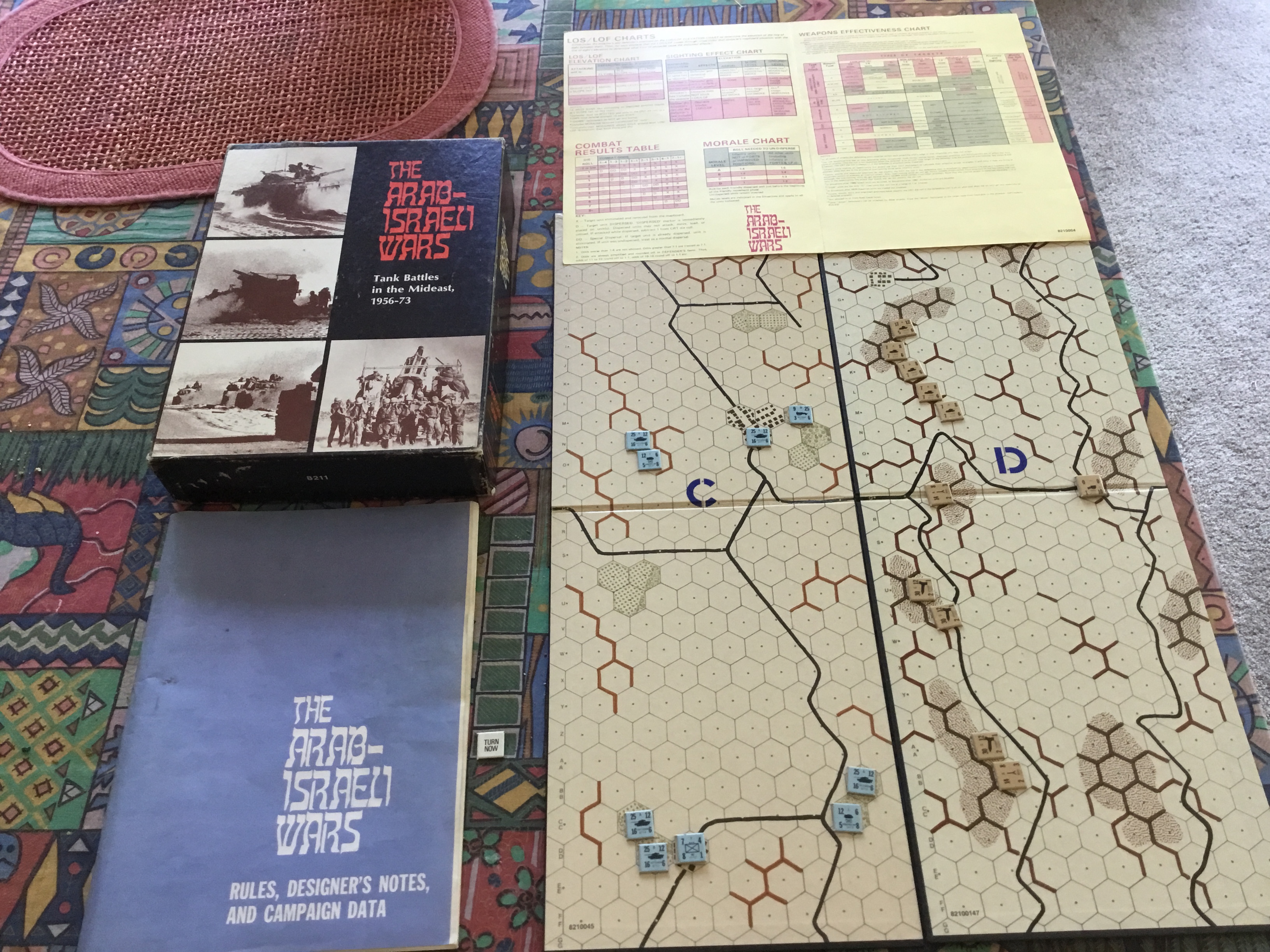
Set up The Arab-Israeli Wars, the final iteration of the Panzer Blitz Series. When I opened the box, I discovered three old envelopes containing the counters for Situations (they didn’t call them Scenarios back then) 2, 3 and 4. Have no idea when I last played. So….start at the beginning.
Before all of that, I read the rules. Three levels; Beginning, Standard and Advanced. Each layers on unit capabilities and additional types of units, even including fixed wing and rotary aircraft. The usual foodgroups for tactical armor games; direct fire, indirect fire, overrrun, and close assault.
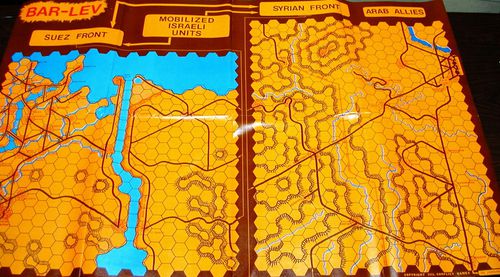
Scenarios reflect increasing complexity and number of units. Counters are large and easy to read, maps are bland, but functional. On the other hand, what can you do with the desert? Well, someone did get creative with Bar Lev.
(In)Famously Psychadelic!
In short, what’s not to like for a reasonable armored combat simulation that doesn’t bog you down?
My only gripe is that the charts are on a double-faced fold out requiring all kinds of fiddling to work with…..and some genius included the turn track. But, the genius did add dotted lines so the track can be cut away from the charts.
It’s sunny now, but will still get in a few plays. Here’s a photo of the whole shooting match. Excuse the E-Bay Listing Approach.
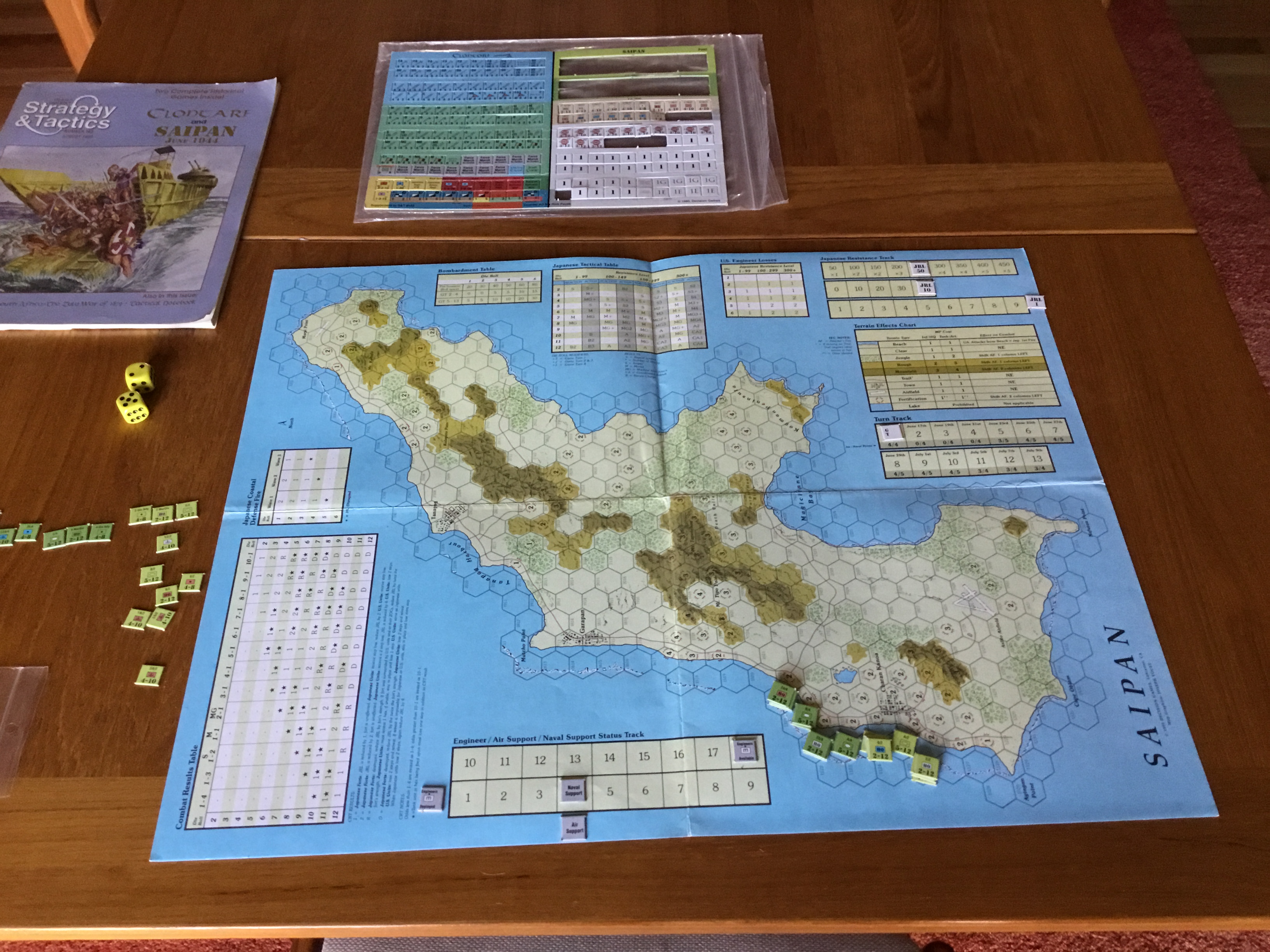
Opened up a box and it jumped right out at me! “It” is an old S&T magaizine game, Saipan.
Why not? It’s solitaire and is the first game I’ve ever played that has any of my old units in it (2/24 and HQ 24th Marines).
It’s another slog. Wristage and more wristage; have to reduce 88 (yes 88!), Japanese fortifications, plus the chance of encountering Japanese troops every hex you move into (except destroyed fortifications). Lots of rolling to do. I can handle that, but what’s vexing is the step losses. Yes, one has to use numbered chits to designate losses. Ugh.
All that griping aside, the system seems viable, with NGF, Air support, Japanese coastal defenses, and reasonable command and control (called Lines Of Communication) rules for Division and Regimental HQs. All in all, the game seems a reasonable representation of a meat grinder of a campaign.
I have Bloody Buna on the table and now this damn thing. It is a rut! Need to get an East Front game out (and not Stalingrad) next!
Mangled Turn 1, forgetting Japanese reactions to Marine movement. But, it was an easy re-set. Will try it again tonight.
Been playing another small game. It’s a game with a war theme, so I guess it is a war game. Realism…….not so much. Entertainment and Fun……so much.
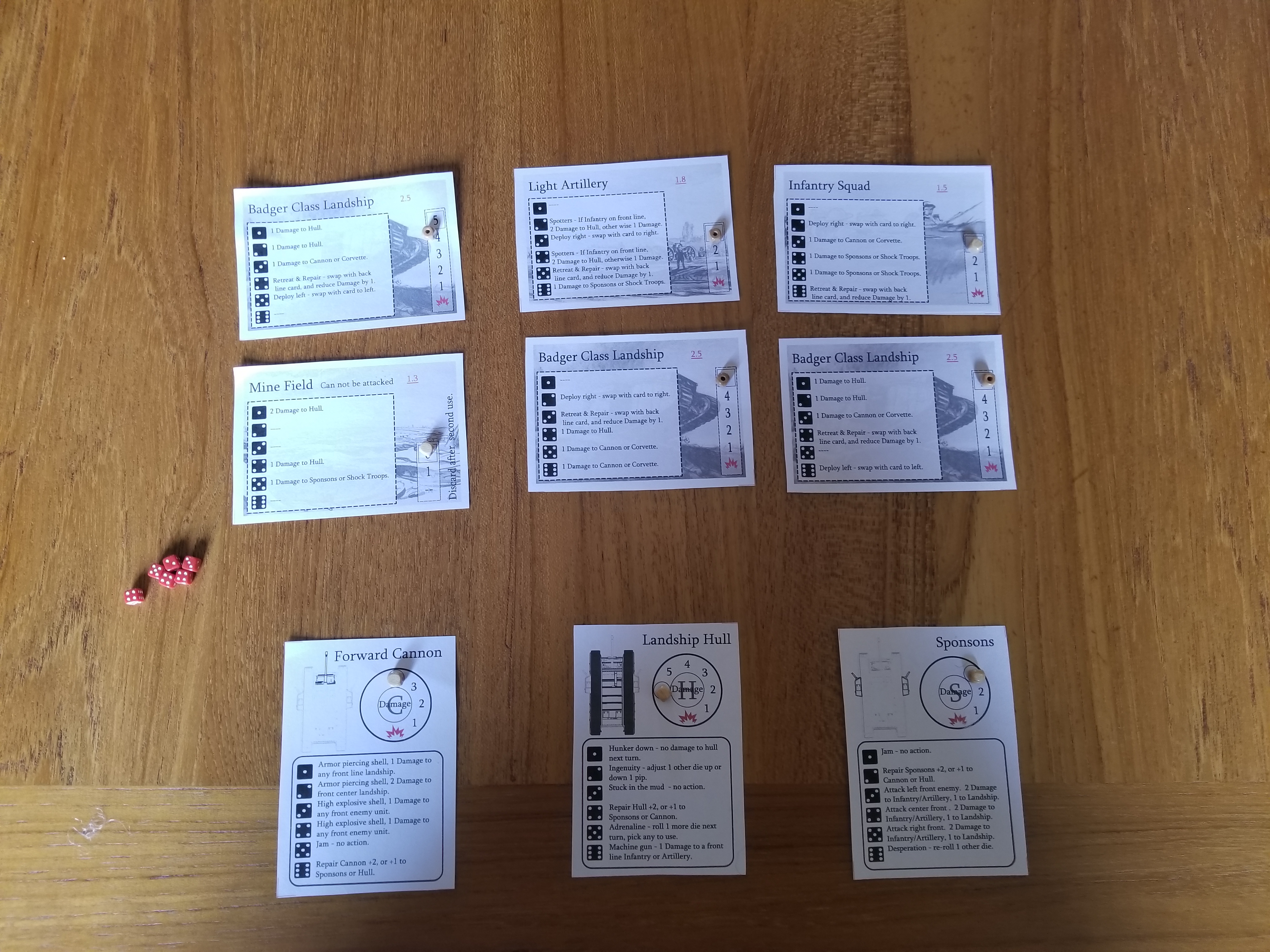
It’s Pocket Landship, a PNP game I stumbled across over at Boardgamegeek.
The link is for the updated version, with more options and better graphics. The original looks like this when set up.
No, The Cards Are Not Huge. Yes, The Dice Are Very, Very, Small.
Game is simple and elegant. In the basic game, you control one Landship, with three components – Hull, Sponson, and Gun. The enemy has six random elements, including infantry, artillery and other land ships. Only the front three are in play at any one time. Roll three die for the enemy. Assign lowest die to the left unit, and other two in ascending order. See what happens. For your Landship, roll three die and allocate as best you can. If you destroy one enemy element, another moves up. Last Man Standing wins.
Fun and compact. As the say, a great “filler” game. Just like TAC, buy this one before it gets snapped up, pimped up, and priced up!
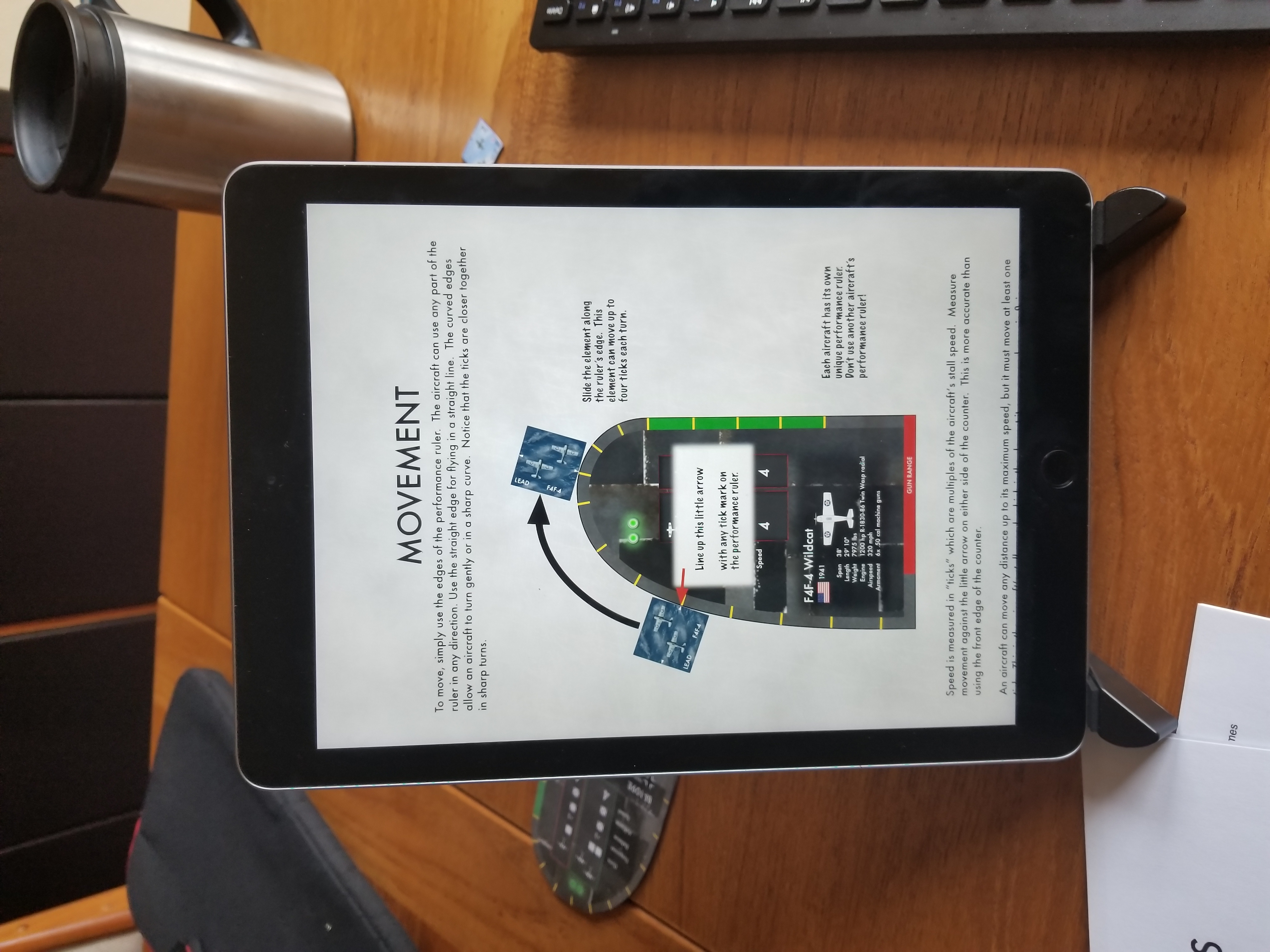
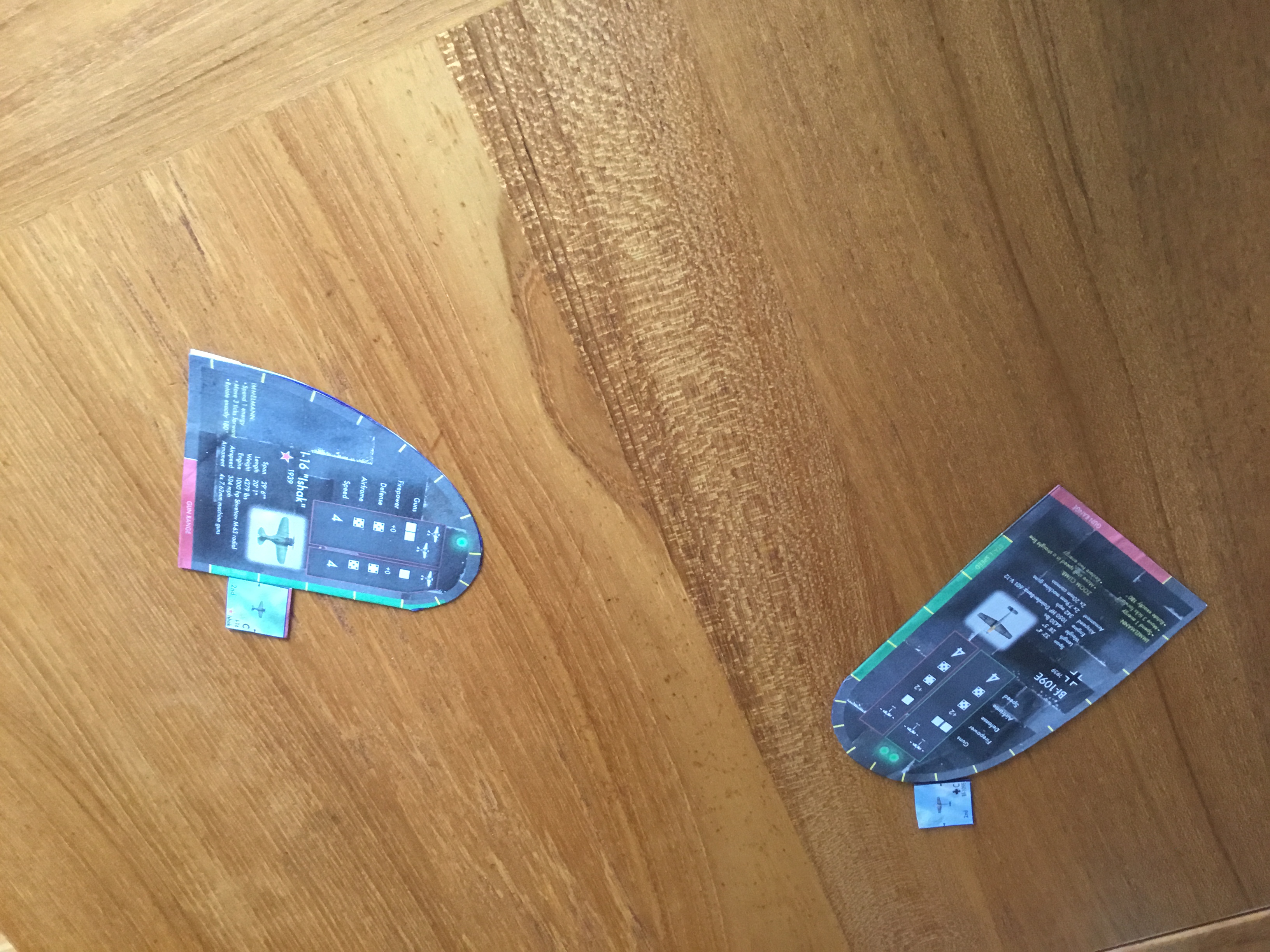
Undertook a mini project when TAD. It was TAC – Table Air Combat.
This is a simple, fun, inexpensive WWII aerial combat game with a wide variety of aircraft types. It can be found over at Wargamevault.
You get a PDF copy of the rules with each aircraft type. The PDF is very well done. Other help is available for free download.
The aircraft maneuvering card includes all the information you need to fly the aircraft, so after a few plays, and familiar with the general rules, you can seamlessly transition to any aircraft you like.
The counters show a single aircraft on one side, and two aircraft on the other I’m thinking about mounting 1/700 aircraft on a counter for a 3-D effect.
Speaking of 3-D, the system incorporates “energy” as a means of simulating vertical maneuver. The concept is simple, an aircraft can gain energy by climbing (reducing linear movement), which allows it to gain speed in a dive.
The footprint is very small, making it a great travel game.
For what it is…..it’s great!
Rules are well illustrated, easy to understand and have great graphic qualities.BF 109-E Turning Into A Polikarpov I-16. Note Data On Manuever Care.
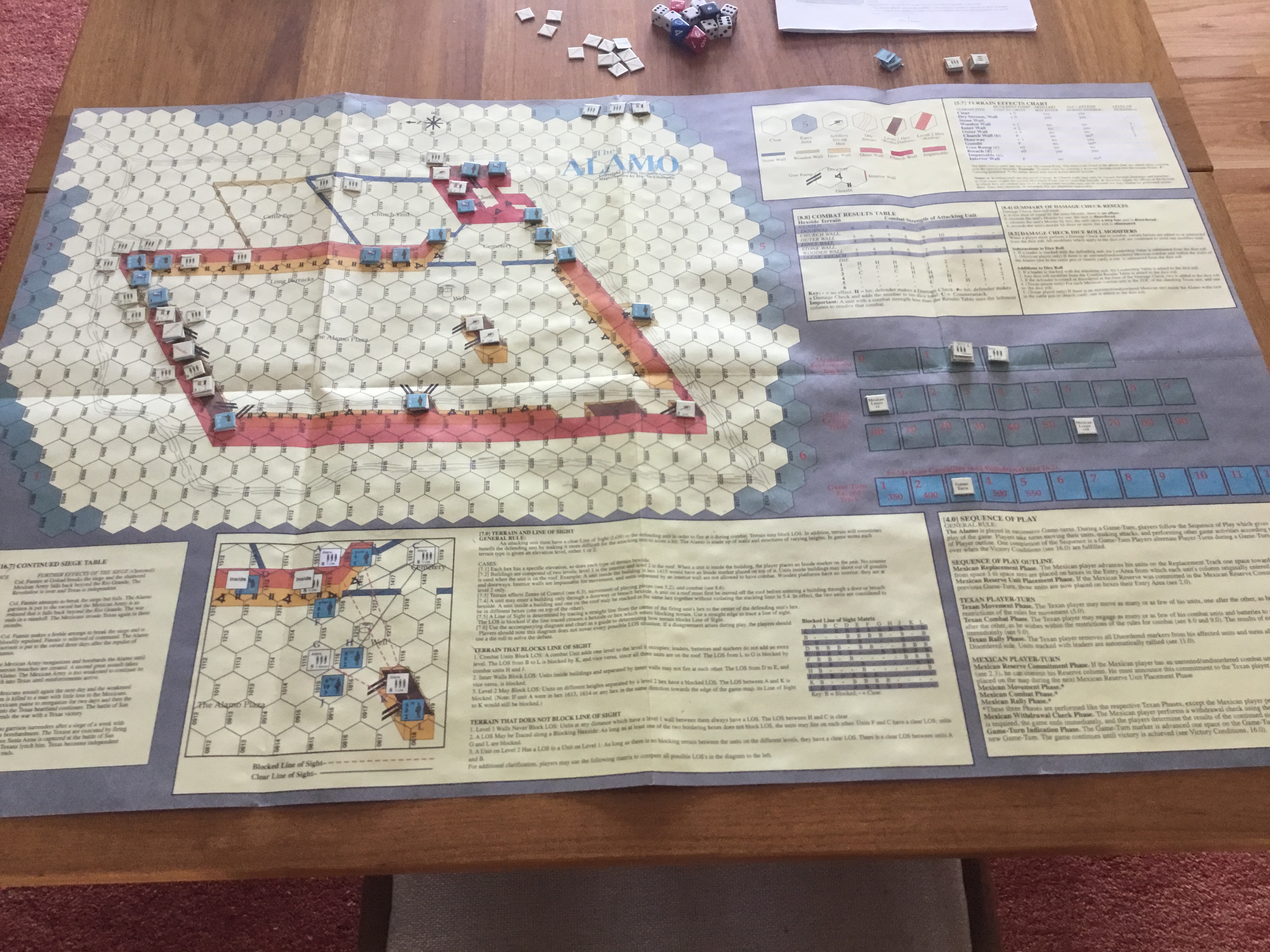
Snow and sickness can lead to some desperate measures. After FAB I opened a shrink wrapped time capsule…..The Alamo: Victory In Death.
It’s not like my recent games. Yes, there is a lot of wristage, but with counters and a map that contains all of the charts. So 1980’s, and so appreciated.
This game is well-suited for solitaire. I used a die to determine where the Mexicans were to attack.
But, it can be tedious, with many die rolls for shooting and melee combat. However, the tension factor is excellent, especially when the defenders have to fall back from the walls to defend the interior of the mission.
I still am badly confused by the rules concerning Mexican losses that result in an immediate Texas victory during the first five turns.
Bought it with some Christmas money after having read the excellent reviews and perusing the Hollandspiele website . That site is a fun place with several intriguing titles .
It’s a real puzzler of the game and a departure from a card-driven or hex and counter game .
The map is attractive with the counters more than serviceable. I do like the wooden cubes. The rules are well organized, but what really makes things work is the online example of play posted by the designer to the game’s Boardgamegeek page. Invaluable.
However, by the time I was well into the first turn I started getting uncomfortable . A great game, but it’s solo playability, for me, is marginal . It’s a cat and mouse affair begging for two players, not one trying to outguess himself .
I’ll set it up again and try a scenario in which the British focus on a specific course of action ie. attack down the Hudson Valley…..just like Gentleman Johnny B. We’ll see how that goes .