Category Archives: Boardgames

Der Weltkrieg – Osmanli Harbi – The Ottoman War 1914-1918

Finally finished up Galacia after more than a year on the table.  Yes, that long.  Pathetic is too kind a description.

Shamed, I had no other option But to set up another Der Weltkrieg offering, Osmanli Harbi.  Much lower counter-count, but some very interesting scenarios and rules.

The module’s scenarios cover the Caucasus, Macedonia, Iraq, Sinai and Albania theaters.  Just the names bring back memories of these regions bedeviling me while playing Pursuit of Glory.

Each theater has separate battle scenarios, as well as a campaign, which the system refers to as “Duration Game Scenario(s).”

Decided to play a Sinai scenario involving the Third Battle of Gaza , and covering the period October through December 1917.

The game’s rules have some significant differences/additions from/to the Der Weltkrieg Standard Rules.

The overarching changes for  Osmanli Harbi address the differences between fighting in Europe and the game’s theaters.  These focus on the harsh environmentss, with its effects on operations as well as logistics.

Desert hexes have reduced stacking limits; roughly half of that allowed in the standard rules.  Units crossing desert hexes also lose one movement point.  An attacker suffers one additional loss when attacking into a desert hex.  Operations during Summer turns involve further reductions in movement allowances as well as increased mandatory combat loses.

Lines of Communications (LOC) and Supply Depots are introduced to reflect the lack of transportation networks in these remote theaters.

LOCs are required for a unit to remain in supply.  LOCs must be traced to a rail line, port, headquarters or depot, with a maximum length of two hexes in the desert.  The headquarters or depot must be within two hexes (in the desert) from a rail line or port.  You cannot “daisy chain” headquarters units.  So, in the desert, a unit risks out-of-supply effects if it is more than two hexes from a rail line, or four hexes with an intervening headquarters.    The effects are attritional, either losing one (1) strength point if moving more than half of its allowance – in any terrain, and/or having to roll for attrition during the Special (first) Phase of a monthly turn.

Other scenario-wide rules involve reduced rail construction and capacity.

The impact of these changes pale in comparison to the rule that allows  Ottomans to mount counter-attacks at maximum strength without infantry or cavalry units being supplied.  In the series rules, a unit can only counterattack at full strength with the expenditure of two (2) supply points per strength point.  If not supplied, the unit attacks at half-strength.  This is a significant factor, with the designer explaining  this rule reflects the Ottoman’s ability to put together scratch forces (much like German Kampfgruppes) to respond to Allied operational successes.

Each set of  scenarios also has its own special rules.  For Gaza, these include rail capacities, German and Austria-Hungary support units, the requirement(s) to maintain garrisons, and special attack rules for the 1918 Meggiddo scenario.

I am also using an alternate Combat Results Table (CRT).  This CRT is recommended for low counter density scenarios.

The 3rd Gaza scenario is a stand-up slugging match, with the British assaulting an entrenched Ottoman force.  It’s a good solo scenario since the Ottoman player simply using his limited reinforcements to plug gaps created by British attritional attacks.  Maneuver is limited by desert and mountain terrain.

Victory is determined by capturing/defending cities and combat losses – which are accounted for as “Demoralization Points”.

The first play-through resulted in a Central Powers (Ottoman) Decisive Victory, as the British (Entente) suffered significant casualties while seizing just one of three cities required for a Substantial Victory.

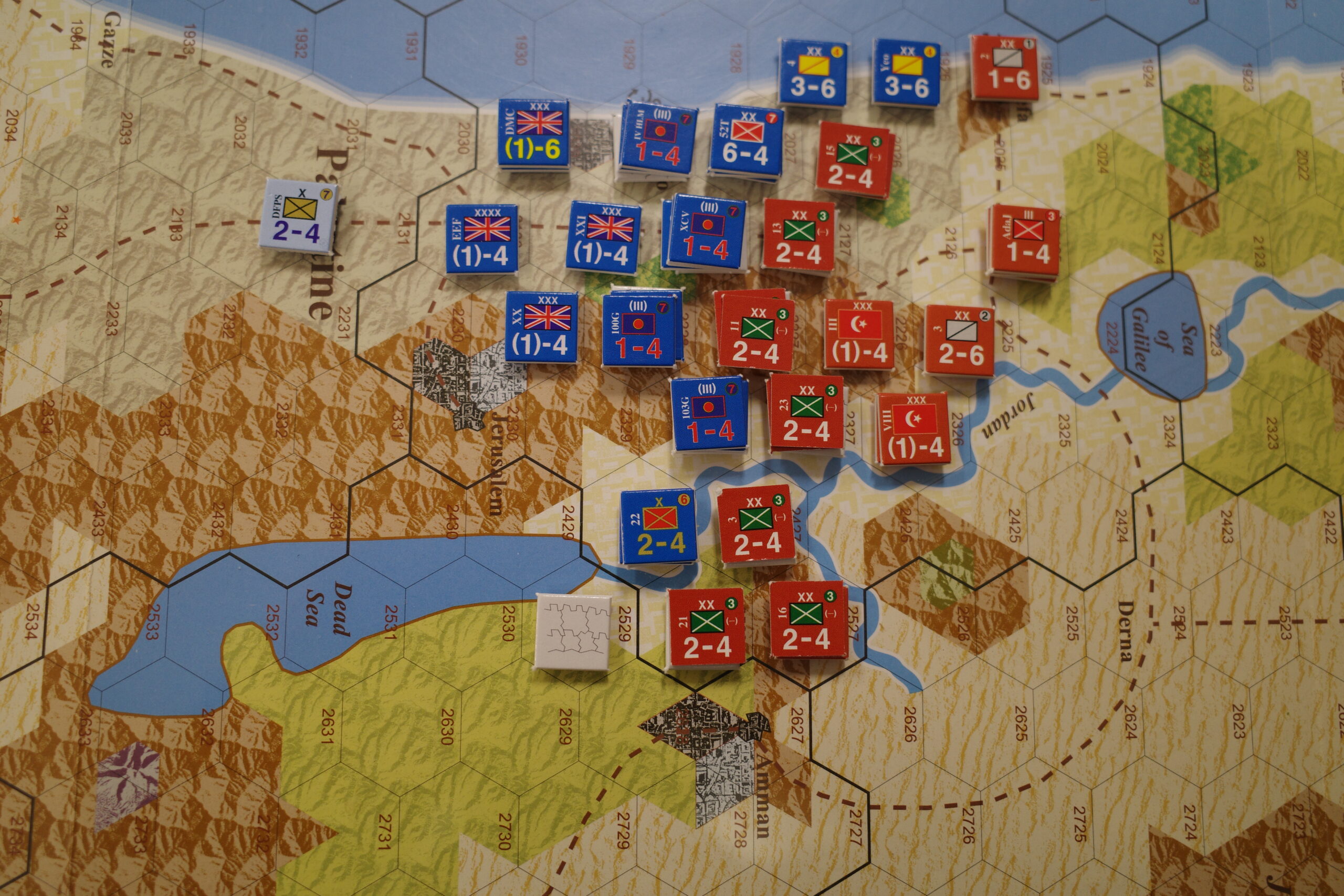
I’ve set the scenario up again, and am giving it another try.  Here’s shot of the game.


GWAS – Attention Diverted

Way back in March I posted about a Great War At Sea (GWAS) project involving Chile and Argentina.

That one is now on a backburner, with my new emphasis on the “what ifs” of the Spanish-American War.  As usual, the move from South America to the Caribbean did not involve a straight line.  Instead the initial detour was to “Plan Black”, a possible United States-Germany confrontation.  This, in turn, was an offshoot of a by-chance read about the international squabble(s) over Guam and the Philippines in which Germany was an active participant.

Plan Black was a bust, since the GWAS scenarios are set during the Dreadnought Era, and I wanted something turn-of-the-twentieth-century.  Looking for a path of least resistance, I dug into GWAS’s 1898, The Spanish-American War,  module.  This opened up some immediate possibilities.

Fortunately, I own a copy of David Trask’s “The War With Spain In 1898”.  This one volume history covers the naval aspects in some detail, going far beyond the usual coverage which is typically limited to the battles of Manila Bay and Santiago De Cuba.

The game’s scenarios cover some hypothetical situations, but I was interested in a campaign that assumed (and this is quite an assumption) that Spain had not neglected its fleet for ten years, and was a far better match for the United States “New Navy”.  This is where Trask’s book was so helpful.

But, things ground to a halt when I decided to use the alternate Dreadnought tactical rules.  These require a roughly 3 ft x 3 ft hexagonal grid sheet, and I don’t have one.

Amazon should be delivering a blue hexagonal grid sheet any day now.  Everything else is ready to go.

And, I will get to Chile vs. Argentina. Sometime.

Up Front – Filling the Gap

This Summer I played Up Front (UF) both solitaire and face-to-face.  It’s a comfortable game.  I keep coming back to it.

What I like about UF is that it isn’t too complex (like Advanced Squad Leader), isn’t too simple (like many miniature tactical/skirmish games), and is more accessible than Advanced Squad Leader Starter Kit (ASLSK).  By “accessible”, I’m referring to a level of detail requiring numerous chart references, multiple plays for the requisite knowledge, or a savant-like memory.

Also….you don’t need the space required for a board.  ASLSK has a number of compact one- board scenarios…..but not that many.  UF doesn’t require  multiple boards to enjoy an involved experience,  but the number of scenarios provided are limited.  However, those scenarios can be tarted-up using different force mixes, different nationalities, or removing cards to create new terrain and obstacles.  Actually, if you could still buy the game (and why that is involves a strange and terrible saga that I am only vaguely familiar with), a case could be made getting a second box to add cards.

By the way, Chris Farrell has some very interesting observations about the game over at his blog.

To keep the game in its comfortable place, I add selected sections to enhance the  Basic Game which is limited to Sections 1-16.

17.  Flank Fire and Encirclement; Lateral Group Transfers

18.  Weapons Acquisitions

19.  Malfunction and Repair

20.  Infiltration and Close Combat

For Chrome, I will include – on a case-by-case basis –  the following sections.

21.  Demolition

22.  Flamethrowers

23.  Pillbox

24.  Minefield

39.  Troop Types

With these five additional rules, you can attack a pillbox; first without any additional weapons, then with demolitions and, finally, flamethrowers.  After that, assault the pillbox through a minefield.  Excellent for solo play.

Tanks? Artillery?   I’ll leave those for Advanced Squad Leader or the Starter Kit.  Tanks & Artillery rules make me uncomfortable.

Learning Curve Continues

Finished up ASLSK’s Scenario S2, War of the Rats.

I thought it would be an easy mopping up after the early punishments meted out by the Germans.  But, the Soviets were surprisingly resilient.  It all came down to a climatic melee in the last German turn, in the last hex, of the last building.

Given the weapon mix (demolition charges and flamethrowers), unit types (conscripts and elite) and urban terrain, the scenario is a great introduction/review of the system’s first infantry-oriented iteration.  As I’ve posted  before, ordnance and especially armored fighting vehicles slow things down.

Well, why not another play?  I’m curious if my “overload tactics” will work again.  And, if so, can I finish off the Soviets quickly?  As a teaching colleague used to say “Repetition is the key to knowledge.”  Then, perhaps, something with ordnance…..

Bits And Pieces

Continuing to fiddle with the Balkan/Central Europe 1938 scenario.

Latest bit of information is a Wikipedia article on the Yugoslavian army, particularly the interwar section.  I know…thin stuff, but there isn’t a whole lot of pre-April War information out there.

Yugoslavia had sixteen (16) infantry divisions, one (1) alpine division, as well as two (2) cavalry divisions in 1935. Mobilization would create another eight (8) infantry, one (1) alpine and one (1) cavalry division within 30 days.

Well, it’s something to work with.

The  mobilization parameters need to be refined, especially for the less-than-reliable Croat units.  My instinct is to stay with random die roles for the Croats, and, since Europa uses two-week turns, having those mobilizing units attaining cadre status at the end of Turn 1, and divisional status at the end of Turn 2 if they do not move or are involved in combat.

Why not?

Learning Curve

Continuing to work on my ASLSK skills with a reset on Scenario S2, this time using my own German dispositions, with a rough approximation of the Soviet dispositions used in the Basic Training magazine’s replay discussed in an earlier post.

I loaded up the west side of the board with German units.  It seemed to work.  The Soviet Conscript units melted away due to some really bad morale die rolls.  Aggressive German advances kept the broken units under Desperation Morale with the very tough -4 modifier to any rally dice rolls.    Here’s an impaired pic taken at the end of Turn 2.

In theory, the DM units have little or no chance to rally and should be destroyed, or at least suffer Casualty Reduction, by German Prep Fires at the beginning of Turn 3.  But, this is ASLSK and anything can happen.

Slow Going

Taking my time with the  1938 Balkans/Central Europe scenario.  I’m using both regional names as they overlap – just ask Google.

Decided to start things off  with a Bulgarian invasion of Romania, with Hungary and Yugoslavia content to wait and watch.

While Bulgaria can commit almost all their assets to the invasion, Romania has to keep several units on their borders with Hungary.  In this battle of “Ants” (where 4-4s and 3-4s are few and far between), a handful of units can make a big difference.

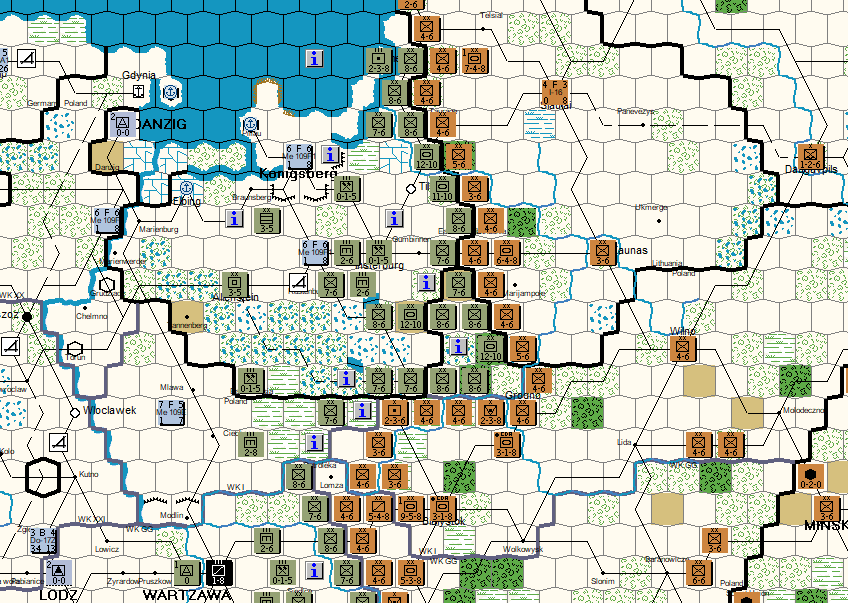
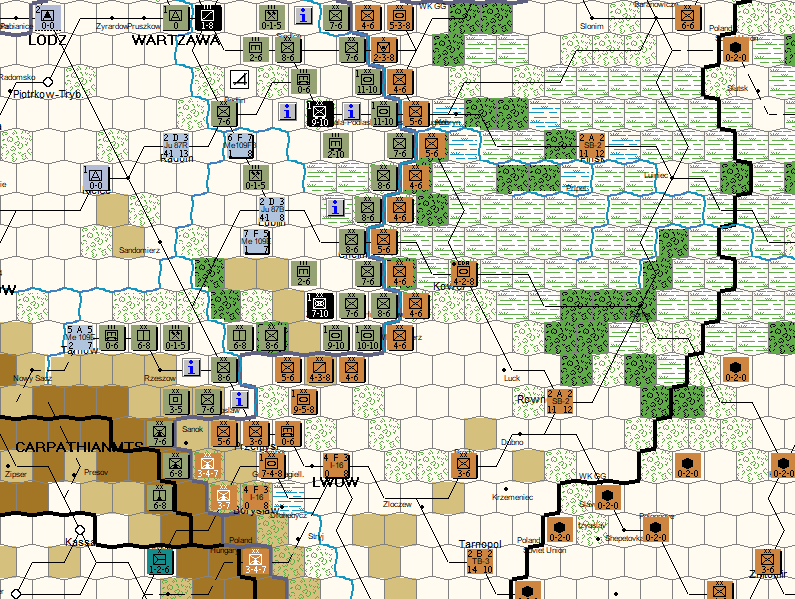
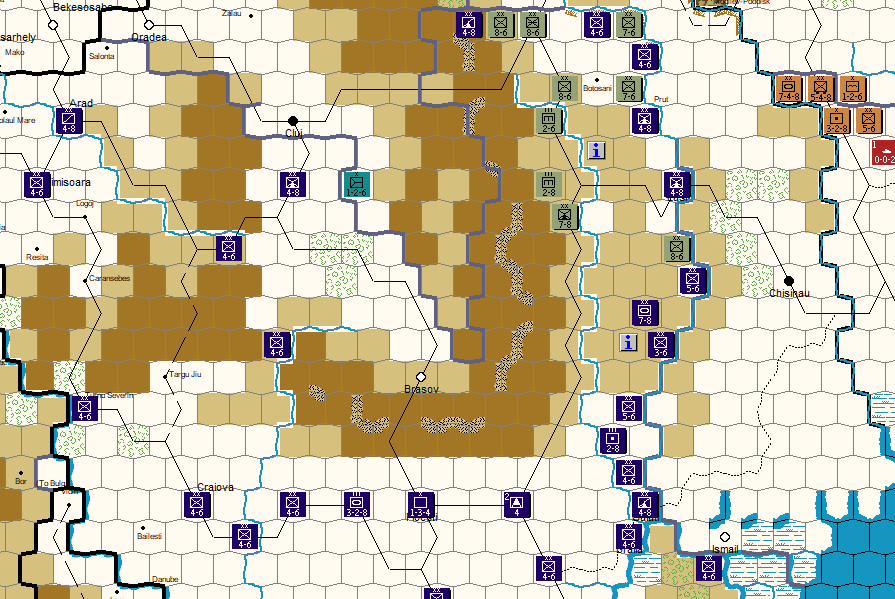
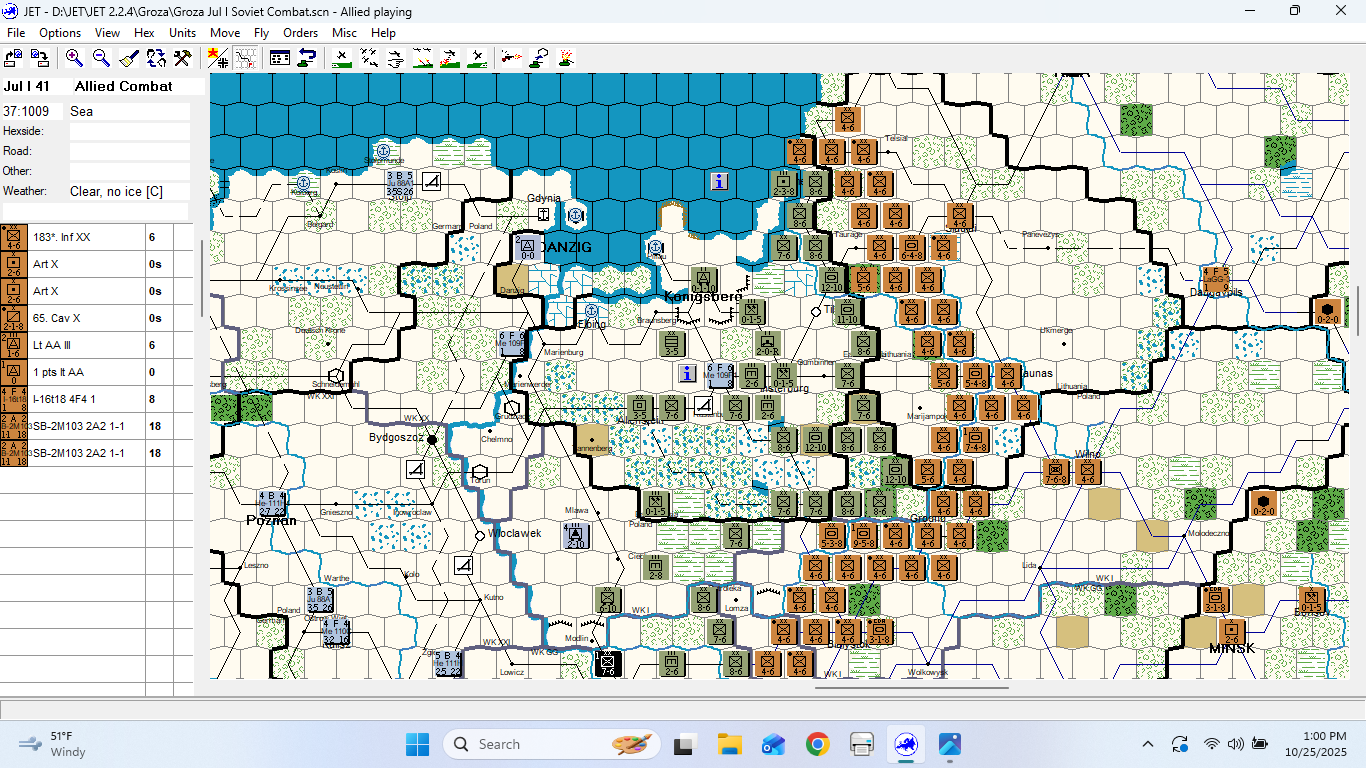
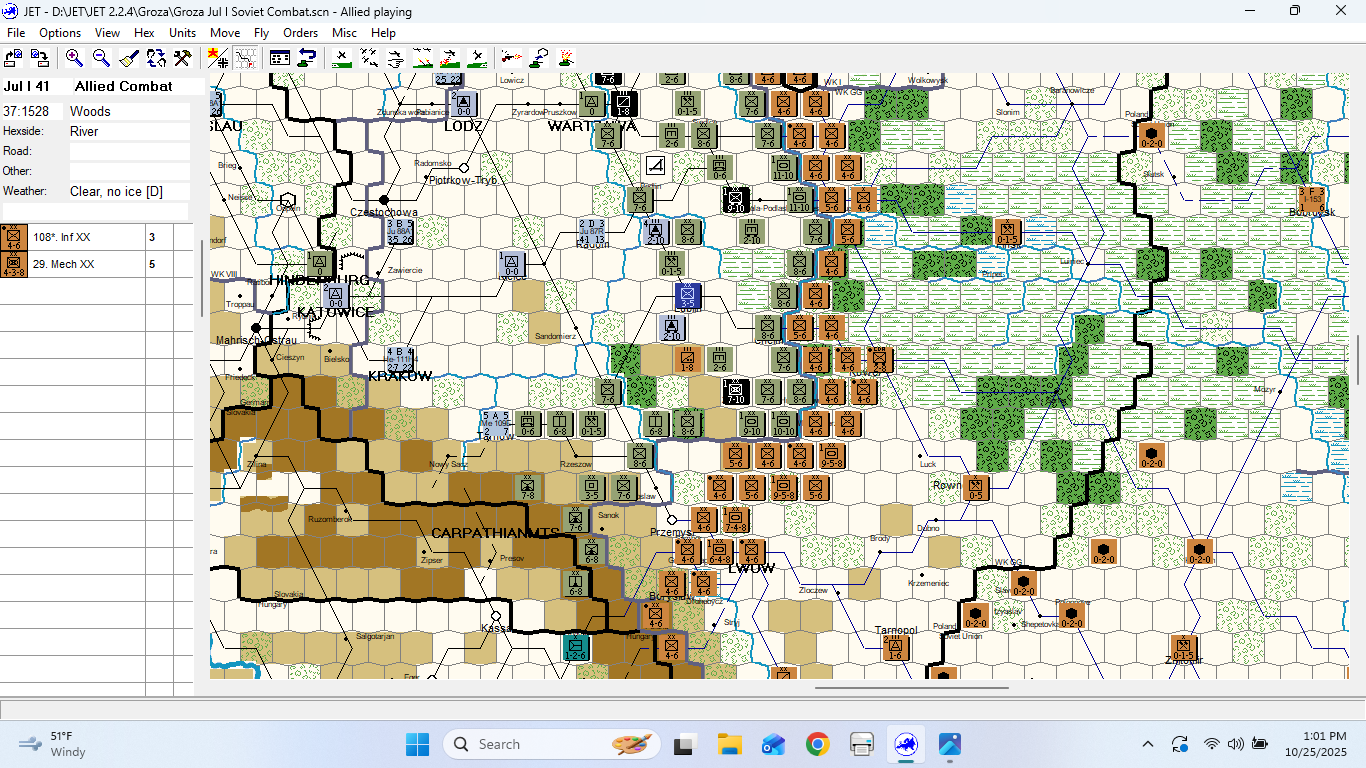
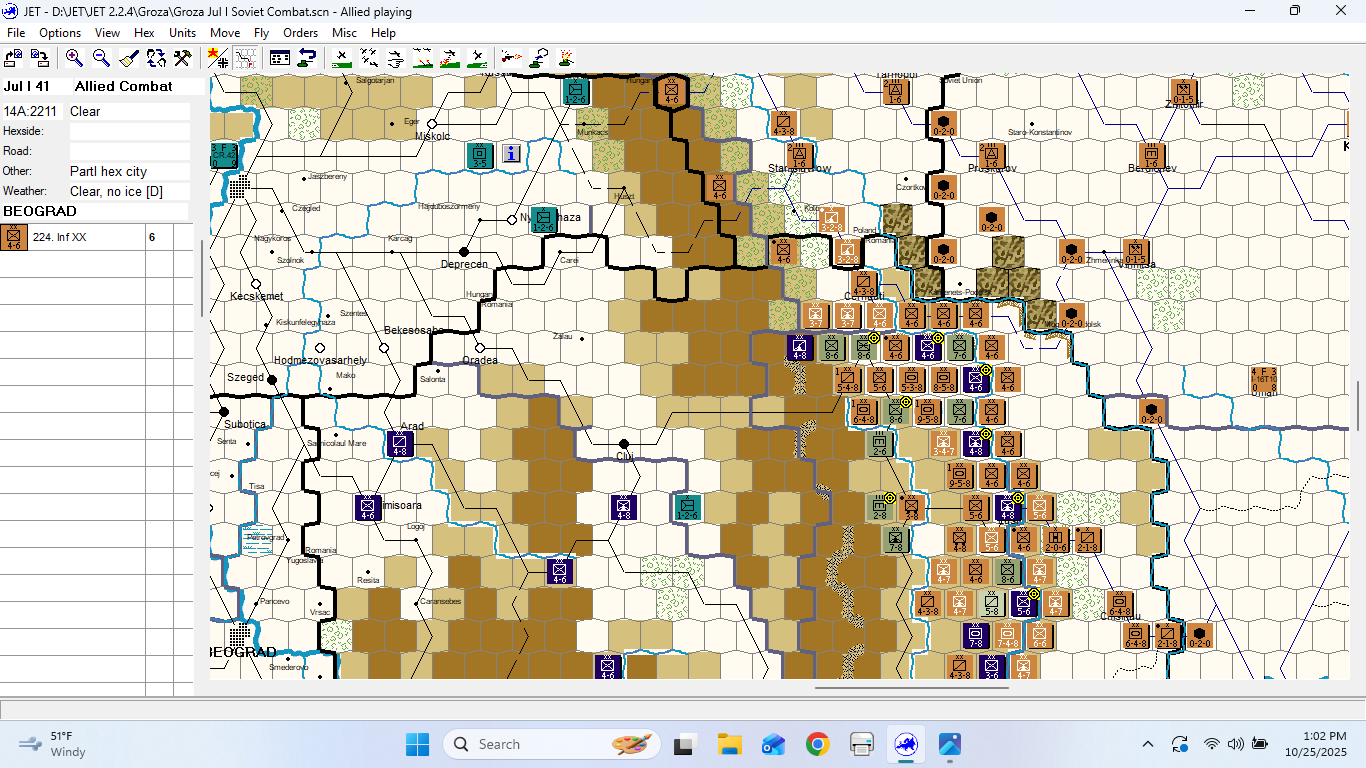
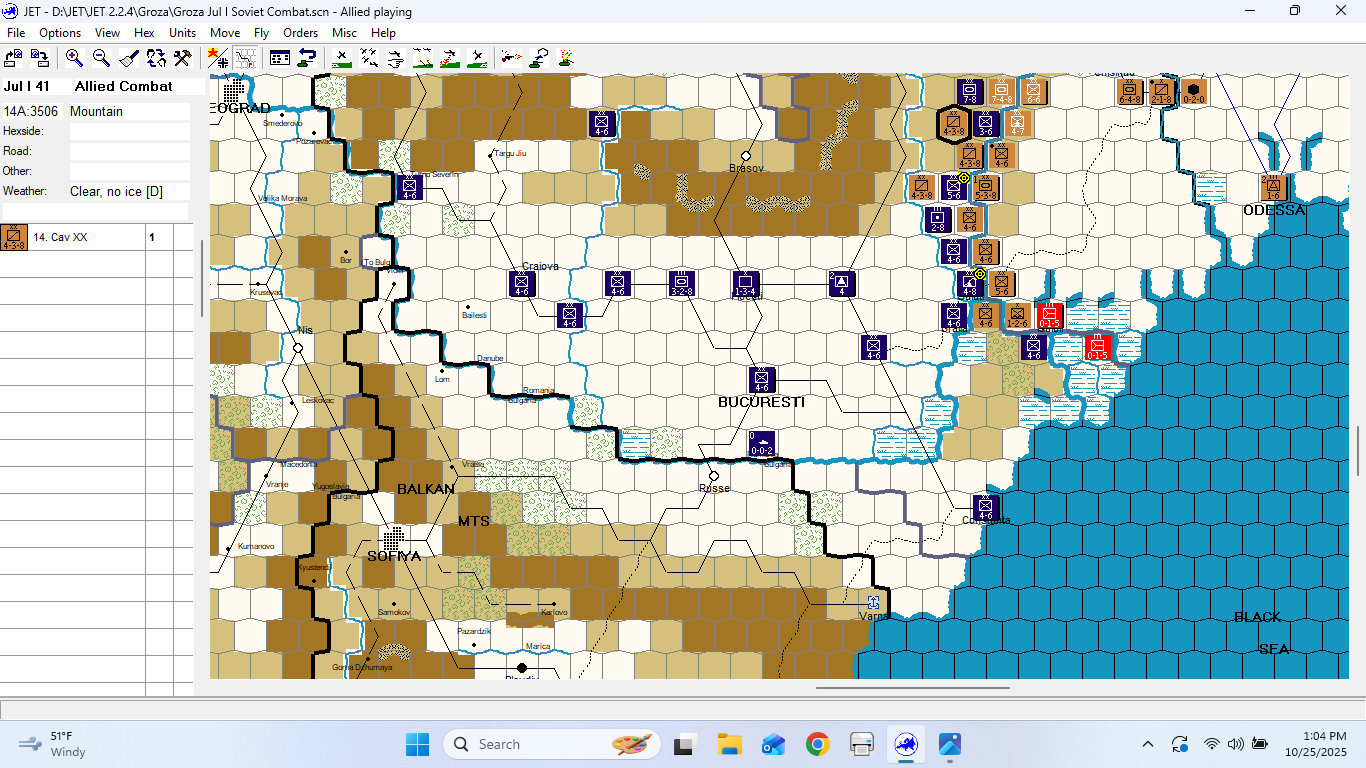
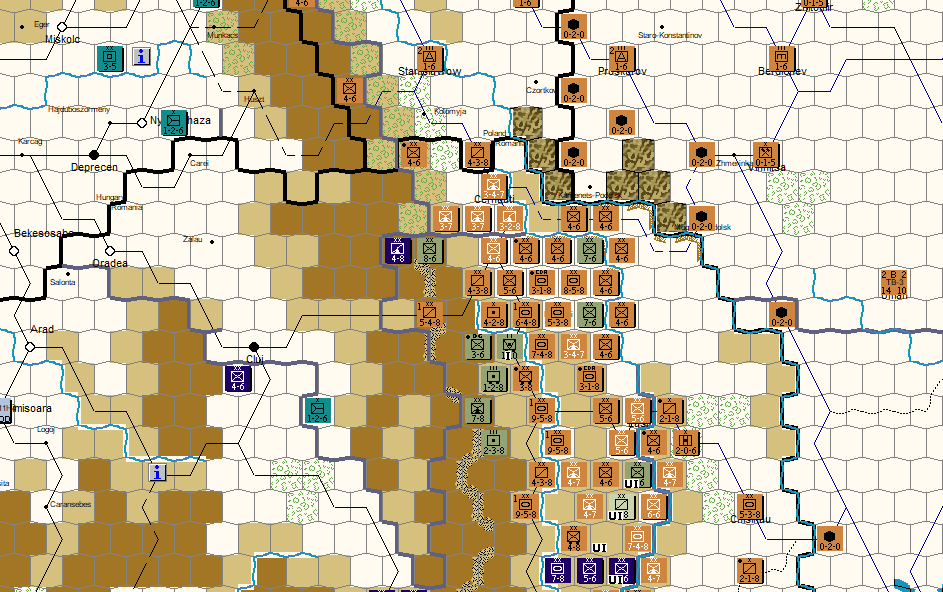
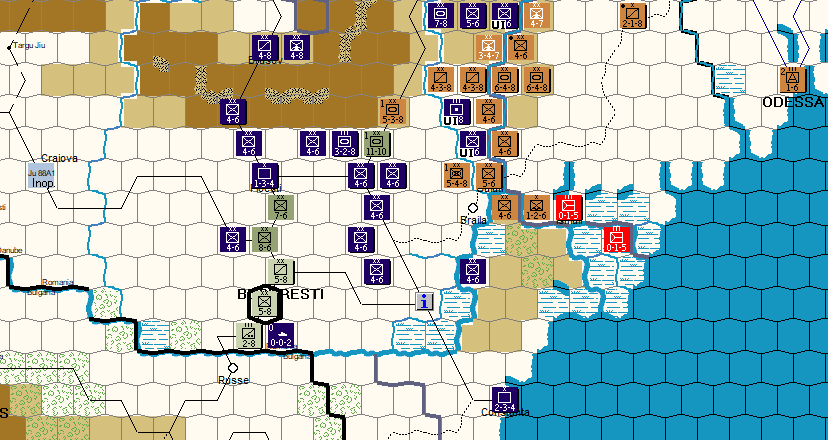
The Bulgarians have already seized both of their territorial objectives, but are bogged down in front of Bucharest.  On the other hand, the Romanians are hard-pressed to defend their capital, much less launch any kind of offensive to retake their occupied cities. Here’s a quick snap.  Bucharest lies below the blue Romanian air units.

Despite the low counter density, it’s just not an infantry and artillery fight.

Both countries do have limited air assets.  The Bulgarians have a mixed bombing unit (one tactical and two strategic bombing factors), while the Romanians have a fighter unit and two bombing (one tactical and one strategic bombing factor) units.  The Romanian fighters returned the first sorties by the Bulgarian bombers and destroyed it in a subsequent attack. The bomber units have supplemented Bucharest’s defense.

Each country has only one engineer unit, but each is active. The Bulgarian engineers constructed an airfield within range of Bucharest, while the Romanians have built a fort to buttress the capital’s defenses.

Armored battalions have also been involved in the combats around Bucharest.

This is a pretty vanilla scenario so far.  I need to spend some time working on the mechanics for triggering Yugoslavian and Hungarian involvement.

Another Hiatus Ends

As usual, lots of plans to game at the Sunfish Capital Of The World, but little accomplished.

Back home digging out from a prolonged absence, but I have had time to get ASLSK back on the small table (as well as my 1938 Europa Scenario on the large table).

Impetus is my receipt of the “Basic Training” publication from MMP.  Mark Pitcavage provides his usual excellent coverage over at Desperation Morale.

I’m working my way through the War Of The Rats scenario replay.  This replay provides an opportunity to review the rules as well as see how experts play the game.  I’ve never played face-to-face, so this type of replay is very welcome despite, as Mark points out, the number of pages devoted to it.  A bit of a slog, but worthwhile.

For extras, “Basic” comes with handy charts, and a counter sheet with German and Minor units, plus a few tanks and guns.

Still having my on-going conflicted thoughts about ASL/ASLSK.  I really like the system, but after ordnance, the increased level of complexity for tanks and the Pacific Theater of Operations (PTO-ASLSK #4) gives me The Willies.

Old Friend – Up Front

Tired, frayed, torn and stained……took out Up Front to get reacquainted before my annual sojourn to The Sunfish Capital Of The World.

I hadn’t opened the battered box for quite a while.  Everything was there, including the rules and cards for the Desert War variant.  I’m starting a serious hunt for Banzai later today.

I bought the core game and variants back in the 80’s and from the look of the components, I must have either  a messy pig, or just played the hell out of them.  I want to think it’s the latter.

The reason for the reunion is  I need some quick set-up and play games during my stay.  Gaming space is limited, and there will be visitors.  The dining room table will be for eating, not for board gaming.

Up Front fills that requirement.  It plays in about an hour, with soldier card deployment, action deck shuffling, and marker setup taking about ten minutes maximum.

One problem…..the rules.  They are more involved than I remembered.  But, the time spent reacquainting myself with them, as well as discovering how much I do not remember, has been enjoyable.  After all of these years it’s still a unique system.

Started a quick play of the first scenario, and rediscovered how you don’t learn the rules by reading them, but by playing.

The game is not particularly solitaire friendly.  Solo systems are out there, but I just keep it simple.  Two reasons…. because my memory is shot, and I never look at a discard draw (last action of a player turn) at the time of draw, but wait until it is that side’s turn again.  I’ll call it “limited intelligence”.

Once Again

Back after another long hiatus involving travel and toil.

Drove over to Tim’s for another grind through Pursuit of Glory.  Grind?  Yes.  As posted before, the game is a brain twister, but very enjoyable.

As always, too much fun chatter and perhaps not enough serious gaming.  But, we were able to get into 1916, with Tim’s Allies having a decided advantage.

We agreed this session was different than the others.  Fewer casualties, with more activity in Sinai/Palestine/Syria than usual, with less in Persia and “The Back of Beyond”.

Here’s a breakdown of action by region.

Sinai/Palestine/Syria:  The Turks actually made it across the Suez Canal,  but were quickly forced back by British/ANZAC/Indian units.  Tim continued placing pressure on the Turks, taking Jerusalem and Damascus.  He correctly pointed out that I should have built a corps in Damascus.  Corps building is a real challenge for the Ottomans.  They do not receive corps as reinforcements, just divisions.  So, corps (which have increased fighting and staying power) must be assembled from two (for reduced corps) or three (full strength) divisions.  This means using operations points move them to a common location and/or to assemble them.

Mesopotamia:  The Allies steadily advanced from Basra towards Baghdad.  Here, I was able to assemble two corps, which stopped the Allies just short of the city.  The Central Powers had difficulties generating tribal resistance, which can be very effective  stopping/delaying an Allied advance.

Caucasus:  Not the usual bloodbath.  I attribute this to the few mandated offensives for either side, as well as no dreaded “Enver” offensives that can be devastating to the Turks, especially in the Winter when combat odds are very unfavorable for the attacker.

The Balkans:  This theater developed rather late in the game with first Romania (Allies) and then Bulgaria (Central Powers) entering the war.  The Serbs (Allies) were in an unfavorable position when the game ended.

Other:  Tim opened up the possibility of a landing in Gallipoli, which achieved its purpose of drawing valuable Ottoman units West, instead of East – where most of the action took place.  He did land at Salonika, but had not advanced by game’s end.

Tim did an excellent job of maintaining pressure on the Turks, forcing me to spend Operation Points on reacting as opposed to proactive uses such as corps building and strategic movement.  The latter is very important for the Ottomans, given the distances to be traveled and poor infrastructure.  Their “interior lines” are more of a handicap than advantage.

At game’s end, Tim had a decided advantage, with the Ottomans just five victory points from defeat.

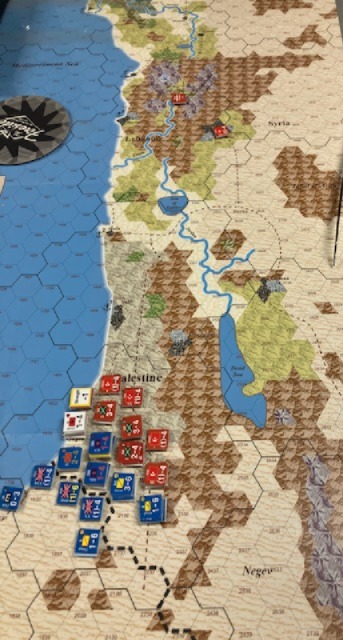
Here’s a quick pic of the board at session’s end.