Monthly Archives: October 2026

Fistful of Lead – Organized

Staying with Wild West skirmish games, I’ve been playing Fistful of Lead.

Sometime between my 2018 posts and now, I put together a southwest town with houses,  church and walled hacienda.  I also painted up some Old Glory 15mm gunfighters.  I played a couple of games…..when, I have no idea…..and then boxed it all up.

After unboxing I discovered my earlier efforts were incomplete.  I needed to get the damn game organized.  There was no way to tell which character was which and what his status – killed, wounded, prone etc. was.

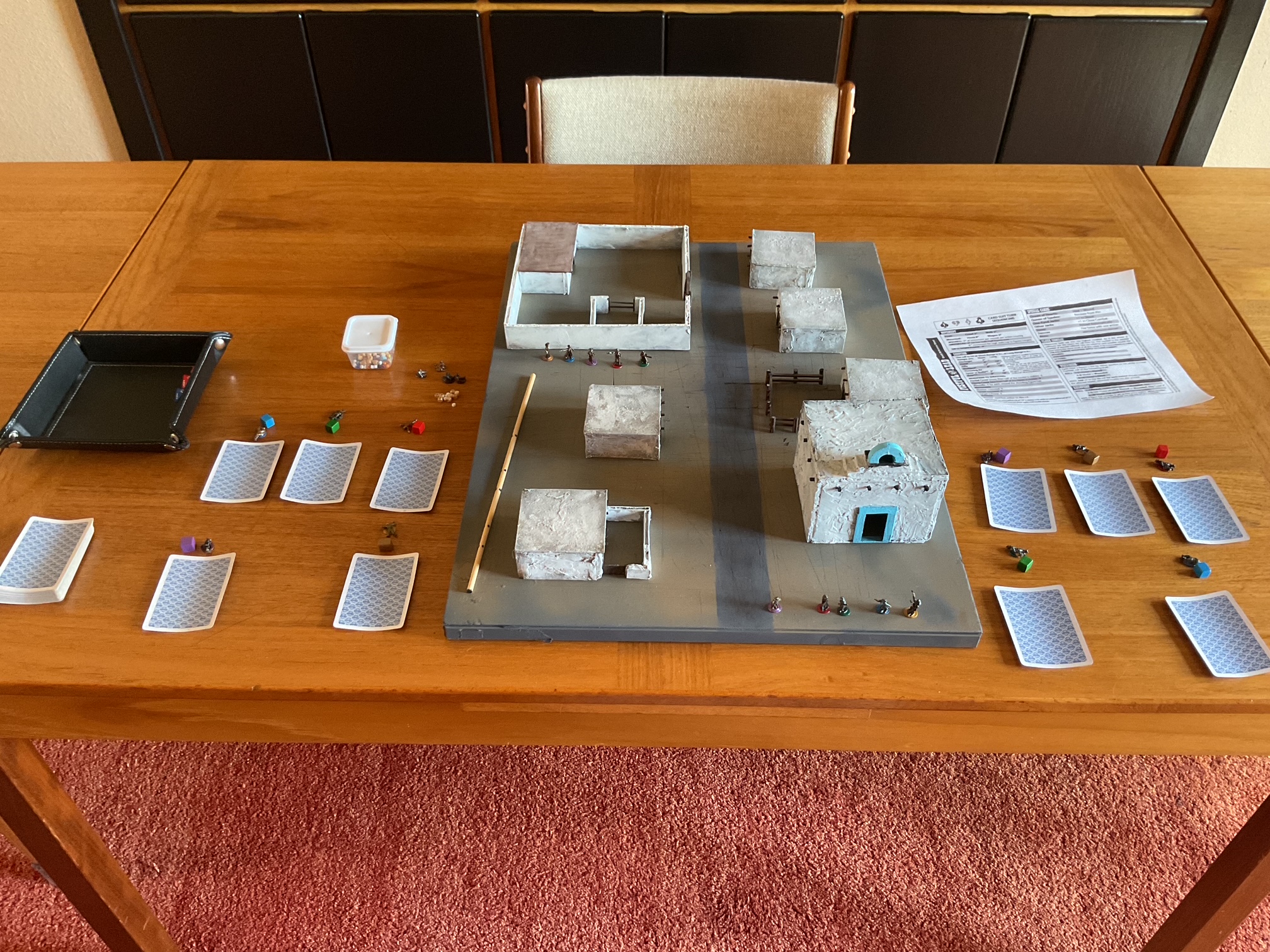
I just don’t like markers cluttering up a miniatures playing surface.  To me, markers ruin the aesthetic of the table.  So, I came up with a system.  Not necessarily a good system, but a system.  Here’s a photo.

One gang is clothed in gray, and other in brown.  Each figure has a colored base that corresponds to a colored cube.  In this game, each side has five figures.  The cards are arrayed by the respective colored cube and the dead figure used if the combatant is killed.  Other figures in either brown or gray are used to represent wounded or pinned (prone) fighters.  Brown beads placed by each card represents each wound, with a small white bead indicating the fighter is pinned.  The result is a playing surface without markers.

As indicated in my earlier posts, I really like these rules.  It moves quickly and all you really need is a measuring stick (inches) and the rules summary sheet. And, most of all, it’s fun.

Pursuit Of Glory – When All Else Fails….Read The Playbook

Tim and I had an enjoyable session with Pursuit Of Glory (PoG) last weekend.

Enjoyable….PoG?  Oxymoron.  This game has a history of breaking my mind. So, why the change?  Great Weather and Bad Football (USC vs UW and Seahawks vs. Chargers).  We took significant breaks from the action.  That’s why we managed only six turns.  And, I must mention the always amusing and distracting banter generated by the Official Playlist Of Wargaming In Central Oregon –  Pandora’s 10cc Channel.

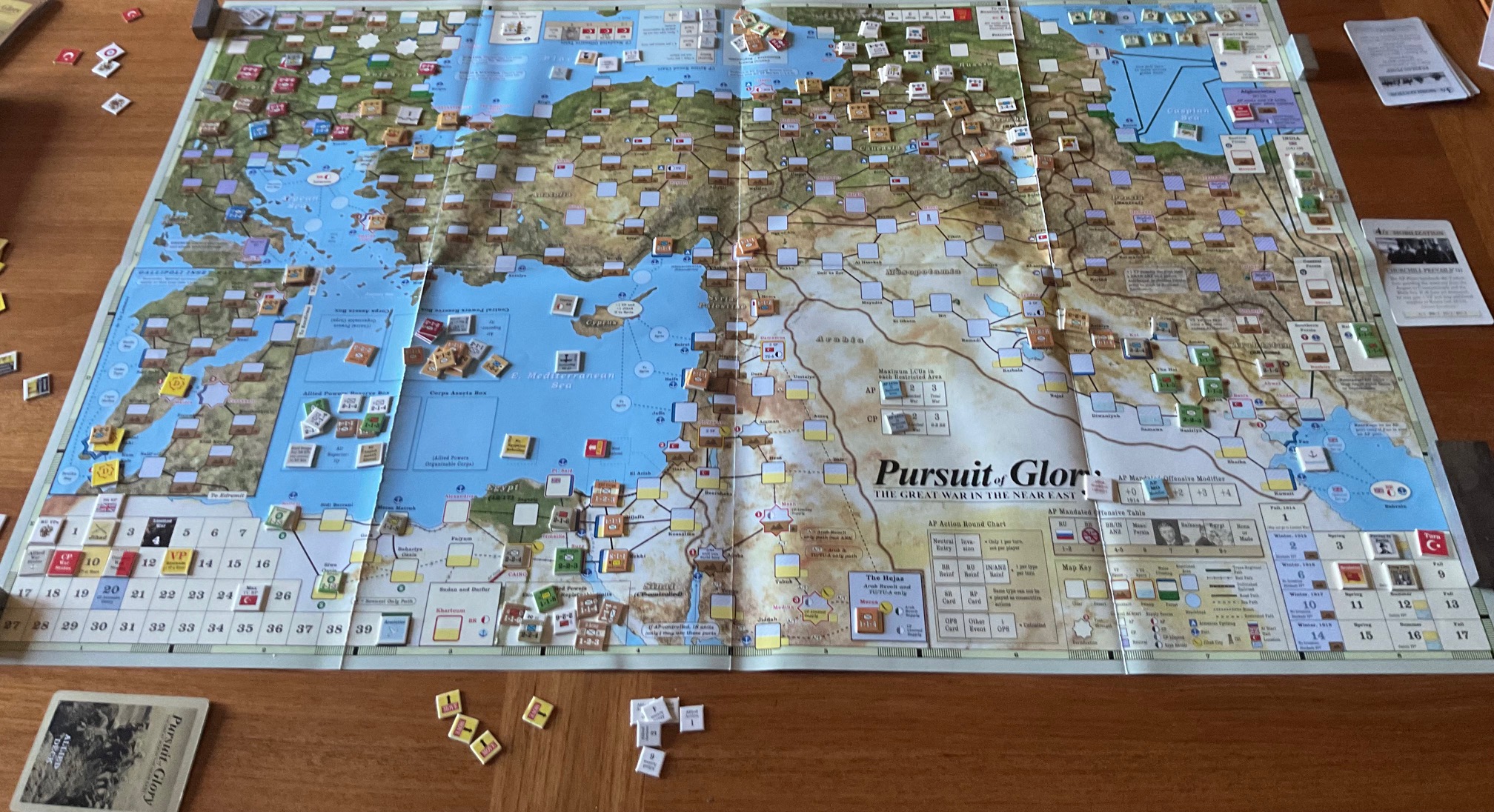
Here’s a situation photo after our last turn.

The Central Powers control the Balkans, the Allies are advancing in Mesopotamia, both sides are staring at each other across the Suez, with the Russians and Turks pondering what to do in the Caucasus and Persia.   The Allies can conduct invasions, and the Central Powers have opened a rail route between Germany and Turkey, so German replacements can be used by the Turks.

As usual, the stage has been set for some interesting gameplay….. right when we shut it down.

We had good discussion about the game the following morning.  I asked Tim to send me his thoughts on important strategies to employ.  I thought it would make for an interesting post.  The more I thought about it, I decided to look at the Playbook.  Never read or, if I did, I didn’t retain anything (as you will read).

The important points are summarized below, as our observations about the game.

Russians:  Be aggressive because you will probably lose.  Delay the inevitable Russian Revolution by getting Victory Points (particularly in Persia) and attrit the Ottomans, who have limited replacement points.

I did a bad job of this.  Passive with both.  Tim had a full complement of Turkish replacement points (25) at game end.  Not good for the Allies.

British Empire:  Protect Suez by moving divisions from other parts of the empire.  Invade Mesopotamia as early as possible.  Support the Russians in Persia.  Deny the CP Jihad points.  Invade Salonika early to support the Serbs and perhaps stop the railroad connection from Germany to Turkey.  Invade other regions to spread out the Turks.

Neither Tim or I were particularly aggressive in Egypt, although we both built Corps and were ready to assault across the Suez.

I invaded Mesopotamia in the first turn and subsequently focused on my play there…..at the expense of the Russians and other invasions. Tim observed that the Ottomans need to reinforce Baghdad and Jerusalem sooner rather than later, and perhaps wait until the Allies are “strung out” in their advance towards Baghdad before deploying tribes.

Again, we both avoided Persia.  Tim thinks he should have been more active there.

I did manage to clean out the Mesopotamia tribes as part of my advance towards Baghdad, despite my incredibly stupid play that allowed Tim to cut off and destroy (by attrition) an understrength Corps – a rare Allies asset.

I always shy away from Salonika.  Must be a product of my knowledge of what happened.  As the guidebook states, invasions take a lot of planning – especially reinforcements and accumulating cards to use for operations.  For me, that’s a distraction from the 10cc station.

Tim was aggressive – as he should be – in Bulgaria.  I was able to stall the advance, but did allow the Serbs to collapse, with the railroad line completed to further bolster the Ottomans.

Turkey:  Build corps, as they are much more powerful than divisions.  Use divisions to delay any advances.  Use entrenchments (easier to build than in Paths of Glory).  Garrison beachheads.  Get Bulgaria in the war as soon as possible.  Likewise, and most importantly, start the Russian Revolution as soon as possible.

Tim did a good job with all of these play suggestions.

My biggest “takeaway” is the realization that the Russians will lose and their role is, by being aggressive, supporting British efforts in other theaters.

I’m looking forward to our next game…..hopefully in November.

Gunfight At O.K. Corral

Started my survey of skirmish games last week.  Besides having fun, I want to come up with a set of hybrid rules incorporating the best element(s) of each game. While hopes are high, expectations are relatively low.

Started with “Gunfight At  O.K. Corral” by Minden Games. This is a “point and shoot” game that plays quickly and has some replay-ability.  I’ve had the  print and play edition for several months.

I’ve always been interested in the event.  Sure, there’s the enjoyable movie, which has some questionable historical aspects.  I’ve been to Tombstone.  It’s, shall we say, “touristy”.  I enjoyed reading “The Last Gunfight“, “High Noon In Lincoln“, and “No Duty To Retreat”

For me, the fundamental definition of replayability is whether or not I enjoyed a game enough to play it again at some point in the future.  Another consideration is rules overhead or, “are the rules so involved that I am willing to  re-learn them at some future date”, and how much effort will that take.  Some rules systems just stay in your head better than others.  Another factor is whether or not the optional rules and/or scenarios are intriguing enough to try another day.

This game has a relatively low rules overhead as well as some optional rules/characters and a campaign game.
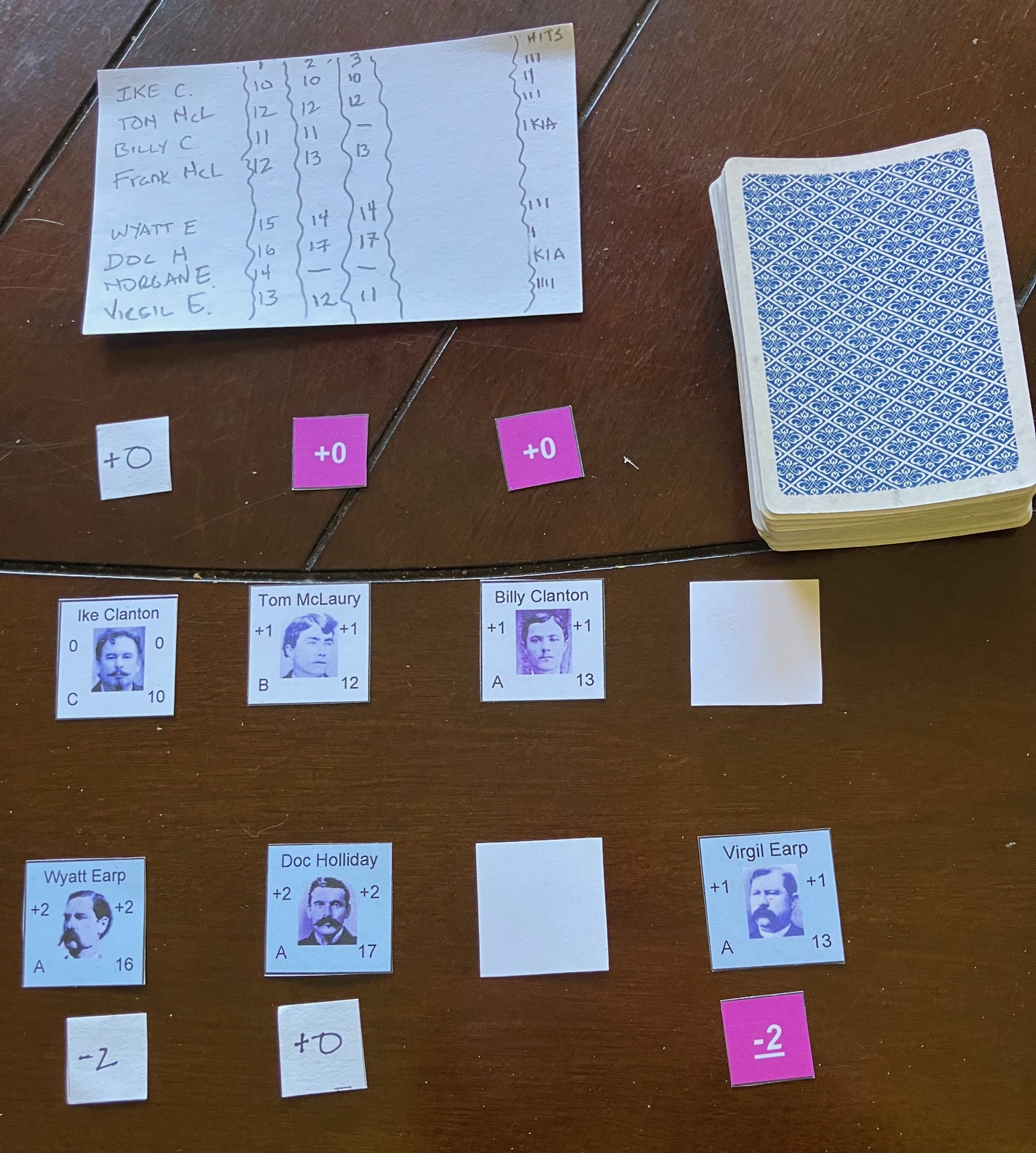
Here’s the feuding factions lined up to conduct business.  I didn’t use the schematic O.K. Corral play area included in the game.  It’s not bad at all.  I didn’t use the two optional allies of the Clantons, which include Johnny Ringo.

The player controls the Earp Faction.  The sequence of play is in phases:  Nominate Targets, Action, Fire Order, Fire.  The Action Phase is skipped on Turn One.

Each participant is rated for Accuracy, Experience (upper right and left, respectively) as well as Morale (alpha) and Gun Speed (numeric).

Accuracy and Experience are used to calculate whether shots hit or miss their target.  Morale is tested for “B” and “C” ratings (which apply to the Clanton Faction) to determine  during Turn One if they fight or run.  Gun Speed determines who fires when in the Action sequence.

The Clanton Faction’s targets are determined (“Nominated”) by the system using a table and six-sided die (this is the only instance where a die is used), while the player nominates the Earps’ targets.  Ranges are short (directly opposed or directly diagonal) or medium (two diagonals).

A modifier chit is drawn for each character before play begins.  This effects the individual’s place in the Fire Order.

Players shoot in a sequence (Fire Order) determined by  the sum of Gun Speed plus the modifier chit.  Shooting is not simultaneous.  So, hits will effect a subsequent shooter’s abilities.  Hits result in a single wound (light), three wounds (major) or KIA.  Six wounds incapacitates a player, or in game terms, renders him “unconscious”.

A deck of  cards determines whether a shot hits or misses, and the location/severity of any hit.  The  To Hit number for all characters is “7”.  This is modified by the character’s Accuracy and Experience ratings.  This modified rating is compared to the value of the card drawn.  If the value of the card is equal to or lower than the final To Hit number, the shooter hits the target.  A King is always a miss, and an Ace always a hit, regardless of To Hit number.   The suit of the subsequent card draw determines the severity of the wound.

A game takes three rounds.  The side with the most participants killed, routed or rendered unconscious is the loser.

I played three games.  While the game is acknowledged to favor the Earp Faction, some ahistorical results occured.  In one game the highly rated Wyatt Earp missed his target on two consecutive turns.  The result was a Clanton Faction victory.

The card use in determining sequence of shooting is one that I will try to incorporate in my hybrid rules.

In summary, this game “is what it is”.  A shootout.  No running, jumping or second-by-second actions (Gunslinger).  The inclusion of 52 additional counters with, photos of characters, including other gunfighters and bystanders allow you recreate any number of historical or theoretical shoot-outs.Of course, one can always cook up a whole bunch or house rules to expand the scope of the action.

The game provides a good value as well as replayability if one is a fan of this genre.