Former clients over for a visit, so the dining room table had to be cleared of my Brandywine Kriegsspiel. Here’s a final look.
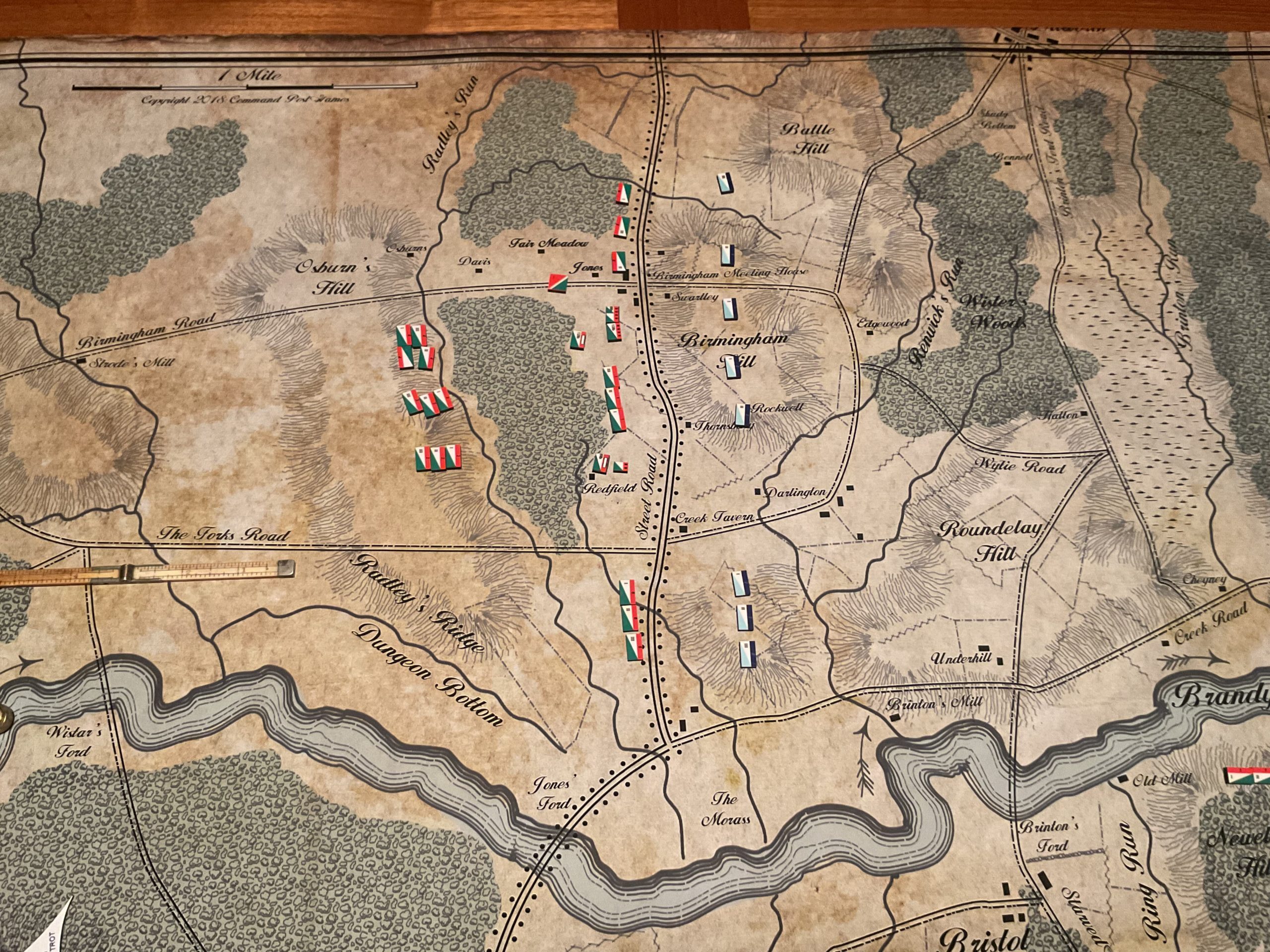
Well, not quite final. I did move the British into melee and that’s where I started thinking about the importance of the Umpire in Kriegsspiel. Not an original or deep thought, but with a twist. Let the rambling begin…….
The Umpire is The Rules. In other wargames you have a rulebook and units with attack, defense, morale and movement ratings. In Kriegsspiel all of these factors are generic. The Umpire decides and/or arbitrates unit capabilities.
For example: How well will units fight in melee? Yes, there are guidelines for the effect of losses, but how well will that unit fight today? Is that simply a product of die rolls, or is there an intrinsic capability for this particular engagement? The rules provide for differentiation in capabilities in certain situations – attacking uphill, across barricades, when tired – but not necessarily between units.
Sure, Continental or British Regular units will perform better than militia and/or irregulars, but how about each regular unit? Are all Continental units inferior to the British in musketry and so use a different die to resolve fire combat? How about melee, an across the board adjustment? At Brandywine, Stephen’s and Stirling’s Continentals fought the British toe-to-toe, while Sullivan’s ran. Yes, they were trying to adjust their position, but what happened?
On top of that, how much research is the player willing to put in to provide a kriegsspiel that takes into account differences that existed on that day? I learned that is very hard work, even if the resources are available.
This leads to the idea that Kriegsspiel is best suited for the generic and scripted encounters. Without an Umpire, the player(s) must decide army or unit capabilities and how they are expressed. What you have is an “ImaginNations” game on a low level operational and tactical scale. Trying for a historical simulation is just too hard.
After all, Kriegsspiel was developed as a teaching tool, incorporating basic concepts/precepts but then crafted to meet, as we used to say, specific “learning objectives”.
So, the next time I pull my Kriegsspiel maps and counters out, I’ll use them to pursue a theoretical situation or, maybe, a historical one, but be satisfied with broad precepts, especially concerning a fighting force’s intangibles.
Hey friend, you know, I recently got interested in the game but I simply don’t know where to start—buy the blocks first or the map, or try to make everything homemade. Honestly, I’m lost with that and also about playing solo, so I don’t know if you could give me a hand with this and give me some advice or help me.
Hello!
I’d suggest googling up The International Kriegsspiel Society website. Lots of information there.
I started out buying the 1862 rules PDF from Too Fat Lardies. I then bought their PDF Meckel map, as well as the Photon Cutter Studios introduction block set. So, for about $75 I was set to play. I later purchased the Kriegsspiel dice from Command Post Games. Command Post also has some interesting maps. Their Table Battles maps can be used for Kriegsspiel. The site explains how. I always play solo with each side having specific orders/objectives.
Hope this helps. Post back if you have followup questions.
Thank you very much for responding, but I have another question: in what way did you print the map from your previous publications? I have been looking for some way, but they all seem to lead nowhere. Thank you for your attention.