After a break, I continued playing the initial encounter between the Portuguese and Zanj.
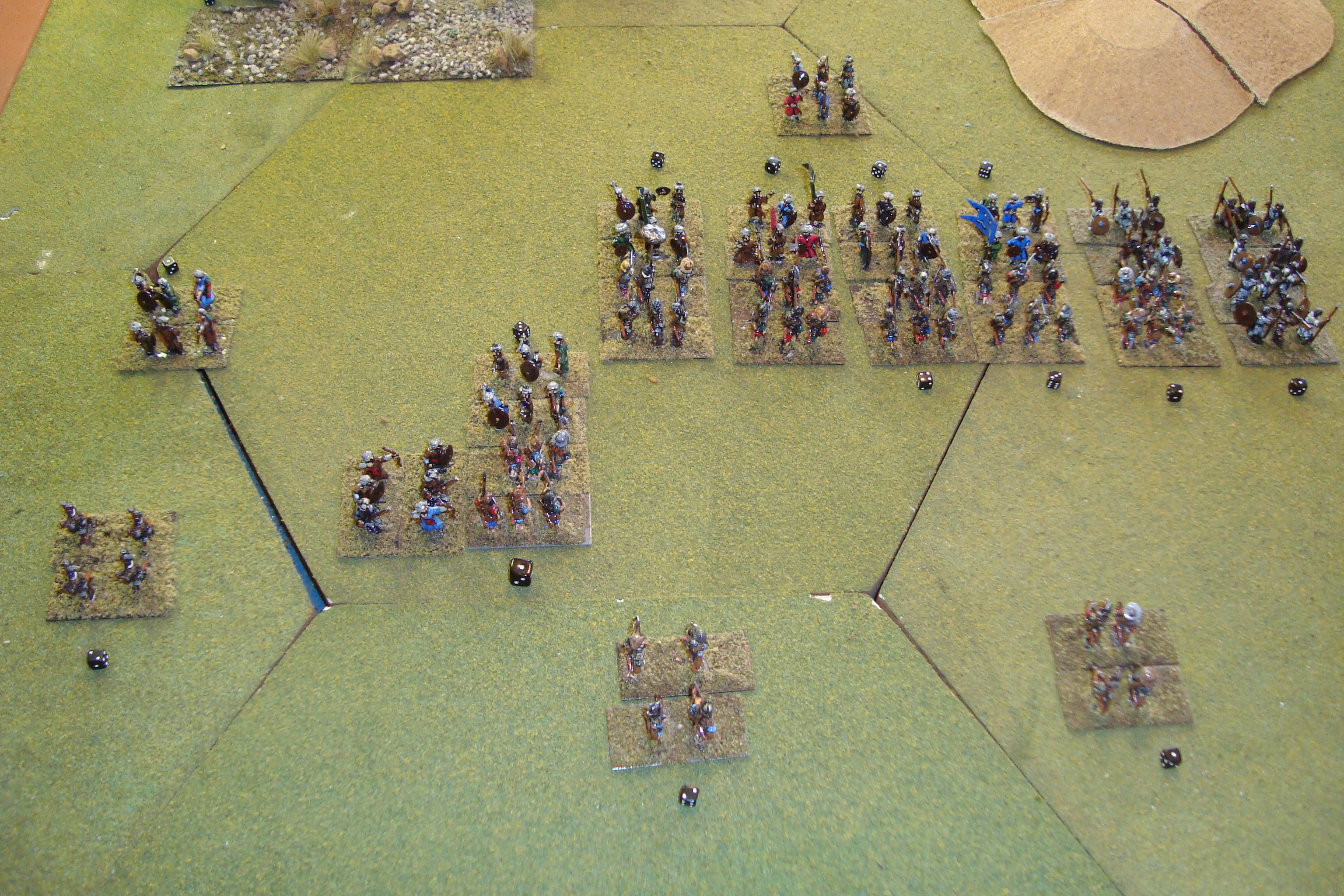
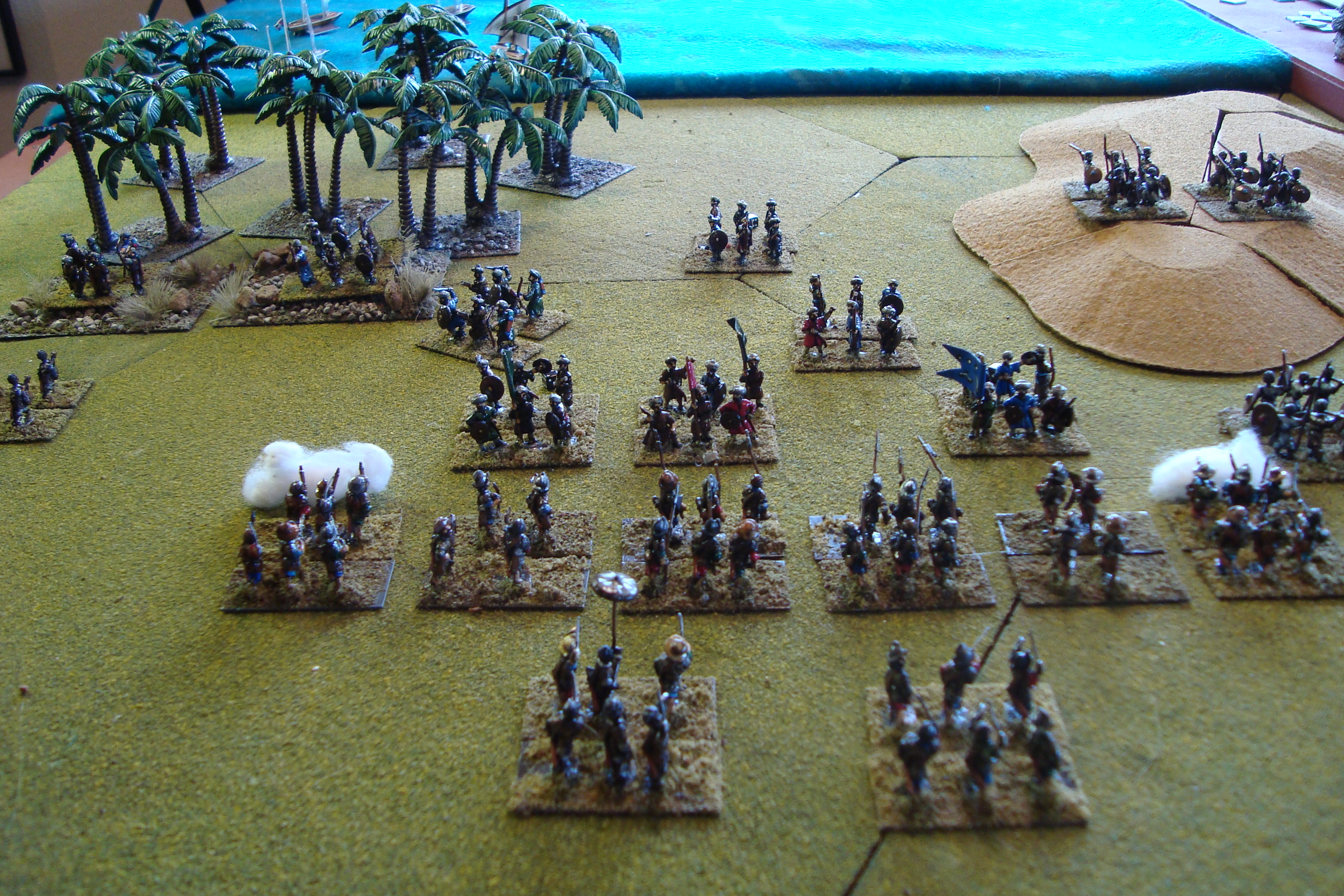
The battle turned into a real slug-fest, with the Portuguese Crossbowmen able to extricate themselves from melee, and the Targeteers, led by Lord Rolando, charging into the Zanj tribesmen. On the left, the Zanj had enveloped a Portuguese Musket unit. But wait…..there was something very, very, very wrong…….Take a look at the picture, which shows a real pounding in progress, but then read the caption.
Hey…All You “Ones”, You’re Wavering……Get Out Of There, Now!
Yes, I completely screwed up the rules (Shocking!). Once resolve drops to a “one” a unit must withdraw 1d3 movement units directly to its rear, maintaining its facing, and cannot initiate melee until its resolve increases. And, if this unit was in melee (as are all of these), its foe can attempt to pursue.
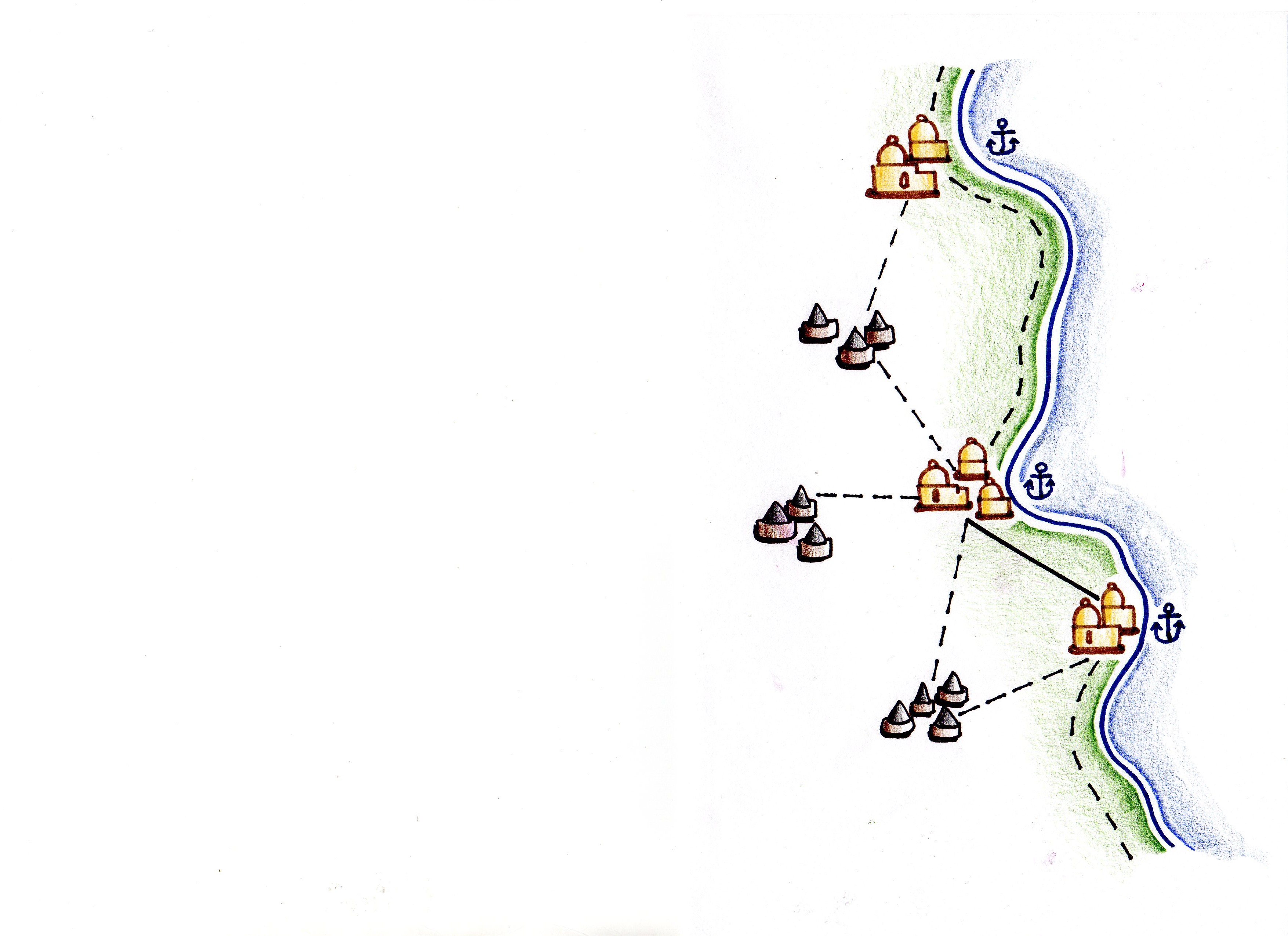
Rhonda drew up a nice generic campaign map based on my ham fisted scrawl. Put it on a half sheet so other half could be used for notes, etc. The southern two cities are connected by a good road, the others with tracks. Cities, road, tracks can be removed when necessary.
The Portuguese completed an unopposed landing, without loss, and advanced along the coastal track towards the northern port town of Mwenye (I used a random name generator which is found here). Since the inland natives’ relations with the coastal Zanj are bad, the Portuguese inland flank is secure.
A Zanj force moved to block the advance, with the two sides meeting at the forest/oasis of Ejiro. This would be a set piece battle with the Zanj occupying a fairly strong defensive position. However, some Zanj units were effected by an cholera epidemic. As a result, their resolve was lowered, while skilled medical care kept the Portuguese healthy.
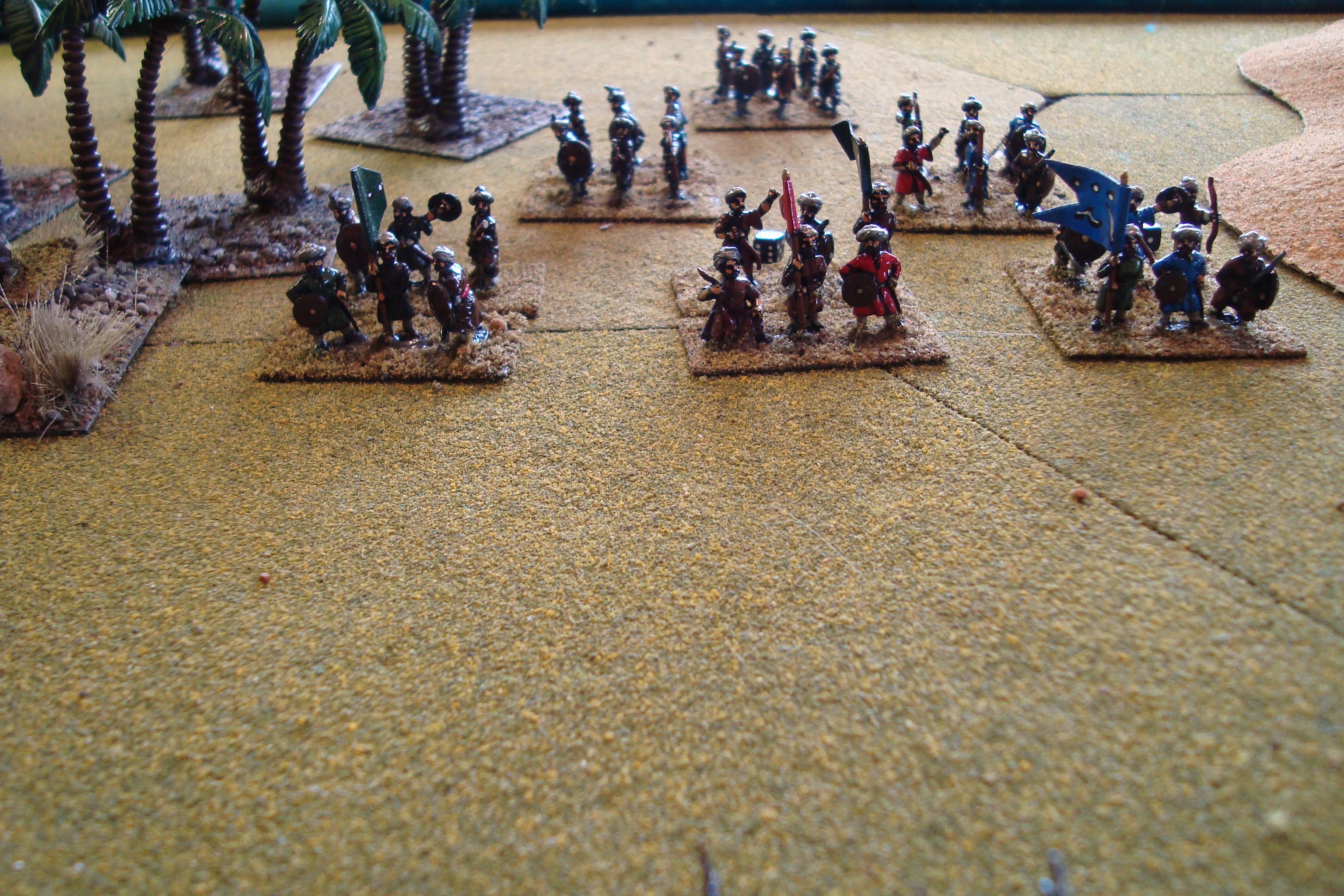
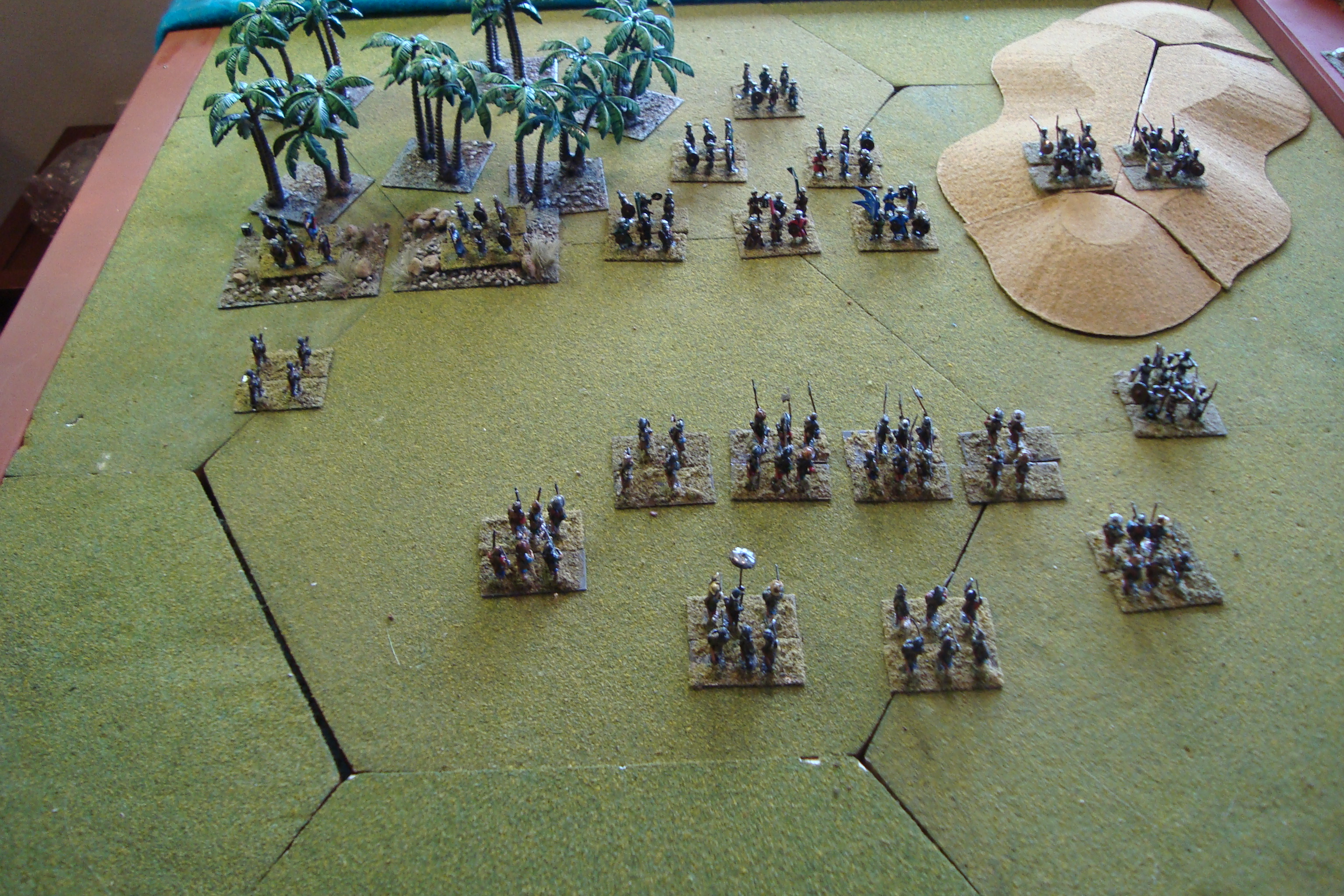
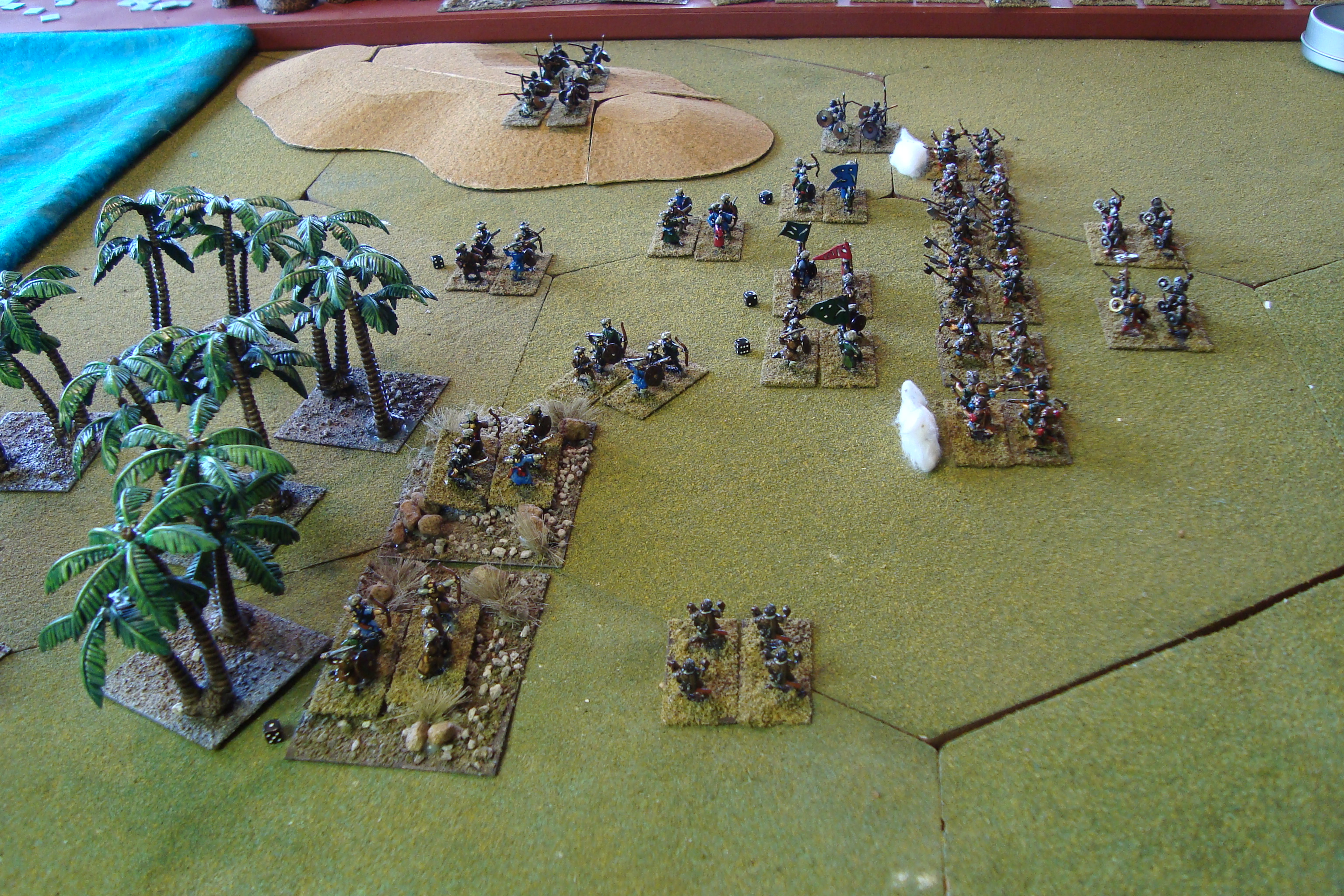
Here’s a pictorial overview of the initial stages of the battle.
Flanks Anchored By Rough Ground And Ridge, Zanj Tribal Warriors Await The Portuguese AdvancePortuguese Advance Begins. Grenadiers On LeftZanj Advance In Response To Portuguese FireAnother View Of Zanj Advance. Interpenetration Not Allowed By Rules.
Ignore this link. It is/was badly flawed. Please see post for 11/27/16
Put together a legible and semi-lucid outline of the campaign set up discussed (and badly presented) in previous posts. It’s a work in progress, but here’s the link.
Rolled for leader qualities and other parameters. Rather than insult you with another scan of scribbled fragments of index card, I’ll post up a “clean” copy of the tables/charts used. Tried to link the variables to the Irregular Wars Chance Cards, with outstanding aspects allowing for good DRMs, and poor aspects leading to bad DRMs. Normal is just normal, with no DRMs. Card use has been difficult to implement solitaire and I hope this is a viable alternative.
Ming Chinese:
Lei Qiu: An inexperienced leader, but bold. Staff includes a skilled logistician and physician.
Portuguese:
Eduardo Nicolau Rolando: Experienced and inspiring leader. Staff also includes skilled logistican and physician. Also, the Portuguese have good local knowledge, which negates many effects of unfavorable terrain.
Relations with natives are bad. They will fight if attacked. There is internal dissent, and government support is weak. This weak support limits their army to 10 elements.
Their leader, Jabir Efe, is inexperienced but bold. Being the home team, they have good local knowledge.
Neither side was able to recruit any natives to augment their forces.
The respective armies are based on both Irregular Wars and DBR lists, given what I have available. Oh My! I’m not following an army list. After years and years of therapy I’ve finally made the jump of just putting something together that has some historical basis and works. Thank Goodness for that.
Decided to stop at Turn 12. British ships that had been standing off the port waiting to evacuate commandos had been destroyed, the demolition teams had, for the most part, expended all their charges, and the German reaction forces were sealing off any other VP targets. So, I blew up the Campbeltown and called it quits.
The tempo of the game really picked up with fewer targets and lower to hit DR for Harbor Defensive Fire.
Took turn-by-turn photos, but all they depict is the pummeling of MTBs by Harbor Defensive Fire, and gunfights between reaction forces and commandos. The highlight was the Turn 8 destruction of the Northern Caisson by Purdon’s commando using their last charge, after being attacked. They needed a D6 roll of “1” to do it, and they did. That was 12 VPs! On the other hand, Woodcock’s commando couldn’t destroy even one of the three storage tanks in Sector 1. Each tank was 3 VPs, and would have put me in range of a decisive victory.
I’m going to play it again. Here’s an overview of lessons learned and rules I need to pay more attention to.
Destroy searchlights and guns, or at least, hit the Power Station. The illumination effects make the already murderous Harbor Defensive Fire even worse. Grenade attacks on guns/searchlights are an excellent use of assault teams.
Do a better job of getting demolition teams to their historical targets. I just whiffed on this one and if they attack their assigned target, it’s a +1 DRM for demolition attacks.
Pay attention to the rules on ammunition depletion when a commando loses a strength point. This effects grenade/demolition capabilities.
Try to get the Wynn to accomplish its historical mission of destroying lock gates. I had to use other boats for this.
Don’t assume that the German reaction will be as slow and weak as the last game. Lots of D6 rolls of “6” really restricted reaction movement, and low rolls for activation reduced the number of German units.
Rather than grind through the move-by-move, here’s a few overall comments about the game play using the rules as a guide.
German Harbor Defense: Has been effective, especially during Turn 3, when 9 targets were hit using D6 to hit roll of 5 or less. The maximum possible is 12. Change to less/equal D6 of 4, literally saved the British.
Covering Fire: Useless for the British. Need a 2D6 of 8 or less, and I’ve been rolling 8+. Also, the mods due to loss of flotilla gun strength has not helped my rolls.
Dockside Defensive Fire: A mixed bag for the Germans. Some successes, but limited. Not the weapon that Harbor Defense is.
Open Sea Combat: So far, one British ship has escaped without contact. More to follow.
Scuttling: I scuttled the Campbeltown on Turn 4 and took off the surviving crew. While this will help with VIPs, it severely reduced the flotilla firepower (see Covering Fire, above). BTW, the Campbeltown took very little punishment before ramming the Southern Caisson.
Torpedo Attacks: Despite low probabilities (1-2 on D6), torpedo boats knocked out two swinging gates, for 8 total VIPs.
German Activation/Movement: Started slowly, but more and more Germans are available. Unfortunately for them, I’ve been rolling D6 6s, so only those units with a strength of 6 can move. This has severely hampered the reaction forces.
British Land Movement: Managed to foul up the objectives for some units, so some moves have been counterproductive, and have effected the ability of units to quickly get to lucrative targets – especially the 12 VIP Southern Caisson. I’ve not done a good job of mixing and matching assault (small arms and grenades) with demolition units, especially when attacking flak positions.
Grenade Attacks: Once I figured out that assault units can do these, they’ve been fairly successful taking out flak positions.
Demolition Attacks: Success on first try has been 50-50, with the key being to have the demolition unit end their move at the target and not take the +2 modification for entering the area during the turn.
German Ships: Haven’t messed with them.
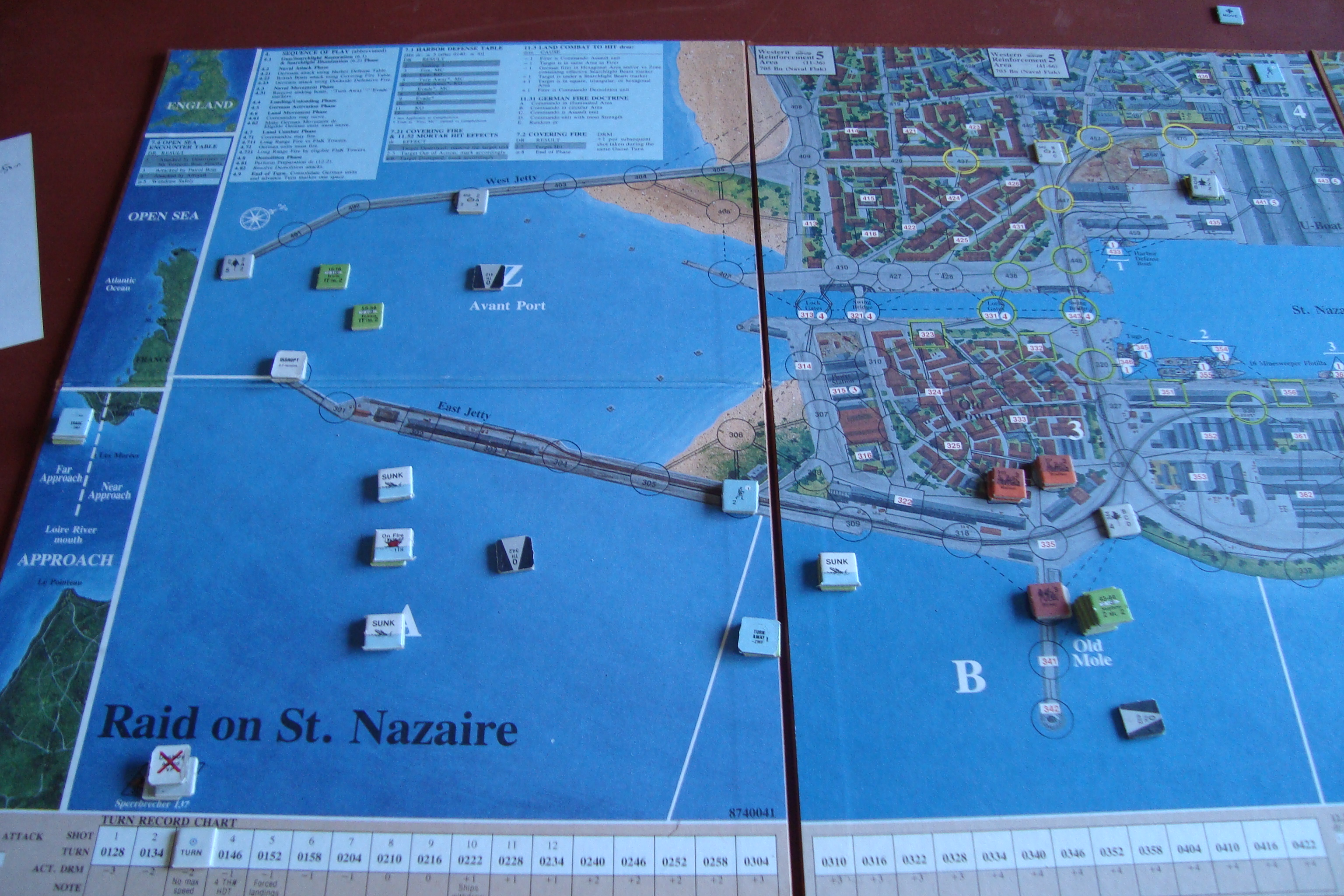
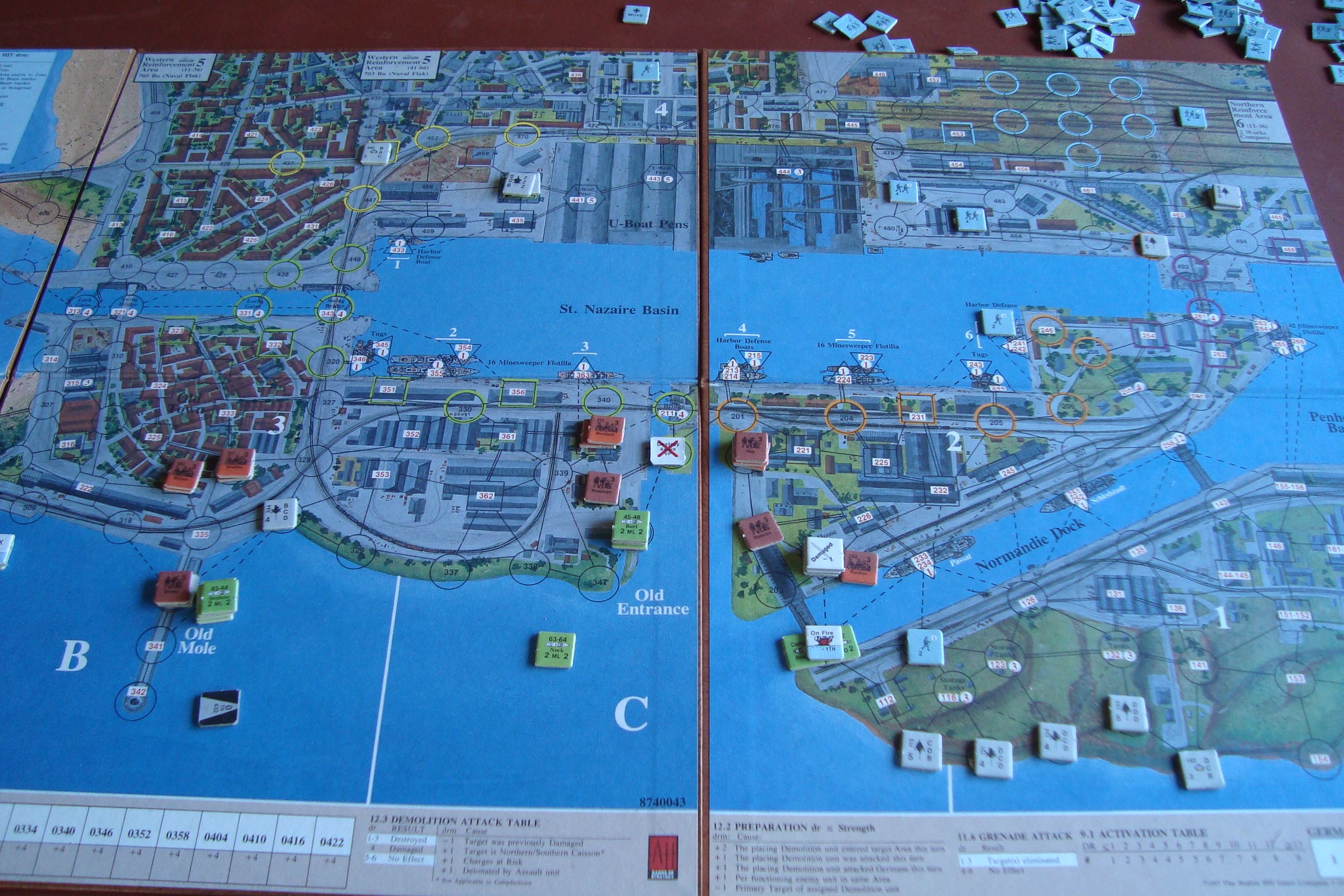
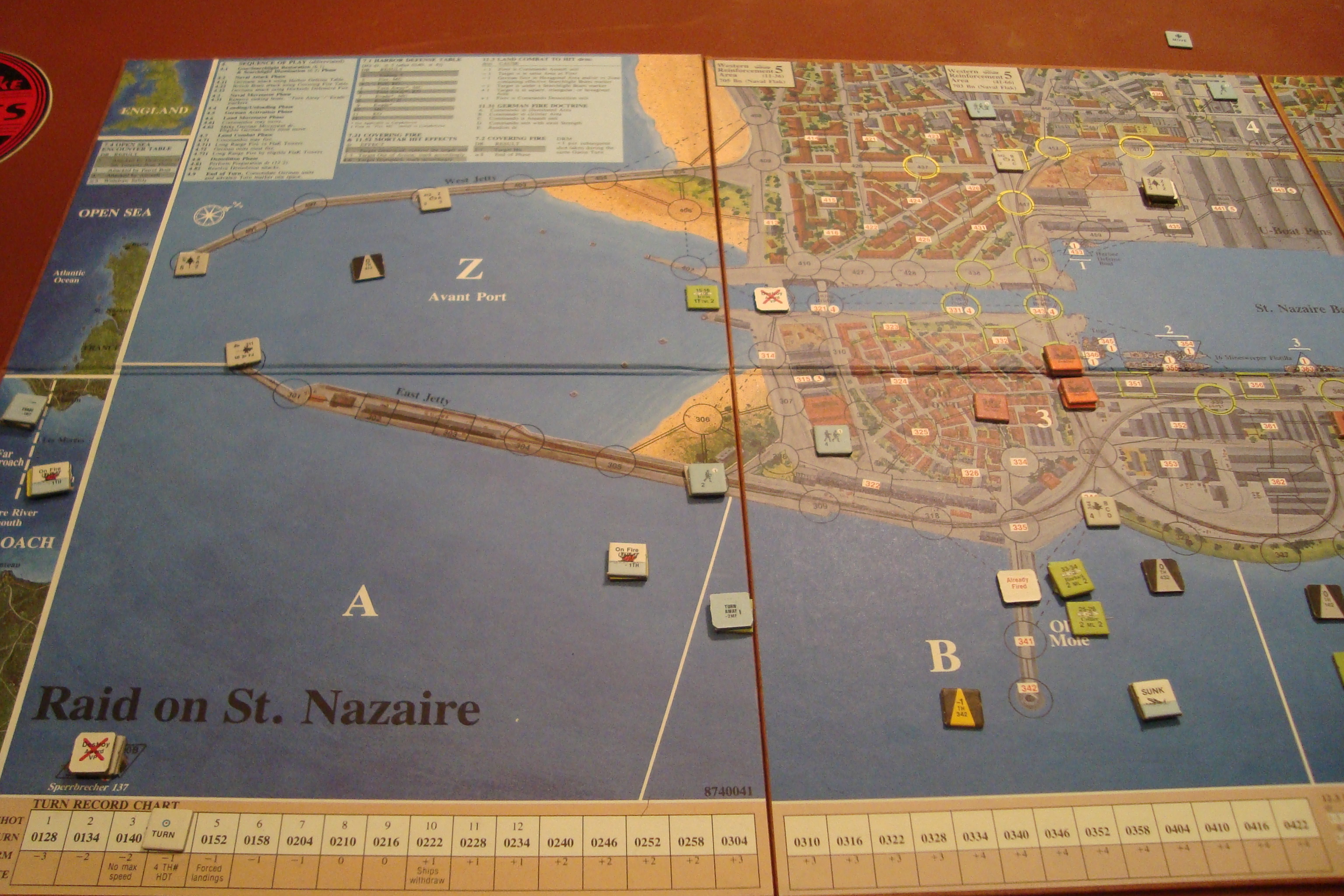
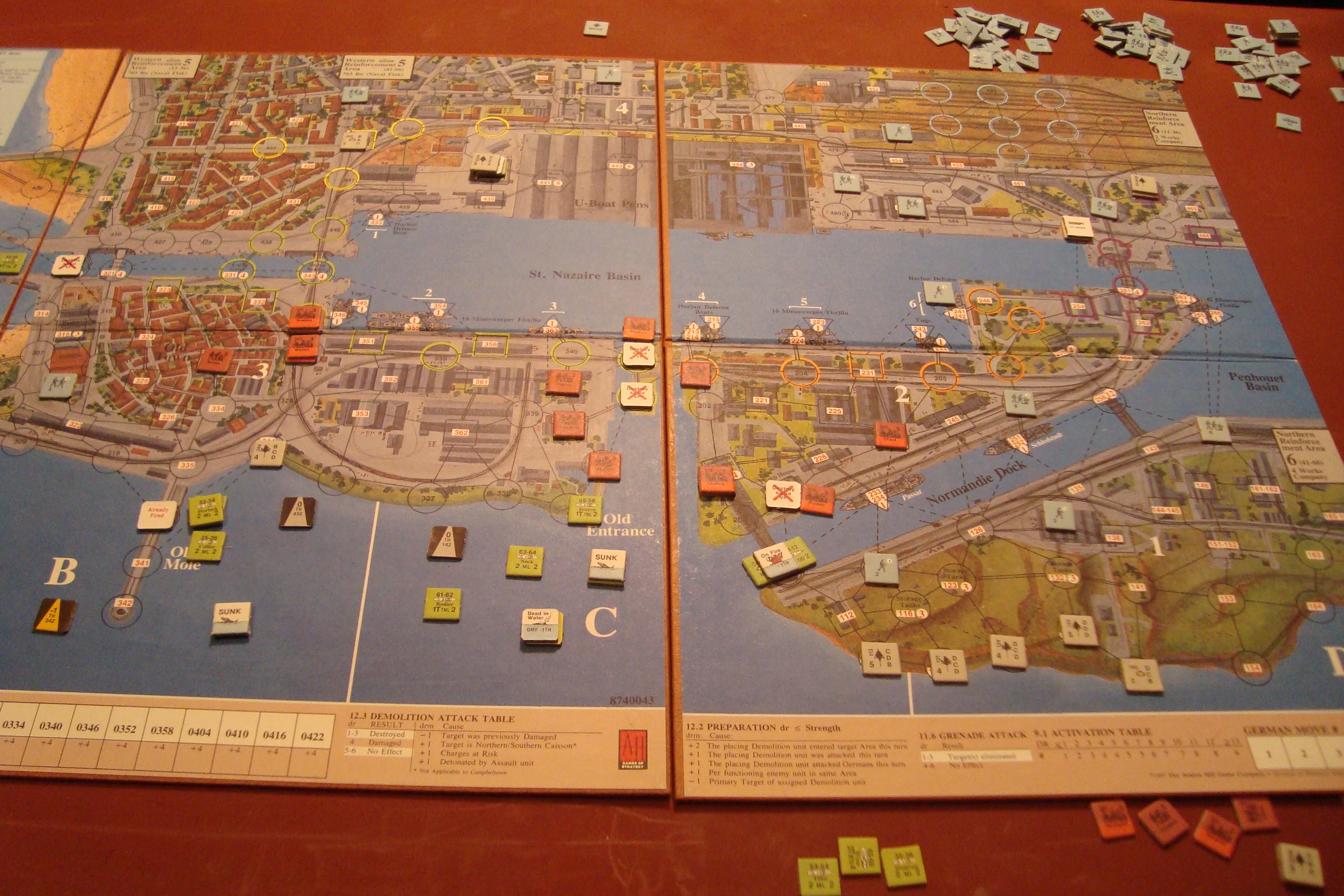
End Turn 3 Western Half of AOEnd Turn 3 Eastern Half of AO
Started landing during Turn 3. Sent two MTBs into the Avant Port (Zone Z) to attack gates. Plenty of carnage from Harbor Defensive Fires.
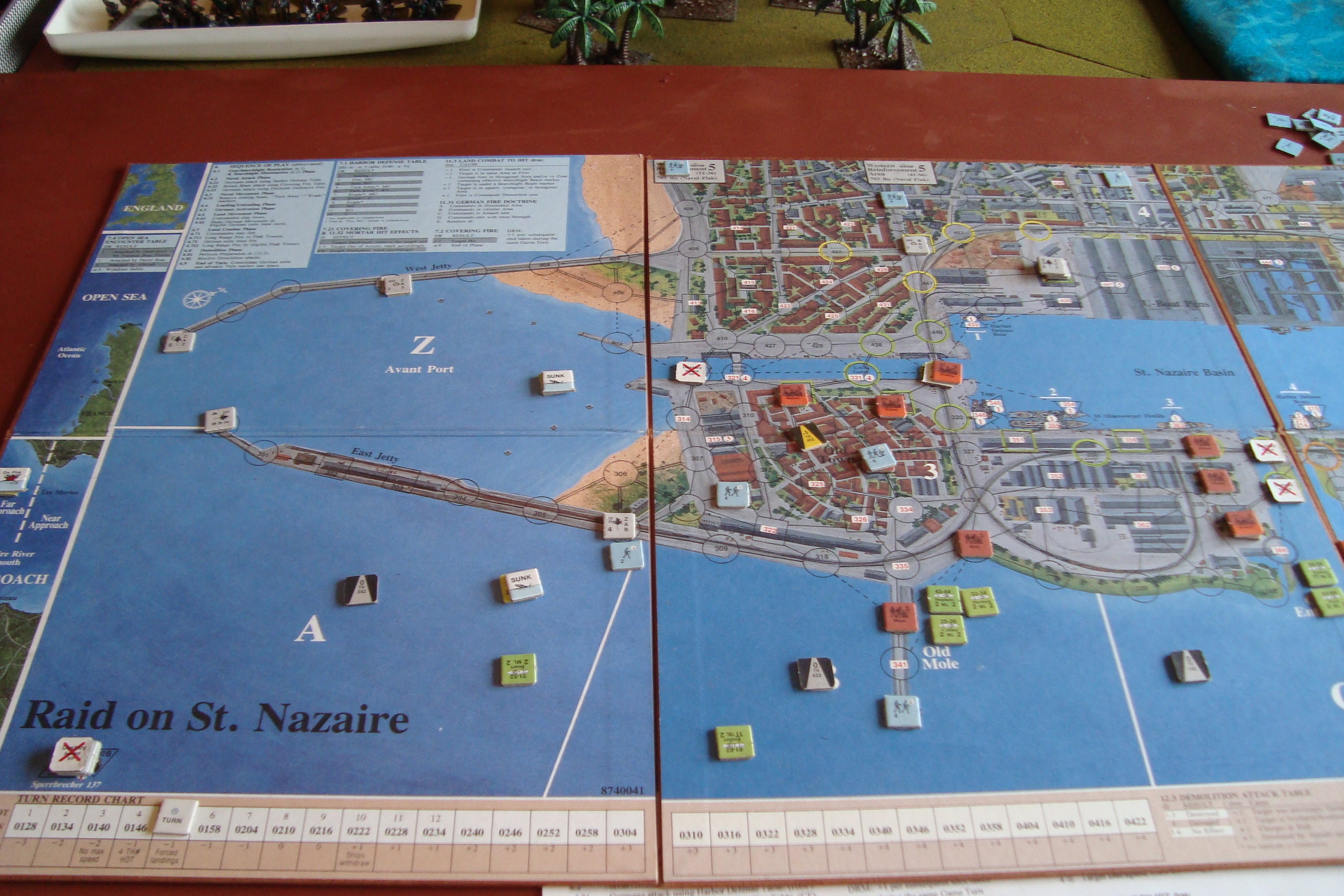
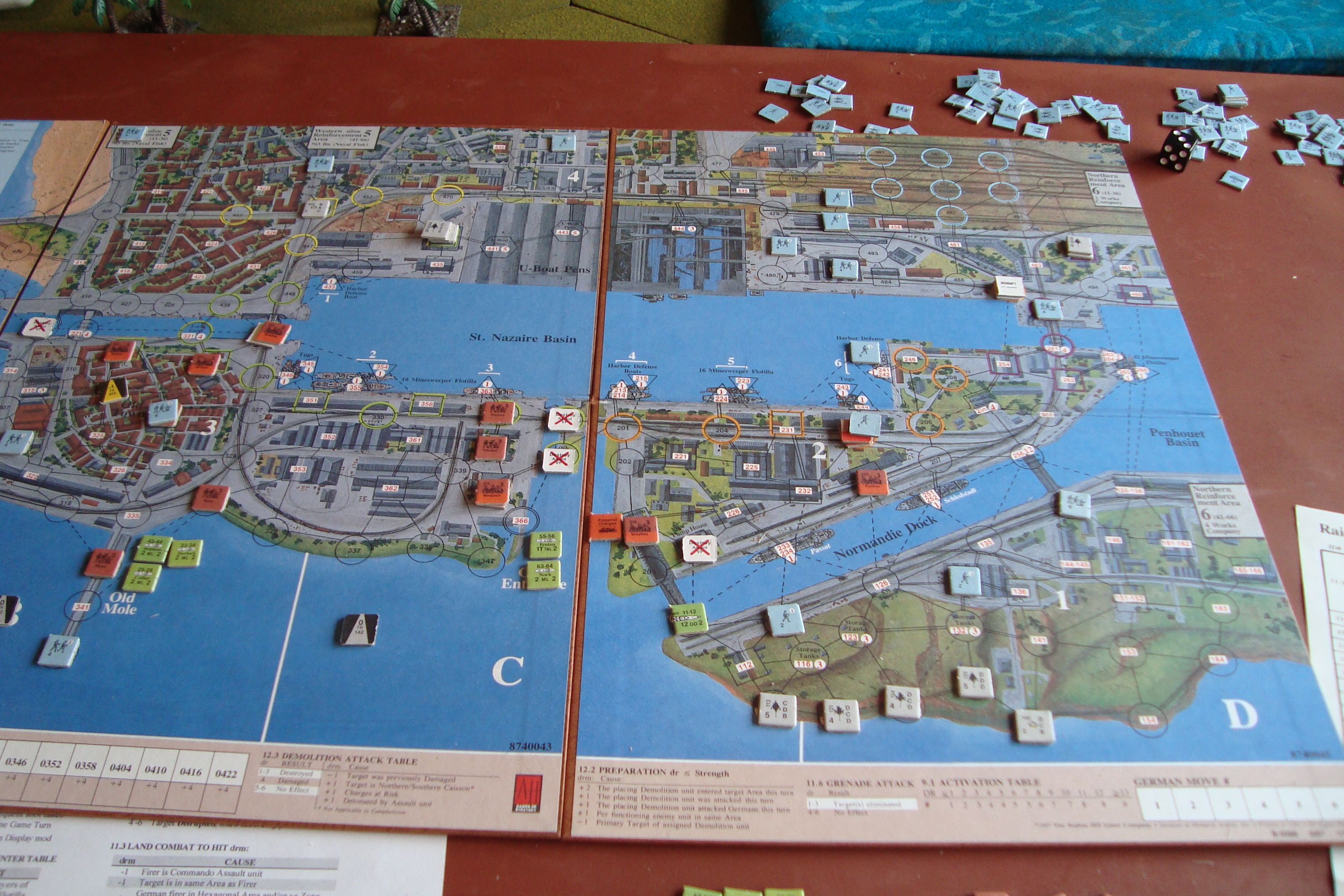
End Turn 4 West Half of AOEnd Turn 4 East Half of AO
Carnage in Zone B and C, but most Commandos ashore with attacks developing with some successes. Effects of German reaction are minimal.
End Turn 5 West Half of AOEnd of Turn 5 East Half of AO
Started evacuating troops back to England, moving back to Zone A. Commando attacks spreading out, more targets destroyed, but German reaction is becoming a problem, with more troops flowing towards the assault and demolition teams and, especially, those moving towards the South Caisson. I have a few boats lurking at the embarkation points anticipating debarkation there.
Used the cards shown in my Zapped! post to get the East African Renaissance Campaign off dead center.
Worked fairly well, but the results were mundane. Had been hoping for a civil war situation, which is the result of both colonial powers being supported by the Zanj or Inland Natives.
Here’s the results:
Ming Chinese
Natives are helpful neutrals, and will provide access to their cities and supplies. The Zanj are neutral but open to other offers. Government support is weak, and their initial troop strength is 10 bases. Their primary objective is a port, with inland towns as their secondary and tertiary objectives.
Portuguese
The Natives are neutral, but open to others. The Zanj are uncooperative and will fight if attacked or territory occupied. The Portuguese also have weak government support, and only 10 bases. Their primary and tertiary objectives are ports, with an inland town a secondary objective.
I’ll start using the Irregular Wars rules to set up some operational parameters.
Just getting started is one of the toughest aspects of wargaming. Sometimes, reading the rules (or just skimming them) seems to be an end in-and-of itself. What a trap! No, you have to play the damn thing, and the first two turns will be laborious with the rules in one hand, and charts in the other, but, if it is a good game, you’ll start looking forward to playing it. If it’s not good…..either another try sometime in the future, or recycle it.
Had one very abortive half-turn, and then finally figured a few things out. Again, the replay really helped.
Took relatively few casualties on Turn 1 (and this game goes for undetermined period of time – until the last British unit is eliminated and/or withdrawn). This is part to two luck hits on German defenses. The Campbeltown is burning (inevitable), a few boats had turn-away results, but only the Falconar is on fire. The Boyd badly hurt the German defenses by managing to sink the flak ship Sperrbrecher, with its two cannon batteries. I’ve got four boats, and the Campbeltown moving towards their landing areas.
Not a bad start. Will start Turn 2 after today’s ballgames.
Finally back at the Pine Cone Lodge, and have spent the past few days setting up projects for the Fall gaming season.
My IPad locked up over the trip and required drastic measures to return to operational condition. And yes, I had not backed it up. Stupid. In a flash, I lost all my back issues of Miniature Wargaming and lots of other stuff.
Stung and motivated, decided to plow ahead with my Renaissance East Africa campaign game without notes and resources. Set up a solo-decision making chain for the initial scenario.
The overarching concept is that the Ming Dynasty continued their ocean going voyages when proposed in 1477. They encounter the Portuguese as far north as Malindi, Kenya circa 1510. The Chinese had visited this city back in 1417, with the Portuguese arriving in 1498. I don’t have Kenyan native figures, but I’ll make my other Sub-Saharan forces do.
The rough/beta decision making chain shown here involves the reaction of Inland Native and Coastal ArabZanj trading cities. Will they ally themselves with one group, cooperate, or remain strictly neutral? OK, it’s backwards, but the scanner is cranky.
Other considerations to be worked on are levels of government support, and reactions of groups that might lead to a civil war.