Fifty days or so since the last post. Not that things haven’t been going on, just haven’t posted up. So, we’re going to binge over the next couple of days with some followups to earlier posts and new business.
Here’s a laundry list of new and on-going projects that have evolved/hatched over the past 45 days. Some real old school in here.
Old West Gunfights – 1/72 Figures and Terrain
Sword and The Flame – Boxer Rebellion With Old Minifigs (and some new recruits)
Traditional Miniatures – Flat Figures, Charles S. Grant and Peter Young classic rules.
Convert DBA to WRG 5th Edition – Dark Ages and Late Medieval
Larger Kriegsspiel Games – Additional Regiments and Other Types of Units
15mm Colonial – Old Minifigs Used With Arab/Turks for Victorian Campaign.
Getting the twitch for some new miniature games, but with minimal budget outlay.
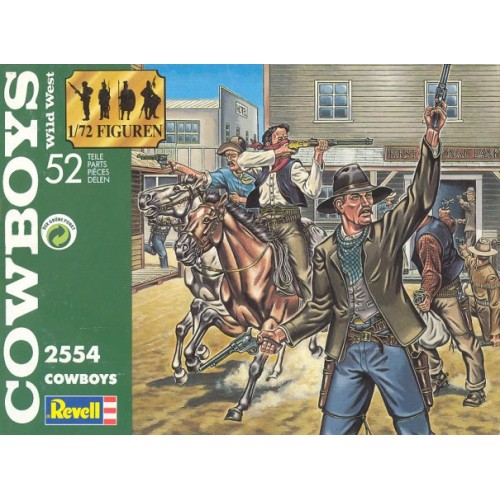
First quasi-project is Western Gunfights using the Fistful Of Lead (Reloaded) rules. They’re available over at WargameVault. My real hope was to use them with smaller 10mm figures. No real options there. Tempted to work with 20mm “Punitive Expedition” figures, but that’s a pricey proposition for what could be a “one and done” game. So, found this at the local vintage toy store.
Cheap, can fabricate some buildings, and if it’s fun……go to the more expensive option.
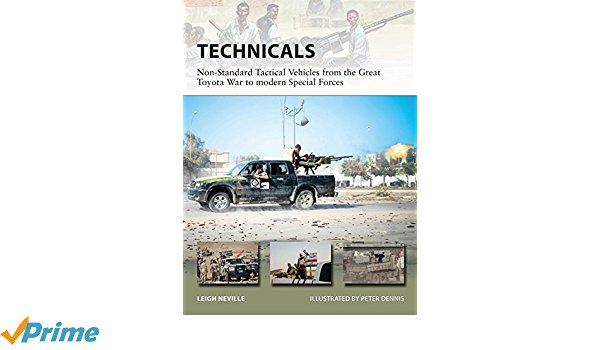
Also purchased an Osprey title on the Technical vehicles.
Now all revved up (no pun intended) on a miniatures treatment using 1/285 GHQ vehicles. Again, pricey, but no real options for low cost tactical minis. Very, very tempted.
TAD at The Sunfish Capitol Of The World. It’s a holding area for some of my older AH games. Never know when there will be a couple of boring rainy days.
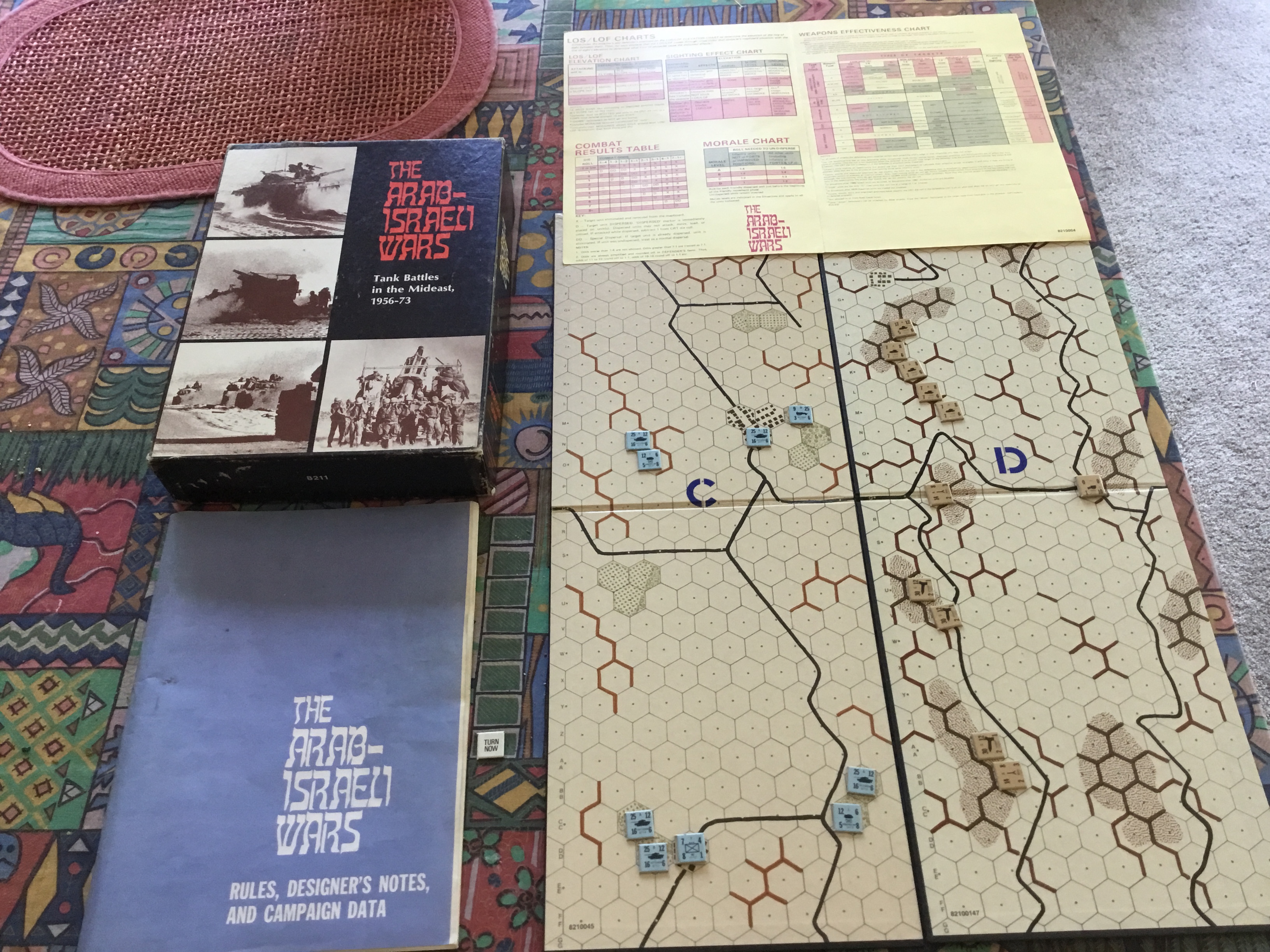
Set up The Arab-Israeli Wars, the final iteration of the Panzer Blitz Series. When I opened the box, I discovered three old envelopes containing the counters for Situations (they didn’t call them Scenarios back then) 2, 3 and 4. Have no idea when I last played. So….start at the beginning.
Before all of that, I read the rules. Three levels; Beginning, Standard and Advanced. Each layers on unit capabilities and additional types of units, even including fixed wing and rotary aircraft. The usual foodgroups for tactical armor games; direct fire, indirect fire, overrrun, and close assault.
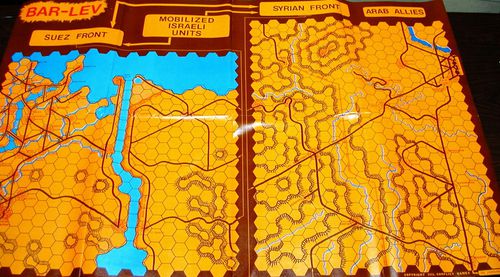
Scenarios reflect increasing complexity and number of units. Counters are large and easy to read, maps are bland, but functional. On the other hand, what can you do with the desert? Well, someone did get creative with Bar Lev.
(In)Famously Psychadelic!
In short, what’s not to like for a reasonable armored combat simulation that doesn’t bog you down?
My only gripe is that the charts are on a double-faced fold out requiring all kinds of fiddling to work with…..and some genius included the turn track. But, the genius did add dotted lines so the track can be cut away from the charts.
It’s sunny now, but will still get in a few plays. Here’s a photo of the whole shooting match. Excuse the E-Bay Listing Approach.
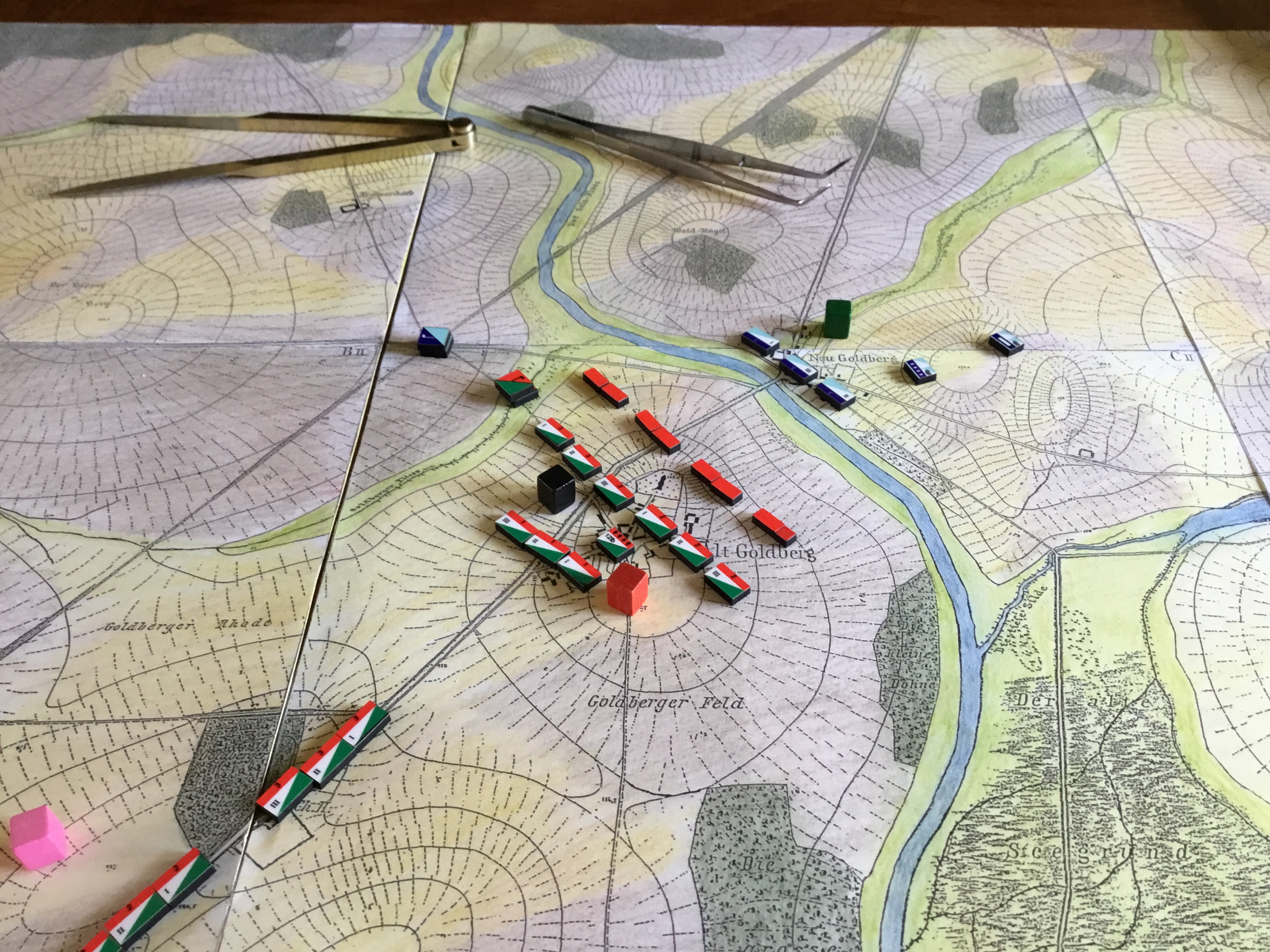
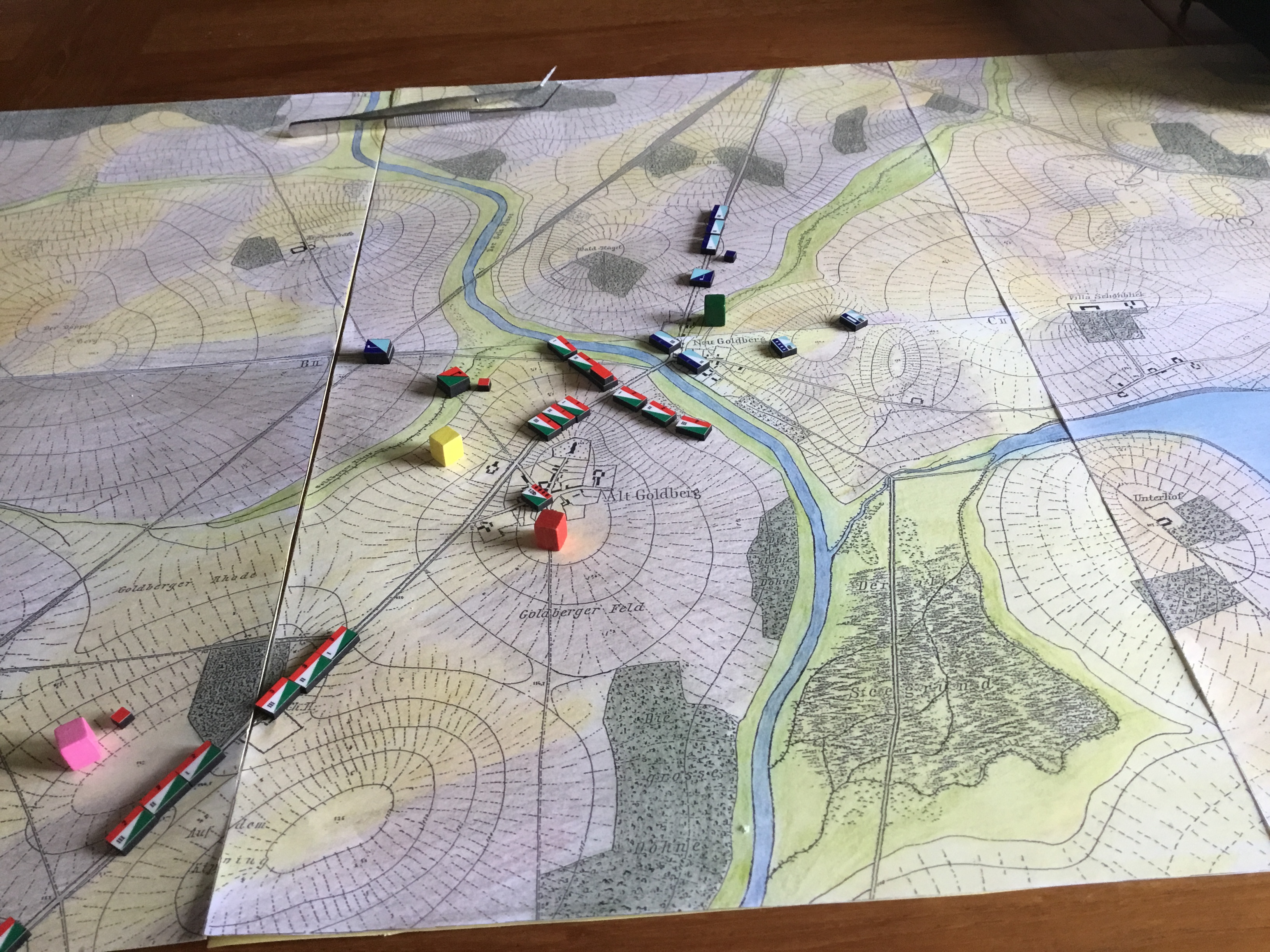
Really enjoyed starting up a Kriegsspiel scenario.
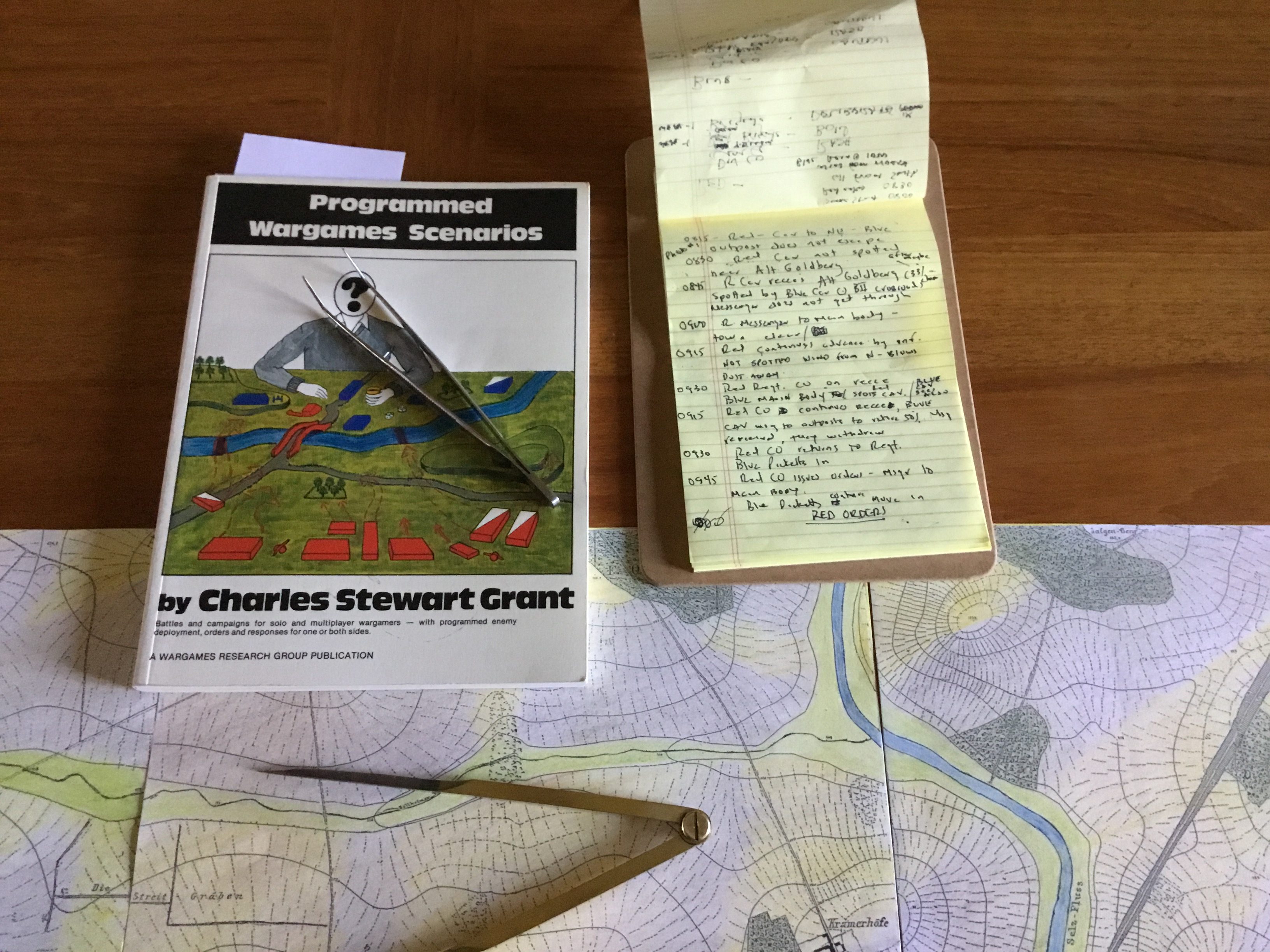
Used the old Programmed Wargame Scenarios book. One of the first to introduce random events and personalities into a solo-friendly context. Also used a log to keep track of events.
KSpiel is intuitive to me. Work with the maps, the contours, basic concepts involving reconnasiance, and security, as well as some period knowledge about Prussian tactics. The latter is covered in the Two Fat Lardies rules.
This allows you to just play the game.
I used a company scale, with three to a battalion, three battalions to a regiment, with three regiments to a division. Each side had one division of infantry, along with attached cavalry squadrons.
The scenario called for Blue to have an advance force at a river crossing and to hold that crossing until reinforcements arrived. Red’s mission was to take the crossing. Both Red and Blue reinforcements (variable timing) had to enter the map from a programmed point (die determined).
I changed the scale from the prescribed 2 minutes per turn to 15 minutes, with an adjustment to movement rates. Risk game blocks designated regimental and division commanders.
Here are a few photos. As always, had to pack it up to go somewhere else.
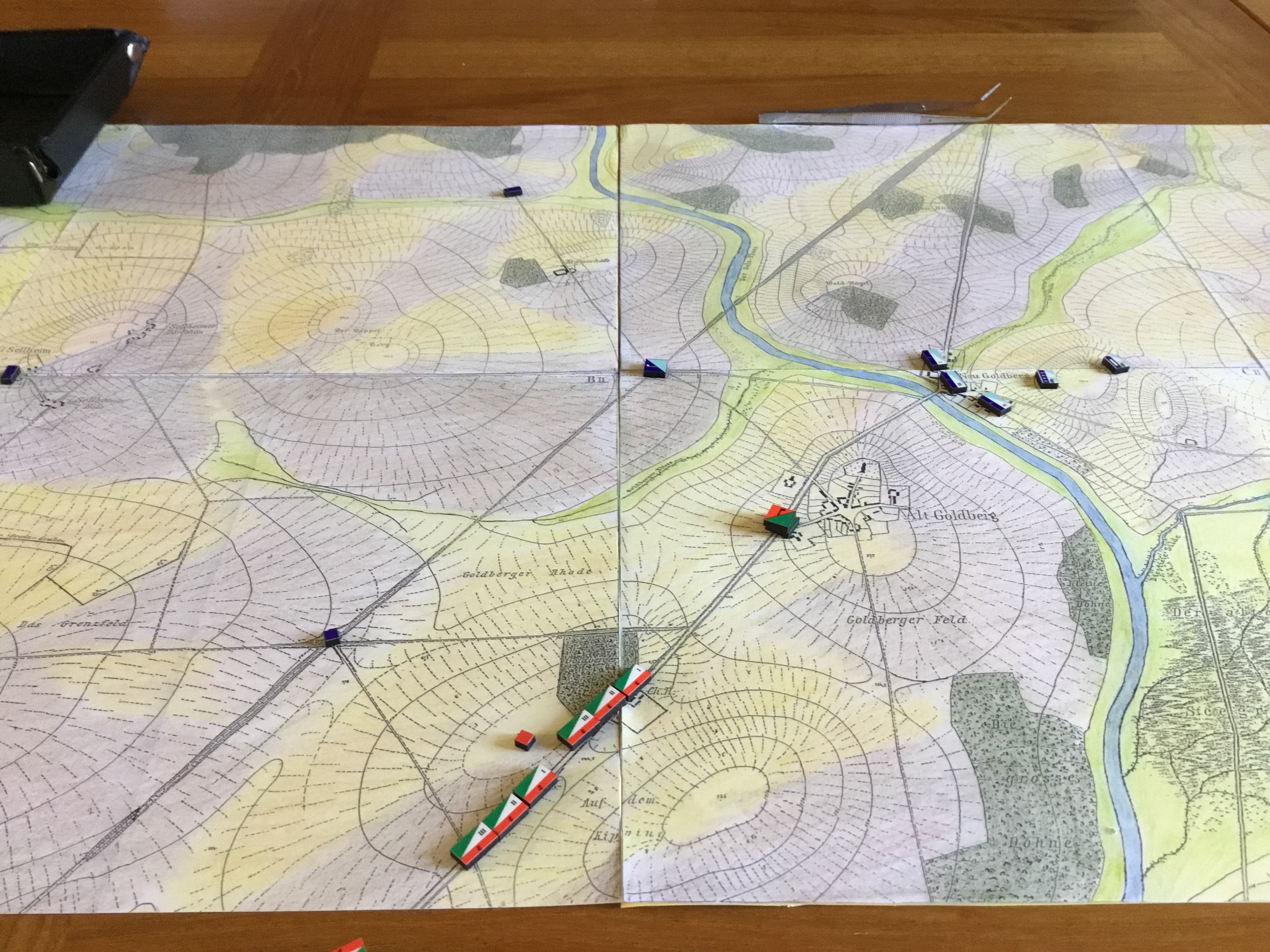
Red Cavalry Occupying Village While First Regiment Advances. Note Blue Cavalry Picquets.
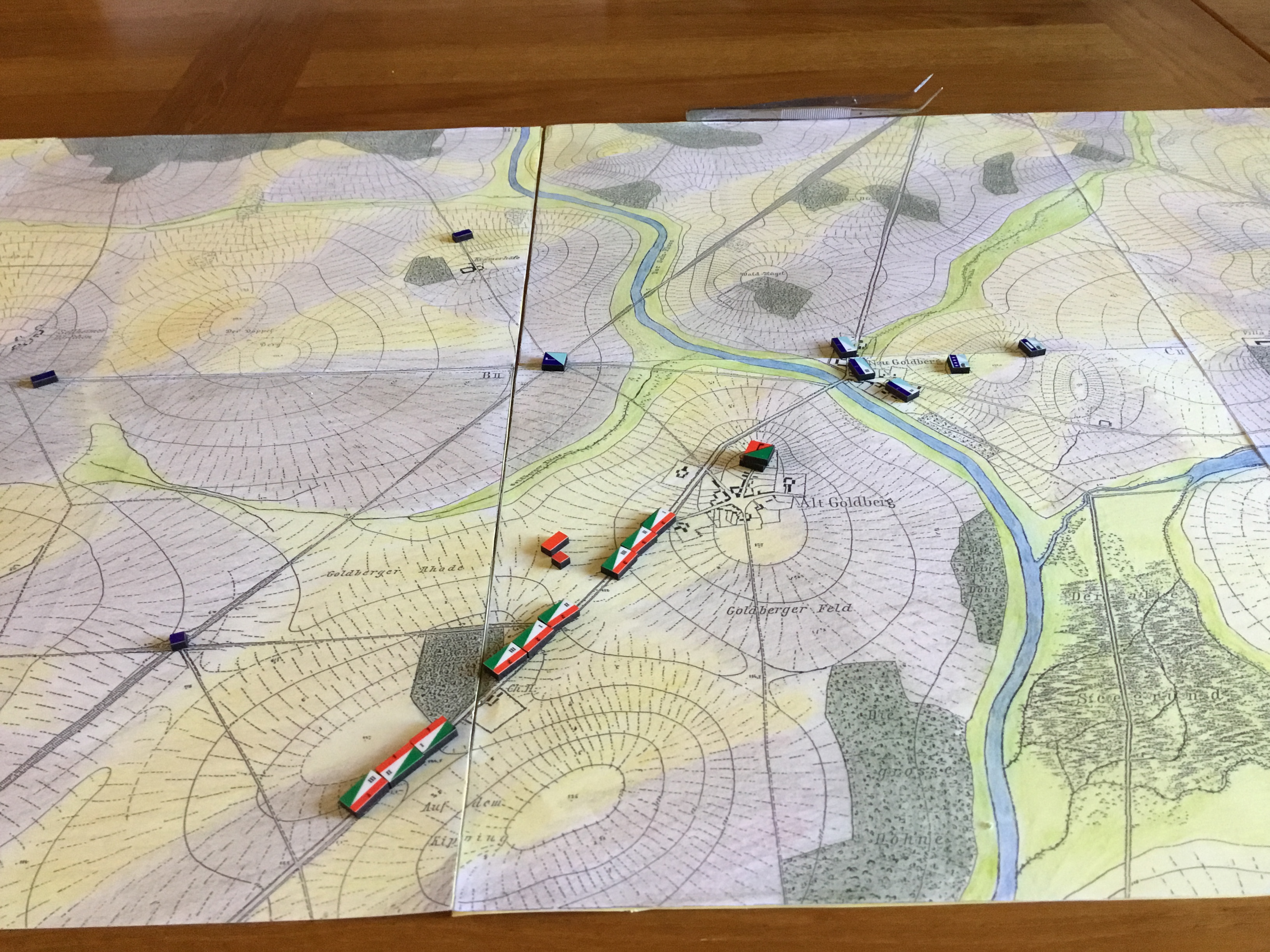
Red Continues Advance.
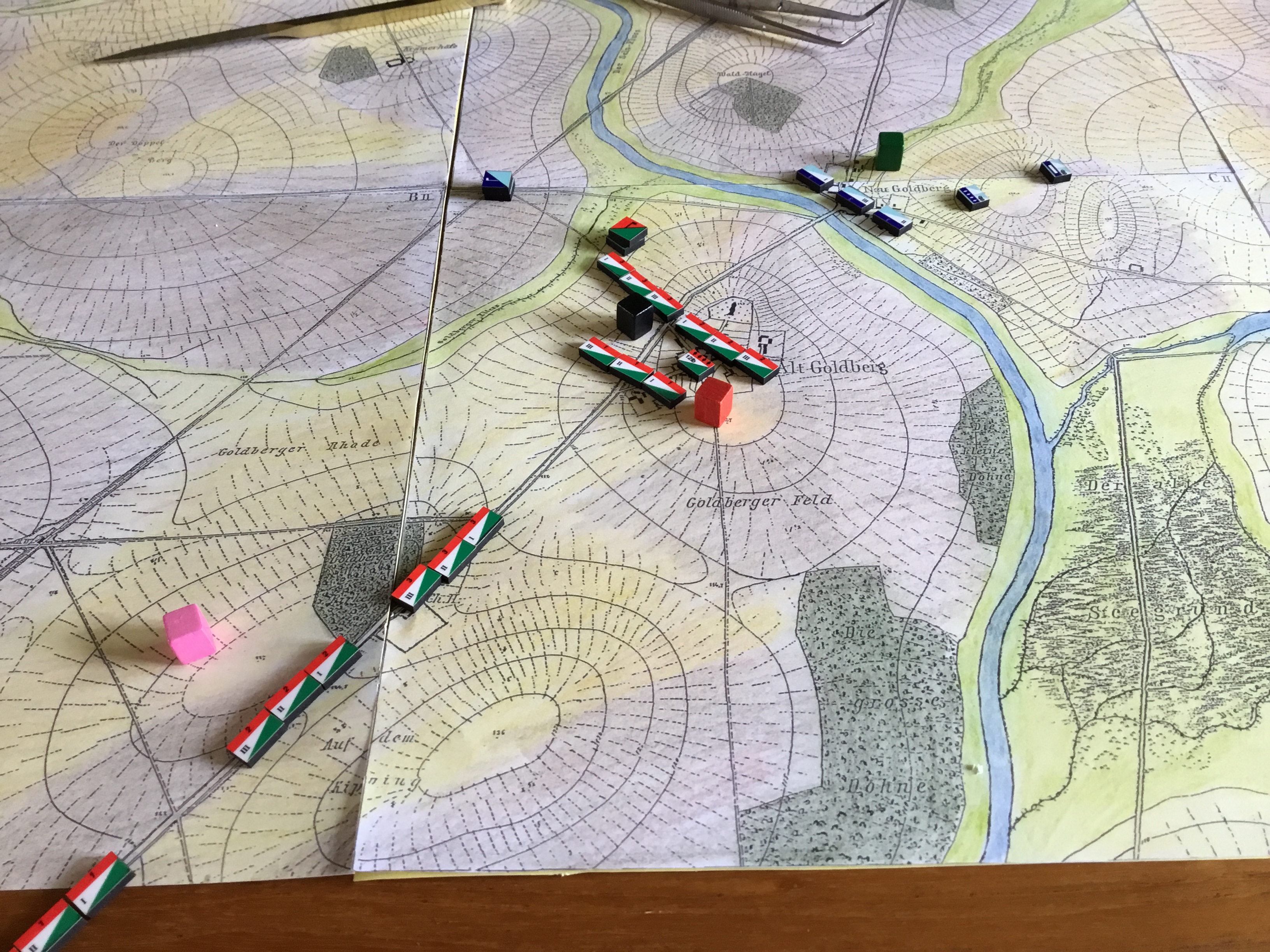
Red Infantry Deploys In Town. Red Block Is Divison CommanderRed Skirmishers Out For Firefight To Prep Objective. Second Regiment Advancing.Blue Reinforcements Advancing. Red Third Battalion In Column For Assault. Note Blue Has Been Attrited. Solid Red Block Indicates Loss Of Half Strength. Small Red Block Is Messenger To Cavalry Unit To Scout For Ford.
After two gratuitous posts, here’s (hopefully) something of substance, and very late getting to the blog.
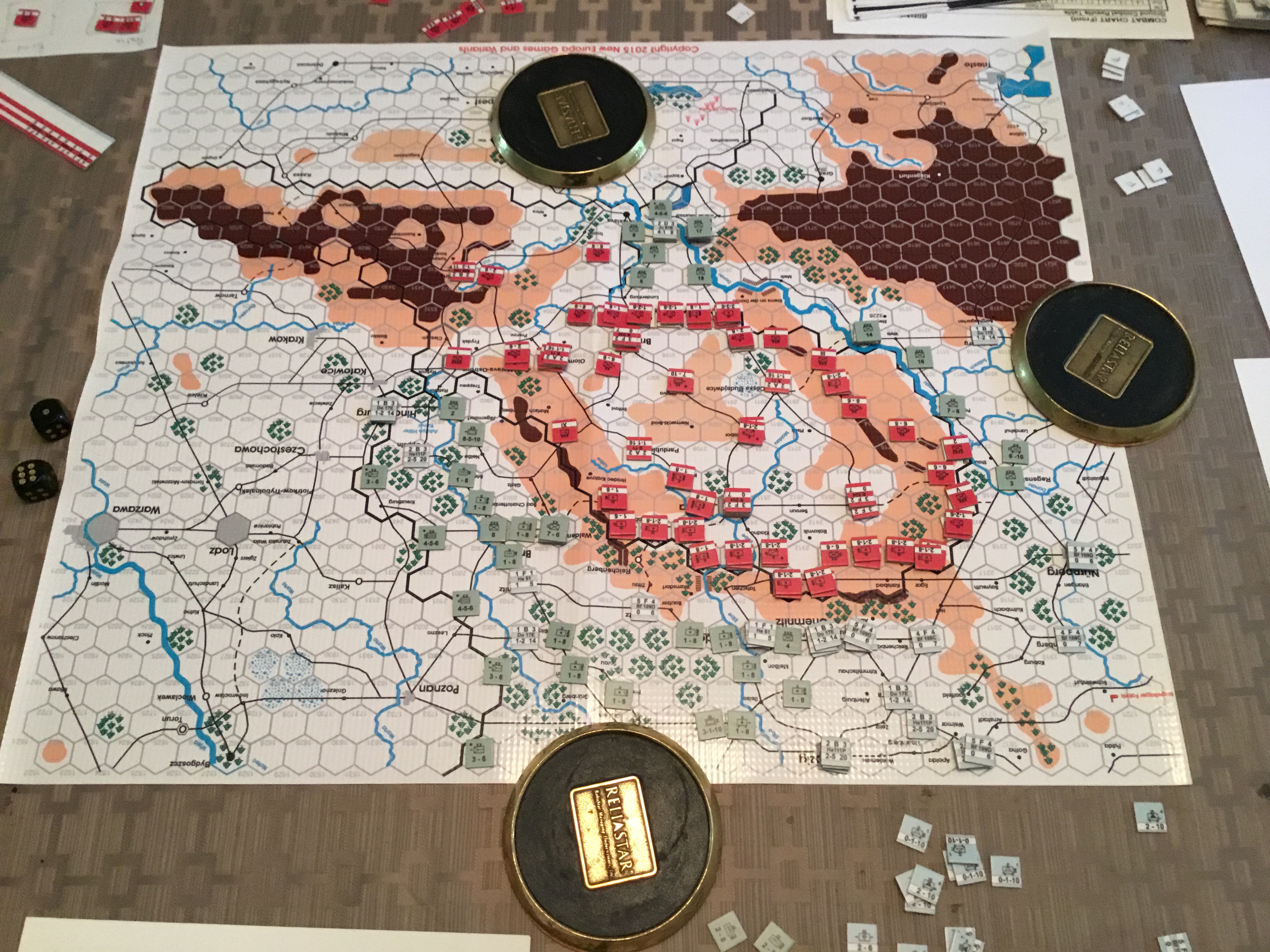
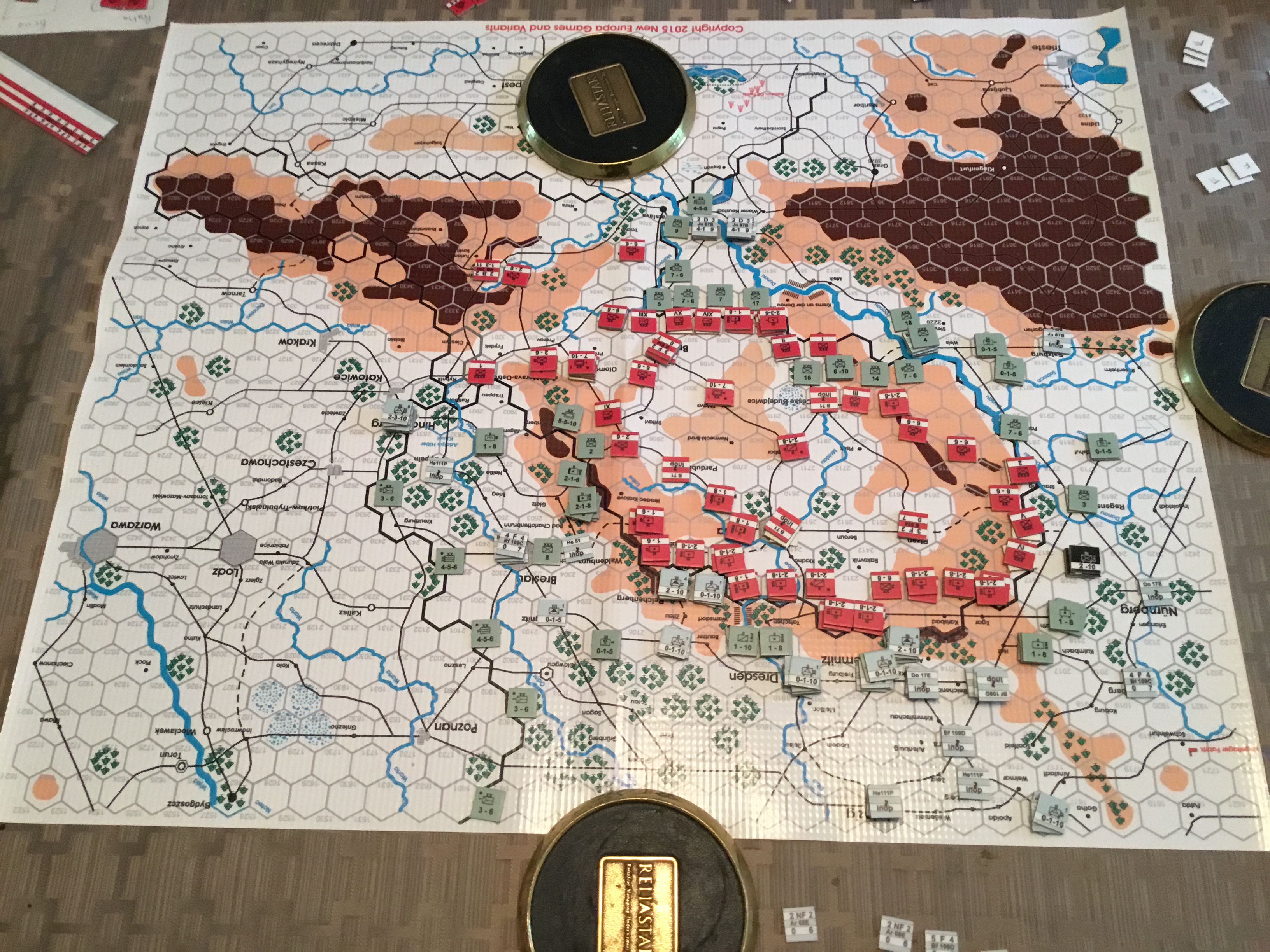
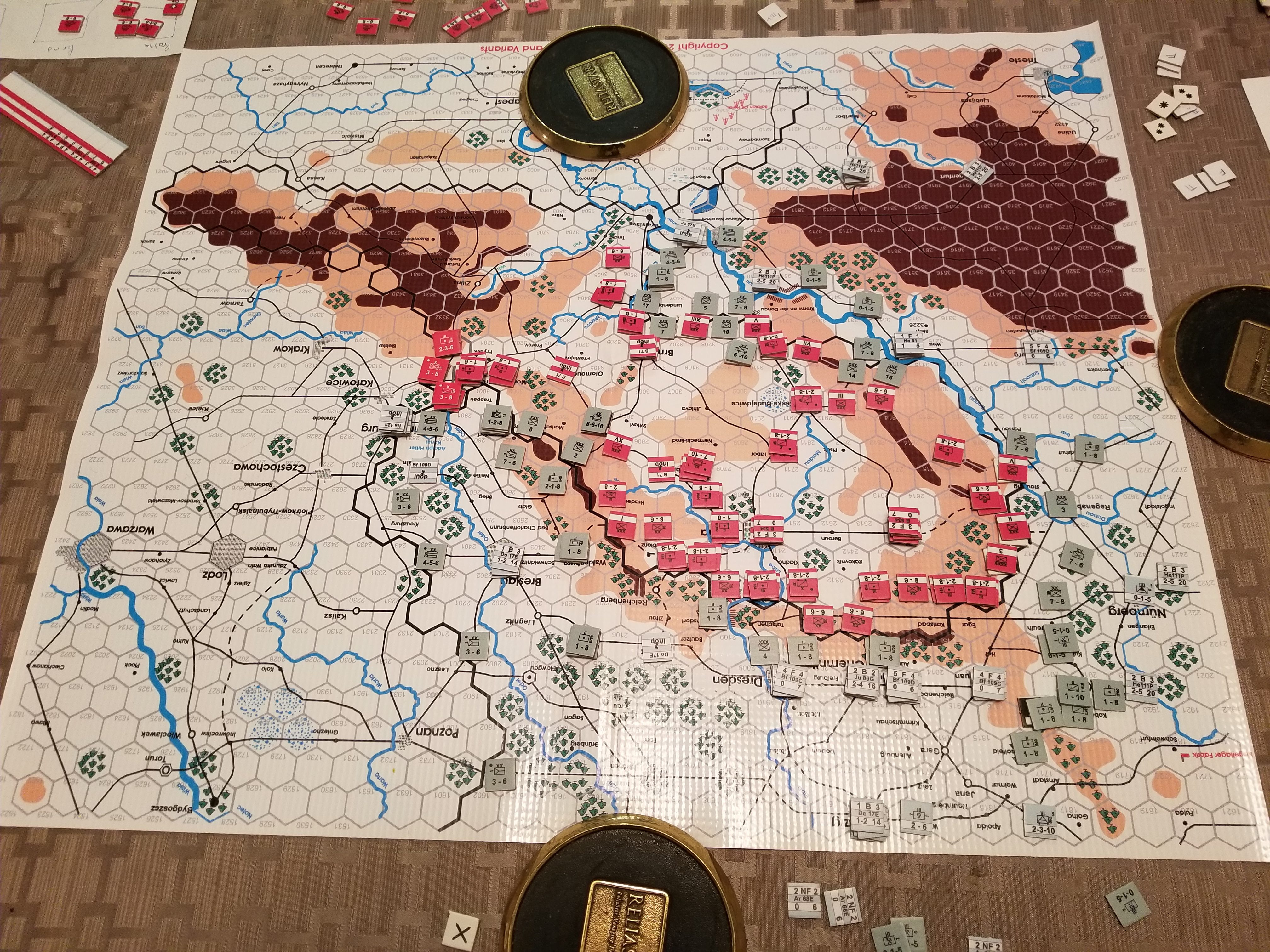
A couple of weeks ago, Tim and I played Fall Grun, a Europa game covering the proposed German invasion of Czechoslovakia in 1938. The hypothetical conflict was previously covered by both Command and Strategy and Tactics magazines. In each of our three “games”, Tim had the Czechs.
This iteration is published by New Europa Games, using John Astell’s Blitzkrieg Unleashed rules. Mr. Astell’s involvement with the Europa system goes back to, I think, the inception. The rules closely follow the Europa template, but involve some interesting changes to ZOCs and Overruns.
The New Europa website is apparently dormant, but has been an excellent source for variant counters. Also, a game anticipating a Hungarian-Roumanian war in wake of the Czech conflict is supposedly in the making. That would be fun.
The game components are of high quality, however the lack of comprehensive charts presupposes ownership of other Europa games. The map is vinyl. Apparently this is cheaper to produce than a paper map. The only downside is that the creases are more obstinate than paper, requiring some improvisational and forceful re-shaping
The Germans have their work cut out for them. The Czech’s have a quality army that receives strong infantry and armored reinforcements very early in the game. The German initial deployment is rather “even”, without any real point of main effort. Many German units, especially valuable engineers and artillery regiments, are placed some distance back from the Czech-German border, and require time to assemble or move to contributory locations. There is also the possibility of Soviet intervention of the Czech side, with also a desulatory appearance by the anti-Czech Poles obsessing over three hexes.
The real German strength is their airforce. Many units, well suited to ground support, but with fighter cover that lacks range and (initially) limited airfields close to the Czech border. Also, Astell’s latest rules (early war) allow positive combat modifiers for an armored mix as low as 10 percent of the attacking forces.
After setup, we played the initial two turns. I dutifully went through the Blitzkrieg playbook using the first turn to annilihate the Czech airforce and mass units for border attacks. Tim countered, and my attacks stalled. And, that was that. A learning experience. Reset for Saturday.
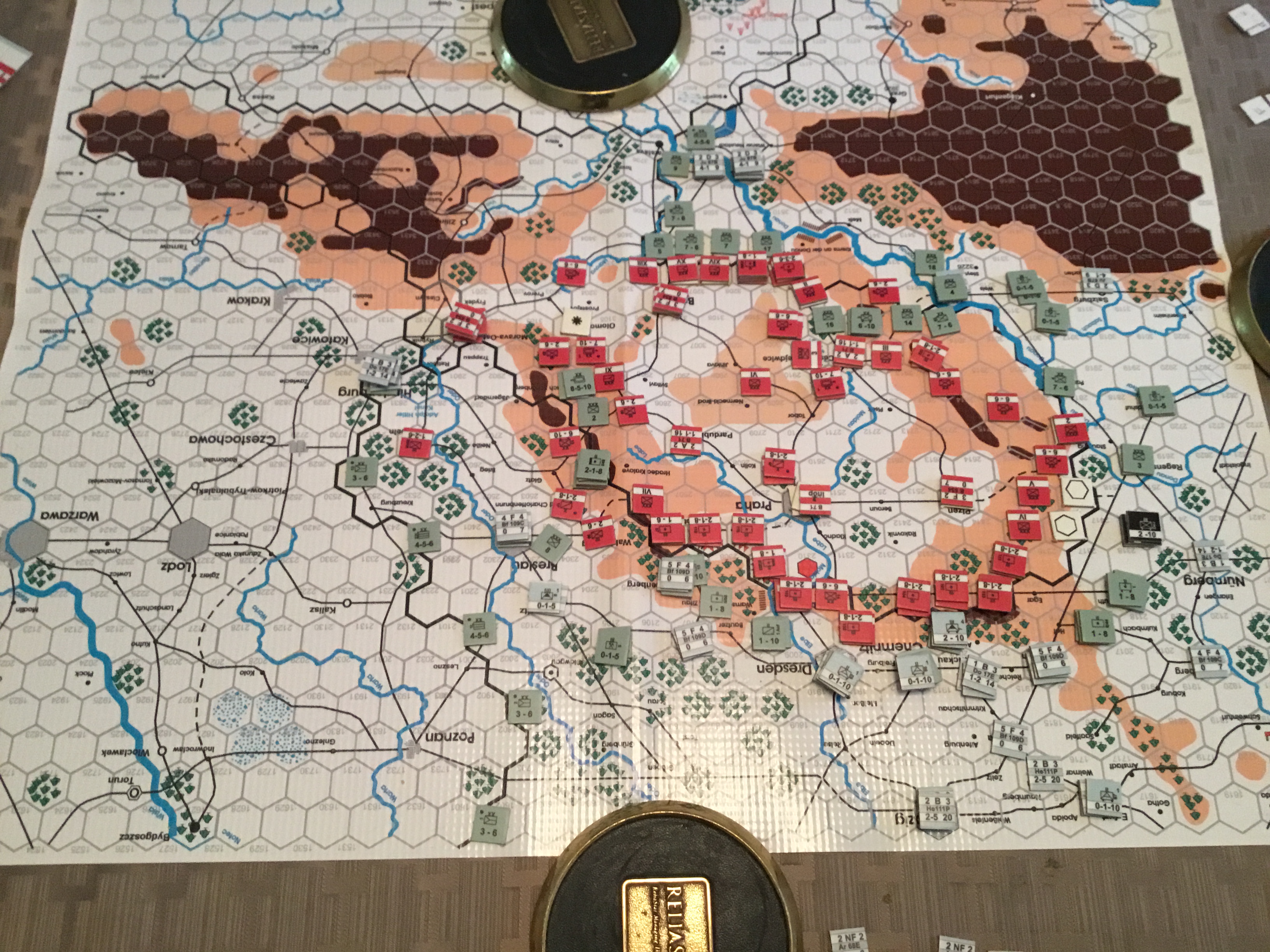
Well, Friday was a learning experience, but not a good one for me. Still allocated aircraft to airfield attacks, but this time I had deployed my engineer units to quick construct airfields, or move into positiion close to the border to construct them on Turn Two. I concentrated my attacks to the southeast and southwest of Prague, hoping to isolate Prague from the strong Czech units facing Vienna.
Initial Setup. That Vinyl Map Needed AnchoringGermans Attempt To Isolate PragueLimited Gains
Weather. Why worry about it, right? Never a thought. It’s October…….crisp fall weather. Oh…….then just roll on the weather table for …..MUD. Ugh…..bad, bad amateur move. It stings even three weeks later.
OK, give it one more try. Another set up after dinner. Same bloody result. This time, more aggressive, greater gains. But, again, MUD.
New Game….Same Result….Stalled
No wonder the General Staff was ready for a putsch. Tough army, difficult terrain, limited mechanized advantage, and an untried airforce lacking airfields. And, also, MUD.
I don’t know if Tim is ready for it, but I’d like to switch sides and see what he can do. He’s good, very good. But this is quite a challenge.
Good game in the tradition that is all best about the Europa system. And, given the strange and terrible saga of this system, it’s best to remember the good.
Gave in and decided to go with DBA 3. Haven’t been overwhelmed with the differences in scale, and the introduction of “solid” troop types. Well, maybe because I don’t have the Army Lists. Still, the addition of “Threat Zones” extending out one stand width from all units precludes unlikely gymnastics, and forcing a fight or withdrawal.
So, the tournament is back on. First round involved Swiss and Condotti. Condotti scored an unlikely upset by turning the Swiss flank moving through bad going, and forcing a Swiss charge into Mounted Knights. Another tactical lesson learned.
Packaging up the last of some 35 games sold over the last few months. Running out of space. Many had been played. Rules read for others, but no great motivation to get them on the table. So, cull the herd.
In the midst of this mayhem, I found a thread over at boardgamegeek. I thought I had a collection! Nothing compared to some of these men.
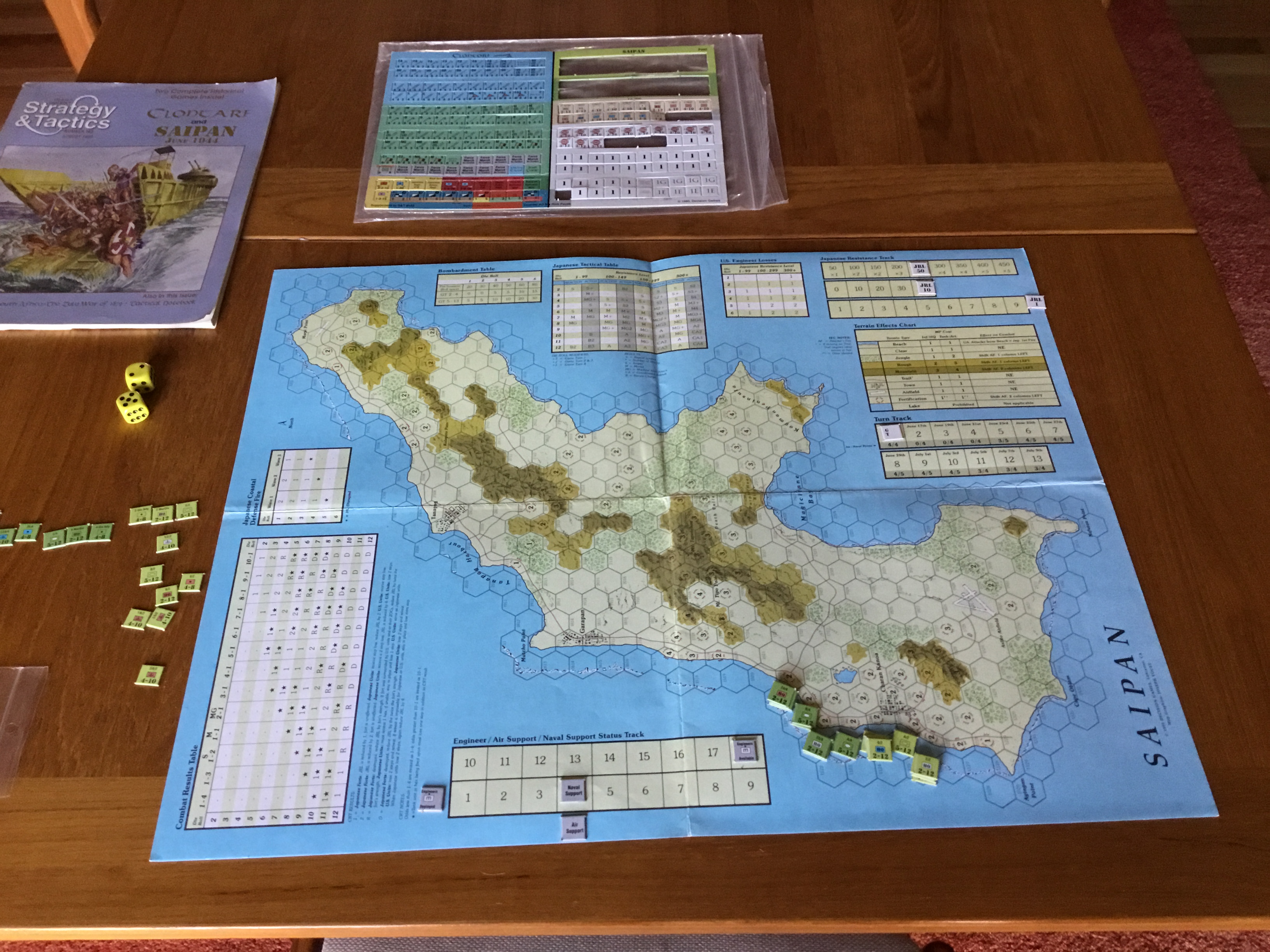
Opened up a box and it jumped right out at me! “It” is an old S&T magaizine game, Saipan.
Why not? It’s solitaire and is the first game I’ve ever played that has any of my old units in it (2/24 and HQ 24th Marines).
It’s another slog. Wristage and more wristage; have to reduce 88 (yes 88!), Japanese fortifications, plus the chance of encountering Japanese troops every hex you move into (except destroyed fortifications). Lots of rolling to do. I can handle that, but what’s vexing is the step losses. Yes, one has to use numbered chits to designate losses. Ugh.
All that griping aside, the system seems viable, with NGF, Air support, Japanese coastal defenses, and reasonable command and control (called Lines Of Communication) rules for Division and Regimental HQs. All in all, the game seems a reasonable representation of a meat grinder of a campaign.
I have Bloody Buna on the table and now this damn thing. It is a rut! Need to get an East Front game out (and not Stalingrad) next!
Mangled Turn 1, forgetting Japanese reactions to Marine movement. But, it was an easy re-set. Will try it again tonight.
Been playing another small game. It’s a game with a war theme, so I guess it is a war game. Realism…….not so much. Entertainment and Fun……so much.
It’s Pocket Landship, a PNP game I stumbled across over at Boardgamegeek.
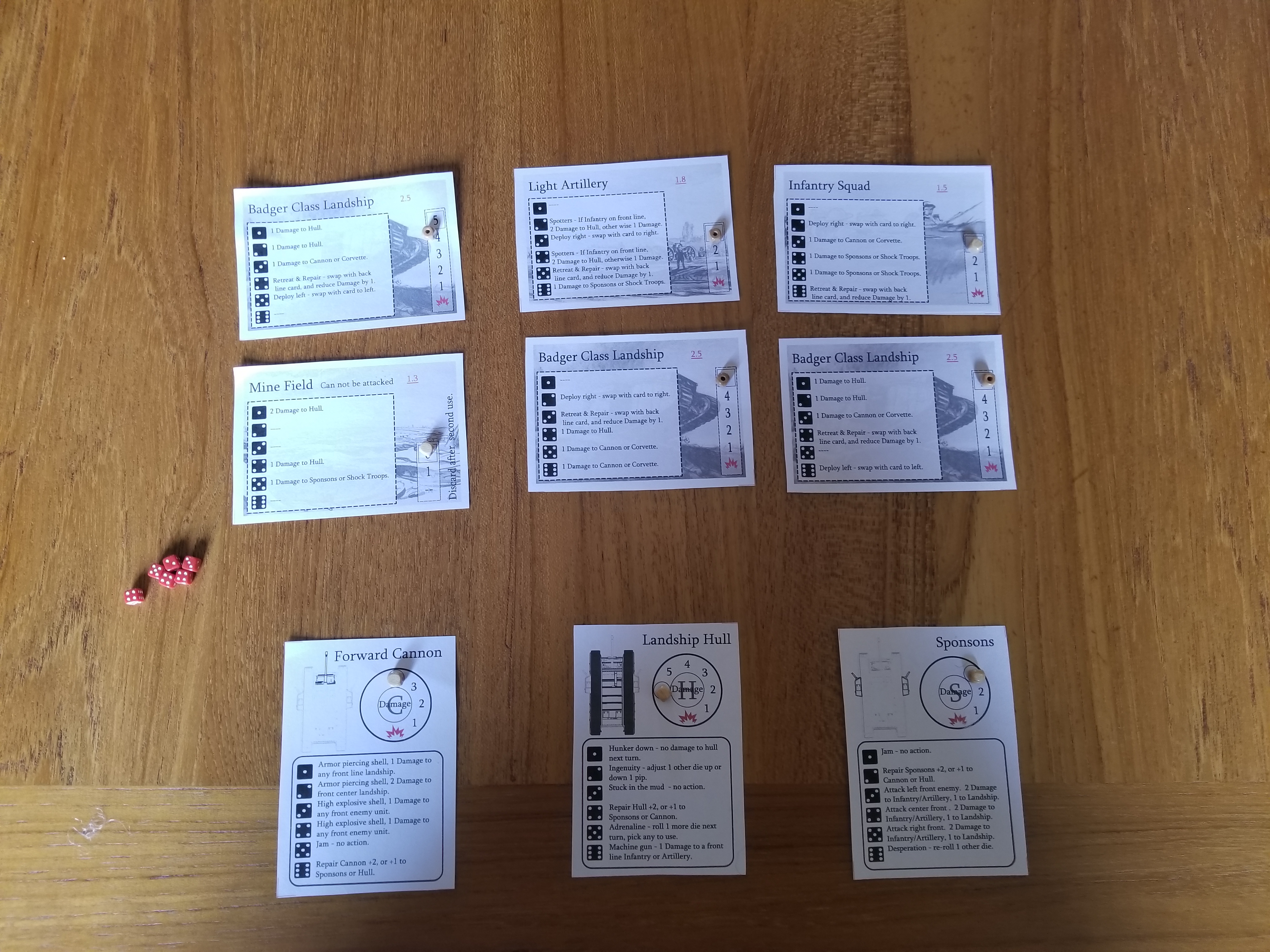
The link is for the updated version, with more options and better graphics. The original looks like this when set up.
No, The Cards Are Not Huge. Yes, The Dice Are Very, Very, Small.
Game is simple and elegant. In the basic game, you control one Landship, with three components – Hull, Sponson, and Gun. The enemy has six random elements, including infantry, artillery and other land ships. Only the front three are in play at any one time. Roll three die for the enemy. Assign lowest die to the left unit, and other two in ascending order. See what happens. For your Landship, roll three die and allocate as best you can. If you destroy one enemy element, another moves up. Last Man Standing wins.
Fun and compact. As the say, a great “filler” game. Just like TAC, buy this one before it gets snapped up, pimped up, and priced up!
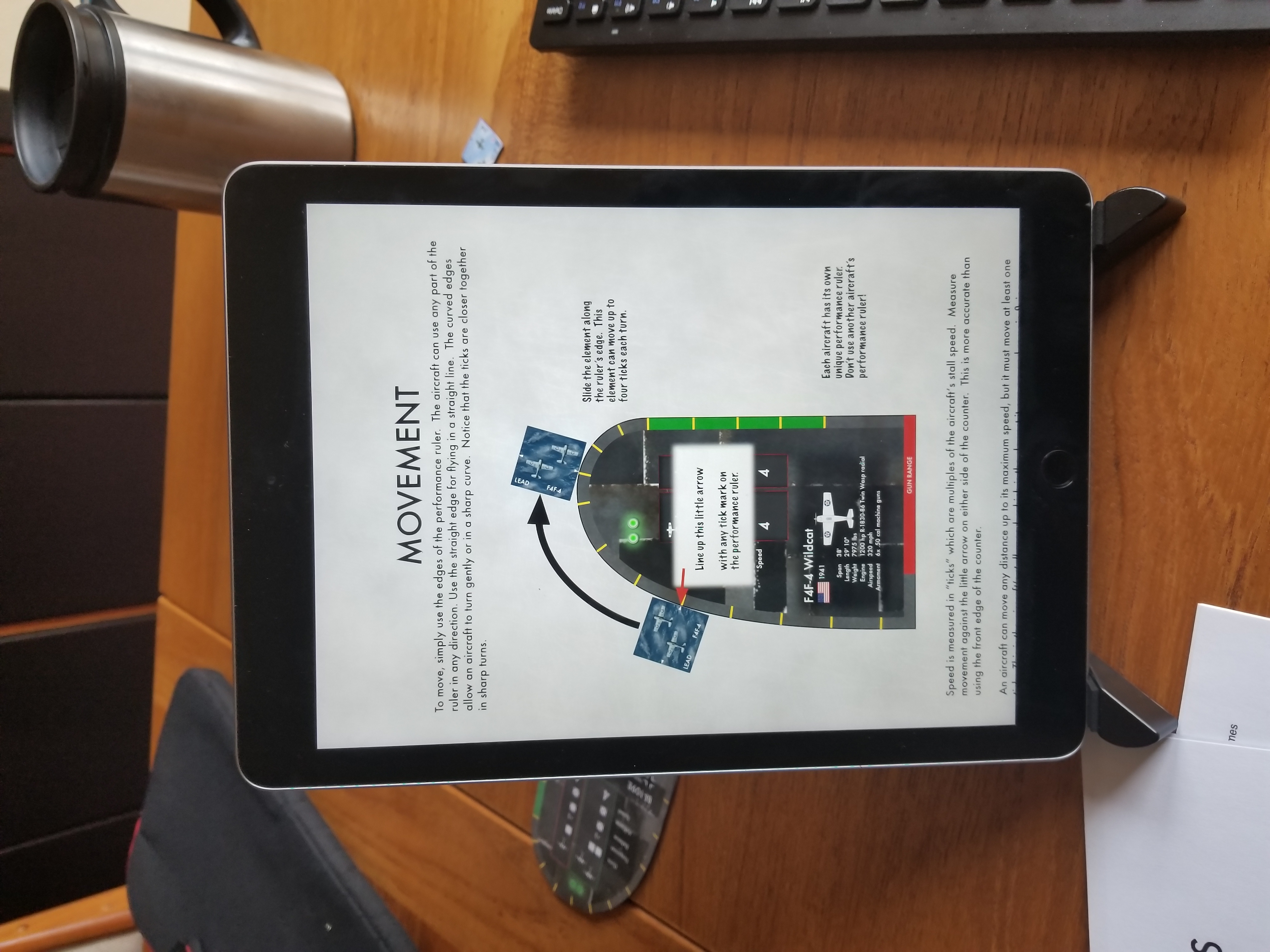
Undertook a mini project when TAD. It was TAC – Table Air Combat.
This is a simple, fun, inexpensive WWII aerial combat game with a wide variety of aircraft types. It can be found over at Wargamevault.
You get a PDF copy of the rules with each aircraft type. The PDF is very well done. Other help is available for free download.
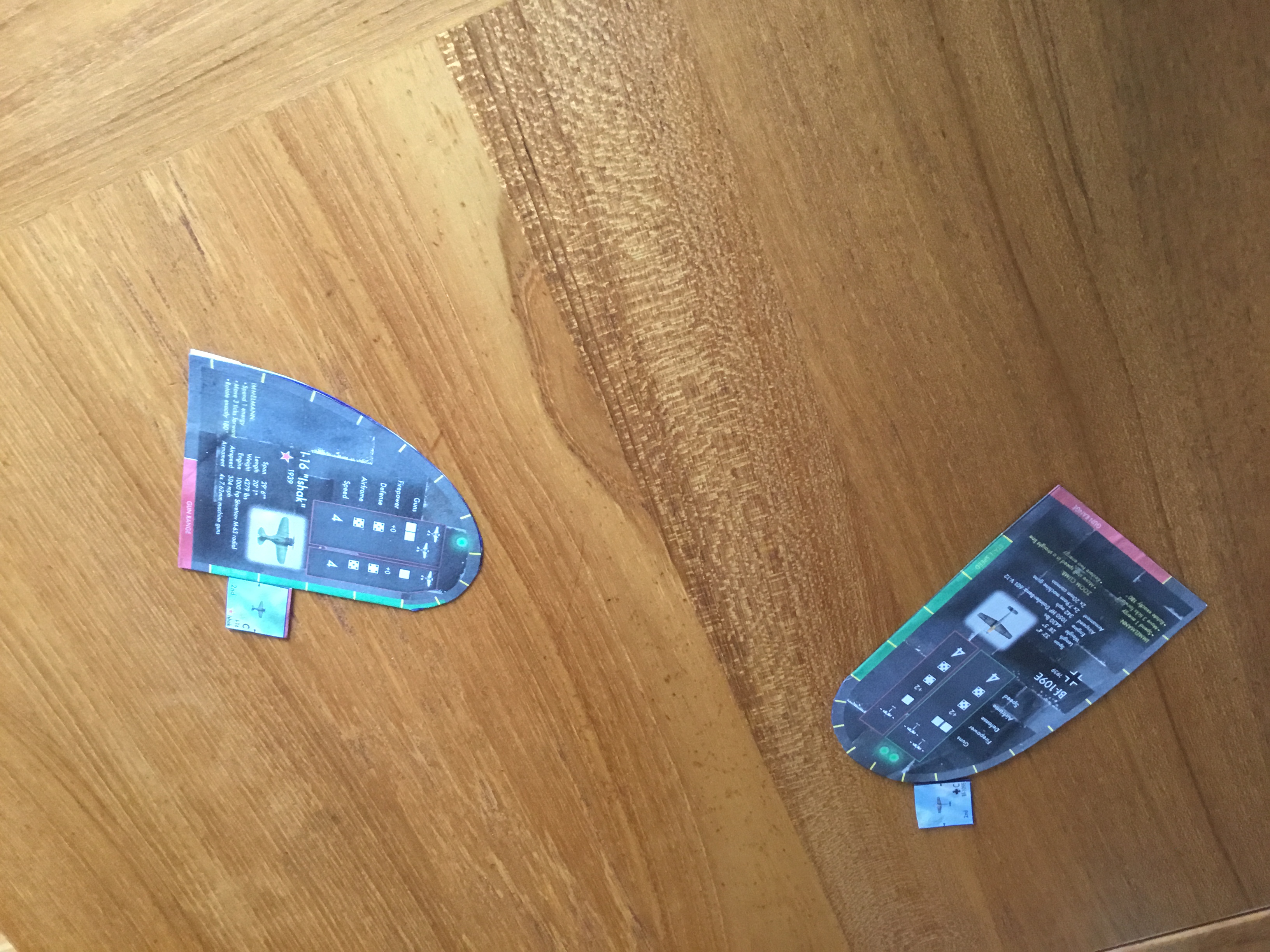
The aircraft maneuvering card includes all the information you need to fly the aircraft, so after a few plays, and familiar with the general rules, you can seamlessly transition to any aircraft you like.
The counters show a single aircraft on one side, and two aircraft on the other I’m thinking about mounting 1/700 aircraft on a counter for a 3-D effect.
Speaking of 3-D, the system incorporates “energy” as a means of simulating vertical maneuver. The concept is simple, an aircraft can gain energy by climbing (reducing linear movement), which allows it to gain speed in a dive.
The footprint is very small, making it a great travel game.
For what it is…..it’s great!
Rules are well illustrated, easy to understand and have great graphic qualities.BF 109-E Turning Into A Polikarpov I-16. Note Data On Manuever Care.