Category Archives: World War II

Weekend At Tim’s

Real pleasant couple of days in Portland.  Hotter than Hell, but we stayed refreshed and hydrated.

Maybe that’s one reason not a lot of gaming took place.  Also a perceived need to view a few action films outweighed the desire to push cardboard.

We played “Operation Exporter” from  War In The Desert.  This is an operational simulation of the  Allied invasion of Syria.  Not exactly Tim’s cup of tea – low counter density, only a small portion of the map used and….gasp…..no real tanks (only a couple of Vichy light tank units with attack strengths of 1).  The Allies will win, it’s just a matter of time.  However, the victory point schedule makes time of the essence

Nonetheless, Tim did a great job as Allied Commander.  He used his one motorized asset to harass the Vichy flanks and optimized the use of his limited air assets and naval gunfire.  He also quickly assembled the two divisions available to him, with their enhanced combat power and zones of control.  The regiments and brigades that make up all the Vichy forces cannot be formed into divisions.

I played my part by having a (typical) cavalier approach to victory conditions.  While Tim didn’t win on VIPS, he certainly won the game.

I didn’t fare as well when we switched sides.

This is a good little scenario.  It’s viewed as excellent starter game as it has all of the Europa food groups, but without the counter density to make the experience overwhelming.

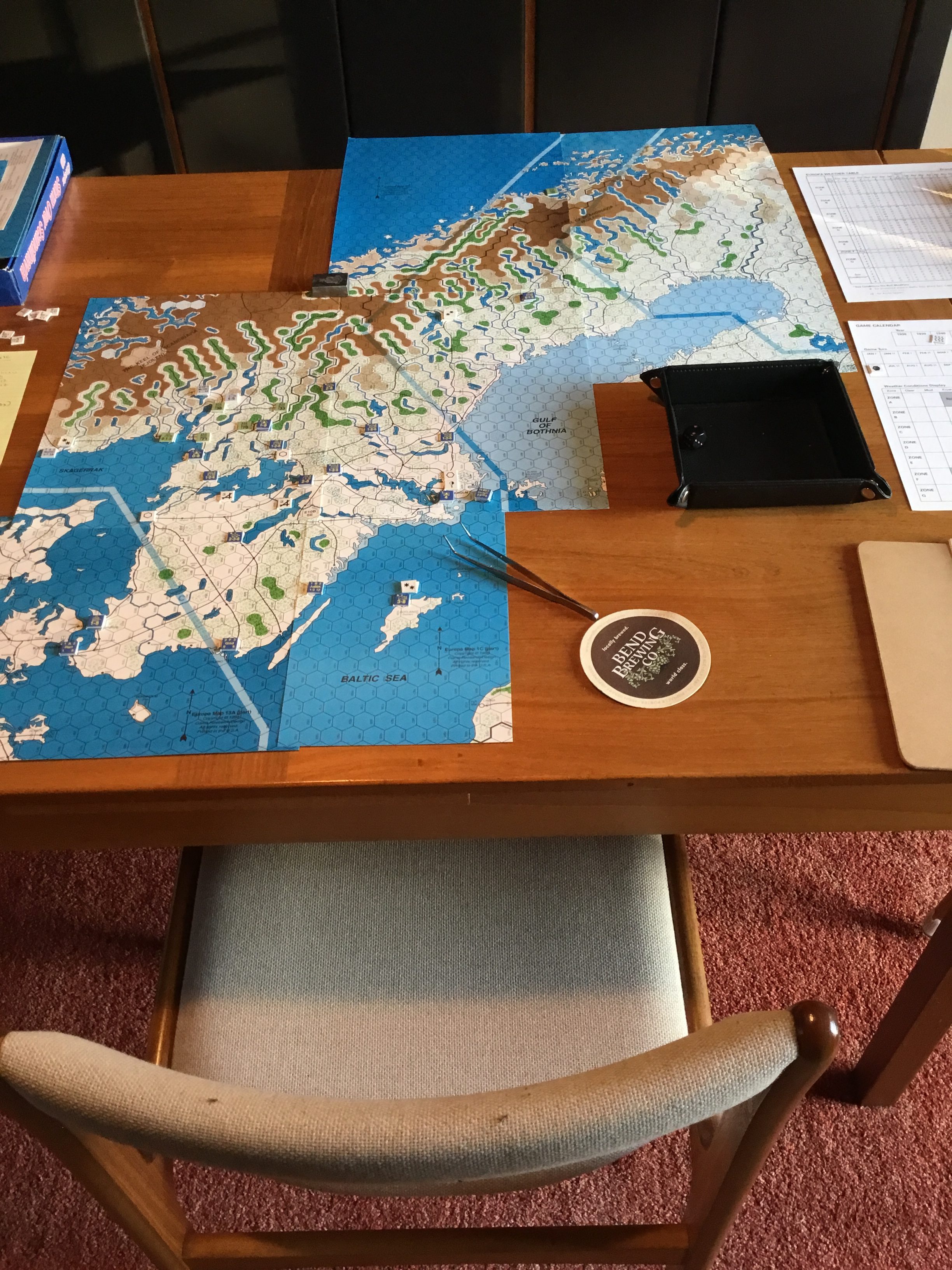
He’ll be out at The Pinecone Lodge around Labor Day for Storm Over Scandanavia’s hypothetical scenarios involving the invasion of Sweden.

In A Rut

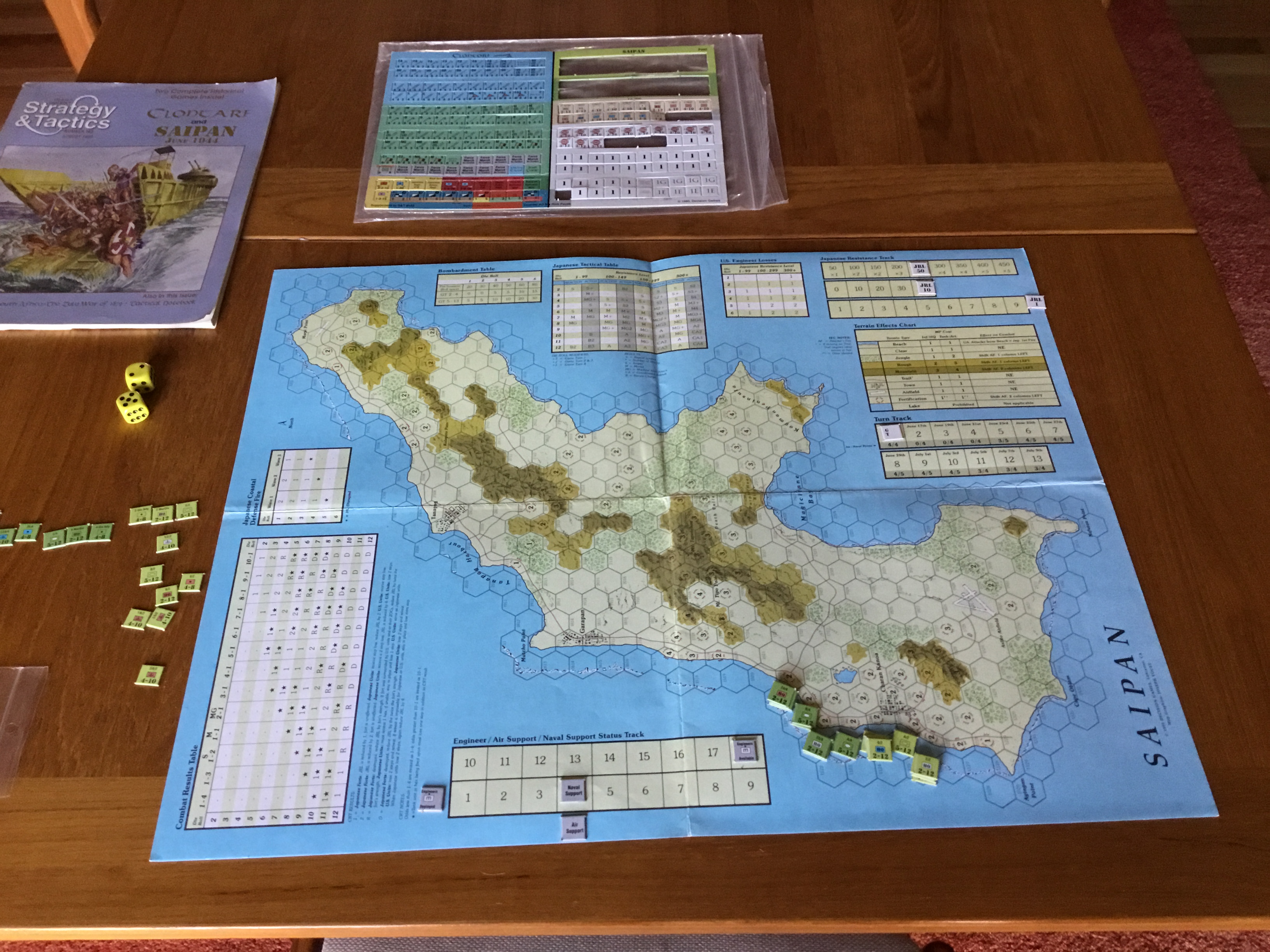
Opened up a box and it jumped right out at me!  “It” is an old S&T magaizine game, Saipan.

Why not?  It’s solitaire and is the first game I’ve ever played that has any of my old units in it (2/24 and HQ 24th Marines).

It’s another slog.  Wristage and more wristage; have to reduce 88 (yes 88!), Japanese fortifications, plus the chance of encountering Japanese troops every hex you move into (except destroyed fortifications).  Lots of rolling to do.  I can handle that, but what’s vexing is the step losses.  Yes, one has to use numbered chits to designate losses.  Ugh.

All that griping aside, the system seems viable, with NGF, Air support, Japanese coastal defenses, and reasonable command and control (called Lines Of Communication) rules for Division and Regimental HQs.  All in all, the game seems a reasonable representation of a meat grinder of a campaign.

I have Bloody Buna on the table and now this damn thing.  It is a rut!  Need to get an East Front game out (and not Stalingrad) next!

Mangled Turn 1, forgetting Japanese reactions to Marine movement.  But, it was an easy re-set.  Will try it again tonight.

Ready To Grind


Table Fun

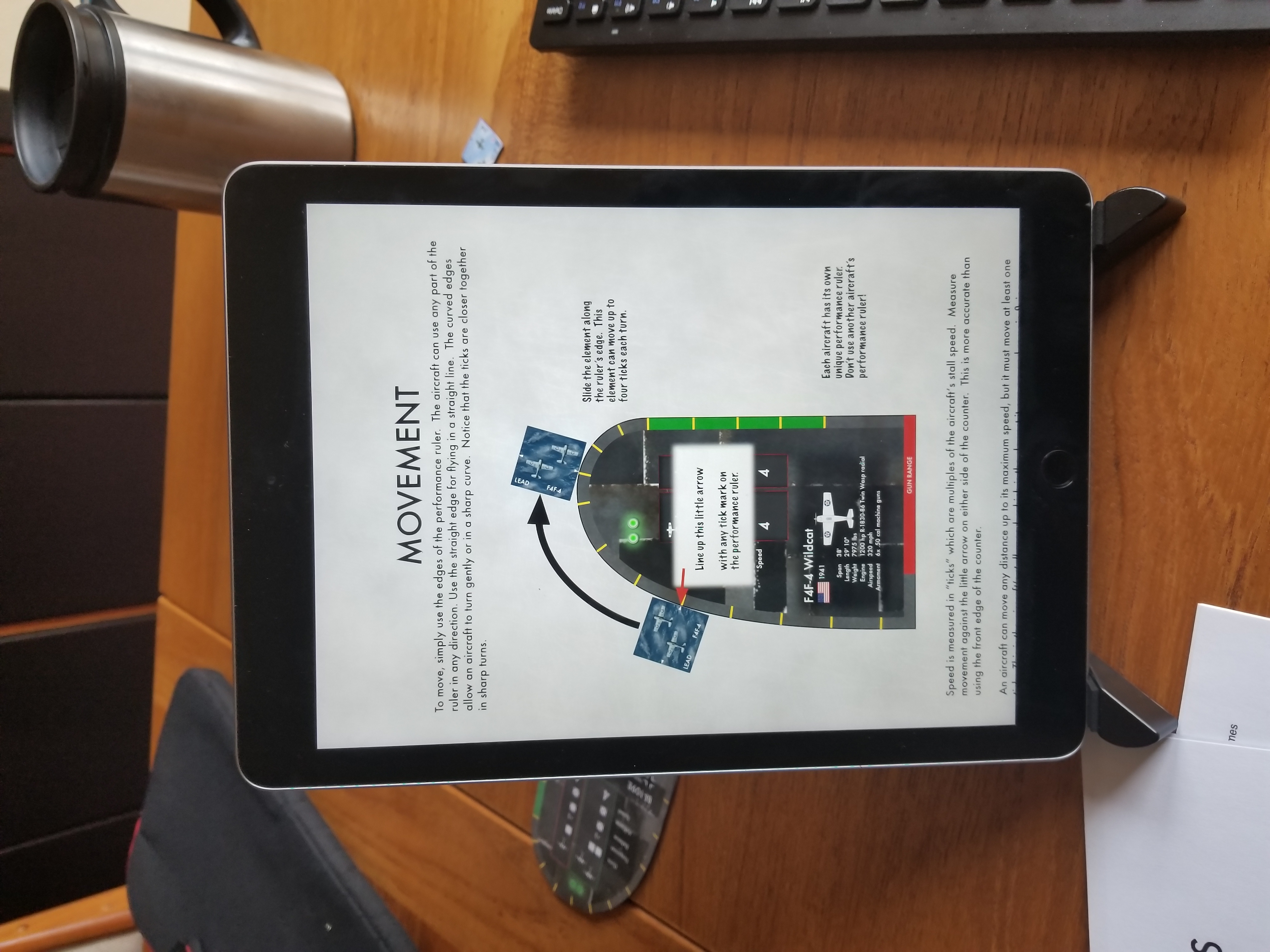
Undertook a mini project when TAD.  It was TAC – Table Air Combat.

This is a simple, fun, inexpensive WWII aerial combat game with a wide variety of aircraft types.  It can be found over at Wargamevault.

You get a PDF copy of the rules with each aircraft type.  The PDF is very well done.  Other help is available for free download.

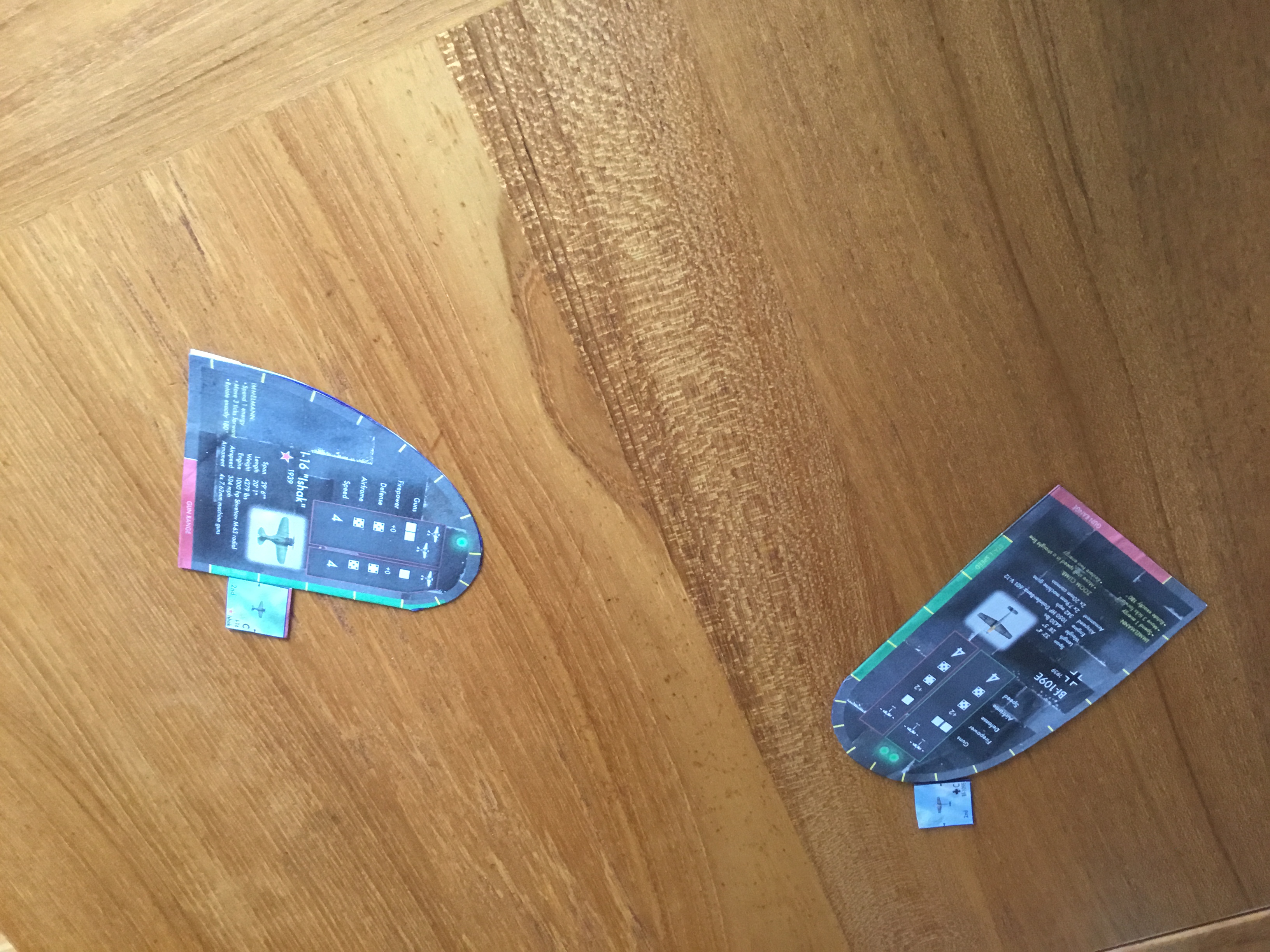
The aircraft maneuvering card includes all the information you need to fly the aircraft, so after a few plays, and familiar with the general rules, you can seamlessly transition to any aircraft you like.

The counters show a single aircraft on one side, and two aircraft on the other I’m thinking about mounting 1/700 aircraft on a counter for a 3-D effect.

Speaking of 3-D, the system incorporates “energy” as a means of simulating vertical maneuver.  The concept is simple, an aircraft can gain energy by climbing (reducing linear movement), which allows it to gain speed in a dive.

The footprint is very small, making it a great travel game.

For what it is…..it’s great!

Rules are well illustrated, easy to understand and have great graphic qualities.
BF 109-E Turning Into A Polikarpov I-16. Note Data On Manuever Care.

A Little Bloodier

Was able to get through about 12 turns of Bloody Buna before I left for latest elder-care iteration.

It’s easy to understand why the response to this game was muted. Supply is everything, and there isn’t enough of it. Unlike many games where new supply counters are generated every turn, or MSRs linking supply sources to units are lengthy and developed, this game has short MSRs (2-4 hexes), and a very limited number of supply counters.

The result is the need to accept attrition die rolls as the cost of conducting business. While Allied units can huddle in defensive positions near supply sources, they will have to conduct operations far from these sources in order to win. The Japanese face a dwindling level of supply as the campaign progresses, and will have to hold on to their gains in order to eke out at least a marginal victory.

This isn’t the Western Desert. No booming and zooming.

So far, the Japanese were able to advance to Kokoda, eliminating Australian units that were tasked with a delay/defend mission. However, the Japanese are now on half-supply.

Another Japanese force moved east of Buna to cut off Allied forces that had moved west from Milne Bay. Again, both sides will soon be out of supply and subject to random attrition and accompanying loss of combat power.

I’m charmed by this game, if only because of the limitations created by factors taken for granted in so many other games.

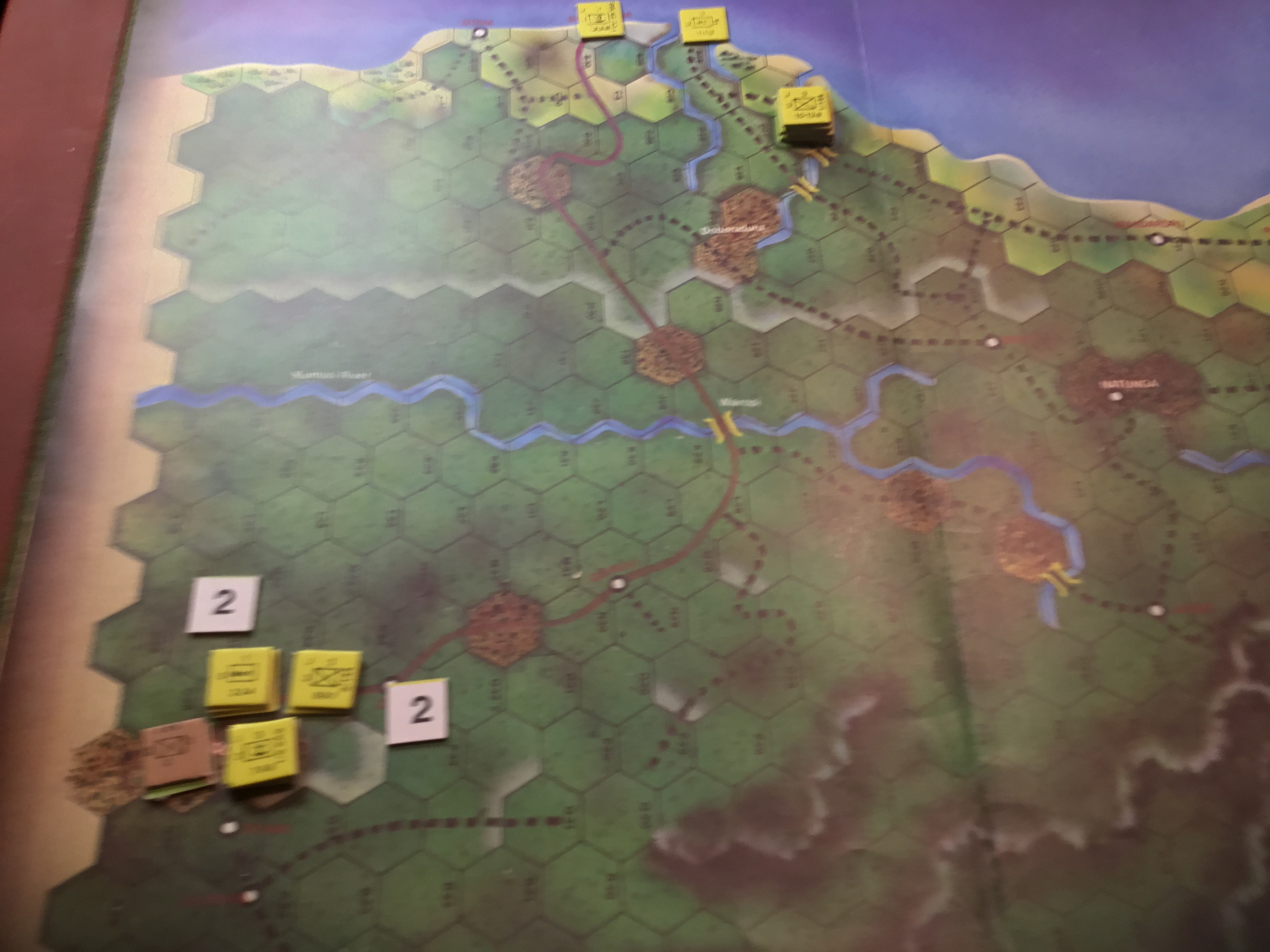
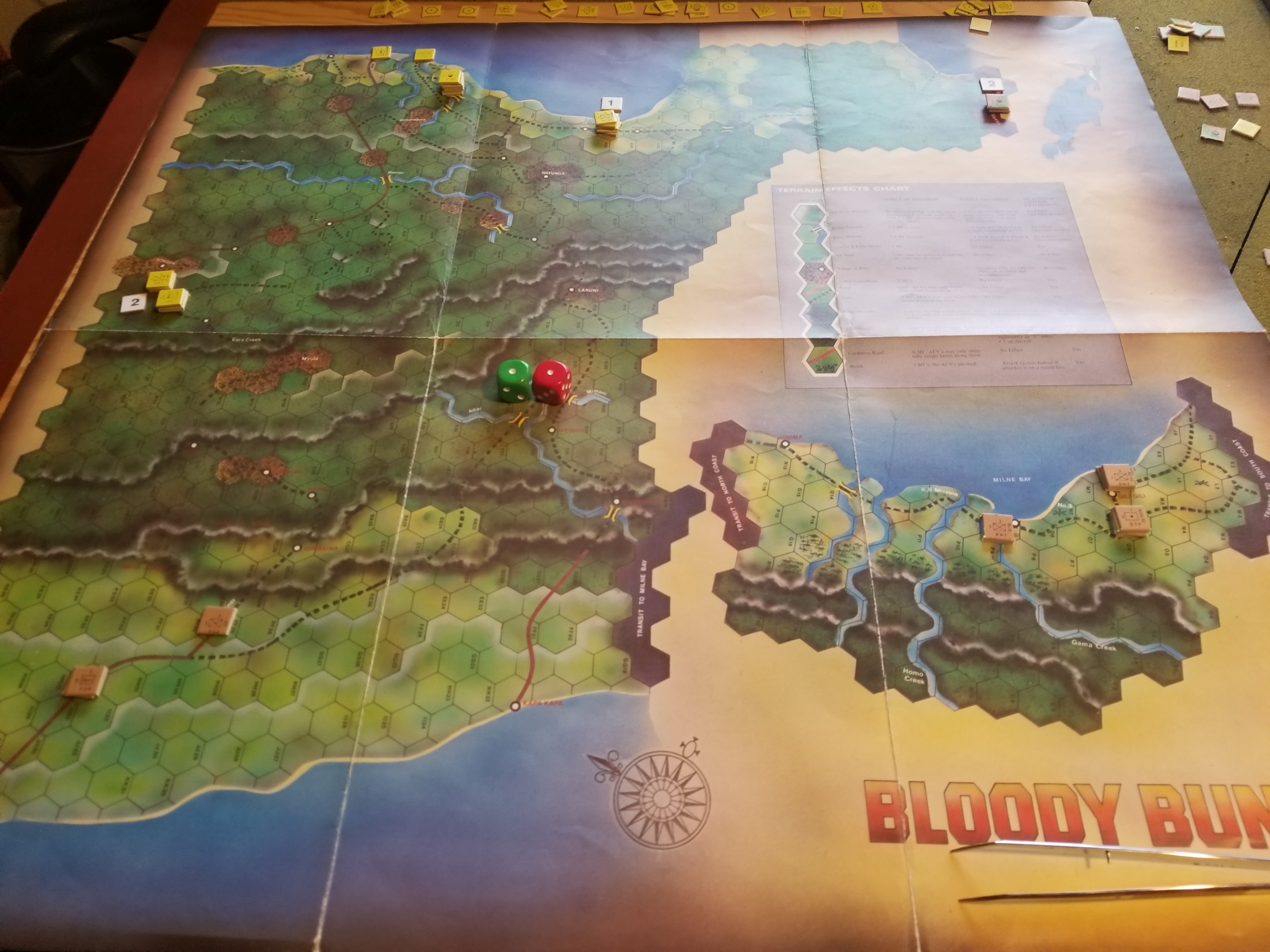
Here’s a couple of bad pics depicting the Japanese attack on Kokoda, and the situation when I left.  Number chits indicate supply turns remaining.


Slow But Not Yet Bloody

Back to playing the Campaign game for Bloody Buna.  Not for the time challenged, as it extends for 43 turns.  The game develops slowly, just like that Sloth/Pictionary commercial that is thankfully off the air now.

The potential for unit attrition dictates modest rates of advance and husbanding of supplies.  Units are battalions or companies, so it is ant-tastic.  But, these can be powerful ants, with the ability to generate high-odds attacks even in unfavorable terrain.

The Japanese have some interesting victory conditions that allow them to not have to take Port Moresby or Milne Bay, but simply threaten it.  This puts the onus on the Allies to contain the Japanese advance, and then roll it back literally to their start point in the vicinity of Buna.

Will post up game summary soon.


Grinding Again

Have also set up Bloody Buna. This treatment of the New Guinea Campaign appeared in The Wargamer Magazine way back in 1979. The game has a primary map covering the main area of operations, and then a secondary map covering the Milne Bay area. Units can move between the two utilizing Transit Boxes.

The rules address the salient characteristics of the campaign: horrendous terrain and weather. Supply and movement are defined by both.

Each time a unit attempts to move more than one-half of its allowance, it must take an Attrition Check. On a die roll of 1-4, everthing is fine. However, roll a D5, the unit loses a strength (or “hit” according to the rules), but can proceed. Roll a D6, lose a “hit” and no more movement. In addition, during rain turns, units add a +1 modifier. Only jungle qualified units receive a -1 modifier when attempting an Attrition Check.

Supply is also limited by terrain and weather. Supply line length varies by type of supply unit, and whether at full or half strength. Supply units can provide support for a limited number of turns. Units operate at full strength for three turns, supporting a maximum of 5 combat units per turn, and then at half strength for another three turns, with, again, a maximum of 5 combat units supported.

Artillery can attack alone using indirect fire, that strength varying by range but limited by line-of-sight.

There are also rules for air support, airlift and amphibious landings. Haven’t dug into those yet.

There are three scenarios, as well as a full campaign game. I’m trying the smallest, which focuses solely on the Japanese advance on Milne Bay.

Grinding Pt. 2

Decided to go with the other mini-introductory scenario, Assault on Castle Hill.

Probably missing something, but the tactical options are limited.  After three play-thrus came to the conclusion that the only option for the Germans was to  kill the outpost units using a first impulse artillery attack.  Second impulse then into the outpost units’ area, with the rest of the turn involved taking fire from the adjacent hex.   Turn 2, move-in to Objective Area 9, take the beating and hopefully win the close combat.

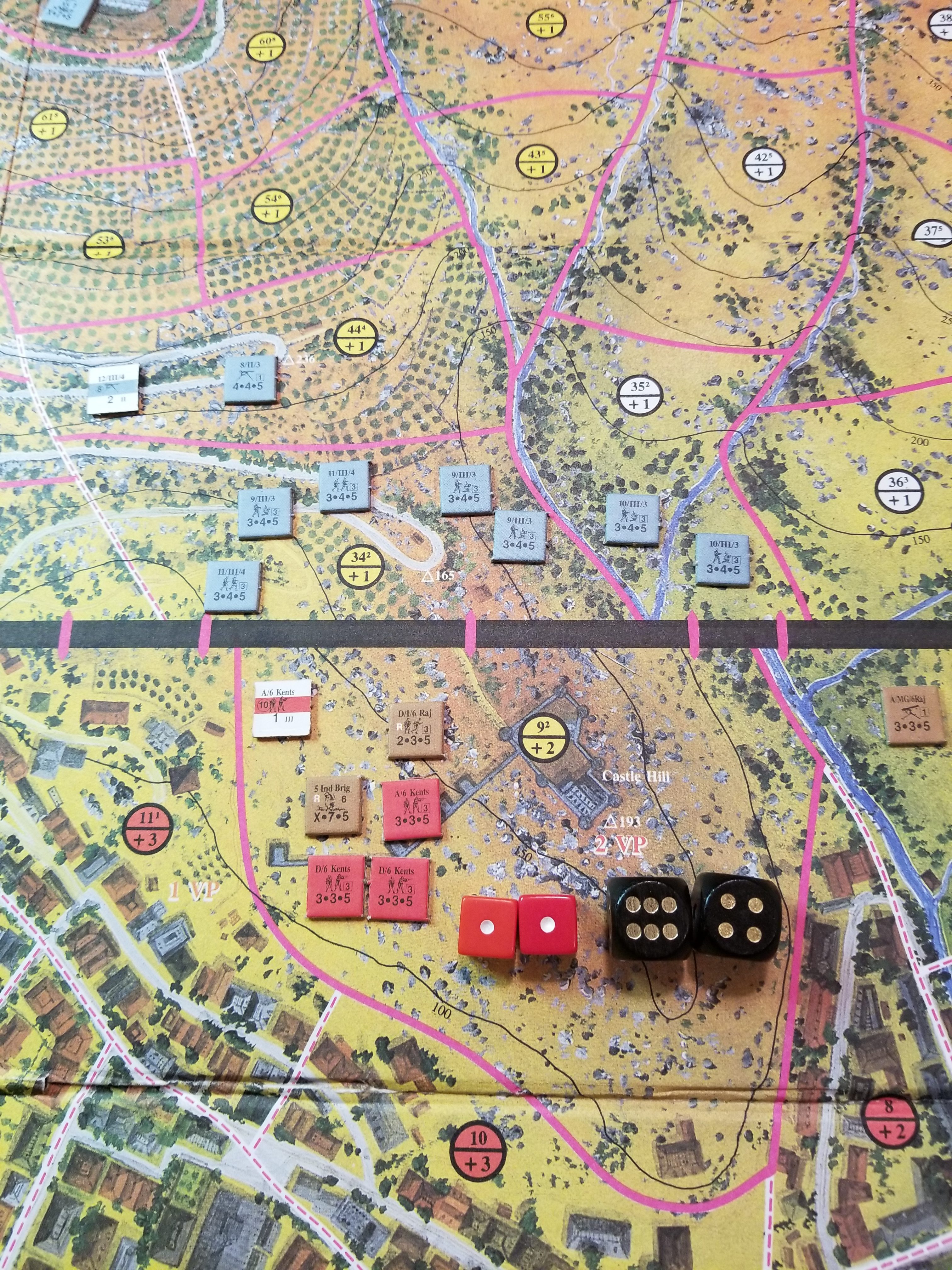
Big lesson learned…..one  attack can finish things.  Take a look at this photo of a Artillery Bombardment dice roll.  Yikes.  Game Over….BLAMMO.

The scenario does serve its purpose as valuable learning tool.

Going to continue the grind and now, yes today, set up one of the two longer scenarios.

Grinding

Been working up for a solo play of  Thunder at Cassino.    It’s one of the heirs to Storm Over Arnhem, but with more chrome.

Machine Gun Units and Rubble  impede movement, while terrain regularly effects combat.   The player with Tactical Advantage can designate a Night Turn at any time, using fire and movement modifiers favoring the attacker.

I decided to set-up one of the Introductory (2 Turn) Scenarios – Counterattack At The Roundhouse.  Knowing quite well my excessive problems with a first play-thru, I downloaded the Series Replay from The General Volume 24, Number 6 as a guide to RAW.  These back issues can be found at View From The Trenches.  This is also an ASL site.  Ahhhh…..come on, give ’em a couple of quid.

The positive of all of this programmed stumbling is that one actually learns about the game.  The negative is that it’s not fun by any means (I’d suggest some type of alteration to take the edge off), but it does help you come to grips with RAW, and also offers insights into game play.

Now that this grinding is over, I’ll set up the other introductory scenario and try it on my own.  Grinding is, after all, very appropriate for an Italian Campaign game.

The Channel Dash

That’s the popular name for Operation Cerberus, Germany’s plan to sneak two battlecruisers from Brest to Wilhelmshaven.   It’s also the topic for an Against the Odds Magazine Pocket Battle Game.

It’s an area movement game, with the Germans having to fight off multiple air and surface unit attacks while moving through the English Channel.  However, the German player can use his air assets to attack threatening British surface units.

It’s a fun little game, but, as one reviewer observed, with relatively little replay value.  Why?  The options for each side are very limited.  On the other hand, it’s dicetastic, so any number of situations might arise.   This randomness also makes it a good game for solitaire play.

This pocket battle really pushes the envelope when it comes to rules and chart density.  It is what it is, a game on a postcard.  Lots of information in very small print.  I’m thinking about enlarging it along the lines of a Minden Games footprint.  My only reason for this is that it came with die-cut counters, making it less of a print-and-play type offering which I usually put on thin card stock.

Worth getting at the right price – free with an ATO purchase.

Tim’s Take

Here are Tim’s thoughts:

  • As the German, I’m not sure it if is better to do overruns before combat or afterwards.  More than once, I had a stack stopped and left out of position for the combat phase when it received an adverse result on the CRT.  Maybe overruns are best used to disrupt a key soviet unit (most likely a headquarters unit).  I tried that once and it seemed to work well.
  • I forgot that ZOC’s don’t extend across the Don (even though you reminded me…probably the beer had an impact…).  That explains why I put so much time and effort into that area.  I was trying to extricate a couple of motorized divisions that had gotten ZOC’d up and that I wanted to use elsewhere.  Just like Hougomont at Waterloo, a subsidiary battle took on a life of its own.
  • I belatedly realized that I’d captured Voronezh on turn 2.  There are three hexes of Voronezh and I thought you had to capture all of them to get the VPs for the city…I only needed the two I had captured right away.
  • The Hitler directives do play a role.  I lost a motorized division when I had too many motorized/panzer units in the north and I was reluctant to move units across the Don as I was afraid that a bad die roll would result in them being taken away and sent somewhere else.
  • I enjoyed playing the game and I definitely want to try it again.